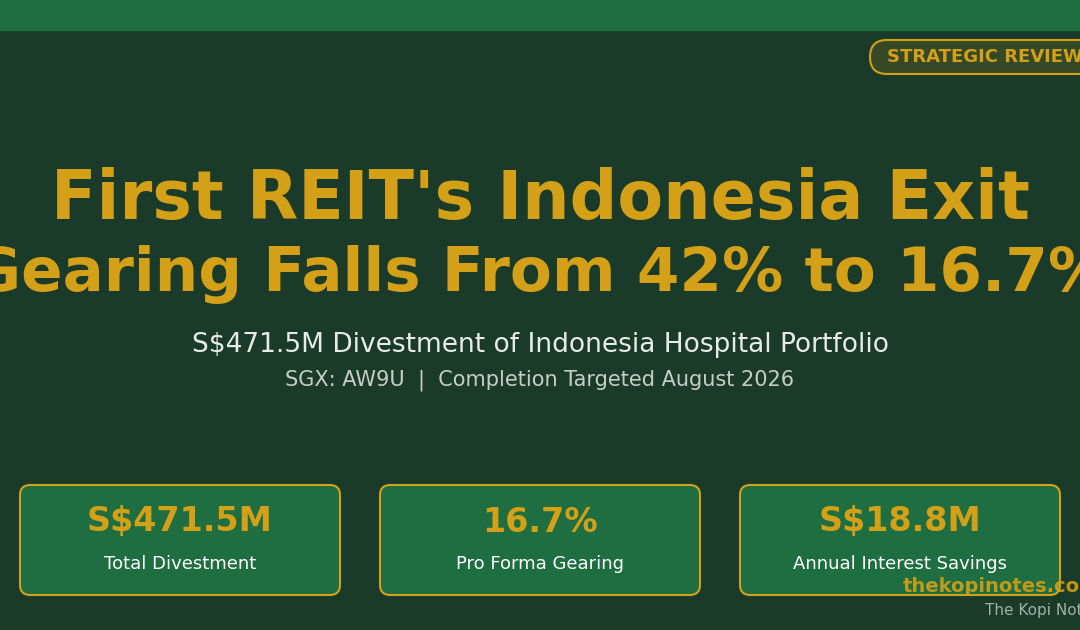
First REIT’s Indonesia Exit: The S$471.5M Divestment That Cuts Gearing From 42% to 16.7% (SGX: AW9U)
Asia’s first listed healthcare REIT is selling every property it owns in Indonesia. Here’s what the S$471.5 million deal means for the balance sheet, the dividend, and unitholders as completion approaches this month.
First REIT (SGX: AW9U) is divesting its entire Indonesia hospital portfolio to tenant Siloam International Hospitals and related parties for approximately S$471.5 million, with a further S$294.8 million available via a put option. The deal slashes aggregate leverage from 42.1% to a pro forma 16.7% and saves S$18.8 million a year in interest, but it also removes the bulk of First REIT’s rental income. Completion is targeted for August 2026.
Not financial advice. All figures are for educational reference only. Data as at August 2026 unless noted.
- First REIT is exiting Indonesia completely — selling 14 properties that made up 82.5% of FY2025 rental income and 74.5% of assets under management.
- Aggregate leverage falls from 42.1% to a pro forma 16.7%, making First REIT one of the least-geared REITs on SGX, with S$18.8M in annual interest savings.
- DPU takes a real hit — pro forma income-only DPU drops to about 1.56 cents, though a one-off S$9.7M special distribution partially bridges the gap to 2.02 cents.
Table of Contents
Contents — Click to expand
- What Happened: First REIT’s Full Exit From Indonesia
- Why Sell? The IDR Problem That’s Eaten 16.9% of DPU Since FY2021
- The Numbers: S$471.5M Now, Up to S$294.8M More Later
- Balance Sheet Transformation: Gearing Falls From 42% to 16.7%
- The DPU Trade-Off: What Unitholders Give Up and Get Back
- Governance: Why This Needed a Unitholder Vote
- What Happens Next: Timeline and Redeployment Risk
- Verdict: Should You Hold or Buy First REIT Now?
- Frequently Asked Questions
What Happened: First REIT’s Full Exit From Indonesia
First REIT (SGX: AW9U) is Asia’s first listed healthcare REIT, managed by First REIT Management Limited and sponsored by OUE Limited and OUE Healthcare Limited. As at 31 December 2025, it owned 31 properties worth about S$1.02 billion: 14 in Indonesia (11 hospitals, two integrated hospital-and-mall assets, and one integrated hospital-and-hotel), three nursing homes in Singapore, and 14 nursing homes in Japan.
On 1 April 2026, First REIT announced it would sell every single one of those 14 Indonesia properties. Eight hospitals go to Siloam International Hospitals — First REIT’s own tenant — for roughly S$389.2 million. Three non-core assets go to related parties Lippo Karawaci and PT Metropolis Propertindo Utama (MPU) for about S$82.4 million combined. On top of that, First REIT holds a put option to sell the remaining six hospitals to Siloam for approximately S$294.8 million, exercisable to 31 October 2026.
Put together, this is First REIT’s largest restructuring in two decades — a complete pivot away from an Indonesia-heavy portfolio toward Singapore and Japan, with room to redeploy into other developed markets.
The table below summarises the two-tranche structure.
| Tranche | Buyer | Consideration | Status |
|---|---|---|---|
| 8 hospitals (Proposed Hospital Divestments) | Siloam International Hospitals | ~S$389.2M | Approved at EGM, targeting Aug 2026 completion |
| 3 non-core assets | Lippo Karawaci / MPU | ~S$82.4M | Approved at EGM, targeting Aug 2026 completion |
| 6 remaining hospitals (Put Option) | Siloam International Hospitals | ~S$294.8M | Optional, exercisable to 31 Oct 2026 |
Source: First REIT “Progresses Strategic Review” press release and SGX announcements, 1 April 2026.
Why Sell? The IDR Problem That’s Eaten 16.9% of DPU Since FY2021
You might wonder why a REIT would sell 74.5% of its assets. The short answer: currency risk was quietly destroying unitholder returns for years.
Since a 2021 master lease restructuring, rental income from the Indonesia hospitals has been paid in Indonesian rupiah (IDR), then converted to Singapore dollars for distribution. The leases have a built-in 4.5% annual rent escalation — sounds great on paper. But the rupiah has persistently weakened against the SGD over the same period. The result: DPU has been eroded by 16.9% since FY2021, even though the underlying Indonesia assets performed fine in local-currency terms.
Layer on top of that a deteriorating macro backdrop. In 1Q 2026, credit rating agencies revised Indonesia’s sovereign outlook to negative, adding regulatory and policy uncertainty on top of the currency drag. For a REIT whose income depended overwhelmingly on one emerging market, that’s a structural risk that no amount of asset management can fully offset.
The Manager’s stated logic for going fully developed-market: more predictable macro and policy conditions, a lower equity risk premium, cheaper cost of debt, currency stability, stronger legal and regulatory frameworks, higher-credit-quality tenants, and better property liquidity. Whether or not you agree with every point, the direction is a clear de-risking move.
The Numbers: S$471.5M Now, Up to S$294.8M More Later
The headline consideration of S$471.5 million represents a 2.1% premium over the average of two independent valuations (about S$461.8 million) commissioned by the trustee and manager separately. Breaking it down: the eight hospitals fetch a 2.8% premium to valuation, while the non-core assets go for close to book value.
On completion, First REIT will also recover approximately S$6.9 million in outstanding rental arrears from MPU, which had built up from unpaid quarterly rent on the mall and hospital components of Lippo Plaza Kupang.
The Manager has waived its S$2.4 million divestment fee — a small but symbolically important gesture given the size of the transaction and the related-party dynamics involved (more on that below).
Separately, if First REIT exercises its put option on the remaining six Indonesia hospitals before 31 October 2026 (extendable to 31 December 2026 by mutual agreement), that would bring in a further S$294.8 million, based on a fresh valuation at the time of exercise. Unlike the first tranche, Siloam holds no matching call option — the decision to exercise sits entirely with First REIT.
Balance Sheet Transformation: Gearing Falls From 42% to 16.7%
This is the part of the story that’s hardest to argue against. First REIT’s aggregate leverage had crept up to around 42.1%–44.6% through 2025 and early 2026 — uncomfortably close to the MAS 50% ceiling for a REIT of its size. Most of the S$471.5 million in divestment proceeds will go straight to debt repayment: roughly S$362.7 million toward the CGIF-guaranteed bonds, a standby letter of credit, and a S$300 million facility tied to the hospital properties.
The pro forma effect, assuming the deal had completed on 31 December 2025: aggregate leverage falls to 16.7%, total debt drops from S$454.8 million to about S$110.0 million, and annual interest expense falls by roughly S$18.8 million. Net asset value per unit eases only slightly, from 24.97 cents to 23.43 cents.
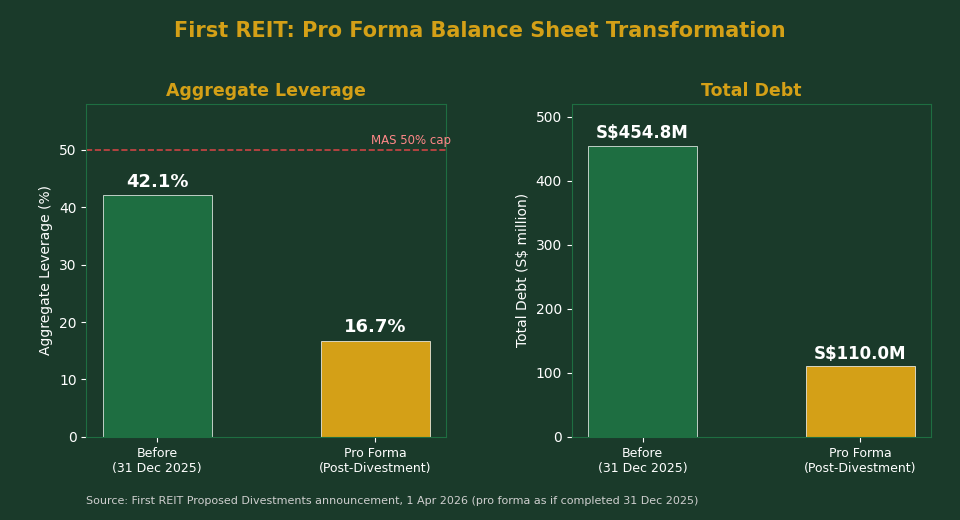
| Metric | Before (31 Dec 2025) | Pro Forma |
|---|---|---|
| Aggregate Leverage | 42.1% | 16.7% |
| Total Debt | S$454.8M | S$110.0M |
| Annual Interest Expense | Baseline | -S$18.8M |
| NAV per Unit | 24.97¢ | 23.43¢ |
Source: First REIT Proposed Divestments announcement, 1 April 2026. Pro forma figures assume completion on 31 December 2025 and are for illustration only.
With gearing this low, First REIT would have unusually large debt headroom versus almost any other SGX-listed REIT — you can benchmark that against other trusts using our S-REIT Gearing Ratio & ICR Calculator. The catch is that low gearing on a shrunken asset base isn’t automatically good news for income — it just means the REIT has plenty of capacity to borrow again once it finds something to buy.
The DPU Trade-Off: What Unitholders Give Up and Get Back
Here’s where the story gets less clean. Indonesia generated 82.5% of First REIT’s FY2025 rental income. You can’t sell 74.5% of your assets and keep your distribution intact — some DPU decline is unavoidable.
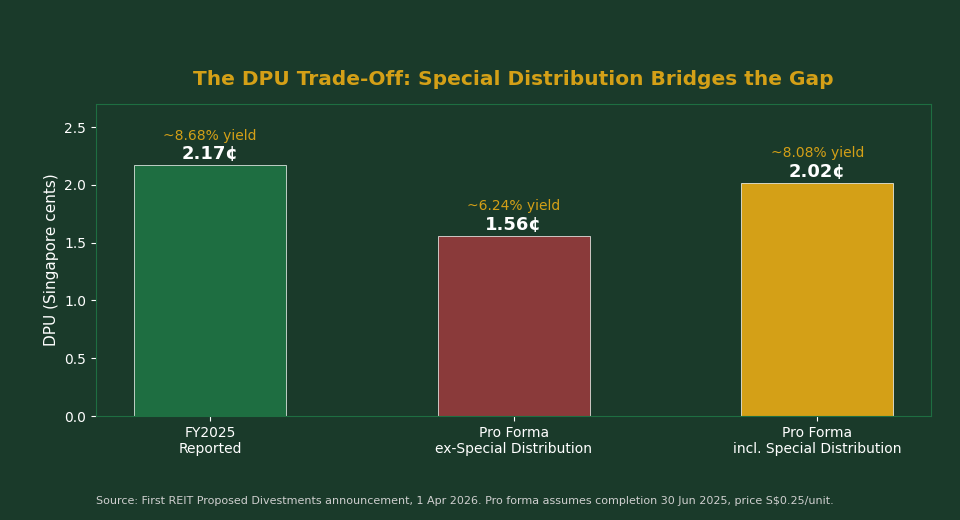
Using FY2025 as the base case and assuming completion had happened on 30 June 2025, First REIT’s DPU would have declined from its actual reported 2.17 cents (an 8.68% yield at the S$0.25 reference price) to approximately 1.56 cents on a pure ongoing-income basis — a 6.24% yield. That’s the real, recurring hit from losing the Indonesia rental stream.
To soften the landing, the Board plans a Special Distribution of about S$9.7 million — equal to the premium the REIT captured over independent valuations — to be paid out across the two financial quarters after completion. Including that one-off payment, pro forma DPU works out closer to 2.02 cents, an 8.08% yield. That’s a much smaller gap versus the FY2025 reported figure, but it’s important to understand this bridge is temporary. Once the special distribution is paid out, the REIT’s ongoing DPU reverts to whatever the smaller, developed-market portfolio can generate on its own — likely closer to that 1.56-cent, 6.24%-yield run rate unless new acquisitions replace the lost income.
Independent research house Beansprout has flagged this exact concern, maintaining a Neutral stance on the stock — its analysis notes the special distribution works out to only 0.46 cents per unit and “will not be able to compensate unitholders for the loss of rental income” on its own, meaning First REIT needs to fill the income gap with new acquisitions within roughly six months of completion to minimise the hit to unitholder returns.
Governance: Why This Needed a Unitholder Vote
This deal isn’t a simple arm’s-length sale. Siloam, Lippo Karawaci and MPU — the three buyers — are all connected to Dr Stephen Riady and Dr James Tjahaja Riady, who together are deemed interested in approximately 45.72% of First REIT’s units and are classified as Controlling Unitholders. That makes this an Interested Person Transaction (IPT) under SGX rules, on top of qualifying as a “major transaction” since it exceeds 50% of First REIT’s net asset value and net property income.
Both classifications trigger mandatory unitholder approval. First REIT appointed SAC Capital as an Independent Financial Adviser (IFA) to assess whether the deal was struck on normal commercial terms and not prejudicial to minority unitholders — the IFA opined that it was, and the Independent Directors and Audit and Risk Committee concurred. The Sponsors (OUE Limited and OUE Healthcare) and their associates abstained from voting, leaving the decision entirely to independent unitholders.
Two conditional resolutions — one covering the hospital divestments, one covering the non-core divestments — went to a poll vote at an Extraordinary General Meeting on 23 June 2026, each requiring a simple majority and each conditional on the other passing. Ahead of the vote, First REIT’s broker deck disclosed that a Citi-run sale process had engaged more than 60 potential parties before settling on Siloam as the buyer for the hospital assets — evidence the Manager sought to establish a fair market price rather than simply selling to the connected tenant by default.
What Happens Next: Timeline and Redeployment Risk
Completion of the first-tranche divestments is targeted for August 2026 — the same month you’re reading this. Once that closes, First REIT becomes a cash-rich, lightly-geared trust holding only Singapore and Japan nursing homes, plus the option to pull in another S$294.8 million by exercising the Siloam put before its 31 October 2026 deadline.
The real test starts after completion. First REIT’s stated plan is to redeploy capital into developed-market acquisitions across Singapore, Japan, and Australia. That’s easier said than done — competitive bidding for quality healthcare and living-sector assets in developed markets typically compresses acquisition yields, and there’s no guarantee First REIT can find deals accretive enough to restore its distribution to pre-divestment levels within a reasonable timeframe. Until acquisitions are announced, First REIT is, in effect, a healthcare REIT with a shrunken healthcare portfolio and a large cash pile waiting to be deployed.
Verdict: Should You Hold or Buy First REIT Now?
If you already hold First REIT, this transaction meaningfully de-risks your investment. You’re trading a high-yielding but currency-exposed, ageing Indonesian hospital portfolio for a much smaller, better-capitalised, developed-market REIT with one of the lowest gearing ratios on SGX. The IFA’s endorsement, the waived divestment fee, and the process discipline (60-plus parties canvassed) all suggest the Manager negotiated in good faith for minority unitholders, even in a deal where the buyers are related parties.
If you’re considering buying in now, understand exactly what you’re buying: a REIT mid-transformation, with a temporarily inflated yield from a one-off special distribution, and genuine uncertainty about how quickly — and how accretively — it can redeploy its war chest. The pro forma 6.24% ongoing yield (before any special distribution) is a more honest number to anchor your expectations on than the 8%+ headline yield you’ll see quoted while the special distribution is still being paid out.
This is a name to watch rather than a name to chase purely on yield. For a broader view of how First REIT’s new, lower-geared profile compares with other S-REITs once the dust settles, see our Best REITs in Singapore 2026 roundup, and our passive income Singapore guide for how a REIT like this fits into a diversified income portfolio. If you’re mapping out how any First REIT yield — old or new — fits your retirement number, our Singapore retirement planning calculator can help you model it.
Want exposure to a basket of S-REITs instead of picking single names through a transition like this? Syfe (referral code SRPRFFFCD) offers a managed REIT+ portfolio, while Endowus (referral code 2V343) lets you access diversified REIT and income funds using CPF or SRS savings.
Frequently Asked Questions
What is First REIT selling in Indonesia?
First REIT is divesting all 14 of its Indonesia properties: 8 hospitals to Siloam International Hospitals for approximately S$389.2 million, and 3 non-core assets (2 to Lippo Karawaci, 1 leased to MPU) for about S$82.4 million. A further 6 hospitals can be sold to Siloam via a put option for approximately S$294.8 million, exercisable to 31 October 2026.
Why is First REIT exiting Indonesia?
The Indonesian rupiah’s persistent depreciation against the Singapore dollar eroded First REIT’s DPU by 16.9% since FY2021, despite built-in 4.5% annual rent escalations. Combined with a negative sovereign outlook revision on Indonesia in 1Q 2026, the Manager decided to fully exit and redeploy capital into developed markets with more currency stability and predictable regulation.
How does this affect First REIT's gearing?
Pro forma aggregate leverage falls from 42.1% (as at 31 December 2025) to approximately 16.7% after the divestment proceeds are used to repay debt. Total debt drops from S$454.8 million to about S$110.0 million, saving an estimated S$18.8 million in annual interest expense.
Will First REIT's dividend go down?
Yes, on an ongoing basis. Pro forma DPU excluding the one-off special distribution is approximately 1.56 cents, down from FY2025’s reported 2.17 cents. A S$9.7 million special distribution partially bridges this to about 2.02 cents for a limited period after completion, but that bridge is temporary and not a recurring feature of the dividend going forward.
Was this deal approved by unitholders?
The Proposed Divestments were put to a unitholder vote at an Extraordinary General Meeting on 23 June 2026, structured as two conditional resolutions requiring a simple majority each. The Sponsors abstained from voting given the transaction’s Interested Person Transaction status, and an Independent Financial Adviser recommended unitholders vote in favour. Completion is targeted for August 2026.
What is First REIT's share price and yield in August 2026?
As at 10 August 2026, First REIT traded at approximately S$0.23 per unit, with a trailing dividend yield in the high single digits. Note that current trailing yield figures reflect the REIT’s pre-divestment income base and will likely normalise lower once the Indonesia rental income is removed, partially offset by the special distribution.
What happens to First REIT after the Indonesia exit?
Post-completion, First REIT retains 3 nursing homes in Singapore and 14 nursing homes in Japan, plus a significantly de-geared balance sheet with capacity for new acquisitions. Management intends to redeploy capital into developed markets — Singapore, Japan and Australia — though no specific acquisitions had been announced as at the time of writing, making the pace and success of redeployment a key risk to watch.
Disclaimer: This article is for educational and informational purposes only and does not constitute financial advice. Figures are sourced from First REIT’s SGX announcements dated 1 April 2026, EGM materials, and third-party research as cited. Pro forma figures are illustrative estimates only and are not a guarantee of actual post-completion results. Always conduct your own research or consult a licensed financial adviser before making investment decisions.
This article was researched with the help of AI. While we strive to keep all information accurate and up to date, there may be errors. If you notice any discrepancies, please contact us.