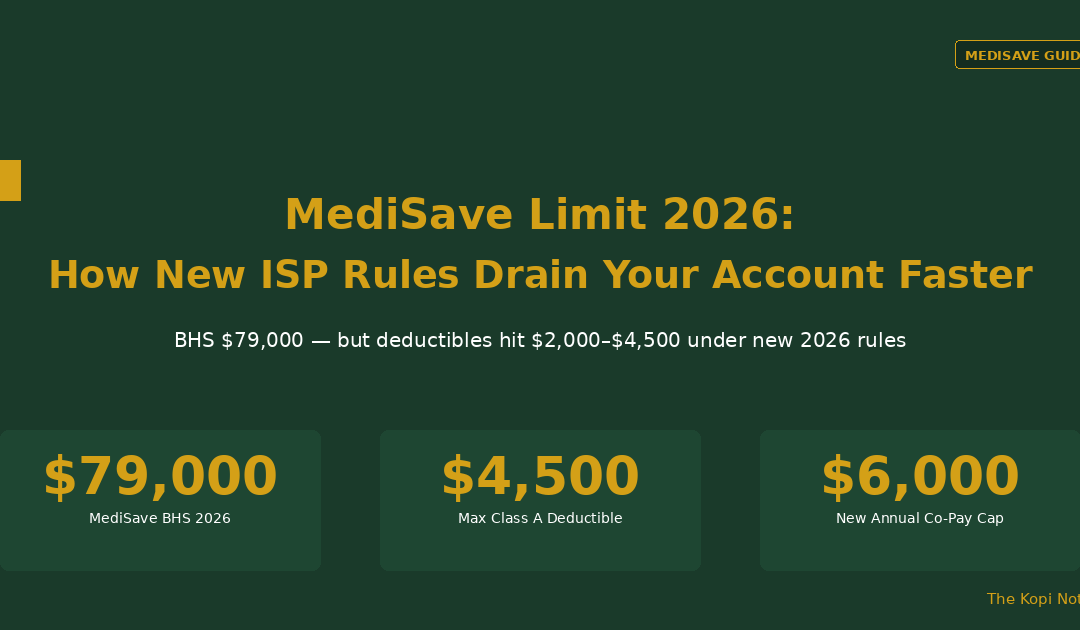
MediSave Limit 2026: How New ISP Rider Rules and Higher Deductibles Are Draining Your Account Faster
BHS raised to $79,000 — but April and June 2026 rule changes mean you need more MediSave per hospitalisation, not less.
The MediSave limit in 2026 is $79,000 — this is the Basic Healthcare Sum (BHS), the cap on how much can sit in your MediSave Account. But two rule changes in 2026 mean Singaporeans are drawing down their MediSave faster than before: from 1 June 2026, MediShield Life deductibles rose to $2,000–$4,500 per year, and from 1 April 2026, new ISP riders can no longer cover those deductibles. Together, they shift hundreds or thousands of dollars in annual healthcare costs back onto your MediSave balance.
Not financial advice. All figures are for educational reference only. Data verified as at 2 October 2026.
- MediSave BHS 2026 = $79,000 (up from $75,500 in 2025). Amounts above this overflow to your Retirement Account or Special Account.
- June 2026: MediShield Life deductibles rose to $2,000–$4,500 per policy year depending on ward class and age.
- April 2026: New ISP riders can no longer cover deductibles — you now pay these directly from cash or MediSave.
- Combined effect: Each hospitalisation can now drain $2,000–$4,500 more from your MediSave than under the old rider system.
Table of Contents
Contents — Click to expand
- What Is the MediSave Limit (BHS) in 2026?
- June 2026: How Deductibles Changed
- April 2026: How New ISP Rider Rules Shift Costs to MediSave
- Worked Example: What You Now Pay Per Hospitalisation
- MediSave Withdrawal Limits for ISP Premiums (AWL)
- How to Plan Your MediSave for Future Healthcare Costs
- Frequently Asked Questions
What Is the MediSave Limit (BHS) in 2026?
The Basic Healthcare Sum (BHS) is the maximum balance your MediSave Account can hold before surplus contributions are redirected. In 2026, the BHS is $79,000 — an increase from $75,500 in 2025. The government adjusts the BHS annually to keep pace with rising healthcare costs and longer life expectancies.
Here is what happens at different MediSave balance levels:
- Below BHS ($79,000): All CPF contributions and voluntary top-ups flow into your MediSave Account normally.
- At or above BHS: Excess MediSave contributions are channelled to your Special Account (if you are below 55) or Retirement Account (if you are 55 and above).
- Members who turned 65 before 2026 retain a fixed BHS from their cohort year — for example, those who turned 65 in 2025 retain $75,500 as their fixed BHS for life.
For most working Singaporeans, the BHS feels like a distant ceiling. But in retirement, when contributions stop and withdrawals for ISP premiums and hospitalisation begin, the balance falls steadily. The 2026 rule changes affect how fast that happens. You can find a full breakdown of MediSave limits in our MediSave limit 2026 guide covering BHS, MMSS and withdrawal caps.
| BHS Milestone | 2025 | 2026 |
|---|---|---|
| Basic Healthcare Sum | $75,500 | $79,000 |
| Annual increase | — | +$3,500 (+4.6%) |
| MMSS matching grant (ages 55–70) | Not available | Up to $1,000/year |
Source: CPF Board, January 2026
June 2026: How Deductibles Changed
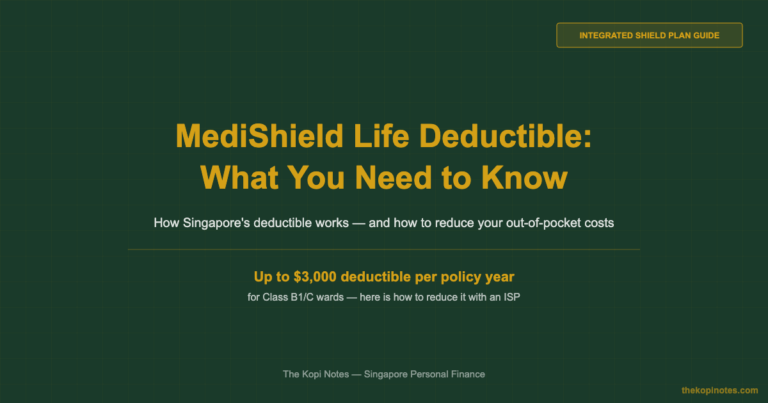
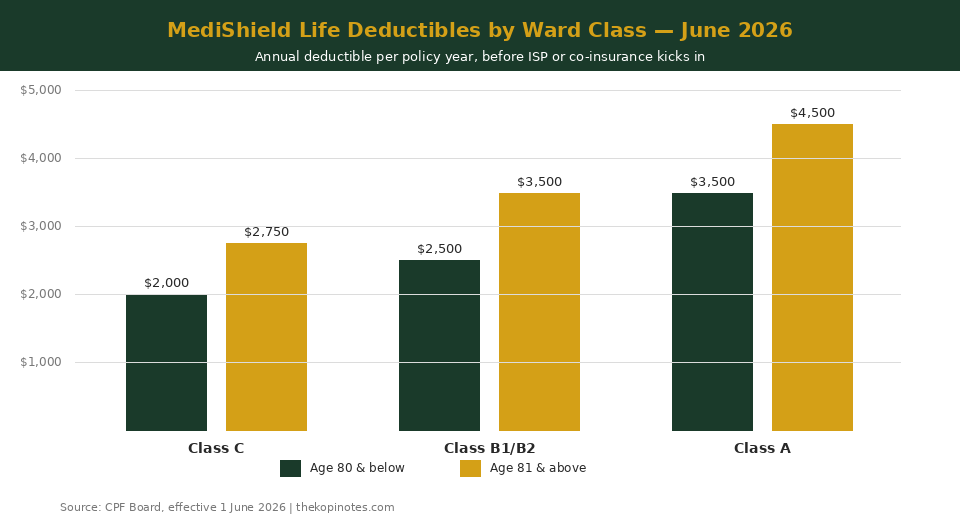
From 1 June 2026, the Ministry of Health raised MediShield Life annual deductibles across all ward classes. A deductible is the fixed amount you pay first before MediShield Life or your ISP kicks in — once per policy year (April to March), not per hospital admission.
The increase was significant. For a Singapore resident below 80 staying in a Class A private ward, the annual deductible rose to $3,500. For those aged 81 and above in the same ward, the deductible is now $4,500.
| Ward Class | Age 80 & Below | Age 81 & Above |
|---|---|---|
| Class A (Private Hospital / Class A Public) | $3,500 | $4,500 |
| Class B1 / B2 / B2+ (Public Hospital) | $2,500 | $3,500 |
| Class C (Subsidised) | $2,000 | $2,750 |
Source: CPF Board, effective 1 June 2026
Under the previous deductible structure, amounts were lower — and for many policyholders with old-style ISP riders, the deductible was covered by the rider anyway. That has now changed.
April 2026: How New ISP Rider Rules Shift Costs to MediSave
Before April 2026, Singaporeans could buy full-coverage ISP riders that paid for both the deductible and co-insurance — meaning a policyholder with a rider paid effectively nothing out of pocket for covered hospitalisations.
From 1 April 2026, MOH banned the sale of such full-coverage riders. All newly purchased riders must comply with three new rules:
- No deductible coverage: The rider cannot pay your annual deductible ($2,000–$4,500). You must fund this yourself — from cash or MediSave.
- Minimum 5% co-payment: After the deductible, you pay at least 5% of your eligible bill amount.
- Co-payment cap of $6,000/year: Once your total co-payments reach $6,000 in a policy year, the new rider covers 100% of eligible costs above that. (The old cap was $3,000.)
The positive trade-off: new rider premiums are approximately 30% cheaper than the old full-coverage riders — around $600 per year less for a Class A private hospital rider. But this saving is easily offset in any year you are hospitalised. You can explore the full cost comparison in our breakdown of new ISP rider 2026 co-payment rules and worked examples.
Existing policyholders who bought their rider before 1 April 2026 are grandfathered until their next renewal after 1 April 2028, after which they must switch to a compliant rider. If you are in this category, your MediSave is not yet impacted — but it will be. Understanding whether to cancel or keep your old rider is a critical decision. Our guide on whether to cancel your ISP rider in 2025–2026 walks through the considerations.
Worked Example: What You Now Pay Per Hospitalisation
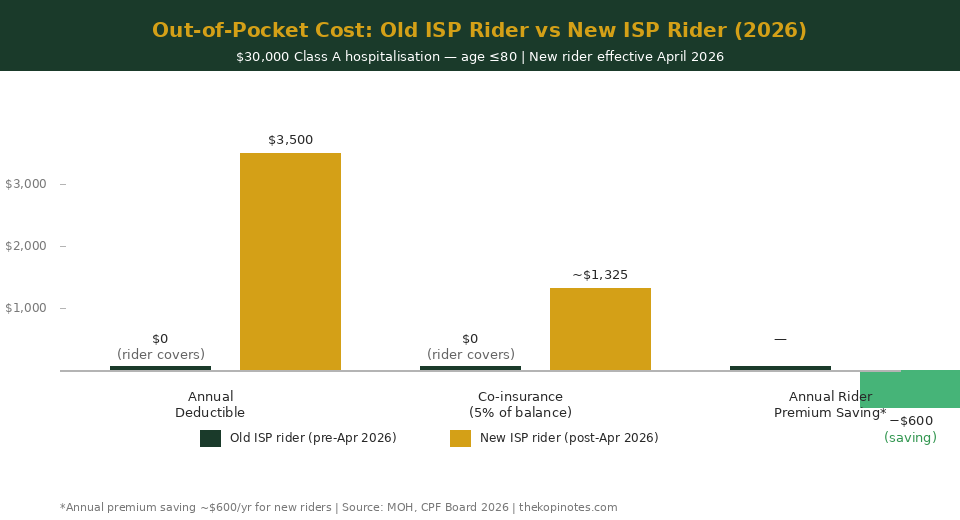
To understand the real impact on MediSave, consider a 55-year-old Singapore resident with an ISP covering Class A private hospital care, hospitalised for 5 days with a total bill of $30,000.
| Payment Component | Old Rider (Pre-April 2026) | New Rider (Post-April 2026) |
|---|---|---|
| Annual deductible | $0 (rider covers) | $3,500 (from MediSave/cash) |
| Co-insurance (5% of balance) | $0 (rider covers) | ~$1,325 (5% × $26,500) |
| Total out-of-pocket | ~$0 | ~$4,825 |
| Amount payable from MediSave | Rider premium only | Deductible + co-pay (up to MediSave limits) |
| Annual rider premium saving | — | ~$600 less/year |
Example assumes Class A ward, age ≤80, one hospitalisation in the policy year. Co-insurance simplified for illustration. Source: MOH ISP rider framework, CPF Board deductible schedule, 2026.
In this scenario, a single hospitalisation under the new rider costs approximately $4,825 more than the old rider — compared to an annual premium saving of just $600. This is not an argument against new riders (which are still far better than no rider at all), but it is a reminder that each hospitalisation now draws significantly more from your MediSave than it used to. For context on how the full hospital bill is divided between MediShield Life, your ISP, and yourself, see our detailed guide to 2026 MediSave hospitalisation claim limits.
MediSave Withdrawal Limits for ISP Premiums (AWL)
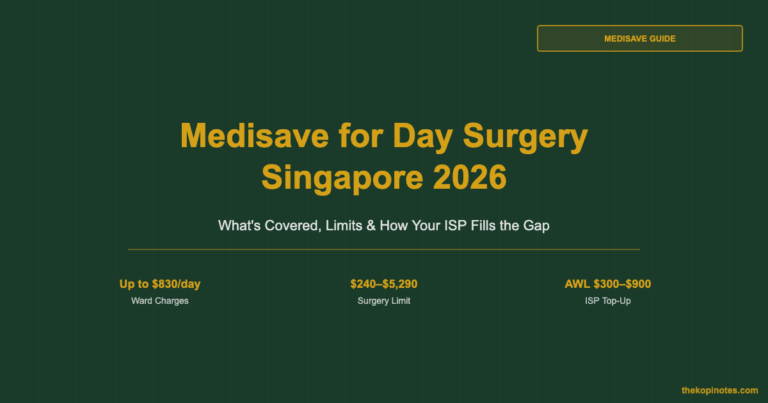
Separate from the deductible, your MediSave can be used to pay ISP base plan premiums — but not rider premiums. The amount you can use is capped by your Additional Withdrawal Limit (AWL), which is set by age:
| Age Group | Annual AWL for ISP Premium |
|---|---|
| Ages 1–40 | $300 per year |
| Ages 41–70 | $600 per year |
| Ages 71 and above | $900 per year |
Source: CPF Board AWL schedule, 2026
These limits apply to the base ISP plan premium only — not the rider. Rider premiums must be paid from cash. Because ISP premiums rise steeply with age (often reaching several thousand dollars a year for a 70-year-old), the AWL typically covers only a fraction of your actual premium cost. The rest comes from cash. Many Singaporeans are surprised to discover that MediSave cannot fully fund their ISP as they age — this is a planning gap worth addressing early.
How to Plan Your MediSave for Future Healthcare Costs
Given the higher deductibles and tightened rider rules in 2026, how should you approach MediSave planning? Here are three practical steps:
1. Know Your Annual MediSave “Burn Rate”
Calculate how much your MediSave is likely to be drawn each year in retirement:
- ISP base premium (AWL portion): Up to $300–$900/year (depending on age)
- MediShield Life premium: Paid from MediSave automatically
- Hospitalisations: Each admission can now cost $2,000–$4,500 in deductible alone
Even without hospitalisation, a retiree aged 75 can expect to use $1,000–$2,000/year from MediSave for premiums alone. A hospitalisation adds another $2,500–$4,500. This matters when you consider that contributions stop at retirement.
2. Consider Topping Up Your MediSave While You Can
Voluntary cash top-ups to MediSave (up to the BHS of $79,000) attract tax relief of up to $8,000 per year. For those in higher tax brackets, this makes topping up one of Singapore’s most efficient tax-saving moves. The new Matched MediSave Scheme (MMSS) provides an additional government match of up to $1,000 per year for eligible Singaporeans aged 55–70 with income below $34,000 and net worth below $60,000. Our MediSave limit guide covers how voluntary top-ups and tax relief work in detail.
3. Factor Healthcare Into Your Retirement Plan
Singapore’s official retirement planning calculator can help you model how long your CPF funds — including MediSave — will last under different healthcare scenarios. With deductibles at $3,500 for a Class A ward and no rider coverage of those deductibles for new policyholders, a realistic healthcare budget becomes an essential part of any retirement plan.
The key takeaway: $79,000 in MediSave sounds like a lot — but it can erode faster than expected once hospitalisations begin. Two serious admissions in a year, each with a $3,500 deductible and $1,000+ in co-payments, could drain $8,000–$9,000 in a single year alone. For those concerned about whether their current ISP still makes sense, our guide on ISP rider cancellation decisions in 2025–2026 may be helpful. You can also see how MediShield Life claim limits interact with your bill in our MediShield Life claim limits by ward class 2026 breakdown.
Frequently Asked Questions
What is the MediSave limit in 2026?
The MediSave limit in 2026 is $79,000 — officially known as the Basic Healthcare Sum (BHS). This is the maximum balance allowed in your MediSave Account. CPF adjusts the BHS annually; it was $75,500 in 2025. If your MediSave exceeds $79,000, any additional contributions flow into your Special Account (below age 55) or Retirement Account (above 55). Members who turned 65 before 2026 retain their cohort’s fixed BHS for life.
Can I use MediSave to pay the ISP deductible under the new 2026 rules?
Yes. The annual MediShield Life deductible — which ranges from $2,000 to $4,500 depending on your ward class and age — can be paid using MediSave. This is separate from your ISP rider premium, which must be paid in cash. Since new ISP riders from April 2026 no longer cover the deductible, most policyholders will use their MediSave balance to fund this amount each time they are hospitalised in a new policy year.
Why did the MediShield Life deductibles increase in June 2026?
The Ministry of Health raised deductibles from 1 June 2026 as part of MediShield Life’s regular review to maintain the plan’s long-term sustainability. Higher deductibles encourage cost-conscious healthcare decisions — patients have more financial skin in the game before insurance pays. The increase also aligns deductibles with inflation in healthcare costs since the previous review. For most ward classes, deductibles roughly doubled compared to earlier years.
How does the new ISP rider co-payment cap of $6,000 work?
Under new ISP riders purchased from April 2026, you first pay the annual deductible ($2,000–$3,500 for most ward classes). After that, you pay at least 5% of your remaining eligible bill as co-insurance. This 5% continues until your total co-payments for the year reach $6,000. Once you hit the $6,000 cap, your ISP rider pays 100% of eligible claims for the rest of the policy year. This cap doubles the previous $3,000 limit under old-style riders.
Is $79,000 in MediSave enough for retirement healthcare costs?
For many Singaporeans, $79,000 provides a meaningful healthcare cushion — but it may not be enough if you face multiple serious hospitalisations in retirement. A single Class A hospitalisation with the new deductible structure can cost $3,500–$4,500 in deductible alone, plus co-payments. Add annual ISP and MediShield Life premiums (often $1,000–$2,000+ at age 70), and a retiree could draw $5,000–$8,000 from MediSave in a single difficult year. Topping up while you are still contributing is the most effective way to build a larger buffer.
What is the Matched MediSave Scheme (MMSS) and who is eligible?
The MMSS launched in January 2026 offers eligible Singaporeans a dollar-for-dollar government top-up of up to $1,000 per year when they voluntarily contribute to their MediSave. To qualify, you must be aged 55–70, have an annual income below $34,000, and a net worth below $60,000 (excluding HDB flat value). The MMSS is designed to help lower-income older Singaporeans build their healthcare safety net ahead of retirement. Applications are made through the CPF Board.
Should I keep my old ISP rider or switch to a new one before April 2028?
This depends on your health status and financial situation. Old-style riders (bought before 1 April 2026) that cover deductibles remain valid until your next renewal after 1 April 2028 — so you have time to decide. Keeping your old rider means lower out-of-pocket costs if you are hospitalised, but you pay higher premiums. Switching to a new rider saves around $600/year in premiums but exposes you to deductibles of $2,000–$4,500 each policy year. For anyone with a history of hospitalisations or chronic conditions, maintaining the old rider until forced to switch is often the more financially prudent option.
Understand Your Full ISP Picture
With 2026 deductibles at $2,000–$4,500 and new rider rules in effect, planning your hospitalisation budget matters more than ever.
Get Free Insurance Advice
Speak with a licensed insurance advisor. No obligation, no cost.
By submitting this form, you agree to our Privacy Policy.
This article was researched with the help of AI. While we strive to keep all information accurate and up to date, there may be errors. If you notice any discrepancies, please contact us.