Private Hospital Integrated Shield Plan Singapore: Complete 2026 Guide
Compare all 7 insurers’ private hospital coverage, claim limits, and the April 2026 rider changes — everything you need before you upgrade.
A private hospital Integrated Shield Plan (ISP) lets you claim for treatment at any private hospital in Singapore, on top of your compulsory MediShield Life coverage. Seven insurers sell one today: AIA, Great Eastern, HSBC Life, Income, Prudential, Raffles Health, and Singlife. Since 1 April 2026, MOH’s new rider rules mean you pay the first S$3,500 yourself before your rider coverage begins.
Not financial advice. All figures are for educational reference only. Data verified as at 21 July 2026 against MOH and insurer sources unless otherwise noted. Confirm exact premiums, limits, and terms with your insurer or a licensed financial adviser before purchasing or switching plans.
- All 7 ISP insurers in Singapore now sell a private hospital tier plan — annual claim limits range from S$1.2 million (Prudential’s base tier) to S$2.5 million (HSBC Life).
- Since 1 April 2026, new riders no longer cover your S$3,500 deductible, but the co-payment cap rose to S$6,000 and rider premiums fell by roughly 30% on average.
- Private hospital tier costs meaningfully more than Class A. Only upgrade if you specifically want private hospital access — not just a nicer public ward.
Table of Contents
Contents — Click to expand
- What Is a Private Hospital Integrated Shield Plan?
- The 7 Private Hospital ISPs in Singapore (2026)
- How the April 2026 MOH Reforms Changed Your Rider
- Private Hospital vs Class A Ward: Which Should You Choose?
- Who Should Buy a Private Hospital Tier ISP?
- What Does a Private Hospital ISP Cost?
- How to Apply or Upgrade Your Plan
- Frequently Asked Questions
What Is a Private Hospital Integrated Shield Plan?
Every Singapore Citizen and Permanent Resident already has MediShield Life. That’s your basic, compulsory hospitalisation insurance run by the CPF Board. It covers Class B2 and C wards in public hospitals.
An Integrated Shield Plan (ISP) sits on top of MediShield Life. A private insurer adds extra coverage so you can claim for a higher ward class — up to and including private hospitals. Private hospital tier is the most comprehensive, and most expensive, level of ISP cover.
With a private hospital ISP, you can be treated at any private hospital in Singapore — Mount Elizabeth, Gleneagles, Mount Alvernia, Parkway East, or Raffles Hospital, among others. You also keep access to Class A wards in public hospitals if you prefer.
Private hospitals aren’t subject to MOH’s public hospital fee benchmarks. Bills can run two to three times higher than an equivalent procedure at a restructured hospital. That’s why private hospital ISPs carry the highest annual claim limits of any tier — up to S$2.5 million a year — and the highest premiums.
Every private hospital ISP still has two components: the MediShield Life portion (funded from your CPF MediSave, standardised across insurers) and the private insurer’s additional coverage — the part that actually pays for private hospital bills. MediSave can cover part of both, subject to your Additional Withdrawal Limit (AWL).
The 7 Private Hospital ISPs in Singapore (2026)
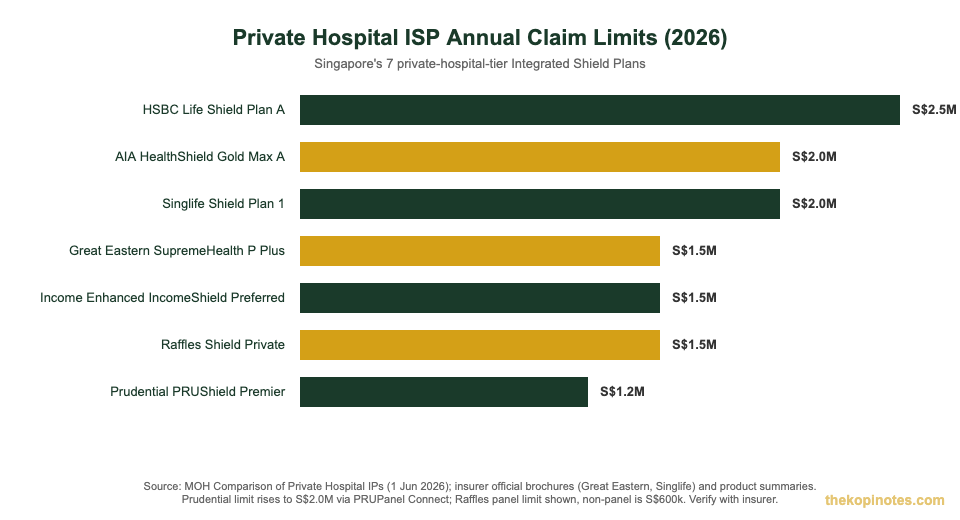
As at 1 June 2026, MOH’s official Comparison of Integrated Shield Plans lists seven active private hospital ISPs — one per insurer. Three older private hospital plans (Great Eastern SupremeHealth A, Income IncomeShield Plan P, and Singlife Shield Starter) are closed to new buyers; existing policyholders can keep renewing them, but nobody can newly join.
| Insurer | Private Hospital Plan | Annual Claim Limit |
|---|---|---|
| HSBC Life | HSBC Life Shield Plan A | S$2,500,000 |
| AIA | HealthShield Gold Max A | S$2,000,000 |
| Great Eastern | GREAT SupremeHealth P Plus | S$1,500,000 |
| Income | Enhanced IncomeShield Preferred | S$1,500,000 |
| Raffles Health | Raffles Shield Private | S$1,500,000 (panel) / S$600,000 (non-panel) |
| Prudential | PRUShield Premier | S$1,200,000 (up to S$2,000,000 via PRUPanel Connect) |
| Singlife | Singlife Shield Plan 1 | S$2,000,000 |
Source: MOH Comparison of Integrated Shield Plans, as at 1 June 2026; insurer product summaries. Panel/non-panel limits and terms vary — verify with your insurer.
Every plan above gives you access to private hospitals island-wide, but the fine print differs — panel networks, annual limits, and how riders are structured. If you’re deciding between insurers, these dedicated guides break down premiums, riders, and who each plan suits best: AIA HealthShield Gold Max A: Complete Guide (2026), Great Eastern Supreme Health P Plus Review Singapore (2026), Prudential PRUShield Premium Guide (2026), Singlife Shield Plan 1 Review 2026, and NTUC Income Enhanced IncomeShield Review 2026.
How the April 2026 MOH Reforms Changed Your Rider
On 1 April 2026, MOH’s new requirements for Integrated Shield Plan riders took effect across every insurer, including all seven private hospital plans above. This is the biggest change to Singapore’s private health insurance framework in years.
Here’s what changed, in plain terms:
- Riders can no longer cover your deductible. Before April 2026, a top-tier rider could absorb your entire annual deductible — S$3,500 for a private hospital admission. New riders sold from 27 November 2025 onwards can’t do this. You pay that S$3,500 yourself, every policy year you make a claim.
- The co-payment cap rose to S$6,000. Once you’ve paid the deductible, your rider caps your co-insurance share at a minimum of S$6,000 a year — up from S$3,000 previously.
- New rider premiums fell. MOH expects new riders to cost roughly 30% less on average than the riders they replace. Some insurers went further — Singlife’s new Health Plus riders are 30% to 84% cheaper, in exchange for the reduced deductible cover.
| Feature | Old Rider (bought before 27 Nov 2025) | New Rider (sold from 1 Apr 2026) |
|---|---|---|
| Deductible covered? | Yes — rider absorbs S$3,500 | No — you pay S$3,500 yourself |
| Co-payment cap | S$3,000/year | S$6,000/year minimum |
| Max out-of-pocket per year | ~S$3,000 | ~S$9,500 |
| Rider premium | Baseline | ~30% cheaper on average (up to 84% for some insurer tiers) |
Source: MOH Newsroom, “New Requirements for Integrated Shield Plan Riders” (effective 1 April 2026).
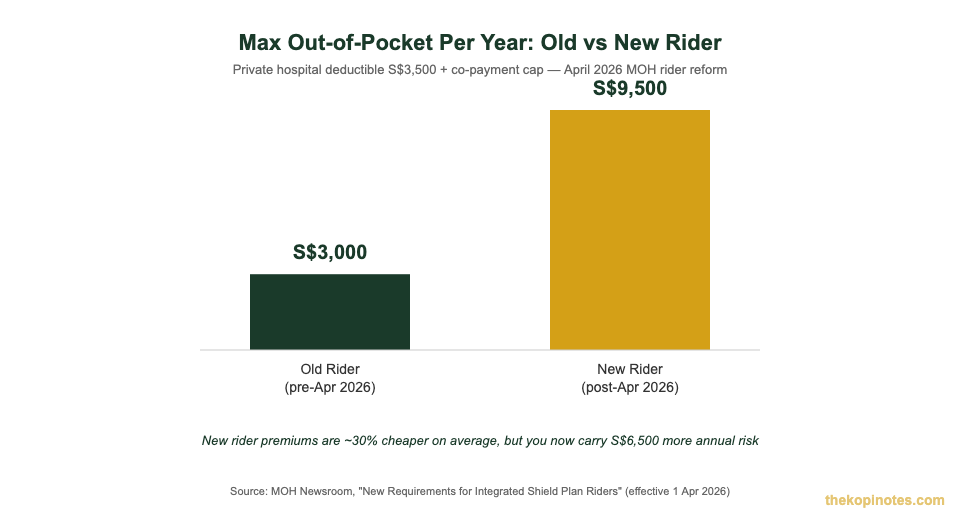
Do the math and the trade-off is stark. Under an old, grandfathered rider, your maximum yearly out-of-pocket cost was about S$3,000. Under a new rider, it’s up to S$9,500 — the S$3,500 deductible plus up to S$6,000 in co-payments. That’s S$6,500 more exposure a year, offset by a cheaper premium.
If you already hold a rider bought before 27 November 2025, you’re grandfathered. Your benefits carry over at renewal unless you actively choose to switch. Don’t switch without running the numbers first — once you move to a new rider, you can’t go back to the old structure.
Meanwhile, base plan premiums — the part before any rider — have kept rising with medical inflation, which industry surveys put at around 16.9% for 2026. Income Insurance, for instance, raised premiums on its Preferred and Advantage plans — the tiers covering private hospital and Class A wards — by 13% to 14% this year. A cheaper rider doesn’t automatically mean a cheaper total bill.
Private Hospital vs Class A Ward: Which Should You Choose?
This is worth asking before you pay for the top tier. A Class A ward at a public hospital — Singapore General, Tan Tock Seng, Changi General, and others — gives you a single room, your choice of specialist within that hospital, and significantly lower bills than a private hospital for the same procedure.
A private hospital plan buys you three things a Class A plan doesn’t: choice of hospital (not just choice of doctor within a public one), typically shorter waiting times for elective procedures, and hotel-like amenities. It does not buy you meaningfully better clinical outcomes. Singapore’s public hospitals are internationally regarded, and many surgeons who operate privately also hold posts at public institutions.
The cost gap is real. Comparing a top-tier private hospital plan against the same insurer’s Class A plan — for example, AIA HealthShield Gold Max A versus Gold Max B, or Prudential PRUShield Premier versus PRUShield Plus — private hospital premiums typically run 40% to 80% higher at the same age, before you even add a rider.
If your main goal is a private room and avoiding a public hospital queue, a well-selected Class A plan paired with a good rider often achieves most of that benefit at a meaningfully lower cost. Private hospital tier makes more sense if you have a strong preference for a specific private hospital or specialist, or you regularly see a particular private specialist for an ongoing condition.
Who Should Buy a Private Hospital Tier ISP?
A private hospital ISP tends to suit you if:
- You have an established relationship with a specialist who only practises at a private hospital, and continuity of care matters to you.
- Your household income comfortably covers the higher premium at older ages — private hospital premiums in your 60s and 70s can exceed S$5,000 to S$8,000 a year before any rider.
- You want the shortest possible wait for elective procedures like joint replacements or cataract surgery.
- You’re comfortable carrying up to S$9,500 in annual out-of-pocket exposure under the new rider rules, through savings or a supplementary buffer.
Consider a Class A plan instead if:
- Cost is a significant factor, especially as you plan for rising premiums into your 70s and 80s.
- You don’t have a strong preference for a specific private hospital or specialist.
- You’d rather redirect the premium difference into an emergency healthcare fund. Run your numbers through the Insurance Gap Calculator Singapore to see where you might be over- or under-insured.
What Does a Private Hospital ISP Cost?
Private hospital ISP premiums vary by insurer and rise steeply with age, because private hospital bills themselves are effectively uncapped. As a rough guide, expect to pay somewhere in the low hundreds of dollars a year in your 20s and 30s, climbing into the thousands by your 50s, and potentially S$5,000 to S$8,000-plus a year in your 70s — before adding a rider.
Your base plan premium can largely be paid from MediSave, subject to your Additional Withdrawal Limit (AWL), which rises with age. Rider premiums are usually payable in cash — this hasn’t changed under the April 2026 reforms.
Because exact premiums vary by insurer, age band, and smoking status, the most reliable numbers come from each insurer’s current rate card. The provider guides linked earlier in this article — covering AIA, Great Eastern, Prudential, Singlife, and Income — each include a full premium table by age band, updated for the April 2026 changes.
How to Apply or Upgrade Your Plan
If you’re a new applicant:
- Confirm you’re a Singapore Citizen or Permanent Resident — this is required for MediShield Life, and by extension, any ISP.
- Choose your insurer and private hospital plan from the table above.
- Declare your full medical history. Omitting a pre-existing condition, even a minor or old one, can void a future claim.
- Add a rider if you want to reduce your co-payment exposure, understanding it will no longer cover your deductible under the new rules.
- Set up MediSave deduction for the MediShield Life component and any base premium within your AWL.
If you’re upgrading from a Class A plan:
Switching to private hospital tier is medically underwritten again — insurers will ask about your current health, and any new or worsening conditions since your last application could be excluded or loaded. This differs from simply renewing an existing policy, which doesn’t require fresh underwriting. Time the switch while you’re healthy, and don’t let your existing policy lapse while the new one is being approved — even a brief coverage gap is a real risk.
Frequently Asked Questions
What is a private hospital Integrated Shield Plan?
A private hospital Integrated Shield Plan (ISP) is the top coverage tier of Singapore’s Integrated Shield Plan system. It sits on top of your compulsory MediShield Life coverage and lets you claim for hospitalisation at any private hospital in Singapore, not just Class A or B1 wards in public hospitals. All seven ISP insurers — AIA, Great Eastern, HSBC Life, Income, Prudential, Raffles Health, and Singlife — currently offer one.
Which insurers offer private hospital ISP coverage in Singapore in 2026?
As at June 2026, MOH lists seven active private hospital ISPs: AIA HealthShield Gold Max A, Great Eastern GREAT SupremeHealth P Plus, HSBC Life Shield Plan A, Income Enhanced IncomeShield Preferred, Prudential PRUShield Premier, Raffles Shield Private, and Singlife Shield Plan 1. Three older private hospital plans have been closed to new applicants but continue for existing policyholders.
How much more does a private hospital ISP cost than a Class A plan?
Private hospital premiums are typically 40% to 80% higher than the equivalent insurer’s Class A plan at the same age, before adding a rider. The exact gap depends on the insurer and your age band, so check each insurer’s current premium table for a precise comparison.
What changed for private hospital ISP riders after 1 April 2026?
From 1 April 2026, new riders can no longer cover your MOH-set deductible (S$3,500 for a private hospital admission). Instead, the co-payment cap rose to a minimum of S$6,000 a year, and new rider premiums fell by roughly 30% on average. Your maximum yearly out-of-pocket cost under a new rider is about S$9,500, versus roughly S$3,000 under an old, grandfathered rider.
Can I switch from a Class A plan to a private hospital plan?
Yes, but you’ll need to go through medical underwriting again, as if you were a new applicant. Insurers will ask about your current health and any conditions that have developed since your last application, and could exclude or load cover for these. Apply while you’re healthy, and never let your existing coverage lapse while waiting for the upgrade to be approved.
Do I need to be a Singapore Citizen or PR to buy a private hospital ISP?
Yes. Integrated Shield Plans build on MediShield Life, which is only available to Singapore Citizens and Permanent Residents. Foreigners on work passes or long-term visit passes aren’t eligible for an ISP, though some insurers offer separate international or expatriate hospitalisation plans that work differently and aren’t MediSave-linked.
Not Sure Which ISP Tier Is Right for You?
Compare every insurer’s plans side-by-side, or check where your current coverage might fall short.
This article was researched with the help of AI. While we strive to keep all information accurate and up to date, there may be errors. If you notice any discrepancies, please contact us. Not financial advice — figures are for educational reference only, data verified as at 21 July 2026.
Get Free Insurance Advice
Speak with a licensed insurance advisor. No obligation, no cost.
By submitting this form, you agree to our Privacy Policy.
This article was researched with the help of AI. While we strive to keep all information accurate and up to date, there may be errors. If you notice any discrepancies, please contact us.