Prudential PRUShield Premium Guide (2026): Standard, Plus & Premier Explained
Prudential PRUShield is one of Singapore’s seven Integrated Shield Plans (ISPs), offered by Prudential Assurance Company Singapore. It builds on your MediShield Life base to cover private hospitals, Class A and B1 wards at restructured hospitals, with three plan tiers — Standard, Plus and Premier. From April 2026, Prudential launched the new PRUExtra Care Series riders, which are 30–45% cheaper than old riders but now require you to pay the deductible ($1,500–$3,500) out of pocket.
Not financial advice. All figures are for educational reference only. Data as at June 2026 unless noted.
- PRUShield has 3 tiers: Standard (B1 ward), Plus (Class A), Premier (private hospital)
- New PRUExtra Care Series riders (April 2026) are 30–45% cheaper but you now pay the deductible ($1,500–$3,500) yourself
- PRUShield is priced higher than some competitors but has a fast claims process — median 0 days according to MOH
Table of Contents
- What Is PRUShield?
- The Three PRUShield Plan Tiers
- PRUShield Premium Table 2026
- New PRUExtra Care Series Riders (April 2026)
- April 2026 Changes: What You Need to Know
- How Much Will You Pay Out of Pocket?
- How PRUShield Compares to Other ISPs
- PRUShield Claims Process
- Verdict: Is PRUShield Right for You?
- Frequently Asked Questions
What Is PRUShield?
PRUShield is an Integrated Shield Plan (ISP) — a private health insurance policy that sits on top of your MediShield Life coverage. Every Singapore Citizen and Permanent Resident already has MediShield Life. PRUShield enhances that coverage so you can access higher ward classes, private hospitals, and more generous claim limits.
Here’s the simple picture. MediShield Life covers basics — think Class B2/C ward in restructured hospitals. PRUShield kicks in above that, covering Class A wards, private hospitals, and “as charged” bills that would otherwise leave you with large out-of-pocket amounts.
Prudential is one of seven insurers in Singapore approved by MOH to offer ISPs. The others are AIA, Great Eastern, Income, Raffles Health Insurance, Singlife, and AXA. Each insurer’s ISP must include MediShield Life as the mandatory base.
You pay PRUShield premiums using your MediSave account — no cash needed for the base plan. Riders like the PRUExtra Care Series must be paid in cash.
The Three PRUShield Plan Tiers
PRUShield comes in three tiers. Each tier determines which hospital ward class you’re covered for and the annual claim limit you get.
PRUShield Standard
This is the entry-level tier. It covers you in restructured hospitals up to Class B1 ward. The annual claim limit is $200,000 — lower than most competitors at this tier. There is no pre- or post-hospitalisation coverage.
For most Singaporeans who want meaningful private coverage, PRUShield Standard is not enough on its own. The lack of pre- and post-hospitalisation benefits is a real gap — those costs (specialist consultations, physiotherapy, follow-up scans) add up quickly.
PRUShield Plus
This is the mid-tier. It covers Class A wards in restructured hospitals. Annual claim limit is up to $600,000. You get 180 days of pre-hospitalisation coverage and 365 days of post-hospitalisation coverage.
For a non-smoking male aged 31–35, the annual premium is about $119 — similar to other Class A plans, though competitors like Great Eastern’s Supreme Health A Plus offer higher claim limits ($1,000,000) at a lower price ($106–$123). That said, the claims speed at Prudential is a differentiator (more on that below).
PRUShield Premier
The top tier. It covers private hospitals in Singapore. Annual claim limit is up to $1,200,000 (or $2,000,000 if all claims are at PRUPanel Connect providers). You get 180 days of pre-hospitalisation and 365 days of post-hospitalisation coverage.
For a non-smoking male aged 31–35, the annual base premium is about $300. The annual limit of $1.2 million is reasonable but sits below competitors like AXA Shield Plan A ($2.5 million) and AIA Healthshield Gold Max A ($2 million).
PRUShield Premium Table 2026
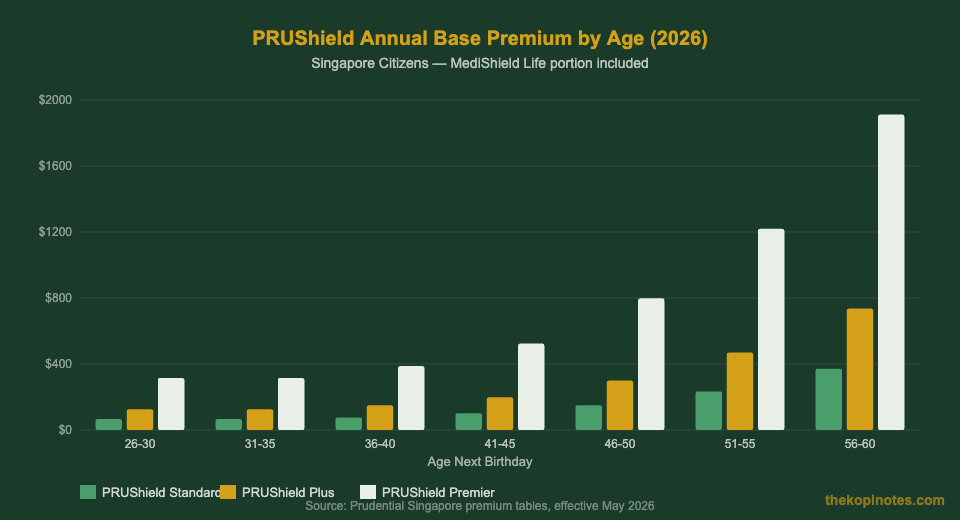
PRUShield premiums increase with age — that’s normal for all ISPs. The figures below are for Singapore Citizens and PRs (MediShield Life portion included), effective from May 2026. You pay these with MediSave up to MediSave withdrawal limits; any excess is paid in cash.
| Age Next Birthday | Standard (approx.) | Plus (approx.) | Premier (approx.) |
|---|---|---|---|
| 26–30 | ~$63 | ~$119 | ~$300 |
| 31–35 | ~$63 | ~$119 | ~$300 |
| 36–40 | ~$72 | ~$142 | ~$368 |
| 41–45 | ~$97 | ~$188 | ~$498 |
| 46–50 | ~$143 | ~$285 | ~$758 |
| 51–55 | ~$222 | ~$446 | ~$1,158 |
| 56–60 | ~$353 | ~$699 | ~$1,816 |
Source: Prudential Singapore premium tables, effective May 2026. Figures are approximate and include MediShield Life portion. Actual premiums vary by exact age, residency status and claims history. Always check the official Prudential premium tables for exact figures.
Two things to note here. First, premiums rise sharply after age 50. A 56-year-old pays nearly 6x the premium of a 30-year-old for the same Premier plan. Second, Prudential uses claims-based pricing — if you make claims in a year, your rider premium may rise at the next renewal. However, with the new PRUExtra Premier Care rider, if all your claims are at panel specialists in panel hospitals, your premium stays level.
New PRUExtra Care Series Riders (April 2026)
From 1 April 2026, Prudential replaced the old PRUExtra CoPay riders with a new range called the PRUExtra Care Series. Three new riders are available:
| Rider | Best For | Premium vs Old Rider |
|---|---|---|
| PRUExtra Premier Care | All private hospitals | At least 30% cheaper |
| PRUExtra Preferred Care | PRUPanel Connect hospitals only | At least 45% cheaper (some up to 55%) |
| PRUExtra Plus Care | Restructured hospitals (Class A) | At least 30% cheaper |
Source: Prudential Singapore, April 2026. PRUExtra Care Series replaces PRUExtra CoPay series from 1 April 2026.
Why are premiums cheaper? Because you now share more of the risk. The new riders no longer cover the minimum IP deductible. You pay that yourself. That’s a big change — so let’s look at what it means for your wallet.
New Perks in the PRUExtra Care Series
It’s not all about cost savings. The new riders come with a few genuinely useful additions:
Critical Illness (CI) Benefit. If you’re hospitalised due to early, intermediate or late-stage CI, you get an additional policy year limit of up to $100,000. That’s meaningful — CI treatment is expensive and often involves extended hospital stays.
Retrenchment Waiver. If you’re retrenched and remain unemployed for 6 consecutive months, Prudential waives 12 months of rider premiums for PRUExtra Premier Care and PRUExtra Preferred Care holders. In Singapore’s economic climate, this is a useful safety net.
PRUWell Reward. PRUExtra Premier Care customers who are “issued clean” (no pre-existing exclusions) and make no claims get a 20% discount on their standard premium at the next renewal. A nice reward for staying healthy.
Level premiums at panel. If all your claims are made with panel specialists at panel hospitals, your PRUExtra Premier Care premium stays level at the next renewal. Worth planning for if you’re a regular private hospital user.
April 2026 Changes: What You Need to Know
The April 2026 changes were driven by MOH’s effort to make private health insurance more sustainable. Healthcare costs have been rising — Prudential cited higher claims incidence, medical inflation, and rising staff costs as key drivers.
Here’s what changed on 1 April 2026:
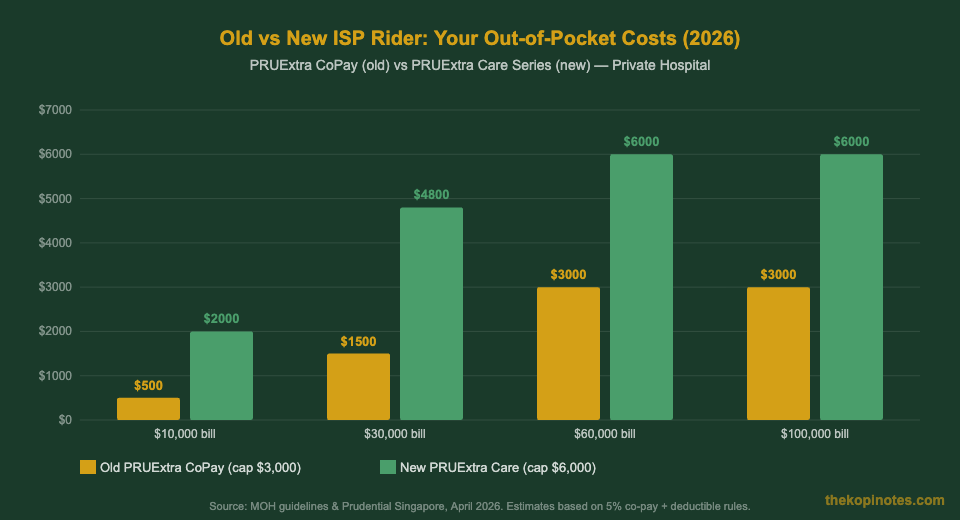
Deductible no longer covered by riders. The minimum IP deductible — $1,500 for restructured hospitals (Class A), $3,500 for private hospitals — must now be paid out of your own pocket. Previously, your PRUExtra CoPay rider covered most of this. You can use MediSave to pay the deductible, subject to MediSave withdrawal limits.
Co-payment cap doubled. The annual cap on your co-payment (your 5% share of each bill) rose from $3,000 to $6,000. This means in a bad year, your maximum out-of-pocket co-payment exposure doubled.
Existing riders continue. If you already have an old PRUExtra CoPay rider, you don’t need to do anything immediately. Your rider continues on its current terms. If you bought a rider between 27 November 2025 and 31 March 2026, you’ll transition to the new Care Series at your next renewal from 1 April 2028.
How Much Will You Pay Out of Pocket?
This is the question most people ask. Here’s a worked example using the new PRUExtra Care rules for a private hospital stay.
Say you’re admitted to a private hospital and your bill comes to $30,000. With PRUShield Premier and the new PRUExtra Premier Care rider:
Step 1 — Deductible: $3,500 (you pay this; can use MediSave)
Step 2 — Co-insurance: 5% of remaining $26,500 = $1,325
Step 3 — Co-payment cap check: $1,325 is below the $6,000 cap
Your total out-of-pocket: $4,825 (deductible + co-insurance, can use MediSave for deductible)
PRUShield + rider pays: $25,175
Under the old PRUExtra Premier CoPay, the deductible was largely covered by the rider, and the cap was $3,000. So your equivalent out-of-pocket for a $30,000 bill was closer to $1,500. The new system increases your exposure.
However, your annual rider premium drops by at least 30%. If you’re a 40-year-old paying $2,000/year for the old rider, you might save $600+ per year with the new Care rider. Over 5 years that’s $3,000 in savings — which starts to offset the higher deductible exposure if you don’t get hospitalised every year.
How PRUShield Compares to Other ISPs
PRUShield is not the cheapest ISP in Singapore — but it has genuine strengths worth considering. Here’s how it stacks up at the private hospital tier (ages 31–35):
| Plan (Private Hospital) | Annual Premium | Annual Limit | Pre / Post Hosp. |
|---|---|---|---|
| PRUShield Premier | ~$300 | $1.2M ($2M at panel) | 180 / 365 days |
| AIA Healthshield Gold Max A | ~$360 | $2M | 13 months / 13 months |
| Singlife MyShield Plan 1 | ~$409 | $2M | 180 / 365 days |
| GE Supreme Health P Plus | ~$322 | $1.5M | 120 / 365 days |
| NTUC Enhanced IncomeShield Preferred | ~$225 | $1.5M | 180 / 365 days |
Source: Individual insurer premium tables and MAS / MOH ISP comparison data, 2026. Premiums for non-smoking male, age 31–35, SG citizen.
PRUShield Premier sits in the middle of the pack on price. NTUC Income is notably cheaper ($225 vs $300) with a higher annual limit ($1.5M vs $1.2M). But PRUShield’s claims speed is a genuine differentiator — median 0 days processing time vs some competitors taking 3–7 days.
If you’re looking at the integrated shield plan comparison from a total-cost perspective, also factor in the rider premium. With the new PRUExtra Preferred Care (45% savings), PRUShield Premier + rider may become more competitive versus some alternatives.
PRUShield Claims Process
One of PRUShield’s strongest selling points is claims speed. According to MOH’s comparison data, PRUShield has a median claims processing time of 0 days — meaning most claims are processed on the same day. The 75th percentile is 1 day.
That matters when you’re in hospital and need a Letter of Guarantee (LOG) quickly. PRUShield offers an electronic LOG service — your hospital can check coverage digitally without paperwork delays. You can track your claim status via PRUServices online.
In practice, how smooth your claims experience is often depends on your financial adviser. A good adviser handles the paperwork and coordinates with Prudential directly, so you can focus on recovery. Many Seedly and Google reviews highlight this — customers who have active advisers rate their PRUShield experience significantly better than those who don’t.
Verdict: Is PRUShield Right for You?
PRUShield is a solid, reliable ISP — not the cheapest, but not the most expensive either. Here’s a quick summary of who it suits best:
Consider PRUShield if: You want fast, hassle-free claims. You value a large established insurer. You’re considering the new PRUExtra Care CI benefit. You use Prudential’s PRUPanel Connect network of specialists and hospitals.
Look elsewhere if: You’re purely cost-focused — NTUC Income Enhanced IncomeShield is cheaper at most tiers. You want the highest annual limits — AIA and AXA offer higher caps. You primarily use restructured hospitals at B2/C ward — MediShield Life alone may be sufficient.
The April 2026 rider changes make the cost calculation more complex. Before deciding, use the Singapore retirement calculator to model your long-term healthcare cost exposure, and speak to a MAS-licensed financial adviser who can model the premium vs out-of-pocket tradeoff for your specific age and health profile.
For a full breakdown across all 7 ISPs in Singapore, see our shield plan comparison Singapore 2026 guide.
Frequently Asked Questions
What is the difference between PRUShield Standard, Plus and Premier?
What are the new PRUExtra Care Series riders?
Can I pay PRUShield premiums with MediSave?
Should I keep my old PRUExtra CoPay rider or switch to the new Care Series?
How does PRUShield compare to other ISPs in Singapore?
What is PRUPanel Connect?
Not financial advice. The information above is for educational reference only. Always refer to the official Prudential Singapore product brochures and speak to a MAS-licensed financial adviser before making any decisions about your Integrated Shield Plan. Premium figures are approximate based on publicly available data as at June 2026.
Get Free Insurance Advice
Speak with a licensed insurance advisor. No obligation, no cost.
By submitting this form, you agree to our Privacy Policy.
This article was researched with the help of AI. While we strive to keep all information accurate and up to date, there may be errors. If you notice any discrepancies, please contact us.