From 1 April 2026, Prudential replaced its PRUShield riders with three new PRUExtra Care plans — Premier Care, Preferred Care, and Plus Care. Premiums are at least 30% lower, and up to 55% lower for Preferred Care. In exchange, new riders no longer cover your deductible, and the annual co-payment cap doubled from S$3,000 to S$6,000.
Not financial advice. All figures are for educational reference only. Data verified as at 13 August 2026 against official CPF Board, MOH and Prudential Singapore sources unless otherwise noted.
- Prudential’s rider suite is gone. It’s replaced by three new riders — PRUExtra Premier Care, Preferred Care, and Plus Care — all at least 30% cheaper than before.
- The catch: you now pay the MOH-set deductible (S$1,500 to S$3,500, depending on ward class) out of your own pocket before the rider kicks in.
- New perks help offset this — up to S$100,000 extra coverage if you’re hospitalised for a critical illness, and a 12-month premium waiver if you’re retrenched.
Table of Contents — Click to expand
- What Changed on 1 April 2026
- Meet the Three PRUExtra Care Riders
- How Much Cheaper Are the New Premiums?
- What You Now Pay Yourself: The Deductible
- New Benefits: Critical Illness Top-Up & Retrenchment Waiver
- Can You Keep Your Old Rider?
- Worked Example: How the New Rider Pays Out
- Is a Rider Still Worth Buying in 2026?
- How This Fits With Your MediSave
- Frequently Asked Questions
What Changed on 1 April 2026
Every Integrated Shield Plan (IP) rider in Singapore got redesigned this year, not just Prudential’s. The Ministry of Health (MOH) announced the shake-up in November 2025, and it took effect for new policies from 1 April 2026.
Here’s why. MOH found that private hospital IP policyholders with a rider were 1.4 times more likely to make a claim, with claims 1.4 times larger on average, than those without one. When a rider covers almost the entire bill, there’s less reason for patients and doctors to be cost-conscious. That pushes up claims across the whole pool, which then pushes premiums higher for everyone.
To fix this, MOH set two new rules for every rider sold or renewed from 1 April 2026:
- Riders can no longer cover your deductible. You pay this fixed amount yourself before the rider kicks in.
- The annual co-payment cap rose from S$3,000 to a minimum of S$6,000. This is the most you’ll pay in co-insurance each year, on top of the deductible.
In exchange, MOH expects new rider premiums to run about 30% cheaper on average industry-wide. Prudential’s PRUExtra Care Series is its answer to these rules. For the full regulatory picture across all insurers, see our breakdown of the April 2026 ISP rider rule changes.
Meet the Three PRUExtra Care Riders
Prudential retired its old rider lineup entirely and replaced it with three new options, collectively called the PRUExtra Care Series. Each one pairs with a different tier of your PRUShield base plan.
| Rider | Pairs With | Best For |
|---|---|---|
| PRUExtra Premier Care | Private healthcare institutions | Full freedom to choose any private hospital and doctor |
| PRUExtra Preferred Care | Prudential’s preferred private list (PRUPanel Connect) | Private care at a lower premium, using panel specialists |
| PRUExtra Plus Care | Restructured hospitals, up to Class A wards | Public hospital Class A coverage without private hospital pricing |
Source: Prudential Singapore, PRUShield Changes page and media release, 1 April 2026.
All three replace Prudential’s previous suite outright. If you’re still deciding which PRUShield base plan tier to pair a rider with, our PRUShield premium guide breaks down Standard, Plus and Premier side by side.
How Much Cheaper Are the New Premiums?
This is the headline change. Prudential says the three new riders are at least 30% more affordable than the previous suite, across every age group and plan type — with some age bands seeing even bigger savings.
PRUExtra Preferred Care stands out. It’s at least 45% cheaper than its old equivalent, and Prudential says some customer groups see a 55% reduction.
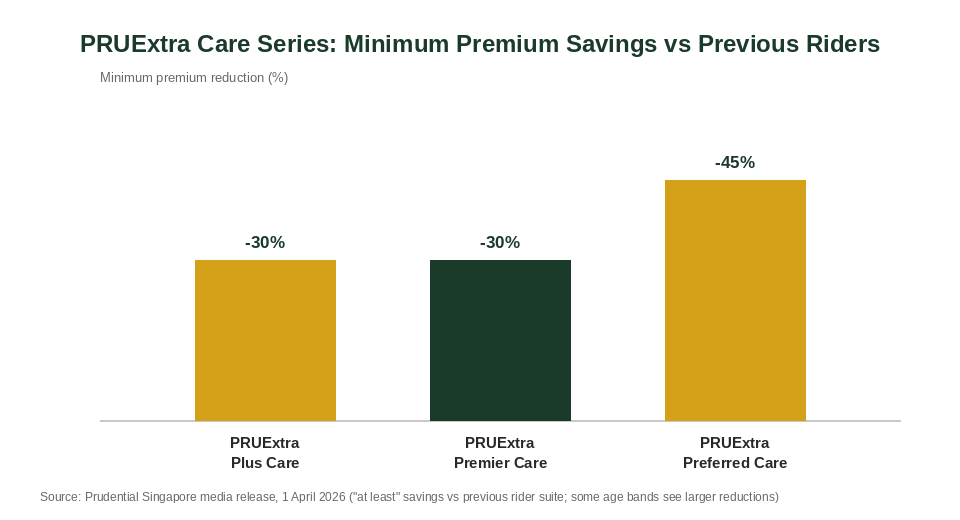
Source: Prudential Singapore media release, 1 April 2026. Figures are minimum reductions — actual savings vary by age band and plan.
Here’s why the savings are real, not just marketing. Riders used to cover almost everything, including your deductible. That meant claims flowed through more easily, which pushed up how often people claimed and how large those claims were. By removing deductible coverage, Prudential (and every other insurer) can charge a genuinely lower premium, because the pool of claims it’s insuring is smaller.
Prudential hasn’t published a full age-by-age dollar premium table for the new riders at the time of writing. For an official illustration of what 30% savings looks like in cash terms, MOH’s own case study is useful: a 60-year-old on a private hospital IP with rider saves about S$1,600 a year in cash by switching to a new-format rider. That’s an industry-wide MOH example, not a PRUShield-specific number, but the underlying maths applies the same way to PRUExtra Care.
What You Now Pay Yourself: The Deductible
Before 1 April 2026, your rider usually covered the deductible for you. Now it doesn’t. You pay the deductible in full, out of pocket or via MediSave, before your rider’s co-insurance coverage starts.
The deductible amount is set by MOH, not by Prudential, and it depends on the ward class you use — not just the plan you’re targeted for.
| Ward Class Used | Minimum Deductible (per policy year) |
|---|---|
| Class A / Private | S$3,500 |
| Class B1 | S$2,500 |
| Class B2 | S$2,000 |
| Class C | S$1,500 |
| Day surgery / short stay (non-subsidised) | S$2,000 |
| Day surgery / short stay (subsidised) | S$1,500 |
Source: Ministry of Health, New Requirements for IP Riders press release, 26 November 2025 (Annex A). Deductible is the lower of the amount for your targeted plan coverage or the ward class you actually use.
The deductible only has to be paid once per policy year — multiple bills in the same year count towards it. Once you’ve cleared it, standard co-insurance applies, capped by the new S$6,000 minimum co-payment ceiling.
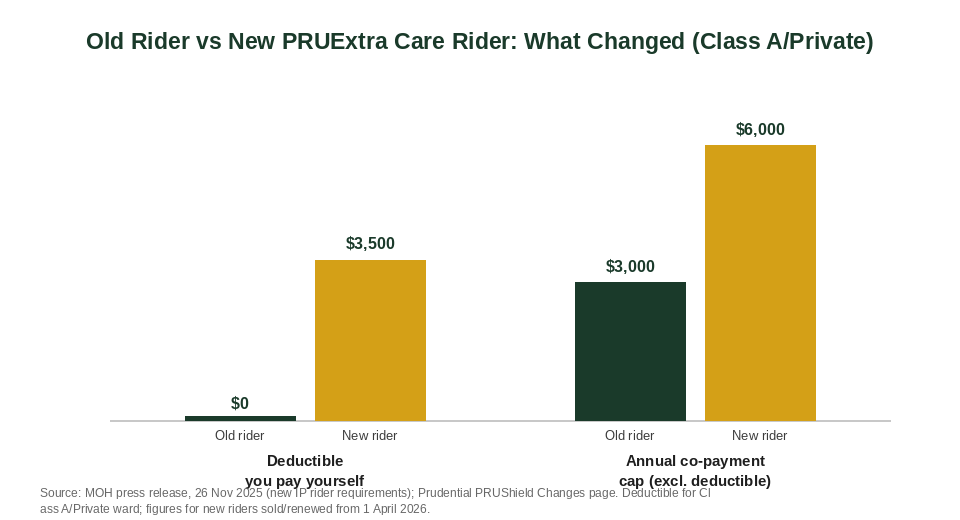
Source: MOH press release, 26 November 2025; Prudential PRUShield Changes page. Figures shown for Class A / Private ward, new riders sold or renewed from 1 April 2026.
Two features can soften the blow. First, if you’re on PRUExtra Premier Care and stick to panel or extended panel specialists at panel healthcare institutions, your premium stays level at renewal under Prudential’s claims-based pricing framework. Second, Premier Care customers who are issued without special terms and make no claims get a 20% “PRUWell Reward” discount off their standard premium at the next renewal.
New Benefits: Critical Illness Top-Up & Retrenchment Waiver
The PRUExtra Care Series isn’t only about cutting costs. Prudential added two new benefits that didn’t exist in the old rider suite.
Critical illness policy year limit top-up. If you’re hospitalised or need surgery for a covered early, intermediate, or late-stage critical illness, your policy year limit increases:
- PRUExtra Premier Care: +S$100,000 additional limit per policy year
- PRUExtra Preferred Care: +S$100,000 additional limit per policy year
- PRUExtra Plus Care: +S$50,000 additional limit per policy year
This matters because critical illness treatment — think cancer, heart attack, or stroke — often means repeated procedures that can eat through your annual claim limit fast. Singapore’s cancer incidence rate has roughly tripled for men and quadrupled for women between the early 1970s and early 2020s, according to the Singapore Cancer Registry, so this isn’t a hypothetical risk for most families.
Retrenchment premium waiver. If you’re retrenched and stay unemployed for a continuous six months, you can apply for a 12-month waiver on your rider premium. This applies to PRUExtra Premier Care and PRUExtra Preferred Care (not Plus Care), and the waiver continues even if you find a new job partway through the 12 months.
Can You Keep Your Old Rider?
If you already hold a PRUShield rider, the transition depends on when you bought it.
- Bought before 27 November 2025: You keep your existing terms — deductible coverage included — until your first policy renewal on or after 1 April 2028.
- Bought between 27 November 2025 and 31 March 2026: Same transition timeline applies — you move to a new-format rider no later than your first renewal after 1 April 2028.
- Bought from 1 April 2026 onwards: You’re automatically on the new PRUExtra Care Series.
Once your policy does transition, here’s what your options look like, according to Prudential’s own customer notice:
| If You Want To… | What Happens |
|---|---|
| Upgrade or downgrade within the old (withdrawn) suite | Not allowed. You can only move to the new PRUExtra Care Series. |
| Drop the rider and keep only the main PRUShield plan | You shoulder the full co-insurance yourself and lose the stop-loss benefit, PRUPanel Connect perks, and non-cancer drug list coverage. |
| Switch to a new PRUExtra Care rider | Old rider benefits no longer apply. Upgrading is subject to medical underwriting and possible exclusions. |
Source: Prudential Singapore, “Prudential launches more affordable Integrated Shield Plan riders with additional benefits,” 1 April 2026.
If you’re unsure which path suits you, it’s worth comparing how Prudential’s move stacks up against other insurers in our Integrated Shield Plan comparison for 2026 before you decide.
Worked Example: How the New Rider Pays Out
Numbers make the deductible-and-cap mechanic easier to picture. MOH published this example when it announced the rider changes — it’s an industry-wide illustration, not a PRUShield-specific figure, but the deductible-plus-coinsurance mechanic works identically for PRUExtra Care.
A 60-year-old on a private hospital IP with a rider switches to the new rider format in April 2026 and saves about S$1,600 in cash that year from the lower premium. Three years later, he undergoes knee joint replacement surgery in a private hospital, with a bill of S$56,900.
- He pays the S$3,500 deductible himself, plus 5% co-insurance on the remainder — S$6,170 in total.
- This S$6,170 is fully covered by MediSave, within the applicable hospitalisation withdrawal limits.
- Compared to his old rider, he pays S$3,330 more at claim time — but he’d already banked S$4,800 in premium savings over the prior three years.
The trade-off is straightforward once you see it laid out: lower premiums every year, in exchange for a bigger one-off cash outlay if you’re hospitalised. For most people, hospitalisation is infrequent — MOH notes an average 60-year-old undergoes day surgery or hospitalisation about twice in the next 10 years — so the premium savings tend to outweigh the deductible cost over time.
Is a Rider Still Worth Buying in 2026?
There’s no universal answer, but here’s how to think about it.
A rider is probably worth it if: you want access to private hospitals or specific specialists, you’re not confident you could fund a S$1,500–S$3,500 deductible plus co-insurance out of cash or MediSave at short notice, or you value the new critical illness top-up given your family’s health history.
You might skip it, or downgrade, if: you’re comfortable relying on your base PRUShield plan and public hospital Class A/B1 wards, you have a solid emergency cash buffer, or the premium (even at the new lower rate) still strains your budget more than the coverage is worth to you.
Don’t treat this as a one-time decision. Prudential itself recommends reviewing your protection with a financial representative as your life stage and finances change, rather than assuming today’s choice is permanent. If you want a broader view of where your coverage might fall short, TKN’s insurance gap calculator is a useful starting point.
How This Fits With Your MediSave
One thing hasn’t changed: your PRUExtra Care rider premium is still paid entirely in cash. MediSave cannot pay for any IP rider premium — PRUExtra Care included — regardless of your age. This rule has applied since 2021 and wasn’t touched by the April 2026 reforms.
What MediSave can help with is claim time. The deductible and co-insurance you pay when you’re actually hospitalised can be paid from MediSave, subject to the standard hospitalisation withdrawal limits — separate from the Additional Withdrawal Limit (AWL) that applies to your base PRUShield premium. For the full mechanics of what MediSave can and can’t cover across your entire ISP bill, see our guide on using MediSave to pay your Integrated Shield Plan premium.
It’s also worth knowing your overall MediSave ceiling. The Basic Healthcare Sum (BHS) — the cap on how much you can hold in your MediSave account — rose from S$75,500 to S$79,000 for CPF members below 65, effective 1 January 2026, according to CPF Board.
Disclaimer: This article is for educational purposes only and does not constitute financial, insurance, or medical advice. Rider terms, premiums, and benefit figures are sourced from Prudential Singapore and the Ministry of Health as at August 2026 and are subject to change. Always verify current terms directly with Prudential or a licensed financial adviser before making decisions about your PRUShield policy.
Frequently Asked Questions
What is the PRUExtra Care Series?
The PRUExtra Care Series is Prudential’s new lineup of PRUShield riders, launched 1 April 2026. It has three plans — PRUExtra Premier Care, PRUExtra Preferred Care, and PRUExtra Plus Care — replacing Prudential’s previous rider suite entirely, in line with new MOH requirements for all Integrated Shield Plan riders.
How much cheaper are the new PRUShield riders?
Prudential says all three PRUExtra Care riders are at least 30% cheaper than the previous suite, across every age group and plan type. PRUExtra Preferred Care sees the biggest cut — at least 45% lower, with some customer groups seeing up to a 55% reduction.
Do I have to pay the deductible myself now?
Yes. From 1 April 2026, new IP riders — including PRUExtra Care — no longer cover the MOH-set minimum deductible. This ranges from S$1,500 to S$3,500 depending on the ward class you use. You pay it yourself, in cash or via MediSave, before the rider’s co-insurance coverage starts.
Can I keep my old PRUShield rider?
If you bought your rider before 1 April 2026, you keep your existing terms until your first policy renewal on or after 1 April 2028. After that, you’ll transition to a PRUExtra Care plan. You cannot upgrade or downgrade within the old, withdrawn rider suite once the transition applies.
What happens if I’m retrenched and can’t pay my rider premium?
PRUExtra Premier Care and PRUExtra Preferred Care customers who remain unemployed for a continuous six months can apply for a 12-month waiver on their rider premium. The waiver continues even if you find new employment during that period. This benefit does not apply to PRUExtra Plus Care.
Can MediSave pay for my PRUShield rider premium?
No. Rider premiums, including PRUExtra Care, must always be paid in cash — this has been the rule since 2021 and wasn’t changed by the April 2026 reforms. However, the deductible and co-insurance you owe when you actually make a claim can be paid from MediSave, subject to standard hospitalisation withdrawal limits.
Review Your PRUShield Coverage Before Your Next Renewal
Compare PRUShield’s tiers, check your MediSave limits, and see how the new rider rules affect your out-of-pocket costs.
PRUShield Premium Guide →
PRUShield Explained →
Insurance Gap Calculator →
Sources: MOH, New Requirements for IP Riders (26 Nov 2025); Prudential Singapore media release (1 April 2026); Prudential PRUShield Changes page; CPF Board, AWL for IP premiums.
Get Free Insurance Advice
Speak with a licensed insurance advisor. No obligation, no cost.
By submitting this form, you agree to our Privacy Policy.
This article was researched with the help of AI. While we strive to keep all information accurate and up to date, there may be errors. If you notice any discrepancies, please contact us.