Singlife Shield Plan 2026: New Riders, April Changes & What You Need to Know
The April 2026 MOH reforms changed Singlife Shield riders significantly. New riders are cheaper by up to 84% — but come with a higher out-of-pocket cap. Here’s what changed and whether you should switch.
The Singlife Shield Plan is Singapore’s Integrated Shield Plan (ISP) backed by Singlife — the insurer formed from the merger of Aviva Singapore and Income Insurance. From 1 April 2026, MOH’s new ISP rider rules took effect: new Singlife Health Plus riders no longer cover the annual deductible, the co-payment cap has risen to S$6,000, but new rider premiums are 30–84% cheaper. If you bought your old rider before 27 November 2025, your benefits are grandfathered — do not switch without careful consideration.
Not financial advice. All figures are for educational reference only. Data as at July 2026 unless noted. Verify with Singlife or a licensed financial adviser before making any changes to your policy.
- From April 2026, new Singlife Health Plus riders don’t cover the deductible — you pay up to S$3,500 out of pocket per hospitalisation regardless.
- New rider premiums are up to 84% cheaper than old riders, but your maximum out-of-pocket cost per year rises from S$3,000 to S$9,500.
- If you have a grandfathered old rider (bought before 27 Nov 2025), keep it unless the premium increase is unaffordable — you can’t get that deductible coverage back once you switch.
What Changed in April 2026?
On 1 April 2026, MOH’s new requirements for Integrated Shield Plan riders took full effect across all ISP insurers — including Singlife. These are the biggest changes to Singapore’s private health insurance framework since ISPs were introduced.
Here’s the short version:
- New riders can no longer cover the annual deductible. Before April 2026, a top-tier Singlife Health Plus rider could absorb your entire S$3,500 annual deductible for private hospital admissions. New riders sold from 27 November 2025 cannot do this anymore. You pay that deductible yourself — every year you make a claim.
- The co-payment cap rises to S$6,000 per year. Once you’ve paid the deductible, new riders cap your co-insurance at S$6,000 (up from S$3,000 under the old structure). For most single hospitalisations, you won’t hit this cap. For extended or complex stays, it matters.
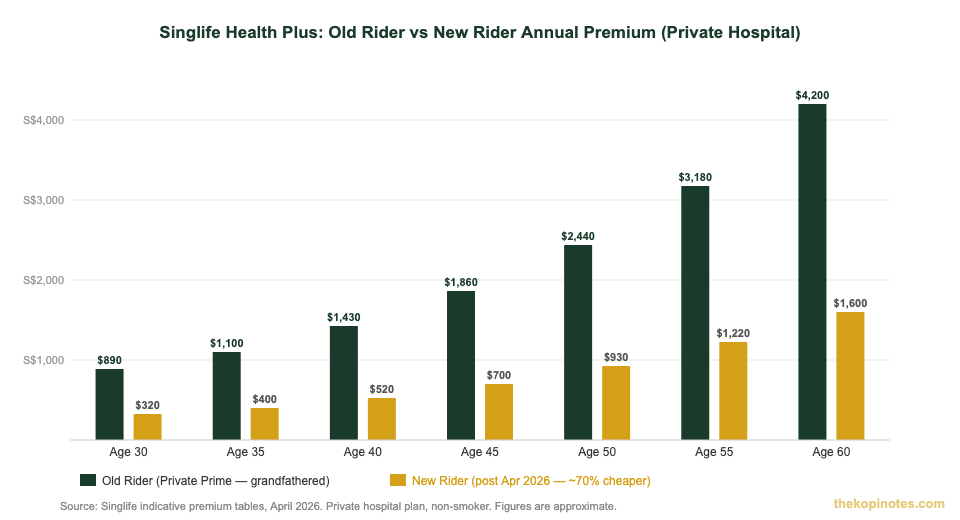
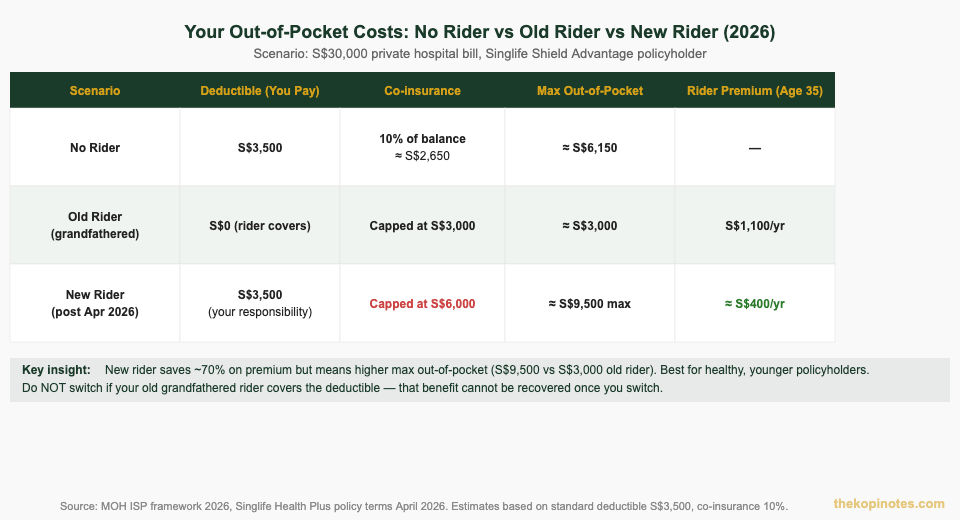
- New rider premiums drop by 30–84%. The trade-off for less coverage is significantly cheaper riders. A new private hospital rider for a 35-year-old might cost S$400/year versus S$1,100/year under an old rider — saving about S$700 annually.
- Singlife introduces three new Health Plus rider tiers. These are Singlife Health Plus Private, Public, and an additional tier with the new Care Collab Recovery Support benefit (up to S$20,000 for home nursing care and rehabilitation over 2 years per lifetime).
Existing policyholders who bought their rider before 27 November 2025 are grandfathered. Your current benefits remain in place at your next renewal unless you actively switch to a new rider.
New vs Old Singlife Health Plus Riders: Full Comparison
Here’s exactly how the old and new Singlife Health Plus riders differ. The numbers assume a private hospital policyholder with a Singlife Shield Advantage (or equivalent private hospital plan).
| Feature | Old Rider (grandfathered) | New Rider (post-Apr 2026) |
|---|---|---|
| Deductible covered? | Yes — rider absorbs S$3,500 | No — you pay S$3,500 cash |
| Co-payment cap (per year) | S$3,000 | S$6,000 |
| Max out-of-pocket per year | S$3,000 (panel providers) | S$9,500 (S$3,500 + S$6,000) |
| Approx. premium saving vs old | Baseline | 30–84% cheaper |
| Recovery Support benefit | Not included | Up to S$20,000 (optional tier) |
| Available to new policyholders? | No (grandfathered only) | Yes |
Source: Singlife Health Plus policy terms, April 2026; MOH ISP Rider Framework 2026. All figures subject to change.
The practical impact is significant. If you stay in hospital twice in one year under a new rider, you could owe S$7,000 (S$3,500 deductible × 2) before your rider’s co-insurance cap kicks in. With an old grandfathered rider, that same scenario costs you S$3,000 total in co-payments. You need to weigh the premium savings against this higher exposure.
For a broader comparison of all ISP providers’ new riders, see the integrated shield plan comparison 2026.
Should You Switch to the New Rider?
This is the question every Singlife Shield policyholder is asking right now. The answer depends on your age, health, and financial situation. Here’s a framework to help you decide.
Keep your grandfathered rider if:
- You are over 50. As you age, hospitalisation risk increases — and so does the value of the S$0 deductible benefit. Giving that up at 55+ is a hard trade-off that’s very difficult to recover from financially.
- You have a family history of chronic illness, heart disease, or cancer. The deductible becomes a real cash obligation each time you’re hospitalised. With higher risk, the S$6,500 in annual savings from a new rider can vanish in a single hospitalisation.
- You have already been hospitalised recently. Switching is voluntary — but once you switch, the new rules apply and you cannot revert to the old rider’s deductible protection.
- You have a spouse or dependant on a family policy with deductible coverage. Losing deductible cover across a family policy amplifies the risk considerably.
Switching to a new rider may make sense if:
- You are young and healthy (under 35) with no significant family medical history. The premium savings of S$500–700/year are meaningful, and hospitalisation at a young age is statistically less likely.
- You have a large emergency fund (at least S$10,000–15,000 in liquid savings). You can self-insure the deductible from savings and pocket the rider premium savings.
- The old rider’s premium has increased steeply at renewal — some old riders saw premiums rise by up to 129% under the April 2026 pricing adjustments. If that makes coverage unaffordable, a new rider is better than no rider at all.
The decision ultimately comes down to your personal risk tolerance and financial cushion. If in doubt, use the Singapore retirement calculator to model your healthcare reserve against different out-of-pocket scenarios over 10–20 years. Also consider speaking with a licensed financial adviser who can look at your full insurance portfolio. You can reach Endowus for broader financial planning — use our Endowus referral code (code: 2V343) for a fee credit when you sign up.
Singlife Shield Plan Tiers (2026)
There are four Singlife Shield plan tiers. Each covers a different hospital ward class and carries a different annual claim limit and premium band. You choose the plan tier separately from your rider — the rider reduces your co-payment obligations on top of the base plan.
| Plan | Ward Class | Annual Limit | Pre-Hosp Cover | Post-Hosp Cover |
|---|---|---|---|---|
| Singlife Shield (Basic) | Class B1 Restructured | S$500,000 | 90 days | 180 days |
| Singlife Shield Plan 2 | Class A Restructured | S$1,200,000 (raised Apr 2026) | 120 days | 180 days |
| Singlife Shield Plan 1 | Private Hospital | S$1,000,000 | 180 days | 365 days |
| Singlife Shield A Plus | Private Hospital (Enhanced) | S$1,000,000 | 180 days | 365 days |
Source: Singlife product brochure, April 2026. Annual limits and coverage days subject to change — verify at Singlife’s official website.
Singlife Shield Plan 2 (Class A) had its annual claim limit raised from S$1,000,000 to S$1,200,000 from April 2026 — a meaningful upgrade that provides greater differentiation between the Class A and private hospital tiers. For most Singaporeans, Plan 2 remains the sweet spot: Class A public hospital access at lower premiums than private hospital plans.
Singlife Shield Premiums 2026
Shield plan premiums increase with age. The figures below are indicative for Singapore Citizens, non-smoker, and include the MediShield Life component which can be paid from your MediSave account. Any amount above the annual MediSave withdrawal limit is billed in cash.
| Age Band | Shield Basic (B1) | Shield Plan 2 (Class A) | Shield Plan 1 (Private) |
|---|---|---|---|
| 21–30 | ~S$290 | ~S$490 | ~S$700 |
| 31–40 | ~S$350 | ~S$640 | ~S$1,000 |
| 41–50 | ~S$490 | ~S$960 | ~S$1,650 |
| 51–60 | ~S$780 | ~S$1,560 | ~S$2,800 |
| 61–70 | ~S$1,340 | ~S$2,760 | ~S$5,000 |
| 71–80 | ~S$2,100 | ~S$4,400 | ~S$8,400 |
Source: Singlife indicative premium tables, June 2026. Non-smoker rates. Premiums include MediShield Life component. Subject to annual adjustment. Verify with Singlife before purchasing.
You can pair your plan premiums with a Healthcare reserve fund to cover the annual deductible. If you invest S$3,500/year via a robo-advisor like Syfe (use our Syfe referral code SRPRFFFCD) into a low-risk cash management account, you build a buffer that covers your deductible without touching your CPF. This strategy works especially well for policyholders who switch to a new, cheaper rider.
How to Apply for Singlife Shield or Change Your Rider
Whether you’re buying Singlife Shield for the first time or reviewing your existing plan after the April 2026 changes, the process is straightforward.
New applicants:
- Go to the Singlife Shield page or apply through a licensed financial adviser.
- Select your plan tier (Basic, Plan 2, Plan 1, or Shield A Plus).
- Declare your full medical history. Omitting pre-existing conditions can void claims — always disclose fully.
- Add a Health Plus rider tier based on your budget and risk tolerance (see the comparison table above).
- Set up MediSave deduction for the MediShield Life component and any additional amount within the annual withdrawal limit.
Existing policyholders reviewing their rider:
- Check your renewal notice carefully — Singlife will have notified you about the premium changes for your existing rider, especially if it’s a Health Plus Private Prime or Public Prime rider.
- If the premium increase is steep (some saw up to 129% for old “maximum coverage” riders), compare the new rider premium against what you’d save versus your current coverage gap.
- If you decide to switch, contact Singlife directly or through your financial adviser. You cannot switch back to the grandfathered rider once you move to a new one.
- Do not let your policy lapse — even a 30-day lapse could mean new health underwriting and possible exclusions for existing conditions.
If you need to compare Singlife against other ISPs — AIA, Great Eastern, Prudential, or Raffles — before deciding, the best integrated shield plan Singapore guide compares premiums, plans, and rider structures across all providers side-by-side.
For your broader financial health — including pairing your ISP with an investment strategy for long-term healthcare reserves — consider building your portfolio through FSMOne or starting retirement savings planning via the Singapore retirement calculator.
Frequently Asked Questions
What is the Singlife Shield Plan in Singapore?
The Singlife Shield Plan is Singapore’s Integrated Shield Plan (ISP) offered by Singlife (the company formed from the merger of Aviva Singapore and Income Insurance). It tops up your mandatory MediShield Life coverage — letting you access higher hospital ward classes (Class A restructured or private) without bearing the full unsubsidised bill. There are four plan tiers covering B1 through private hospital. All plan premiums include the MediShield Life component and can be partially paid via MediSave.
What changed about Singlife Shield riders in April 2026?
From 1 April 2026, MOH’s new ISP rider requirements apply to all new Singlife Health Plus rider sales. Key changes: (1) New riders no longer cover the annual deductible — you must pay S$3,500 (private hospital) or S$2,000 (Class A) out of pocket before insurance activates. (2) The co-payment cap is raised to at least S$6,000 per year. (3) In exchange, new rider premiums are 30–84% cheaper than the old “maximum coverage” riders. Existing policyholders who bought before 27 November 2025 are grandfathered and unaffected unless they switch.
Should I switch from my old Singlife rider to a new rider?
In most cases, if you are grandfathered, keep your old rider. The deductible waiver it provides (saving you S$3,500 cash per hospitalisation year) has high value — especially as you age. The exception: if your old rider’s premium has risen so steeply that it’s genuinely unaffordable, switching to a new cheaper rider is better than letting coverage lapse. Once you switch, you cannot return to the old rider structure. Always discuss this with a licensed financial adviser before making changes.
Can I still use MediSave to pay Singlife Shield premiums?
Yes. The MediShield Life component of your Singlife Shield premium is automatically deducted from MediSave. The additional Singlife Shield premium above the MediShield Life component can also be withdrawn from MediSave up to the Annual MediSave Withdrawal Limit (AMWL), which varies by age. Any excess above the AMWL is billed in cash. Most policyholders under 40 can cover their full base plan premium via MediSave. Rider premiums are paid separately — these are typically cash payments. Check the CPF Board website for the latest AMWL figures.
What is the Singlife Care Collab Recovery Support benefit?
The Care Collab Recovery Support Benefit is a new feature available with select new Singlife Health Plus riders launched in April 2026. It provides up to S$20,000 in coverage for home nursing care and rehabilitation services, capped at 2 years per lifetime. This is designed for post-hospitalisation recovery — for example, after a major surgery requiring physiotherapy, home nursing, or rehabilitation. It is not available on old grandfathered riders and is only accessible when you purchase one of the new April 2026 rider tiers.
What is the maximum out-of-pocket cost under the new Singlife rider?
Under the new post-April 2026 Singlife Health Plus riders, the maximum out-of-pocket cost per year is S$9,500 for a private hospital policyholder: S$3,500 deductible (which the new rider does not cover) plus up to S$6,000 co-payment cap (covered by the rider after you hit this cap). Using panel providers reduces co-insurance, but the deductible is always yours to pay. Under old grandfathered riders using panel providers, the comparable out-of-pocket was approximately S$3,000 per year. Budget for the higher deductible exposure if you switch to a new rider.
How does Singlife Shield compare to AIA HealthShield Gold Max?
Both are among Singapore’s most popular ISPs. Singlife Shield typically has slightly lower premiums than AIA HealthShield Gold Max A at comparable coverage tiers. After the April 2026 changes, both insurers implemented the same MOH-mandated new rider structure — so the deductible rules, co-payment caps, and new rider features are broadly similar across all ISP providers. Where they differ is in their panel doctor networks, additional rider benefits (AIA has wellness-linked features), and premium trajectories at older ages. See the full ISP comparison 2026 for a detailed side-by-side.
Compare All Integrated Shield Plans Now
Not sure if Singlife is right for you? Compare plans, premiums, and riders across all five ISP providers.
Get Free Insurance Advice
Speak with a licensed insurance advisor. No obligation, no cost.
By submitting this form, you agree to our Privacy Policy.
This article was researched with the help of AI. While we strive to keep all information accurate and up to date, there may be errors. If you notice any discrepancies, please contact us.