Critical Illness Insurance for Retirees in Singapore (2026 Guide)
Critical illness (CI) insurance for retirees in Singapore pays a lump-sum cash benefit — typically $100,000 to $300,000 — if you are diagnosed with a major condition such as cancer, heart attack, or stroke. For retirees with limited CPF LIFE payouts and no employer income, this lump sum is the financial lifeline that covers medical costs without raiding your retirement savings. Data as at October 2026.
Not financial advice. All figures are for educational reference only. Verify all information with your insurer and a licensed financial adviser before making any decision.
Most Singaporeans think of CI insurance as something you buy in your 30s or 40s and forget about. But retirement is precisely when CI risk peaks — and when the financial consequences of being hit by cancer, heart attack, or stroke are most devastating. You have no salary to fall back on. Your savings took 30 years to accumulate. And private hospitalisation costs in Singapore for serious conditions routinely exceed $100,000.
This guide covers everything Singapore retirees (and those approaching retirement) need to know about CI insurance: why it matters more at 60+, how much cover you actually need, what happens when DPS expires at 65, and how to choose the right plan in your retirement years.
Why Retirees Face Higher Critical Illness Risk
Age is the single biggest predictor of CI claims in Singapore. According to industry data, the most common age bracket for CI claims is 51–65 — precisely the pre-retirement and early retirement window. By age 60, your cumulative lifetime risk of developing a major cancer, having a heart attack, or suffering a stroke is significantly higher than at 40.
Three biological realities drive this:
- Cancer risk rises with age: Cancer is the leading cause of death in Singapore, accounting for approximately 26% of all deaths (Ministry of Health, 2025). Most cancers — colorectal, prostate, breast, lung — are far more prevalent after 55.
- Cardiovascular risk accelerates: Heart disease is the second leading cause of death in Singapore. Post-menopausal women and men over 60 face sharply elevated cardiovascular risk.
- Stroke risk doubles every decade after 55: Singapore’s ageing population means strokes are becoming one of the fastest-growing hospitalisation causes among retirees.
The LIA Singapore reports that cancer, heart attack, and stroke consistently account for the large majority of all CI claims paid out annually. For retirees, these are not abstract statistics — they are the financial events most likely to upend 30 years of careful saving.
If you are using a Singapore retirement calculator to plan your financial future, make sure you factor in a CI contingency buffer — most planners omit this entirely.
The True Cost of Critical Illness at Retirement
Here is the reality check most Singaporeans avoid looking at. CI treatment costs at Singapore private and restructured hospitals are among the highest in Asia. Even with an Integrated Shield Plan covering hospitalisation, a CI diagnosis creates three simultaneous financial demands:
- Direct medical costs: Costs not covered by MediShield Life / IP — co-insurance, deductibles, non-hospital treatments, and medications can run $30,000–$100,000 even with a good IP plan.
- Income replacement: During a cancer treatment cycle (typically 12–36 months), you cannot work. For retirees, this means drawing down savings faster than planned.
- Lifestyle and care costs: Recovery often requires home nursing, rehabilitation, transport to treatment, and dietary adjustments — none of which are covered by MediShield Life.
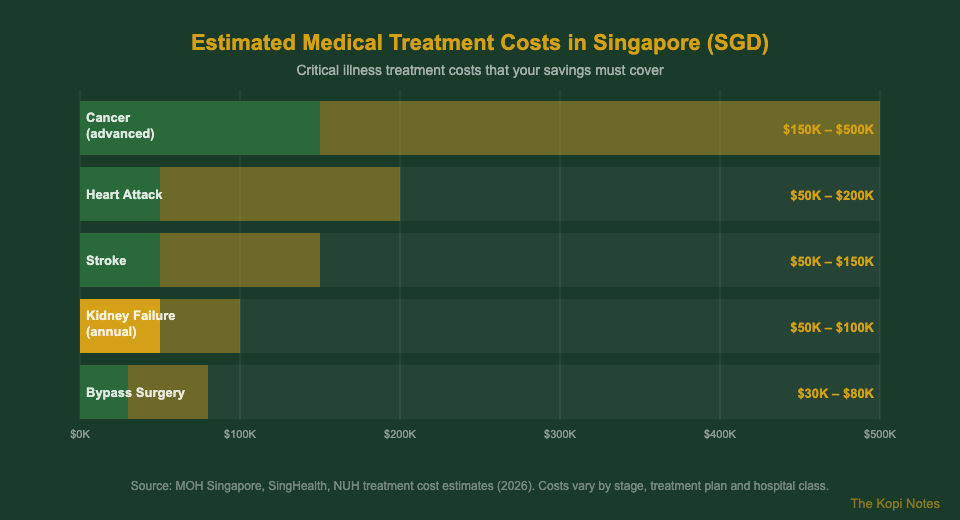
| CI Condition | Est. Treatment Cost (SGD) | MediShield Life Covers | Typical Gap |
|---|---|---|---|
| Advanced Cancer | $150,000 – $500,000 | Hospitalisation only | $50K – $300K+ |
| Heart Attack (with complications) | $50,000 – $200,000 | Hospitalisation only | $20K – $100K |
| Stroke with rehab | $50,000 – $150,000 | Acute hospitalisation | $30K – $100K |
| End-Stage Kidney Failure (dialysis/yr) | $40,000 – $90,000 p.a. | Subsidised dialysis | $15K – $60K/yr |
| Coronary Artery Bypass Surgery | $30,000 – $80,000 | Hospitalisation only | $10K – $40K |
Source: MOH Singapore fee benchmarks, SingHealth, NUH published treatment cost guides (2026). Actual costs vary by stage, treatment plan, hospital class, and IP coverage. Consult your insurer for personalised estimates.
A CI lump-sum payout is unrestricted cash. Unlike a hospitalisation claim that reimburses specific bills, CI cash arrives in your bank account immediately upon diagnosis. You use it however you need — to pay co-insurance gaps, replace income, hire a home carer, or simply preserve your retirement nest egg so you don’t have to sell investments at a distressed price.
The MediShield Life Gap: Why Health Insurance Is Not Enough
Many retirees believe their Integrated Shield Plan (IP) is sufficient. It isn’t — not for CI purposes. Here’s why CI insurance and hospitalisation insurance (MediShield Life / IP) solve fundamentally different problems:
| Feature | MediShield Life / IP | CI Insurance |
|---|---|---|
| What it covers | Hospital bills, procedures | Any use upon diagnosis |
| How payout works | Reimburses specific bills | Lump sum to your bank |
| Income replacement | No | Yes (you choose how) |
| Home care & rehab | Limited / none | Yes (unrestricted cash) |
| Drug co-payment gap | You pay this | CI cash covers it |
| Premium funding | MediSave eligible | Cash / SRS only |
Note: Standalone CI insurance premiums are generally NOT payable from CPF MediSave. Only MediShield Life and Integrated Shield Plan premiums (the insurer component) are MediSave-eligible. Verify with your insurer or CPF Board before assuming MediSave can fund your CI plan.
The two products are complementary. A good IP stops your hospital bills from overwhelming you. CI insurance ensures the rest of your financial life — savings, investments, income — remains intact while you focus on recovery.
Retirees who want to grow their savings while maintaining liquidity can explore products via Endowus or Syfe to keep retirement assets working even during a CI recovery period. The key is not liquidating long-term investments under duress — CI insurance buys you time.
Can You Still Buy CI Insurance After Age 60?
Yes — but with important caveats.
Most major Singapore insurers (AIA, Prudential, Great Eastern, Manulife, Income) offer CI plans with entry ages up to 65 or 70. However, premiums at 60+ are substantially higher than at 40, and medical underwriting becomes stricter. Here is what to expect:
- Higher premiums: A 60-year-old male non-smoker will typically pay 3–5× more for the same CI sum assured compared to a 40-year-old. This is actuarially priced — CI risk is genuinely higher.
- Medical underwriting: Pre-existing conditions (diabetes, hypertension, high cholesterol) may lead to loading (higher premiums), exclusions on specific conditions, or outright decline. Apply before these conditions develop where possible.
- Shorter coverage terms: Many plans cap coverage at age 85. A policy bought at 60 may only cover 25 years — still significant, but less than a whole-life policy.
- Early-stage vs. multi-pay options: Plans covering early-stage CI (not just late-stage) and those allowing multiple claims are worth considering at this life stage, as early detection rates have improved substantially with regular health screening.
Best practice: Review and top up your CI coverage during your 55–60 window, when premiums are still manageable and medical underwriting is less restrictive. Waiting until 65 may severely limit your options.
For comparison purposes, also review how critical illness insurance compares to personal accident insurance — two products frequently confused but serving very different purposes.
How Much CI Cover Do Retirees Actually Need?
The standard industry formula uses three components. As a retiree, your income replacement needs may be lower than a working professional, but your medical cost buffer should be higher:
- Medical buffer: $100,000 minimum — to cover co-insurance gaps, uncovered treatments, home care, and rehabilitation that your IP won’t pay.
- Income replacement (CPF LIFE gap): If you depend on CPF LIFE payouts plus passive income, a CI could disrupt your ability to manage investments. Budget 2–3 years of total household expenses as a buffer.
- Emergency fund top-up: $50,000 to avoid forced liquidation of long-term assets at the wrong time.
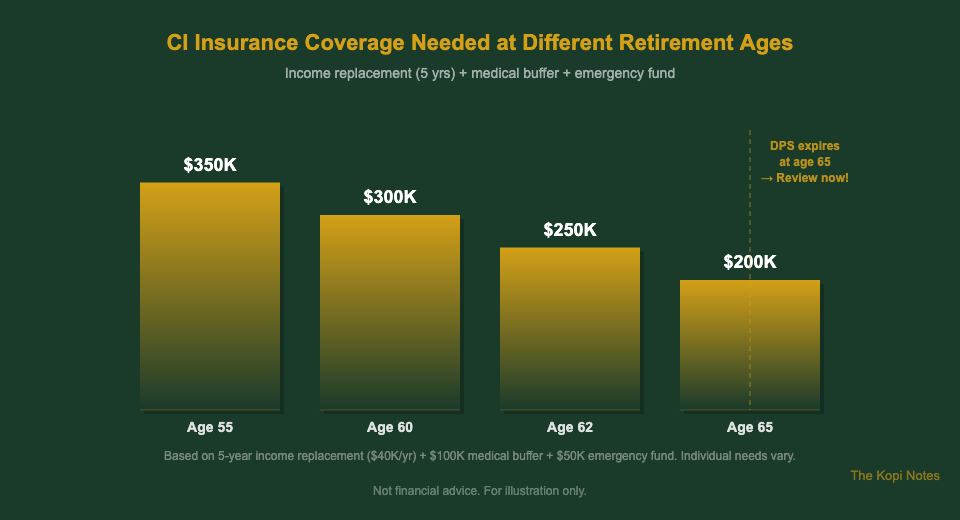
For a retiree with household expenses of $40,000/year, a reasonable CI coverage amount is:
- $100,000 (medical buffer) + $120,000 (3 years expenses) + $50,000 (emergency fund) = $270,000 total
If you already have substantial CPF LIFE payouts, you may reduce the income replacement component. If your IP has significant co-insurance gaps, increase the medical buffer. Use the Singapore retirement calculator to model your specific scenario.
The key principle: CI insurance is not about replacing your salary (you’re retired). It is about protecting your accumulated wealth from being destroyed by a medical event you cannot control.
For context on how to generate sustainable retirement income that CI insurance protects, see our guide on passive income strategies in Singapore.
The DPS Gap at Age 65: A Retirement Planning Blind Spot
Here is a fact many Singaporeans discover too late: your Dependants’ Protection Scheme (DPS) coverage automatically expires at your 65th birthday (or the next policy anniversary, whichever is earlier).
DPS provides $46,000 of term life and TPD coverage for working CPF members. While it is not a CI plan per se, many retirees unconsciously rely on it as a financial safety net — without realising it vanishes at 65.
When DPS expires, you face a coverage cliff:
- Your DPS life and TPD cover disappears
- If you haven’t maintained separate CI insurance, you have zero protection against CI events
- Getting new CI insurance post-65 is expensive and subject to strict underwriting
Action step: At least 2–3 years before your 65th birthday, review your CI insurance comprehensively. Ensure your standalone CI plan can carry you through your retirement years without relying on DPS as a backstop.
Managing your CPF wisely in the lead-up to retirement — including your CPF investment strategy — and maintaining adequate insurance coverage are the twin pillars of financial security in your 60s and 70s.
Practical Tips for Retirees Reviewing CI Insurance
If you are 55–70 and reassessing your CI coverage, here is a practical checklist:
- Get a health screening first: Before applying for any new CI plan, complete a comprehensive health screening. Knowing your current health status lets you apply for coverage before any conditions are diagnosed (pre-existing condition exclusions only apply to known conditions).
- Review existing CI riders: If you have a whole life or investment-linked policy with a CI rider, check the sum assured. Many older plans have CI riders of $50,000–$100,000 — insufficient by today’s treatment costs.
- Consider a multi-pay plan: Plans that pay out multiple times across different CI categories mean you can claim for an early-stage cancer diagnosis AND a subsequent heart attack. For retirees who may face multiple conditions, this structure adds resilience.
- Coordinate with your IP: Understand exactly what your Integrated Shield Plan covers. The gaps between your IP and actual treatment costs determine how large your CI lump sum needs to be.
- SRS funds for premiums: Standalone CI insurance premiums are generally not MediSave-eligible, but SRS (Supplementary Retirement Scheme) funds can be used to pay insurance premiums — worth exploring as part of a retirement tax strategy.
- Consult a licensed financial adviser: CI plan structures vary significantly. An MAS-licensed adviser can compare plans from multiple insurers and help you find coverage that actually fits your retirement health profile.
To diversify your retirement income streams and reduce dependence on any single source, explore the best S-REITs in Singapore 2026 — dividend-paying REITs that complement CPF LIFE payouts and provide income even during a CI recovery period.
Frequently Asked Questions
At what age should a retiree review their critical illness insurance?
Can I pay CI insurance premiums using CPF MediSave?
What happens to my CI insurance if I am already sick when I apply?
How much CI insurance cover should a 62-year-old Singaporean have?
Is CI insurance worth it at 65 given the high premiums?
What are the top 5 conditions covered by CI insurance in Singapore?
Can retirees use SRS funds to pay CI insurance premiums?
Get Free Insurance Advice
Speak with a licensed insurance advisor. No obligation, no cost.
By submitting this form, you agree to our Privacy Policy.
This article was researched with the help of AI. While we strive to keep all information accurate and up to date, there may be errors. If you notice any discrepancies, please contact us.