Group Medical Insurance Singapore 2026: Cost, Best Plans & Employer Guide
A 2026 employer’s guide to group medical insurance in Singapore — costs, top providers, and how it fits with IRAS tax rules and MOM requirements.
Group medical insurance is a company-paid health plan covering hospitalisation, surgery, and often outpatient care for your employees. It typically costs $300 to $1,700 per employee per year, depending on age profile and benefit tier. It’s voluntary for citizens, PRs, and Employment Pass holders — but mandatory, with a minimum $60,000 coverage limit, for every Work Permit and S Pass holder you employ.
Not financial advice. This guide is for educational reference for SME employers. All figures are estimates for general reference only. Data as at July 2026 unless otherwise noted.
- Group medical insurance is separate from MediShield Life and from group term life or Work Injury Compensation Insurance — it’s a voluntary top-up benefit for local staff, but compulsory (minimum $60,000 coverage) for Work Permit and S Pass holders.
- Expect to pay roughly $300–$1,700 per employee per year. You can usually deduct it as a staff cost, capped at 1% of total remuneration (2% with a portable medical benefits scheme).
- Coverage ends the day an employee leaves your company — unlike an individual Integrated Shield Plan, which follows the person for life.
Table of Contents
Contents — Click to expand
- What Is Group Medical Insurance?
- Key Facts at a Glance
- Is It Compulsory in Singapore?
- Best Group Medical Insurance Providers 2026
- How Much Does It Cost?
- Tax Treatment for Employers (IRAS)
- Group Medical Insurance vs Integrated Shield Plans
- How to Set It Up for Your Company
- Who Needs Group Medical Insurance?
- Frequently Asked Questions
What Is Group Medical Insurance?
Group medical insurance — often called a Group Hospital & Surgical (GHS) plan — is health cover your company buys for its employees under one master policy. It typically pays for inpatient hospitalisation and day surgery, and many plans add riders for GP visits, specialist outpatient care, and dental treatment.
It’s easy to confuse with three other things, so here’s the quick distinction. MediShield Life is the basic national hospitalisation scheme every citizen and PR is automatically enrolled in from birth — it isn’t employer-provided. Group medical insurance sits alongside it as an added company benefit, not a replacement. Separately, group insurance in Singapore also covers Work Injury Compensation Act (WICA) insurance and group term life, which pay out for workplace injury or death — not day-to-day medical bills. And an individual Integrated Shield Plan is bought personally by an employee and stays with them for life, unlike a group plan tied to their job.
Key Facts at a Glance
| Metric | Detail |
|---|---|
| What it covers | Hospitalisation and day surgery; GP, specialist, and dental riders depending on plan |
| Who buys it | The employer, under one master policy covering all enrolled staff |
| Compulsory? | Voluntary for citizens, PRs, and Employment Pass holders; mandatory minimum $60,000 coverage for Work Permit and S Pass holders |
| Typical cost | $300–$1,700 per employee per year, depending on tier (see chart below) |
| Common insurers | AIA, Great Eastern, HSBC Life, Income Insurance, MSIG, Prudential, Singlife |
| Tax treatment | Deductible as a staff cost, capped at 1% of total remuneration (2% with portable medical benefits or MediSave top-ups) |
| Portability | Ends when the employee leaves the company — unlike a personal Integrated Shield Plan |
Source: MOM (mom.gov.sg), IRAS (iras.gov.sg), Singapore group insurance broker estimates. July 2026.
Is Group Medical Insurance Compulsory in Singapore?
For your Singaporean, PR, and Employment Pass staff, no. Group medical insurance is a discretionary benefit — companies offer it to attract and retain talent, not because the law demands it.
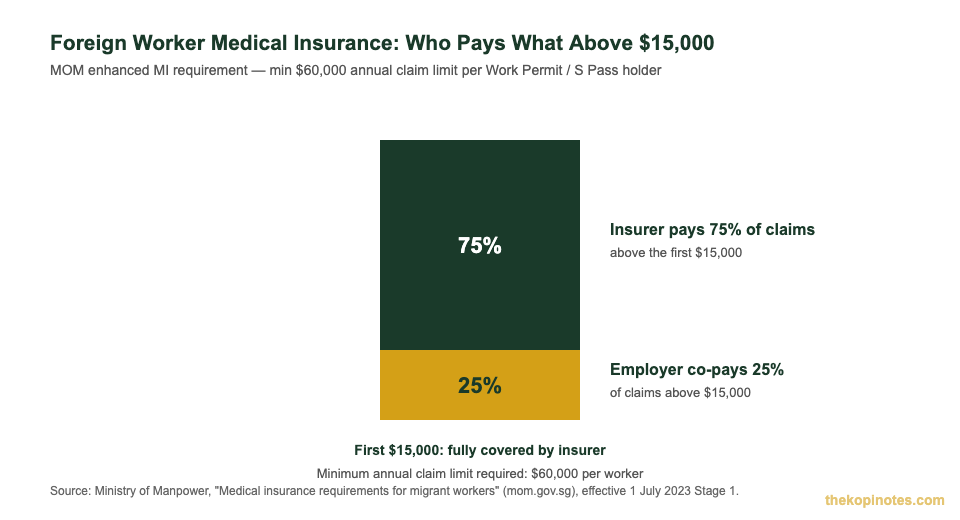
It’s a different story for Work Permit and S Pass holders. The Ministry of Manpower requires every employer to buy and maintain medical insurance with a minimum annual claim limit of $60,000 per worker. That requirement has applied since 1 July 2023. From 1 July 2025, a second stage of enhancements kicked in: insurers must standardise which conditions they can exclude, charge age-differentiated premiums split into two bands (50 and below, and above 50), and pay hospitals directly instead of reimbursing the worker.
You also cannot pass this insurance cost on to your migrant workers. If total claims in a year exceed $15,000, the insurer covers 75% of the excess and you co-pay the remaining 25% — the chart below shows how that split works.
Best Group Medical Insurance Providers in Singapore (2026)
Several licensed insurers write group medical insurance for Singapore companies, all regulated under the same industry framework as the Life Insurance Association Singapore. Most offer SME-friendly packaged plans that need as few as two employees to start, alongside fully customised plans for larger headcounts.
| Insurer | Plan Type | Best For | Notable Feature |
|---|---|---|---|
| AIA | Group Hospital & Surgical + Specialist Outpatient/Dental riders | Companies wanting modular add-ons | AIA Workwell wellness programme bundled in |
| Great Eastern | Great Employee Benefits Plus (under 50 staff); GREAT Platinum Benefits (from 2 staff) | Very small teams | SupremeCare managed-care network, 500+ panel clinics |
| Prudential | PRUTreasures Flexi II (packaged, from 2 staff); customised plan for 50+ staff | SMEs wanting a fixed, simple package | Free annual health screening for insured staff |
| Income Insurance | Group Hospital & Surgical Insurance; WorkMedic for migrant workers | Companies needing both local staff and FWMI cover in one insurer | Unlimited GP panel clinic visits on GHS plans |
| MSIG | Group Hospitalisation & Surgical Plan | Cost-conscious SMEs | Flexible tiers built for small headcounts |
| HSBC Life / Singlife | Group Hospital & Surgical plans | Companies wanting digital-first claims | App-based claims submission and tracking |
Source: Insurer corporate/employee benefits pages (aia.com.sg, greateasternlife.com, prudential.com.sg, income.com.sg, msig.com.sg), July 2026.
There’s no single “best” insurer — the right fit depends on your headcount, budget, and whether you need FWMI cover for migrant workers in the same policy. Get quotes from at least two or three insurers, or work with a corporate insurance broker who can benchmark all of them at once.
How Much Does Group Medical Insurance Cost?
Group medical insurance pricing depends on four things: the age profile of your insured staff, your claims experience from the prior policy year (if any), the benefit structure you choose, and the insurer’s own portfolio performance across similar-sized groups. There’s no fixed rate card — every quote is individually underwritten.
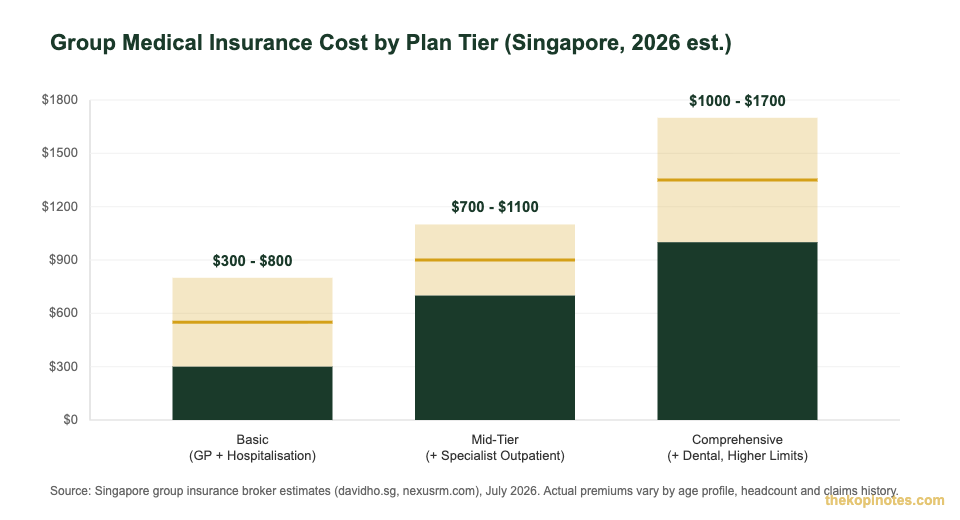
As a rough guide, a basic GP-plus-hospitalisation plan starts from around $300–$800 per employee per year. Add specialist outpatient cover and premiums typically rise to $700–$1,100. Comprehensive plans with dental, higher inpatient limits, and wider panel access can run $1,000–$1,700 or more. For example, a 20-person SME with an average staff age in the early 30s buying a basic plan might pay roughly $550 per head, or about $11,000 in total annually — but always get a live quote, since your own age profile and claims history will move the number up or down.
Tax Treatment for Employers (IRAS Rules)
Group medical insurance premiums are tax-deductible as a staff cost. IRAS caps the total medical expense deduction — which includes group insurance premiums — at 1% of your total employee remuneration for the year. That cap rises to 2% if your company runs a Portable Medical Benefits Scheme, provides a qualifying group insurance benefit, or makes ad-hoc MediSave top-ups for staff.
Here’s a worked example. Say your company’s total remuneration bill is $2,000,000 a year. Under the standard 1% cap, you can deduct up to $20,000 in medical expenses, including group insurance premiums. Move to the enhanced 2% cap, and that rises to $40,000 — often enough to cover a fuller benefit tier for the same headcount.
On the employee side, premiums for a group plan open to all staff generally aren’t taxed as a benefit-in-kind, under an administrative concession from IRAS. The catch: you must apply this treatment consistently across every employee covered by the policy — you can’t claim the concession for some staff and not others. If you decide not to claim the tax deduction for the group premium, you can also amend your employees’ IR8A forms to exclude their share of the premium from taxable income.
Group Medical Insurance vs Integrated Shield Plans
Group medical insurance and an individual Integrated Shield Plan solve different problems, and understanding the gap matters for both employers and employees.
| Feature | Group Medical Insurance | Individual Integrated Shield Plan |
|---|---|---|
| Who owns it | The employer | The individual |
| Portability | Ends when you leave the job | Stays with you for life |
| Underwriting | Often simplified or guaranteed issue at group level | Individual medical underwriting applies |
| Built on MediShield Life? | No — a standalone commercial plan | Yes — rides on top of MediShield Life |
| Can pay premium via MediSave? | Generally no | Yes, within 2026 MediSave withdrawal limits |
This is why many employees keep a personal Integrated Shield Plan even when their employer offers solid group cover — it’s the part of your healthcare protection that doesn’t disappear the day you resign or get retrenched. If you’re weighing how much of your protection should sit with your employer versus your own policies, our guide on term insurance vs life insurance is a useful next read for the personal protection side of the equation.
How to Set Up Group Medical Insurance for Your Company
If you’re setting this up for the first time, work through these steps:
- Map your headcount and age profile. Insurers price groups by age band, so know your staff’s age spread before requesting quotes.
- Decide your benefit structure. Choose ward class (e.g. B1 or private), annual claim limit, and which riders you want — GP, specialist outpatient, dental, or maternity.
- Get quotes from two or three insurers. Great Eastern and Prudential both offer packaged SME plans from as few as two employees, so even very small teams can compare options.
- Check the participation rule. Most insurers require 100% of eligible staff to enrol, to avoid only unwell employees signing up (a problem insurers call anti-selection).
- Submit the fact-finding form. Insurers typically require a Group Insurance Fact-Finding form covering your headcount, industry, and claims history (if switching insurers).
- Communicate the benefit to staff. Share how to find a panel clinic, submit a claim, and who to contact for support.
- Re-benchmark every renewal. Your claims experience from the prior year is a major pricing input, so shop around annually rather than auto-renewing.
Who Needs Group Medical Insurance?
If you employ any Work Permit or S Pass holders, this isn’t optional — MOM requires the minimum $60,000 coverage regardless of your company size. Beyond that legal floor, group medical insurance makes the most sense for SMEs competing against larger companies for talent, since health coverage is one of the most visible benefits candidates compare when choosing between job offers.
It’s also worth adding GP and specialist outpatient riders if you’re seeing high absenteeism from employees delaying treatment over cost. For employees wondering whether their employer’s group cover is enough on its own, our life insurance policy Singapore guide walks through how personal protection — medical, critical illness, and life cover — fits alongside whatever your employer provides.
Frequently Asked Questions
Is group medical insurance compulsory in Singapore?
Not for Singapore Citizens, PRs, or Employment Pass holders — it’s a voluntary benefit. It is compulsory for Work Permit and S Pass holders: MOM requires a minimum $60,000 annual coverage limit per worker, a rule in force since 1 July 2023 and enhanced further from 1 July 2025.
How much does group medical insurance cost per employee in Singapore?
Expect roughly $300–$800 per employee per year for a basic GP-plus-hospitalisation plan, $700–$1,100 for one with specialist outpatient cover, and $1,000–$1,700 or more for a comprehensive plan with dental and higher limits. Your actual quote depends on your staff’s age profile and claims history.
What is the difference between group medical insurance and MediShield Life?
MediShield Life is Singapore’s national basic hospitalisation scheme — every citizen and PR is automatically covered from birth, funded through their own MediSave and premiums. Group medical insurance is a separate, optional commercial plan your employer buys on top of that, usually with higher limits and broader benefits like GP or specialist visits.
Can employees keep group medical insurance after leaving the company?
No. Group medical insurance is tied to your employment — coverage typically ends on your last day of work. This is different from an individual Integrated Shield Plan, which you own personally and keep for life regardless of your job.
Is group medical insurance premium tax-deductible for employers?
Yes. IRAS allows employers to deduct group medical insurance premiums as a staff cost, capped at 1% of total employee remuneration. That cap increases to 2% if your company runs a Portable Medical Benefits Scheme, provides a qualifying group insurance benefit, or makes ad-hoc MediSave top-ups for staff.
Which insurer offers the best group medical insurance for SMEs in Singapore?
There’s no single best insurer for every company — it depends on your headcount and budget. Great Eastern’s GREAT Platinum Benefits and Prudential’s PRUTreasures Flexi II both offer packaged plans starting from just two employees, while MSIG, AIA, Income Insurance, HSBC Life, and Singlife all serve SMEs with flexible tiers. Get quotes from at least two or three before deciding.
Planning Your Company’s Insurance Benefits?
Check how your own personal coverage stacks up alongside what your employer provides.
Get Free Insurance Advice
Speak with a licensed insurance advisor. No obligation, no cost.
By submitting this form, you agree to our Privacy Policy.
This article was researched with the help of AI. While we strive to keep all information accurate and up to date, there may be errors. If you notice any discrepancies, please contact us.