How to Invest in Singapore by Risk Profile: Conservative to Aggressive Portfolios (2026)
A practical guide to matching your investment strategy to your real risk tolerance — with verified CPF, SSB, T-bill, and ETF numbers for 2026.
Most “how to invest in Singapore” guides give you one path. But conservative and aggressive investors need different portfolios. This guide breaks down three risk profiles — conservative, balanced, and aggressive — with real CPF, SSB, T-bill, and ETF allocations for 2026, so you can pick the mix that matches your own risk tolerance and time horizon.
Not financial advice. All figures are for educational reference only. Data verified as at 13 July 2026 unless otherwise noted.
- Conservative: CPF SA/MA/RA (4% p.a. floor through Dec 2026), T-bills (~1.49%–1.50%), and SSB (2.11% 10-year average) — safety and liquidity first.
- Balanced: split between low-cost robo-advisors (Syfe, Endowus, StashAway — fees 0.2%–0.8% p.a.) and globally diversified ETFs.
- Aggressive: DIY low-cost equity ETFs like CSPX (0.07% TER) or VWRA (0.19% TER) for long-term growth — but expect bigger swings.
Table of Contents
Contents — Click to expand
- Why “How to Invest in Singapore” Isn’t One-Size-Fits-All
- The Three Risk Profiles Explained
- Conservative Portfolio: Capital Preservation First
- Balanced Portfolio: Growth With a Safety Net
- Aggressive Portfolio: Maximum Growth
- CPF, SRS and Tax: The Singapore Context
- Conservative vs Balanced vs Aggressive: Side-by-Side
- What Singapore Investors Should Do Next
- Frequently Asked Questions
Why “How to Invest in Singapore” Isn’t One-Size-Fits-All
Most guides answer “how to invest in Singapore” with the same checklist: open a brokerage account, top up your SRS, buy an ETF. That’s a fine starting point. But it skips the real question — how much risk can you actually handle, and how long can you leave the money untouched?
A 25-year-old saving for retirement in 2060 can ride out a 30% market crash. A 58-year-old planning to retire in five years usually can’t. Same CPF rules, same tax system, completely different portfolios.
Your risk profile has two parts. Risk tolerance is how you react emotionally to losses. Risk capacity is how much you can actually afford to lose without derailing your goals. Most new investors overestimate the first and underestimate the second — that mismatch is why so many panic-sell in a downturn, lock in the loss, then miss the recovery.
This guide splits Singapore investing into three practical profiles — conservative, balanced, and aggressive — with real interest rates, fees, and expense ratios verified as at July 2026. If you’ve already read our complete beginner’s guide to investing in Singapore or want to build your first portfolio in 5 steps, this article picks up where those leave off — matching the mechanics to your actual risk appetite.
Your risk profile isn’t fixed either. A promotion, a new mortgage, or a market crash can all shift how much risk you’re willing to carry. Revisit your profile once a year, not just when markets get scary.
The Three Risk Profiles Explained
Before picking any product, work out which of these three profiles fits you. Each one trades off growth potential against how much short-term pain you can stomach.
Conservative investors have a short time horizon — usually under three years — or simply can’t tolerate any capital loss. Think of someone saving for a house downpayment next year, or a retiree who needs the money to live on. Capital preservation matters more than growth.
Balanced investors have a medium time horizon of three to ten years and can tolerate a 10–20% drawdown without panicking. A mid-career professional saving for a child’s university fund, or a house fund seven years out, usually fits here.
Aggressive investors have ten or more years before they need the money, and can sit through a 30%+ market drop without selling. This is typically someone in their 20s or 30s investing for retirement decades away.
Here’s how the three compare at a glance:
| Risk Profile | Time Horizon | Volatility Comfort | Typical Allocation | Example Investor |
|---|---|---|---|---|
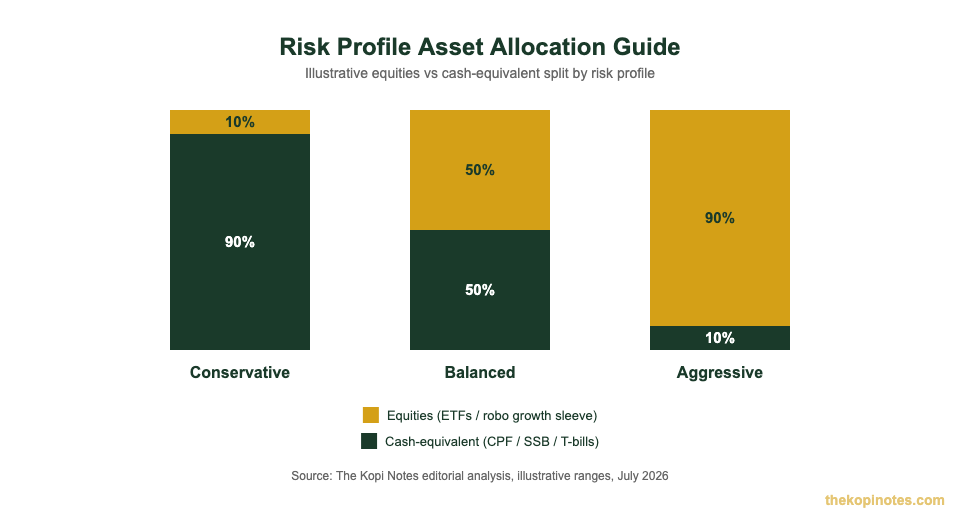
| Conservative | Under 3 years | Low — no tolerance for capital loss | 80–100% cash-equivalent (CPF, SSB, T-bills) | Retiree, house downpayment saver |
| Balanced | 3–10 years | Medium — can tolerate 10–20% drawdowns | 40–60% equities (ETFs/robo), 40–60% cash-equivalent | Mid-career professional, 7-year goal |
| Aggressive | 10+ years | High — can tolerate 30%+ drawdowns | 80–100% equities (globally diversified ETFs) | Investor in 20s–30s investing for retirement |
Source: The Kopi Notes editorial analysis, illustrative allocation ranges, July 2026.
Conservative Portfolio: Capital Preservation First
If you’re conservative, your money should sit in vehicles backed by the Singapore government or fully liquid, not chasing stock market returns.
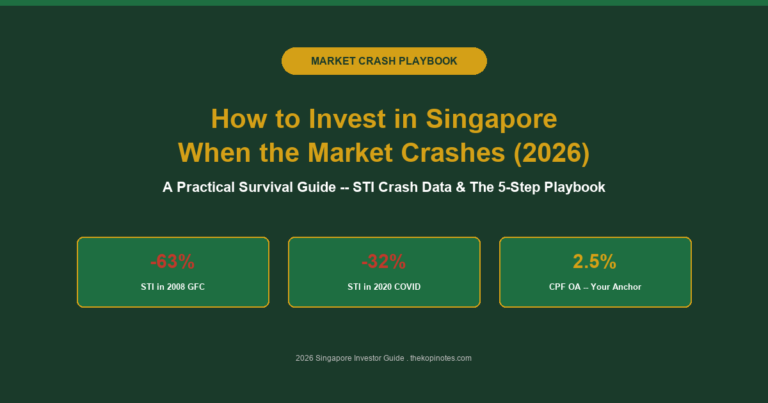
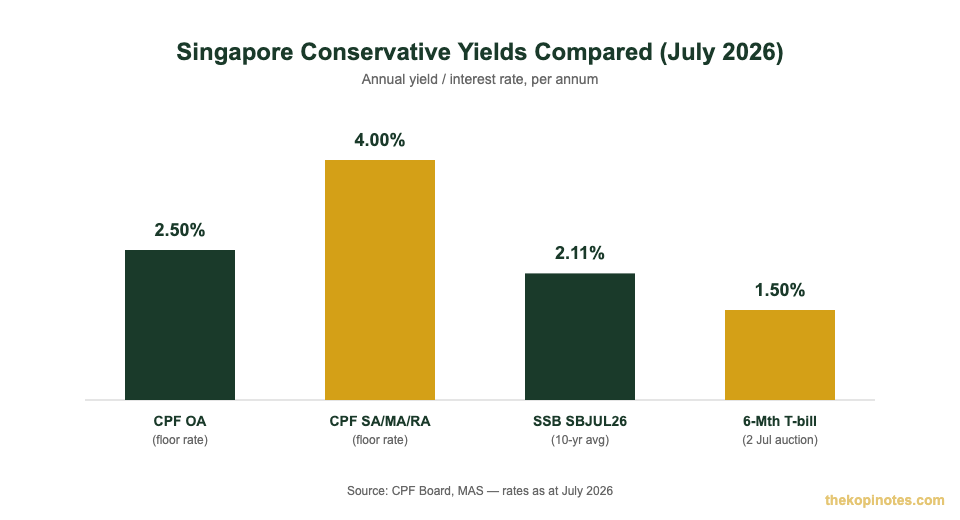
Your CPF Special, MediSave and Retirement Account (SMRA) monies earn a floor rate of 4% per annum — a rate the government has extended through 31 December 2026. Your CPF Ordinary Account (OA) earns a floor rate of 2.5% per annum over the same period. On top of that, the first SGD 60,000 of your combined CPF balances earns extra interest, capped at SGD 20,000 for your OA.
Outside CPF, the Singapore Savings Bond (SSB) is the next stop. The July 2026 tranche (SBJUL26) pays 1.46% in year one, stepping up each year to an average of 2.11% if you hold it the full 10 years. On a SGD 50,000 SSB holding, that’s about SGD 730 in year one, rising toward roughly SGD 1,055 a year on average over the decade. Unlike CPF, you can redeem an SSB in any month with no penalty.
Treasury bills (T-bills) are the third option. The most recent 6-month T-bill auction, on 2 July 2026, cut off at a yield of 1.50% per annum. On SGD 50,000, that works out to roughly SGD 375 in interest over the 6-month tenure. T-bills lock your money up for the full 6 (or 12) months with no early redemption, so only use funds you won’t need before maturity.
For most conservative investors, the sensible split is CPF (already there, keep it), SSB for medium-term liquidity, and T-bills for short-term parking of cash you don’t need for 6–12 months. Skip the stock market entirely unless your time horizon changes.
Source: CPF Board interest rates, April–September 2026; MAS SSB July 2026 issuance (SBJUL26); MAS T-bill auction results, 2 July 2026.
Balanced Portfolio: Growth With a Safety Net
If you’re balanced, you want some equity growth but don’t want to manage a stock portfolio yourself — or you want a defensive sleeve alongside your equities. Robo-advisors are built for this.
Syfe charges 0.65% per annum on the first SGD 50,000 in its managed portfolios, stepping down to 0.55% for the SGD 50,000–250,000 tier and 0.45% for SGD 250,000–1 million. On a SGD 100,000 balanced portfolio sitting mostly in the 0.55% tier, that’s roughly SGD 550 a year — in exchange for automatic rebalancing so you don’t have to track your allocation manually.
Endowus charges 0.60% per annum on cash investments up to SGD 200,000, dropping as low as 0.25% above SGD 5 million. If you’re investing your CPF or SRS money through Endowus instead of cash, the fee drops to just 0.40% per annum. StashAway sits in a similar 0.2%–0.8% range depending on your portfolio size and risk setting.
All three platforms build a diversified mix of equities and bonds behind the scenes — often using globally diversified ETFs similar to VWRA — and automatically rebalance when your allocation drifts. That’s the main thing you’re paying for: not picking stocks, but not having to babysit the portfolio either.
Prefer to compare the platforms feature-by-feature? Our Syfe vs Endowus 2026 breakdown covers minimum sums, portfolio options, and historical returns in more detail. You can also check Syfe’s referral code and sign-up bonus if you decide to open an account.
Source: Syfe, Endowus and StashAway published fee schedules, verified July 2026.
Aggressive Portfolio: Maximum Growth
If you’re aggressive, you’re comfortable picking your own ETFs and riding out the volatility for a lower fee. This usually means buying globally diversified equity ETFs yourself, rather than paying a robo-advisor to do it.
Two of the most popular choices among Singapore investors are CSPX (iShares Core S&P 500 UCITS ETF) and VWRA (Vanguard FTSE All-World UCITS ETF), both listed on the London Stock Exchange. CSPX charges a total expense ratio (TER) — the annual fee a fund charges, deducted automatically from its returns — of just 0.07% per year. VWRA charges 0.19% per year, down from 0.22% before September 2025.
Here’s the cost drag in real numbers. On a SGD 100,000 portfolio, CSPX’s 0.07% TER costs about SGD 70 a year in fund-level fees. VWRA’s 0.19% TER costs about SGD 190. Compare that to a robo-advisor’s 0.55% management fee on the same amount — roughly SGD 550 a year — and the gap is significant. Over a 20–30 year horizon, that fee difference compounds into a meaningfully larger portfolio.
The trade-off is admin work. You’ll need to fund a brokerage account, buy the ETF yourself on the LSE, and rebalance manually if you’re also holding bonds or other assets. Dollar cost averaging — investing a fixed amount on a regular schedule, regardless of price — is the simplest way to do this without trying to time the market.
Not sure which ETF fits your goals? Our Singapore REIT ETF guide covers income-focused alternatives if you also want dividend cash flow alongside growth.
Source: iShares CSPX factsheet; Vanguard VWRA factsheet, verified July 2026.
CPF, SRS and Tax: The Singapore Context
Whatever your risk profile, two Singapore-specific accounts sit underneath your entire strategy: CPF and SRS. Get these right first, before worrying about which ETF to buy.
The CPF Investment Scheme (CPFIS) lets you invest part of your Ordinary Account (OA) and Special Account (SA) savings, but with limits. For CPFIS-OA, you must keep the first SGD 20,000 in your OA before investing the rest. For CPFIS-SA, you must keep the first SGD 40,000 in your SA. Note that as of February 2026, the Special Account closes once you turn 55, with the balance transferred into your Retirement Account — so CPFIS-SA investing is only relevant if you’re below 55.
SRS works differently. It’s a voluntary scheme that gives you dollar-for-dollar tax relief on contributions, up to SGD 15,300 a year for Singapore Citizens and Permanent Residents, or SGD 35,700 a year for foreigners. Money inside SRS can be invested in the same ETFs, unit trusts, and robo-advisor portfolios as cash — the tax relief is the main draw, not a different investment menu.
For conservative investors, SRS funds parked in T-bills or money market funds still earn the market rate while giving you the tax relief upfront. For aggressive investors, SRS is simply a tax-advantaged wrapper around the same CSPX or VWRA position you’d hold anyway. Either way, the tax relief compounds the value of using SRS before investing in a regular brokerage account.
Want the mechanics of allocation limits and CPFIS rules in more detail? Read our CPF investment strategy guide for a full breakdown.
Source: CPF Board CPFIS rules; IRAS SRS contribution caps, verified July 2026.
Conservative vs Balanced vs Aggressive: Side-by-Side
Here’s every profile compared on the numbers that matter — expected fees, time horizon, and where your money actually sits.
| Metric | Conservative | Balanced | Aggressive |
|---|---|---|---|
| Primary Vehicles | CPF SA/MA/RA, SSB, T-bills | Robo-advisor (Syfe/Endowus/StashAway) | DIY ETFs (CSPX, VWRA) |
| Typical Annual Yield/Return* | 1.5%–4.0% | Market-linked, net of fees | Market-linked, net of fees |
| Fees | None (government-backed) | 0.2%–0.8% p.a. | 0.07%–0.19% p.a. (fund TER only) |
| Liquidity | High (SSB/T-bill) to low (CPF) | High — redeem anytime | High — sell anytime on LSE |
| Effort Required | Minimal | Low (automatic rebalancing) | Medium (manual rebalancing) |
| Best For | Under 3-year goals, capital preservation | 3–10 year goals, hands-off growth | 10+ year goals, maximum growth |
*Yield figures for CPF/SSB/T-bill are fixed nominal rates; equity returns are not guaranteed and vary with markets. Source: CPF Board, MAS, iShares, Vanguard, Syfe, Endowus, StashAway — all figures verified July 2026.
Notice that fees rise as you move from conservative to balanced, but drop again for aggressive DIY investors. That’s not a coincidence — robo-advisors charge for convenience and rebalancing, while government-backed instruments and low-cost index ETFs are cheap precisely because nobody is actively managing them for you.
What Singapore Investors Should Do Next
Start by being honest about your time horizon, not your ambition. If you need the money within three years, you’re conservative — full stop, regardless of how much risk you think you can handle.
If you’re balanced or aggressive, decide DIY versus robo-advisor based on how much time you want to spend managing the portfolio. DIY through CSPX or VWRA saves on fees but requires you to rebalance and reinvest dividends yourself. A robo-advisor costs more but runs on autopilot.
Whatever you choose, use dollar cost averaging — investing a fixed SGD amount every month — rather than trying to time a lump sum entry. This smooths out the impact of buying at a market peak.
Finally, review your CPF and SRS allocation before opening any new brokerage account. These two accounts already carry built-in tax advantages that most other investment vehicles can’t match, so make sure you’re using them fully first.
Use our Singapore retirement calculator to see how each risk profile plays out over your actual time horizon, in SGD terms.
Not financial advice. Every investor’s situation is different — consider speaking to a licensed financial adviser before making significant portfolio changes.
Frequently Asked Questions
What is the best way to invest in Singapore for beginners?
There’s no single “best” way — it depends on your risk profile. Conservative beginners should start with CPF, SSB, and T-bills. Balanced beginners often start with a robo-advisor like Syfe or Endowus, which builds a diversified portfolio automatically. Aggressive beginners with a long time horizon can go straight into a low-cost globally diversified ETF like VWRA and use dollar cost averaging.
How much should I invest in CPF, SRS, and ETFs?
There’s no fixed ratio — it depends on your age, tax bracket, and goals. As a general starting point, max out your SRS contribution first if you’re in a higher tax bracket, since the tax relief is immediate and guaranteed. Then split remaining savings between your chosen risk-profile portfolio and an emergency fund in cash or T-bills.
Is the CPF Special Account a good investment?
For conservative money, yes. The CPF SMRA floor rate of 4% per annum, extended through 31 December 2026, beats most bank savings accounts and fixed deposits with zero risk. The trade-off is liquidity — SA money is locked up until you reach the CPF withdrawal age, unlike SSB or T-bills.
Should I use a robo-advisor or invest myself (DIY)?
Use a robo-advisor if you want automatic rebalancing and don’t want to manage the portfolio yourself — expect to pay 0.2%–0.8% per annum for that convenience. Go DIY with ETFs like CSPX or VWRA if you’re comfortable buying and rebalancing yourself, since fund-level fees run as low as 0.07%–0.19% per annum.
What is the minimum amount to start investing in Singapore?
Most robo-advisors like Syfe and Endowus have no minimum investment, so you can start with as little as SGD 1 to SGD 100. Buying ETFs directly on the LSE through brokers like Interactive Brokers usually requires enough to cover at least one share, which for CSPX runs into the hundreds of SGD per unit.
How do I know my risk profile?
Ask yourself two questions: how soon will you need this money, and how would you react if your portfolio dropped 20% next month? If you need the money within three years or would panic-sell, you’re conservative. If you have 10+ years and could sit through the drop without selling, you’re aggressive. Most people land somewhere in between — balanced.
Ready to Match Your Portfolio to Your Risk Profile?
Whether you’re conservative, balanced, or aggressive, open the right account and start investing today.
This article was researched with the help of AI. While we strive to keep all information accurate and up to date, there may be errors. If you notice any discrepancies, please contact us.