Brokerage Account Singapore: Complete Guide to Opening One (2026)
Your step-by-step guide to choosing, opening, and using a brokerage account in Singapore — fees, platforms, and what every new investor needs to know.
A brokerage account in Singapore is a trading account that lets you buy and sell investments — stocks, ETFs, bonds, and REITs — on local and overseas exchanges. The most popular brokerage accounts for Singapore investors are offered by Interactive Brokers (IBKR), Syfe Trade, MooMoo, Saxo Markets, and FSMOne, each with different fee structures, platform features, and minimum funding requirements.
Not financial advice. All figures are for educational reference only. Data as at June 2026 unless noted.
Table of Contents
Contents — Click to expand
- What Is a Brokerage Account?
- Types of Brokerage Accounts in Singapore
- How to Open a Brokerage Account in Singapore
- Best Brokerage Accounts Compared (2026)
- Understanding Brokerage Fees
- What Can You Invest In?
- CDP vs Custodian: What Is the Difference?
- Beginner Tips Before You Start
- Frequently Asked Questions
What Is a Brokerage Account?
A brokerage account is a financial account held with a licensed broker that allows you to buy and sell securities such as stocks, ETFs, bonds, and REITs. In Singapore, brokerage accounts are regulated by the Monetary Authority of Singapore (MAS) under the Securities and Futures Act. Unlike a bank savings account, a brokerage account holds investments rather than cash — though most accounts include a cash wallet that earns no or minimal interest on idle funds.
When you place a buy order through your brokerage account, the broker executes the trade on the relevant exchange (SGX for Singapore stocks, NYSE/NASDAQ for US stocks, LSE for UK-listed ETFs, and so on). The securities you purchase are held either in your Central Depository (CDP) account or within the broker’s own custodian account, depending on which type of brokerage account you choose.
Opening a brokerage account in Singapore is straightforward for Singapore Citizens (SC), Permanent Residents (PR), and Employment Pass or Dependant’s Pass holders. You will typically need to pass a Customer Knowledge Assessment (CKA) or Customer Account Review (CAR) if you want to trade specified investment products (SIPs) such as leveraged instruments or certain overseas securities.
Types of Brokerage Accounts in Singapore
There are two main structures for brokerage accounts in Singapore, and understanding the difference will help you choose the right one:
| Account Type | How Holdings Are Held | Best For |
|---|---|---|
| CDP-linked | Shares registered in your own CDP account with SGX | SGX-listed stocks, S-REITs, Singapore ETFs |
| Custodian (nominee) | Shares held in the broker’s name on your behalf | US stocks, LSE-listed ETFs, overseas securities |
Source: SGX CDP, MAS. As at June 2026.
CDP-linked accounts are mandatory for SGX-listed securities. When you buy a Singapore stock through DBS Vickers, UOB Kay Hian, or Phillip Securities, the shares land in your CDP account — which you own directly and which persists even if your broker closes down. If you do not yet have a CDP account, you can open one free of charge through SGX.
Custodian accounts are used by platforms like Interactive Brokers, MooMoo, and Syfe Trade for overseas securities. Your shares are technically held in the broker’s name (as nominee) on your behalf. This is standard practice globally for international brokers. The key difference: if the broker fails, you are a creditor rather than a direct owner — though MAS regulations require licensed brokers to segregate client assets, which provides meaningful protection.
How to Open a Brokerage Account in Singapore
Opening a brokerage account in Singapore typically takes 15–30 minutes online and 1–5 business days for approval. Here is what you need and what to expect:
Documents Required:
- Singapore NRIC (for SC/PR) or passport + valid employment/dependant’s pass (for foreigners)
- SingPass (most platforms support MyInfo for instant verification)
- Bank account in your name for fund withdrawals
- Tax residency declaration (US persons have additional W-8BEN or W-9 requirements)
Step-by-step process (most platforms):
- Choose your broker — compare fees, markets offered, and platform usability (see comparison table below)
- Register online — most brokers support SingPass MyInfo for instant identity verification
- Complete the suitability assessment — MAS requires all retail investors to complete a Customer Knowledge Assessment (CKA) before trading certain products; it tests basic investment knowledge
- Fund your account — transfer cash via PayNow, FAST, or bank transfer; minimum deposits vary by broker
- Place your first trade — search for the stock or ETF ticker, select the exchange and quantity, and submit a market or limit order
For Singapore residents opening an account with an overseas-headquartered broker (such as IBKR or Saxo), you will need to provide proof of address — a utility bill or bank statement dated within 3 months is typically accepted. The full moomoo Singapore review covers the step-by-step onboarding process for one of Singapore’s most popular mobile brokerage platforms.
Best Brokerage Accounts Compared (2026)
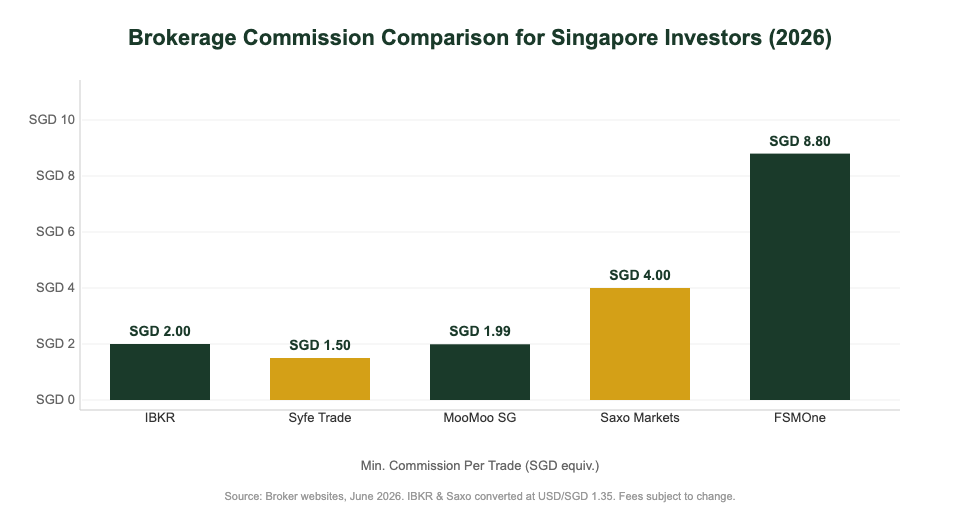
Below is a comparison of the most widely used brokerage accounts among Singapore retail investors as at June 2026. All fee data is sourced directly from broker websites.
| Broker | Min. Commission | Platform Fee | Markets | Best For |
|---|---|---|---|---|
| Interactive Brokers (IBKR) | USD 1.50/trade (US) | None (active traders) | 135+ markets | Cost-conscious investors, ETF buyers, larger portfolios |
| Syfe Trade | SGD 1.49/trade (US) | None | US, HK, SG | Beginners, first-time investors wanting a simple app |
| MooMoo Singapore | SGD 1.99/trade (US) | None | US, SG, HK, AU | Active traders wanting charts and research tools |
| Saxo Markets | USD 3/trade (US) | None | 70+ markets | Sophisticated investors, LSE ETF access |
| FSMOne | SGD 8.80/trade (SG) | 0.08% p.a. | SG, US, HK, funds | Unit trust investors, regular savings plans |
| DBS Vickers | SGD 10 or 0.12% (SG) | None | SG, US, HK, AU | DBS bank customers, CDP-linked SGX trades |
Source: Broker websites, June 2026. Fees subject to change. FX conversion fees apply for overseas trades and vary by broker.
For investors focused on buying LSE-listed ETFs such as CSPX or VWRA, Interactive Brokers and Saxo offer direct access to the London Stock Exchange with the most competitive FX conversion rates. Syfe Trade also provides access to US-listed ETFs at low flat-fee commissions, making it popular for beginners. You can use the Syfe referral code for a bonus when opening your account.
Understanding Brokerage Fees
Brokerage fees in Singapore have dropped dramatically in the past five years, largely driven by the entry of commission-free or near-commission-free US platforms and the launch of local fintech brokers. However, “low fees” can be misleading — here are all the costs you need to account for when choosing a brokerage account in Singapore:
1. Commission per trade
The headline fee most brokers advertise. For Singapore stocks, commissions are typically 0.08%–0.28% of trade value with a minimum of SGD 8.80–SGD 25. For US stocks, commissions have fallen to SGD 1.49–USD 3 per trade at most online brokers. Avoid traditional bank-linked brokers (OCBC Securities, UOB Kay Hian at standard rates) for US trades — their commissions are often 10–20x higher than independent platforms.
2. FX conversion fee
When you buy US stocks or LSE ETFs with SGD, you need to convert currency. This is where many “low-fee” brokers quietly recoup margins. IBKR charges a very small FX spread (typically 0.002% with Tiered pricing). MooMoo and Syfe Trade charge a flat FX conversion fee that varies — check the current rate before trading. On a SGD 50,000 portfolio, a 0.5% FX spread costs SGD 250 per currency conversion.
3. Platform or custody fee
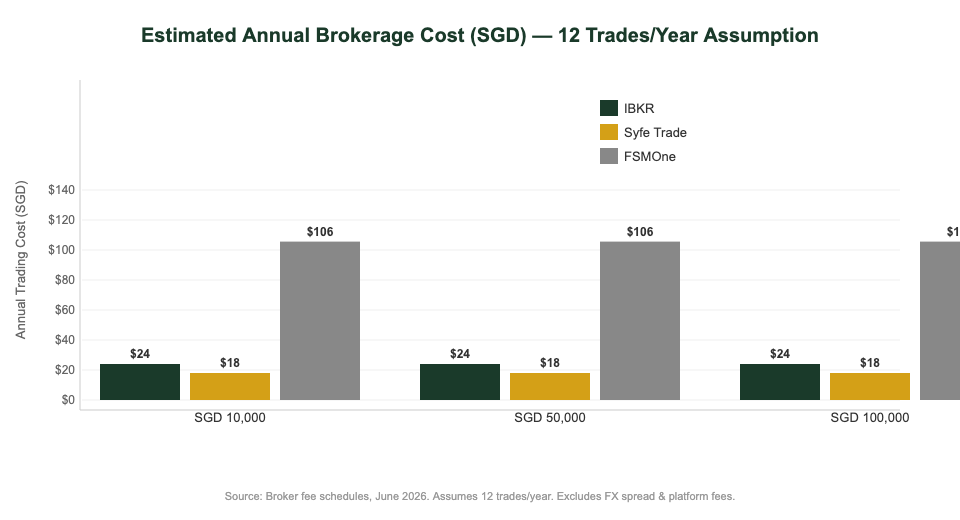
Some brokers charge a custody fee — a percentage of assets under management per year — for holding your securities. FSMOne charges 0.08% p.a. Most major brokers (IBKR, MooMoo, Syfe Trade) charge no custody fee. For a SGD 100,000 portfolio, a 0.08% p.a. custody fee works out to SGD 80/year — modest, but worth factoring in.
4. Inactivity fee
Interactive Brokers historically charged an inactivity fee for accounts generating less than USD 10/month in commissions, but this was removed for accounts under IBKR Lite. Always check the current fee schedule before opening an account, as these policies change.
5. Dividend handling fee
Some custodian brokers charge a fee for receiving dividends on overseas stocks. For dividend investing strategies, this can meaningfully erode returns — check if your broker charges this. See our guide to passive income Singapore for more on building a dividend-generating portfolio.
What Can You Invest In Through a Brokerage Account?
Once your brokerage account is open and funded, you can invest across a range of asset classes. The exact options depend on the markets your broker provides access to:
| Asset Class | Where to Trade | Notes for SG Investors |
|---|---|---|
| Singapore Stocks / S-REITs | SGX | CDP-linked; no capital gains tax; dividends may be taxed at source for REITs |
| US Stocks / ETFs | NYSE, NASDAQ | 30% withholding tax on dividends; US estate tax risk for portfolios above USD 60k |
| LSE-Listed ETFs (UCITS) | London Stock Exchange | Ireland-domiciled; 15% WHT on US dividends; no US estate tax exposure |
| Singapore T-bills / Savings Bonds | SGX / MAS tender | Tax-exempt interest; low risk; useful for capital preservation |
| Hong Kong Stocks | HKEX | Available on IBKR, MooMoo, Syfe Trade |
| Unit Trusts / Funds | FSMOne, Endowus, Syfe | Some platforms allow SRS or CPF-OA funds for eligible unit trusts |
Source: MAS, SGX, broker platforms. As at June 2026.
For investors building a long-term retirement portfolio, a combination of S-REITs for income and LSE-listed ETFs for broad market exposure is a popular strategy. Our Singapore retirement calculator can help you model how different asset allocations affect your projected retirement savings. You can also explore a CPF investment strategy to understand which assets are CPF-investable.
CDP vs Custodian Accounts: What Is the Difference?
This is one of the most common questions from new Singapore investors, and the answer affects which broker you should choose.
The CDP (Central Depository) Account is managed by SGX and holds your Singapore-listed securities directly in your name. It is free to open, and your shares belong to you even if your broker goes under. Annual dividends from SGX-listed stocks and S-REITs are credited directly to your CDP-linked bank account. CDP accounts are mandatory if you want to hold SGX-listed stocks — all Singapore banks’ brokerage platforms (DBS Vickers, OCBC Securities, UOB Kay Hian) use the CDP system.
Custodian accounts are the standard structure for overseas securities. When you buy Apple shares through IBKR or MooMoo, those shares are held in the broker’s custodian account on your behalf. The shares are still segregated from the broker’s own assets under MAS regulations, providing meaningful protection in the event of broker insolvency. However, you are not directly registered as the share owner with the company’s registrar, so you do not receive annual reports directly and your voting rights must be exercised through the broker.
For most Singapore investors, the practical difference matters mainly when buying Singapore stocks (use a CDP-linked broker) versus overseas ETFs and stocks (custodian is fine). If you plan to hold both, consider opening one CDP-linked account for SGX trades and one custodian account for overseas investments. The Singapore REIT ETF guide covers which brokers to use for accessing REIT ETFs on SGX versus LSE.
Beginner Tips Before You Start
Opening a brokerage account is easy; investing well takes more thought. Here are the most important principles for first-time investors in Singapore:
1. Start with low-cost index ETFs rather than individual stocks. A single LSE-listed ETF such as CSPX (tracking the S&P 500) or VWRA (tracking 47 global markets) gives you instant diversification across thousands of companies. Individual stock picking requires significantly more research and carries higher concentration risk.
2. Set a regular investment cadence. Rather than timing the market, dollar-cost averaging — investing a fixed amount every month regardless of market conditions — reduces the emotional pressure of trying to buy at the “right” time. FSMOne’s Regular Savings Plan (RSP) and FSMOne referral code are worth exploring if this approach suits you.
3. Keep an emergency fund before investing. Your brokerage account should hold money you do not need for at least 3–5 years. Keep 3–6 months of living expenses in a high-yield savings account or Singapore Savings Bonds before committing funds to equities. Read our Singapore Savings Bonds guide for a safe short-term parking option.
4. Understand the tax implications. Singapore does not impose capital gains tax — you keep all profit when you sell. However, dividends from US-listed stocks are subject to a 30% US withholding tax, which is why Singapore investors often prefer Ireland-domiciled UCITS ETFs listed on the LSE, which face only 15% WHT. Learn more via our Singapore T-bills 2026 guide for risk-free rate context.
5. Consider Endowus for CPF and SRS investing. If you want to invest your CPF Ordinary Account or SRS funds, platforms like Endowus offer access to institutional-class funds at low fees. Use the Endowus referral code for a fee rebate when you open your account. Standard brokerage accounts cannot hold CPF funds — this requires a CPFIS-approved platform.
Not financial advice. Investing involves risk, including the possible loss of principal. Past performance is not indicative of future results. Always do your own research or consult a licensed financial adviser before investing.
Frequently Asked Questions
What is the best brokerage account in Singapore for beginners?
For beginners in Singapore, Syfe Trade and MooMoo Singapore are the most popular choices due to their low flat-fee commissions (from SGD 1.49/trade), intuitive mobile apps, and no minimum deposit requirements. Interactive Brokers (IBKR) is the best option for investors who want access to the widest range of markets at the lowest long-term cost, but its platform has a steeper learning curve.
How much money do I need to open a brokerage account in Singapore?
Most online brokerage accounts in Singapore have no minimum deposit requirement. Syfe Trade, MooMoo, and Interactive Brokers can all be opened with SGD 0. FSMOne requires a minimum of SGD 100 for the Regular Savings Plan. Traditional bank-linked brokers (DBS Vickers, UOB Kay Hian) also have no minimum deposit, though their commissions are generally higher for smaller trades.
Can foreigners open a brokerage account in Singapore?
Yes. Foreigners holding a valid Employment Pass, Dependant’s Pass, or Long-Term Visit Pass can open brokerage accounts in Singapore. You will typically need your passport, a copy of your pass, and proof of address (utility bill or bank statement within 3 months). US persons (US citizens and green card holders) face additional FATCA documentation requirements — W-8BEN or W-9 forms depending on their tax status.
Is my money safe in a Singapore brokerage account?
Licensed brokerage accounts in Singapore are regulated by MAS under the Securities and Futures Act, which requires brokers to segregate client assets from their own balance sheets. Singapore-listed stocks held through CDP are owned directly by you and are fully protected regardless of broker status. For custodian accounts (used for overseas securities), the segregation requirement provides strong — but not absolute — protection.
Can I invest my CPF or SRS money through a standard brokerage account?
Standard brokerage accounts cannot access CPF funds directly. To invest CPF Ordinary Account funds, you need a CPF Investment Scheme (CPFIS)-approved broker such as DBS Vickers, OCBC Securities, or Phillip Securities. For SRS investing, platforms like Endowus and some bank brokers are approved SRS operators. Robo-advisory platforms like Syfe and Endowus also offer SRS-compatible investment options.
What is a CDP account and do I need one?
A CDP (Central Depository) account is an account with SGX that holds your Singapore-listed stocks, ETFs, and REITs directly in your name. You need a CDP account to invest in SGX-listed securities. It is free to open and can be linked to any Singapore bank brokerage. If you only plan to invest in overseas stocks or LSE-listed ETFs through a custodian broker like IBKR or MooMoo, you do not strictly need a CDP account — though many Singapore investors open both.
What fees should I watch out for beyond the advertised commission?
Beyond the headline commission per trade, watch for: FX conversion fees (can range from 0.002% at IBKR to 0.3%–1% at some banks), platform or custody fees (FSMOne charges 0.08% p.a.), inactivity fees (check the current schedule at your broker), and dividend handling fees for overseas securities. Always read the full fee schedule before opening an account — these secondary fees can exceed the headline commission cost for buy-and-hold investors.
Ready to Open Your Brokerage Account?
Compare fees, open your account today, and start building your investment portfolio. Use our referral links for exclusive sign-up bonuses.
This article was researched with the help of AI. While we strive to keep all information accurate and up to date, there may be errors. If you notice any discrepancies, please contact us.