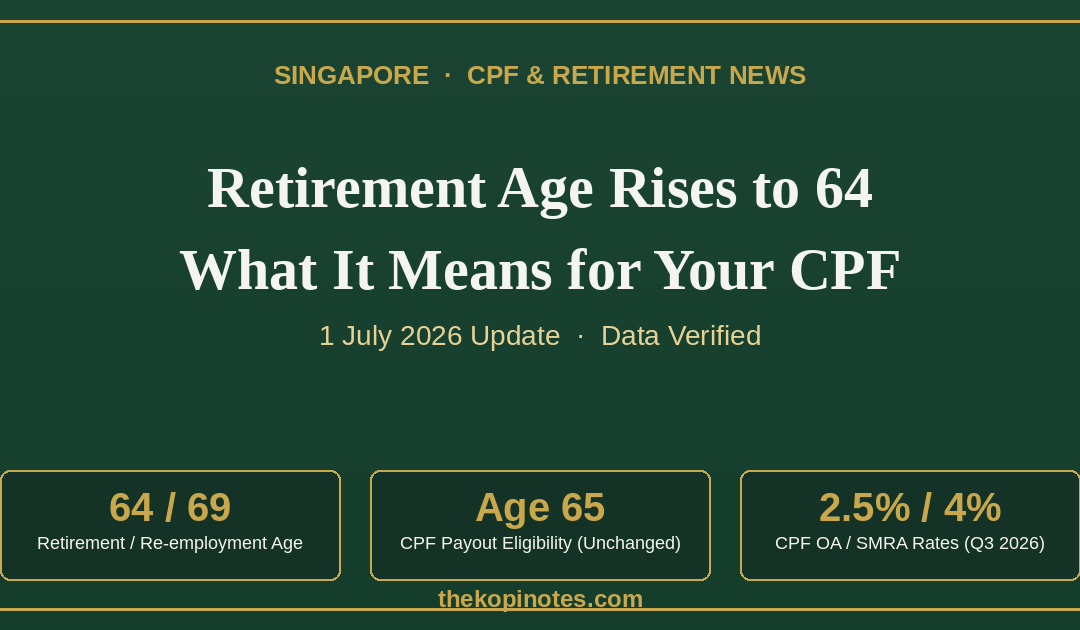
Singapore’s retirement age rose from 63 to 64 and the re-employment age from 68 to 69 on 1 July 2026, while CPF interest rates for Q3 2026 held steady at the 2.5% and 4% floors. The CPF payout eligibility age stays at 65, unaffected by the change. Data verified as at 23 July 2026.
This is an editorial analysis. Not financial advice. Data verified as at 23 July 2026.
What Changed on 1 July 2026
On 1 July 2026, Singapore’s statutory retirement age moved from 63 to 64, and the re-employment age moved from 68 to 69, under the Retirement and Re-employment Act. This is the latest step on a roadmap first announced by the Ministry of Manpower (MOM) in 2024, aimed at reaching a retirement age of 65 and a re-employment age of 70 by 2030. The last increase was in 2022, when the ages moved to 63 and 68 — so this year’s change is a continuation of a legislated schedule, not a one-off announcement.
For TKN readers this is primarily a labour-market update: employers can no longer end an employment relationship purely on the basis of age before the new statutory minimum, and eligible employees must be offered re-employment contracts (at least a year, renewable annually) at least three months before their previous retirement date. To qualify, a worker generally needs to be a Singapore Citizen or PR, have served the current employer for at least two years before the retirement age, have satisfactory performance, and be medically fit to continue.
What this means for SG retail investors: if you or your parents are working past 55, there are now two more years of statutory income protection before an employer can end the relationship purely on age — which in practice means two more years of salary and CPF contributions at senior-worker rates, discussed below.
CPF Payout Age Stays at 65 — And That’s the Important Bit
Here is the detail that trips up a lot of readers: raising the retirement and re-employment age does not move the CPF payout eligibility age, which remains 65. The two are governed separately — retirement and re-employment age sit under the Retirement and Re-employment Act and MOM, while CPF LIFE payout eligibility is a distinct CPF Board policy setting (CPF Board, accessed 23 Jul 2026).
In practice:
- You can start monthly retirement payouts any time from age 65, using the Plan My Monthly Payouts service, which opens three months before your 65th birthday.
- You can defer your payout start any time up to age 70. Each year of deferral increases your eventual monthly payout by up to 7%.
- A higher re-employment age simply gives you the option to keep working and contributing to CPF for longer — it does not force any change to when you can start drawing down.
If you’re using our CPF LIFE monthly payout guide to plan retirement income, the underlying math is unchanged: the levers that matter are still your Retirement Sum tier, your CPF LIFE plan choice, and whether you defer.
Bigger CPF Contributions If You Keep Working Past 55
The other update worth flagging alongside the retirement age change is the CPF contribution rate step-up for senior workers, which took effect on 1 January 2026 and will step up again on 1 January 2027 — with the increase fully allocated to the member’s Retirement Account (RA), up to the Full Retirement Sum (FRS).
| Employee’s Age | Total CPF % (2026) | Total CPF % (from 1 Jan 2027) | Change |
|---|---|---|---|
| 55 and below | 37% | 37% | No change |
| Above 55 to 60 | 34% | 35.5% | +1.5 pp |
| Above 60 to 65 | 25% | 26% | +1 pp |
| Above 65 to 70 | 16.5% | 16.5% | No change |
| Above 70 | 12.5% | 12.5% | No change |
Source: CPF Board, “New CPF contribution rates for senior workers”, accurate as at publication. The above-55-to-60 band’s increase splits into +0.5 percentage point from the employer and +1 percentage point from the employee; the above-60-to-65 band splits +0.5/+0.5.
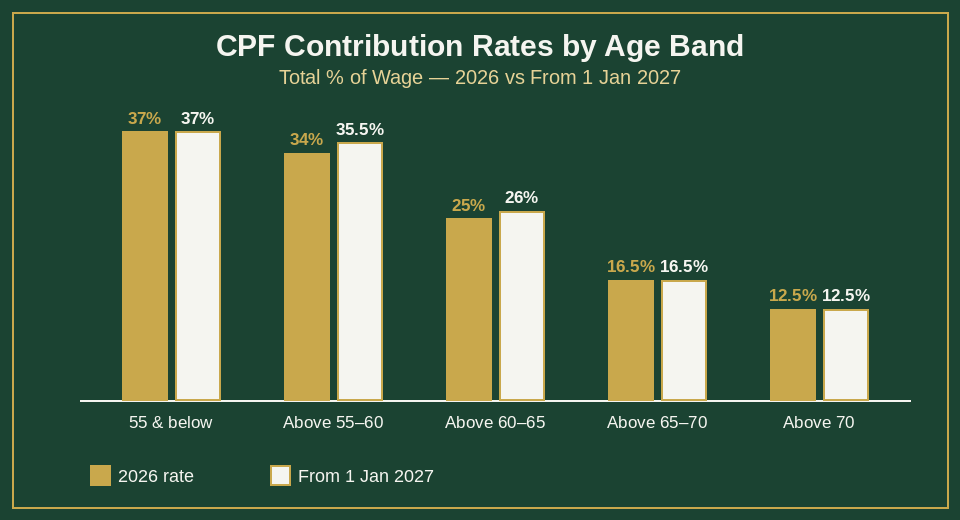
What this means for SG retail investors: if you’re a senior worker who hasn’t yet hit your Full Retirement Sum, every additional year you work past 55 now channels a meaningfully larger share of your wage into your RA — savings that compound at the CPF Special/Retirement Account rate discussed next, not a bank savings rate.
These CPF changes arrive alongside another 2026 update: the Basic Healthcare Sum (BHS), the MediSave savings ceiling for basic subsidised healthcare needs in old age, rose to $79,000 from 1 January 2026 — up 4.6% from $75,500 in 2025, per CPF Board and the Ministry of Health. Members turning 65 in 2026 have their BHS fixed at $79,000 for life; those below 65 will see the cap adjust yearly. Combined with the senior-worker contribution increase above, more of a working senior’s CPF inflow in 2026 is being directed toward retirement and healthcare adequacy rather than the Ordinary Account. See our CPF MediSave cap guide for the full breakdown.
CPF Interest Rates Still Beat the Banks in Q3 2026
CPF Board has confirmed that rates for 1 July to 30 September 2026 are unchanged from the prior quarter: the Ordinary Account (OA) stays at its 2.5% per annum floor, and the Special, MediSave and Retirement Accounts (SMRA) stay at the 4% per annum floor, because the pegged formulas — tied to average 10-year Singapore Government Securities yields — still land below those floor rates. The HDB concessionary loan rate, pegged 0.1 percentage point above OA, stays at 2.6%.
On top of the base rates, members earn extra interest: those below 55 get an extra 1% on the first $60,000 of combined balances (capped at $20,000 for OA); those 55 and above get an extra 2% on the first $30,000 and 1% on the next $30,000 (also capped at $20,000 for OA).
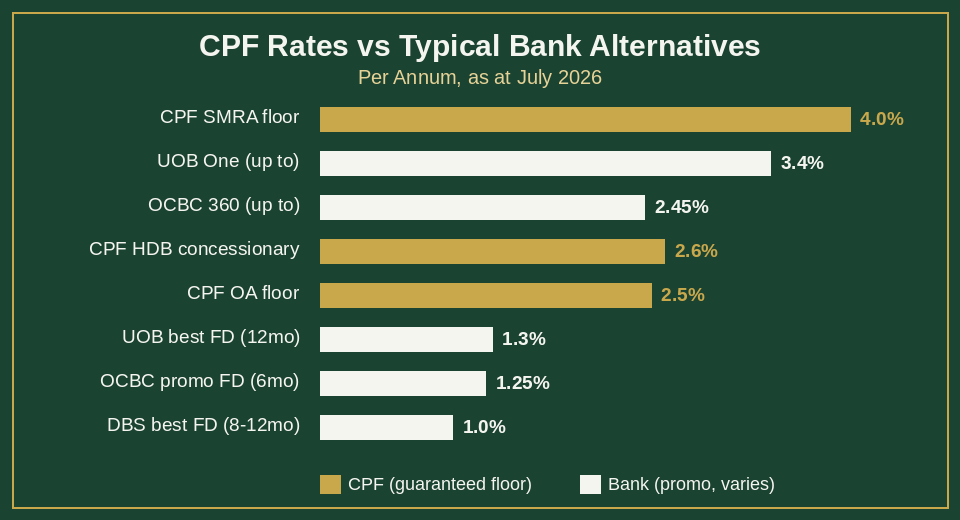
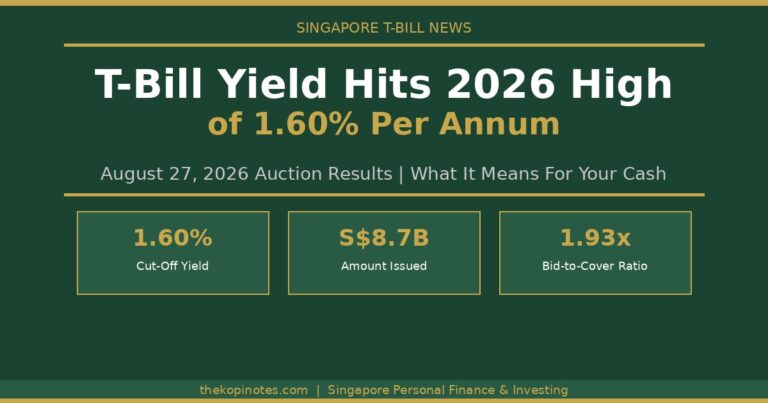
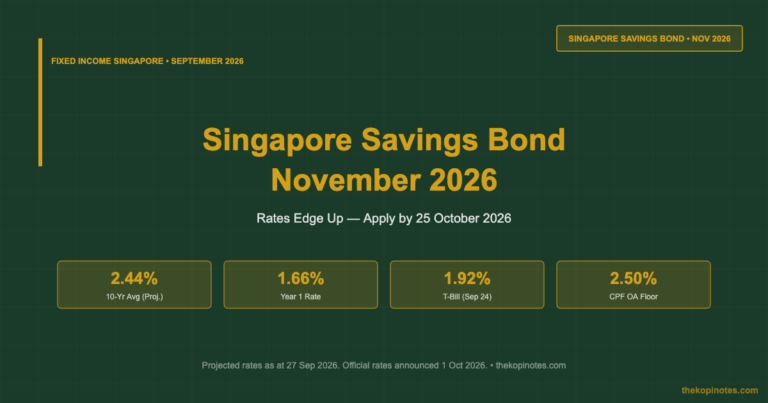
What this means for SG retail investors: even the better promotional fixed deposit and savings account rates being advertised by the banks in July 2026 sit below the SMRA floor of 4% (before extra interest tiers). For money you don’t need liquid — MediSave, Special Account and Retirement Account balances — there’s little reason to chase a “safe” rate elsewhere. For Ordinary Account money earmarked for a house purchase or CPF-approved investment, the comparison against T-bills and the Singapore Savings Bond is closer and depends on your liquidity needs — see our T-bills guide for current yields, or our latest T-bill auction results.
Should You Defer Your CPF Payouts to Age 70?
With the re-employment age now 69, more members will have earned income right up to the door of their CPF payout eligibility age. That raises a genuine planning question: if you don’t need the monthly payout at 65, is deferring to 70 — for up to 7% more per year deferred — worth it?
The honest answer depends on your health, other income sources, and whether the money would otherwise sit idle or be invested elsewhere. Readers weighing this alongside broader CPF withdrawal rules should check our CPF withdrawal options guide, and those tracking the contribution and cap changes for 2026 should read our CPF contribution 2026 guide and CPF MediSave cap guide for the fuller picture of what’s flowing into which account this year.
Bottom Line for SG Investors
The retirement age move to 64 and re-employment age move to 69 are labour-policy changes, not CPF policy changes — your payout eligibility age is still 65, and deferring to 70 still adds up to 7% a year. What actually moves your retirement number in 2026 is the CPF interest rate environment (still 2.5%/4% floors, still ahead of most bank alternatives) and the senior-worker contribution rate step-up, which channels more of your wage into your Retirement Account the longer you work past 55. Combined with the CPF LIFE plan you’ve already chosen, these are the levers worth revisiting this year — not the headline retirement-age number itself.
Frequently Asked Questions
Does the retirement age increase to 64 change when I can withdraw my CPF?
No. The CPF payout eligibility age remains 65 and is not linked to the statutory retirement or re-employment age, per CPF Board.
What is Singapore's retirement age from 1 July 2026?
64, up from 63. The re-employment age rose from 68 to 69 on the same date.
What are the CPF interest rates for Q3 2026 (July to September)?
The Ordinary Account floor is 2.5% p.a. and the Special, MediSave and Retirement Accounts floor is 4% p.a., both unchanged from the prior quarter, per CPF Board’s official announcement.
How much extra interest do I earn on my CPF savings?
Members below 55 earn an extra 1% on the first $60,000 of combined balances (capped at $20,000 for OA). Members 55 and above earn an extra 2% on the first $30,000 and 1% on the next $30,000 (also capped at $20,000 for OA).
Are CPF contribution rates changing in 2026?
Current 2026 rates already reflect the January 2026 increase for senior workers. A further increase for the above-55-to-60 band (+1.5 percentage points) and above-60-to-65 band (+1 percentage point) takes effect from 1 January 2027, per CPF Board.
Should I defer my CPF LIFE payouts to age 70?
Deferring increases your eventual monthly payout by up to 7% per year deferred, up to age 70. Whether it is worth it depends on your other income sources, health and liquidity needs — it is a personal planning decision, not a one-size-fits-all rule.
Based on CPF Board’s official rates and rates compiled by bank-comparison sites in July 2026, the CPF SMRA floor of 4% (plus extra interest tiers) sits above most advertised bank fixed deposit and promotional savings rates, though bank promotional rates change frequently and should be checked directly with the bank.
This article was researched with the help of AI. While we strive to keep all information accurate and up to date, there may be errors. If you notice any discrepancies, please contact us.