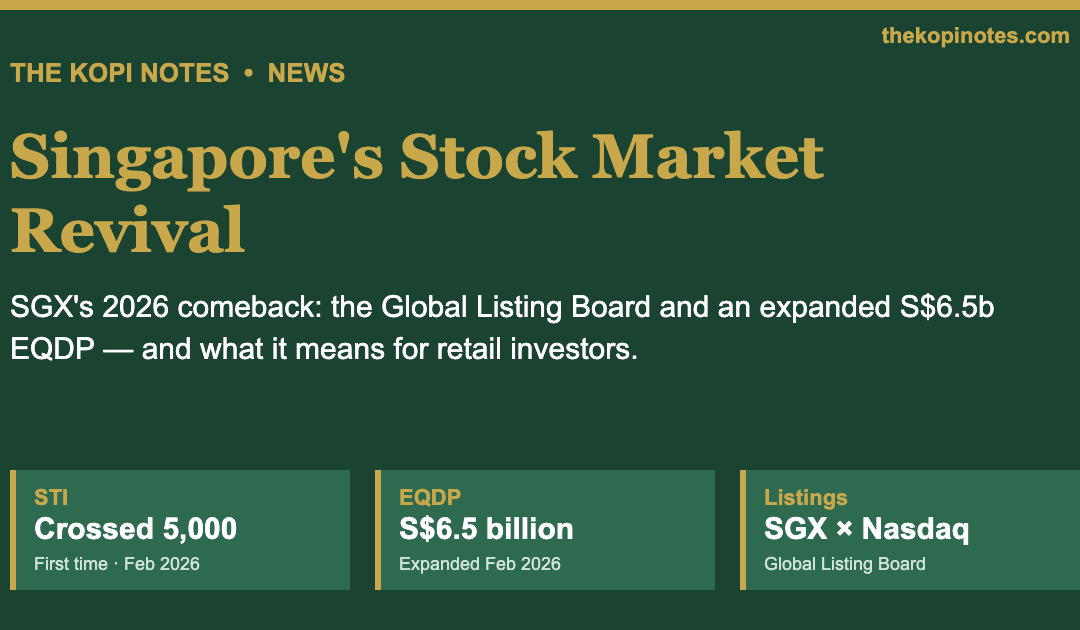
Singapore’s stock market is staging its most deliberate revival in a decade. The Straits Times Index cleared the 5,000 milestone for the first time in February 2026, the S$5 billion Equity Market Development Programme has been expanded to S$6.5 billion, and Parliament has passed the legal framework for an SGX–Nasdaq “Global Listing Board” that lets companies list on both exchanges at once. For retail investors who have watched SGX drift for years, 2026 is the year the policy firepower finally arrived.
This is an editorial analysis. Not financial advice. All figures are for educational reference only. Data as at 6 July 2026 unless noted.
What Actually Changed: Three Moving Parts
The revival is not one announcement but a coordinated push from the Monetary Authority of Singapore (MAS), the Equities Market Review Group, and SGX. Three developments matter most for ordinary investors.
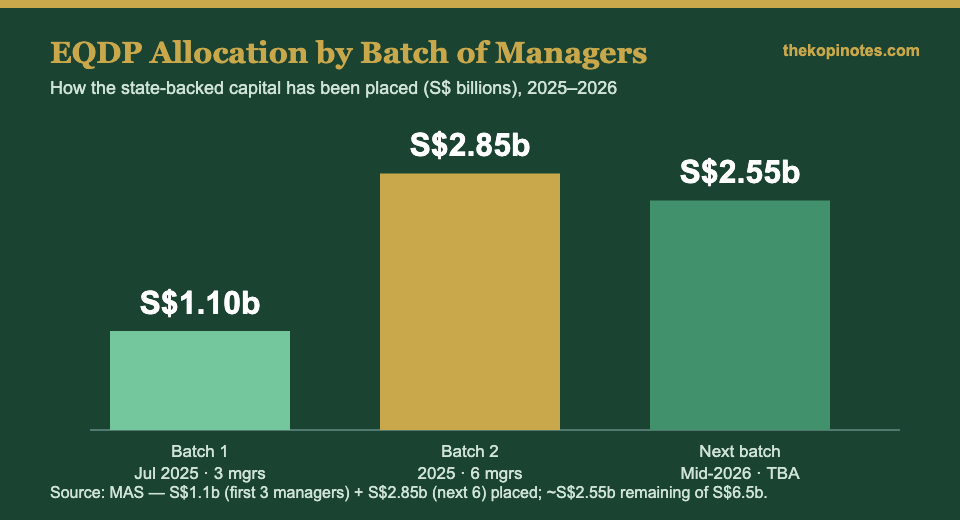
First, capital. In February 2025 MAS and the Financial Sector Development Fund launched the Equity Market Development Programme (EQDP) with S$5 billion earmarked to seed fund managers focused on Singapore-listed equities. On 12 February 2026, MAS expanded the programme to S$6.5 billion. As of 2026, S$3.95 billion has already been placed across nine asset managers — an initial S$1.1 billion with the first three appointed in July 2025, followed by a further S$2.85 billion with a second batch of six — with the next batch due around mid-2026.
Second, plumbing. The Securities and Futures (Amendment) Bill 2026 had its First Reading on 7 April 2026 and was passed on 7 May 2026. It creates the legal machinery for a Global Listing Board (GLB), a joint SGX–Nasdaq initiative that lets an issuer list concurrently on both exchanges under a single, streamlined regulatory regime.
Third, promotion. Alongside the EQDP expansion, MAS committed S$50 million to boost equity research coverage and product listings, and the Review Group unveiled a S$30 million “Value Unlock” package to nudge listed companies toward better shareholder returns.
What this means for Singapore retail investors: For years the knock on SGX was thin liquidity, few new listings, and scant research on anything outside the big banks and REITs. All three of those complaints are being targeted directly — with real money behind them. That does not guarantee higher prices, but it changes the structural backdrop that has held Singapore small- and mid-caps back.
The Global Listing Board: Why Dual Listings Matter
The GLB is the headline structural reform. Under the new law, MAS can designate an overseas venue such as Nasdaq as a “prescribed overseas exchange” and designate SGX’s dual-listing board as a “prescribed DLB.” Where Singapore’s rules and the foreign jurisdiction’s rules differ, MAS can modify or disapply certain offer-related and market-misconduct provisions so a company is not caught between two conflicting rulebooks. Crucially for the retail crowd, issuers will be allowed to circulate a preliminary prospectus while marketing — meaning Singapore investors can be engaged earlier in the IPO process, before the final prospectus is lodged.
The strategic logic is straightforward. A growth company — particularly in the region — often wants access to deep US capital markets but also a home-market listing close to its customers and operations. Historically it had to choose, or run two expensive, duplicative listing processes. A streamlined bridge to Nasdaq makes a Singapore listing far more attractive as one half of a dual-listing, potentially reversing years of companies bypassing SGX entirely for New York or Hong Kong.
What this means for Singapore retail investors: More listings and a credible pipeline of larger, growth-oriented names would deepen the pool of investable Singapore stocks beyond banks and property. It could also improve liquidity and narrow the persistent valuation discount SGX-listed companies trade at versus US peers. The catch: dual listings take time to materialise, and early candidates are likely to be a handful of higher-growth names rather than a flood.
Singapore’s Equity Revival Scorecard — 2026
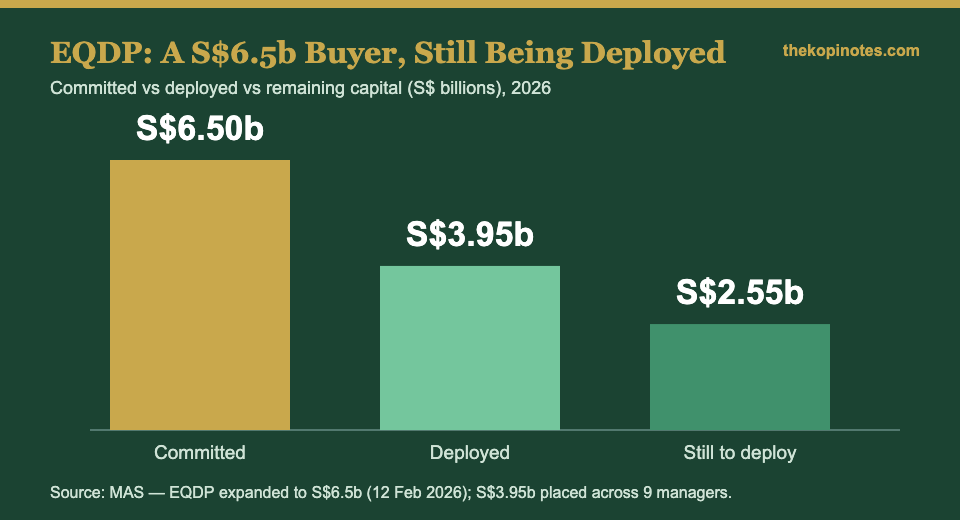
Here is where the main pieces of the revival stand right now. Note how much of the committed capital is still waiting to be deployed — a tailwind that is only partly “in the market” so far.
| Measure | Status (2026) | Why It Matters |
|---|---|---|
| EQDP total size | S$6.5 billion (raised from S$5b on 12 Feb 2026) | State-backed demand tilted toward small/mid-caps |
| EQDP capital deployed | S$3.95 billion across 9 managers | ~S$2.55b still to be allocated — ongoing inflow |
| Global Listing Board | Enabling law passed 7 May 2026 | SGX–Nasdaq concurrent listings under one regime |
| Research & listing grants | S$50 million committed | More coverage of under-followed SGX names |
| “Value Unlock” package | S$30 million | Incentives for better shareholder returns |
| Straits Times Index | Crossed 5,000 first time, 12 Feb 2026 | Sentiment milestone; banks ~half of index weight |
What this means for Singapore retail investors: The single most investable insight in this table is the gap between committed and deployed EQDP capital. With roughly S$2.5 billion still to be placed — and a mandate that prefers strategies tilted toward small- and mid-caps — there is a structural, price-insensitive buyer entering names that retail portfolios have long ignored. That is exactly the kind of flow that can re-rate a neglected corner of the market.
Where the Opportunity — and the Risk — Sits
The obvious temptation is to chase small-caps ahead of EQDP flows. That is also where the risk concentrates. EQDP managers are professional, benchmark-aware, and selective; they are not obliged to buy any particular stock, and the programme is designed to broaden participation over years, not to pump a watchlist over weeks. Buying illiquid microcaps purely on the hope of state-fund buying is speculation, not investing.
A more grounded approach is to treat the revival as improving the whole SGX ecosystem rather than as a stock tip. Quality large-caps — the three local banks, the better-run S-REITs, and established industrials — still anchor most Singapore portfolios and benefit from improved sentiment and liquidity without the fragility of microcaps. For diversified exposure to the index revival itself, a low-cost STI ETF captures the broad move; our guide to ETFs for Singapore investors and the Singapore REIT ETF guide both cover one-ticket options. Investors who prefer to research individual names can start with our screen of the best S-REITs in Singapore 2026, since REITs remain the income backbone of the local market.
What this means for Singapore retail investors: Position for the revival through quality and diversification, not lottery tickets. If you want small/mid-cap exposure, size it deliberately as a satellite allocation, accept the volatility, and judge companies on fundamentals — earnings, balance sheet, and dividends — rather than on hoped-for fund flows. You can sanity-check any dividend name’s yield using our dividend yield calculator, and if REIT metrics are new to you, the DPU explainer is a useful primer.
How This Connects to the Rest of Your 2026 Portfolio
The equity revival does not happen in a vacuum. Domestic interest rates have fallen sharply in 2026, with 3-month SORA sliding to around 1% and T-bills and fixed deposits dropping below 1.6% — a backdrop we covered in our analysis of falling Singapore rates and their impact on S-REITs. Lower “risk-free” yields make dividend-paying Singapore equities relatively more attractive, and they lower financing costs for the very companies the EQDP is designed to support. In other words, cheap money and state-seeded demand are pushing in the same direction.
For investors who want to act, the practical enablers are already in place. A low-cost brokerage with SGX access is the base requirement — readers comparing platforms often start with moomoo or Interactive Brokers for Singapore and US market access, useful if you eventually want to hold both sides of a future dual-listed name. Beyond that, the discipline is the same as always: decide your asset allocation first, then choose instruments, and browse individual ideas in our Singapore stocks section.
What this means for Singapore retail investors: Treat the SGX revival as a reason to revisit your Singapore allocation, not to overhaul your whole plan. A falling-rate, policy-supported market rewards patient dividend and index investors more reliably than it rewards speculators trading headlines.
Bottom Line for SG Investors
2026 is the year Singapore’s equity-market ambitions moved from consultation papers to committed capital and passed legislation. The EQDP has grown to S$6.5 billion with roughly S$2.5 billion still to deploy toward small- and mid-caps; the Global Listing Board gives SGX a genuine bridge to Nasdaq that could revive the IPO pipeline; and grants for research and shareholder value target the market’s oldest weaknesses. None of this guarantees returns, and the biggest mistake would be to chase illiquid names purely on anticipated fund flows. The measured play is to lean into quality Singapore large-caps, REITs, and a low-cost STI ETF, size any small-cap exposure as a deliberate satellite, and let the structural tailwind — cheaper rates plus state-seeded demand — work over years rather than weeks. Watch the mid-2026 EQDP batch and the first GLB candidates as the next concrete signals.
Frequently Asked Questions
What is the EQDP and why does it matter for retail investors?
The Equity Market Development Programme is a MAS and Financial Sector Development Fund initiative that seeds professional fund managers who invest in Singapore-listed equities, with a preference for strategies tilted toward small- and mid-caps. It was launched at S$5 billion in February 2025 and expanded to S$6.5 billion on 12 February 2026. About S$3.95 billion has been placed across nine managers, leaving roughly S$2.5 billion still to be deployed — a source of state-backed demand for names retail portfolios often overlook. This is educational information, not financial advice.
What is the SGX–Nasdaq Global Listing Board?
It is a joint SGX and Nasdaq framework that lets a company list on both exchanges at the same time under a streamlined, harmonised set of rules. The enabling law, the Securities and Futures (Amendment) Bill 2026, was passed by Parliament on 7 May 2026. It also lets issuers share a preliminary prospectus with retail investors earlier in the IPO process.
Should I buy Singapore small-cap stocks to front-run EQDP flows?
Buying illiquid microcaps purely in the hope that a state fund will buy them is speculation, not investing. EQDP managers are selective and are not required to buy any particular stock, and the programme is designed to broaden participation over years. If you want small/mid-cap exposure, size it as a deliberate satellite allocation and judge companies on fundamentals, not on anticipated fund flows.
Did the Straits Times Index really cross 5,000?
Yes. The STI surpassed the 5,000 level for the first time on 12 February 2026, closing that day around 5,016.76. Singapore’s three local banks make up roughly half of the index by weight, so the milestone was driven heavily by financials.
How does the equity revival connect to falling interest rates?
Domestic rates have fallen in 2026, with 3-month SORA near 1% and T-bills and fixed deposits below 1.6%. Lower risk-free yields make dividend-paying Singapore equities relatively more attractive and reduce financing costs for listed companies, so cheaper money and state-seeded demand are reinforcing each other.
What is the simplest way to invest in the SGX revival?
For most investors, a low-cost Straits Times Index ETF provides diversified, one-ticket exposure to the broad market rather than a bet on any single stock. Income-focused investors can complement it with quality S-REITs. Always align any purchase with your own asset allocation, time horizon, and risk tolerance, and remember this is general information rather than personalised advice.
Sources
MAS expansion of the Equity Market Development Programme to S$6.5 billion, MAS media release. First and second batch EQDP asset manager appointments and S$50 million research commitment, MAS media release and Equities Market Review Group update. Securities and Futures (Amendment) Bill 2026 and the Global Listing Board framework, MAS explanatory brief and MAS media release on dual listings. Straits Times Index crossing 5,000 on 12 February 2026, contemporaneous Singapore market reporting.
This article was researched with the help of AI. While we strive to keep all information accurate and up to date, there may be errors. If you notice any discrepancies, please contact us.