Fed’s Hawkish Pause Hammers Singapore REITs — Banks Soar: What It Means for Your Portfolio
The June 2026 FOMC meeting sent a clear signal: rates are staying higher for longer. Here’s what Singapore retail investors need to do now.
The US Federal Reserve held rates at 3.50%–3.75% on June 17, 2026, but the real shock was in the dot plot: 9 of 18 officials now project at least one rate hike this year. The FTSE ST All-Share REIT Index has fallen 6.7% year-to-date, while the Straits Times Index — led by DBS, OCBC, and UOB — has surged 9.1%. For Singapore retail investors holding S-REITs and bank stocks, this is the most important macro shift of 2026.
Not financial advice. All figures are for educational reference only. Data as at June 2026 unless noted.
- The Fed’s June dot plot flipped hawkish — the median rate projection for end-2026 jumped from 3.4% to 3.8%, and almost half of FOMC officials now see a rate hike this year
- S-REITs are down 6.7% YTD as bond yields rose, but dividend yields have climbed to 5.9% on average — a potential buying opportunity for patient income investors
- Singapore bank stocks are at record highs, benefiting from the higher-rate environment with strong net interest income and wealth management flows
What Happened at the June 2026 FOMC Meeting
On June 17, the Federal Reserve kept its benchmark interest rate unchanged at 3.50%–3.75%. That was expected. What wasn’t expected was how hawkish the updated projections turned out to be.
The dot plot — the chart showing where each Fed official thinks rates should go — flipped dramatically. The median year-end 2026 projection jumped to 3.8%, up from 3.4% in March. That’s a meaningful shift. In plain English, Fed officials now think rates will end the year higher than where they sit today.
Here’s how the 18 officials broke down: nine projected at least one rate hike before year-end, eight wanted rates unchanged, and only one saw a cut. Five officials went as far as projecting 50 basis points of hikes — two full quarter-point increases.
The inflation picture drove this shift. The Fed raised its 2026 headline inflation forecast to 3.6%, up sharply from 2.7% in March. Core inflation was bumped to 3.3%. May’s US CPI print came in at 4.2% year-on-year — the first reading above 4% since 2023 — with energy costs jumping 23.5% on the back of the ongoing Middle East conflict.
| FOMC Projection | March 2026 | June 2026 | Change |
|---|---|---|---|
| Fed Funds Rate (year-end) | 3.4% | 3.8% | +40 bps ↑ |
| Headline Inflation | 2.7% | 3.6% | +90 bps ↑ |
| Core Inflation | 2.7% | 3.3% | +60 bps ↑ |
| Officials projecting hike(s) | — | 9 of 18 | Hawkish flip |
| US CPI (May 2026) | — | 4.2% YoY | First >4% since 2023 |
Source: Federal Reserve FOMC Projections, June 17, 2026
For Singapore investors, the message is simple: the rate-cut cycle that many were banking on has stalled. In fact, the next move might be a hike. That changes the playbook for both S-REITs and bank stocks.
Why Singapore REITs Fell — and Keep Falling
Here’s the core problem for S-REITs right now. When interest rates stay high, two things happen that hurt REIT valuations.
First, borrowing costs stay elevated. Most S-REITs carry significant debt — typically 35–40% of their total assets. Higher rates mean higher interest expenses, which eat into distributable income. That means lower Distribution Per Unit (DPU) — basically less cash in your pocket each quarter.
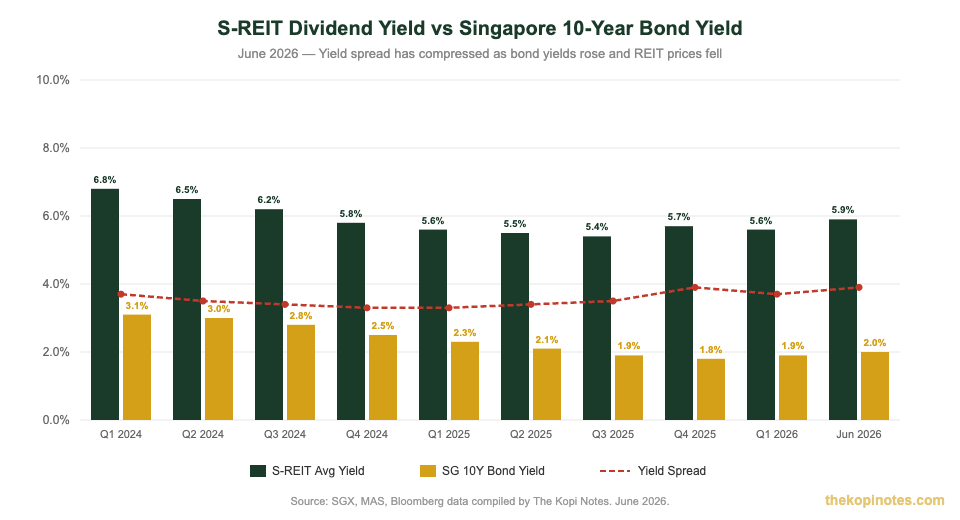
Second, the yield spread compresses. If you can earn 2.0% risk-free from a Singapore Savings Bonds guide, you need a bigger premium to justify the risk of owning REITs. As bond yields rose in 2026, the spread between S-REIT yields and the risk-free rate narrowed. That makes REITs less attractive relative to safer alternatives.
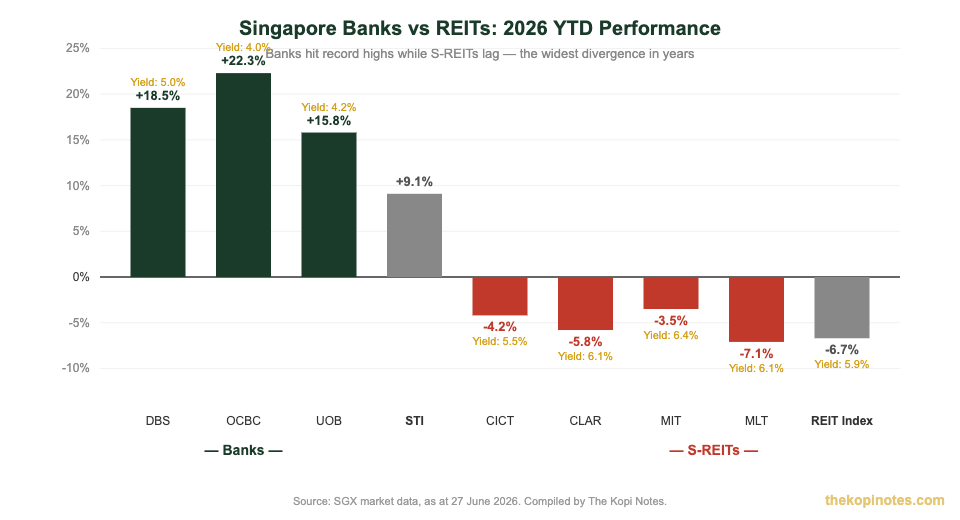
The numbers tell the story clearly. As at early June, the FTSE ST All-Share REIT Index had fallen 6.7% year-to-date. Meanwhile, the Straits Times Index — dominated by bank stocks that benefit from higher rates — climbed 9.1%. That’s a 15.8 percentage point gap between banks and REITs in just six months.
Following the June 17 FOMC meeting specifically, the REIT Index dropped another 1.8% while the STI gained 0.7%. The market is clearly repositioning away from rate-sensitive income assets and into banks.
S-REIT Dividend Yields Right Now
Here’s the silver lining. Because REIT prices have fallen, dividend yields have actually gone up. The average S-REIT yield now sits at 5.9% — higher than it was at the start of the year. For long-term income investors, falling prices on quality REITs can be a buying opportunity.
However, you need to be selective. Not all REITs handle higher rates equally. REITs with lower gearing, longer debt maturity profiles, and strong tenant retention are better positioned. Here are the blue-chip S-REITs and their current yields:
| S-REIT | Sector | Dividend Yield | 2026 YTD | Gearing |
|---|---|---|---|---|
| CapitaLand Integrated Commercial Trust (CICT) | Commercial | 5.5% | -4.2% | 39.8% |
| CapitaLand Ascendas REIT (CLAR) | Industrial | 6.1% | -5.8% | 37.2% |
| Mapletree Industrial Trust (MIT) | Industrial / Data Centre | 6.4% | -3.5% | 38.1% |
| Mapletree Logistics Trust (MLT) | Logistics | 6.1% | -7.1% | 40.5% |
| Keppel DC REIT | Data Centre | 5.2% | -2.1% | 36.8% |
| Frasers Centrepoint Trust (FCT) | Retail | 5.8% | -4.5% | 33.6% |
| Keppel REIT | Office | 6.1% | -5.3% | 39.2% |
Source: SGX, company filings, Bloomberg. Yields and YTD performance as at 27 June 2026.
Mapletree Industrial Trust and Keppel DC REIT stand out as more resilient picks. Both have significant data centre exposure — a structural growth sector driven by AI demand that’s less sensitive to economic cycles. If you’re looking for S-REITs that can weather higher rates, data centre-heavy names deserve a closer look. Our best S-REITs in Singapore 2026 guide covers each in more detail.
Why Singapore Banks Are at Record Highs
While REITs suffer from higher rates, Singapore banks are in the opposite position — they love it. Higher interest rates mean wider net interest margins (NIM), which is the spread between what banks earn on loans and what they pay on deposits. That flows straight to profit.
DBS, OCBC, and UOB have all hit record or near-record share prices in 2026. Here’s a quick snapshot:
| Bank | Price (mid-Jun) | 2026 YTD | Dividend Yield | CET1 Ratio |
|---|---|---|---|---|
| DBS Group (D05) | S$65.01 | +18.5% | 5.0% | 17.0% |
| OCBC (O39) | S$24.62 | +22.3% | 4.0% | 16.9% |
| UOB (U11) | S$41.50 | +15.8% | 4.2% | 14.9% |
Source: SGX market data, company filings. As at mid-June 2026.
OCBC has been the standout performer, up 22.3% year-to-date. Its Q1 2026 results showed net profit rising 5% year-on-year to nearly S$2 billion, with non-interest income surging 20% driven by wealth management and insurance contributions. OCBC’s CET1 ratio of 16.9% also gives it significant capital buffer.
DBS — Southeast Asia’s largest bank — remains the market’s preferred pick for income consistency, with a 5.0% dividend yield including special dividends. Its CET1 ratio of 17.0% is the strongest among the three. For investors who want to ride the higher-rate environment, Singapore banks are the direct beneficiaries.
That said, a word of caution. Bank stocks have already priced in much of the good news. At these valuations, the easy gains may be behind us. If the Fed eventually does pivot to cuts — even if that’s delayed — bank NIMs would compress. If you’re considering adding bank exposure now, our top dividend stocks in Singapore 2026 guide can help you compare yields across the three banks.
What Singapore Investors Should Do Now
The higher-for-longer rate environment demands a recalibrated approach. Here’s how to think about your portfolio:
If You Hold S-REITs: Don’t Panic Sell
Selling your REITs now locks in losses at the worst possible time. If you bought quality blue-chip REITs for income, the underlying property portfolios haven’t changed. Occupancy rates for Singapore commercial and industrial properties remain above 90%. DPU is under pressure, but it hasn’t collapsed.
Instead, review your REIT holdings for quality signals: gearing below 40%, weighted average debt maturity above 3 years, and a track record of stable or growing DPU. REITs that tick these boxes — like Frasers Centrepoint Trust (33.6% gearing) and Keppel DC REIT (36.8% gearing) — are better positioned to ride out the rate environment.
If you have cash to deploy, consider dollar-cost averaging into beaten-down quality names. A 6%+ yield on CapitaLand Ascendas REIT or Mapletree Industrial Trust is historically attractive. You can start building a REIT position through platforms like Syfe referral code and sign-up bonus or moomoo Singapore review — both offer fractional shares for smaller amounts.
If You Hold Bank Stocks: Consider Trimming at Highs
Bank stocks have run hard and fast. DBS at S$65, OCBC at S$24.62 — these are record territory. The risk-reward is less compelling now than it was at the start of the year.
Consider taking partial profits and redeploying into higher-yielding assets. You don’t need to sell everything, but trimming 20–30% of overweight bank positions is prudent risk management. The proceeds could go into Singapore T-bills 2026 for capital preservation, or into beaten-down S-REITs if you’re bullish on an eventual rate normalisation.
If You’re Building a New Portfolio: Diversify
For investors just starting out, this is actually a decent entry point — provided you spread your bets. A balanced Singapore-focused portfolio might look like: 30% Singapore banks for rate tailwinds, 30% S-REITs for income at discounted prices, 20% global ETFs for diversification, and 20% in T-bills or Singapore Savings Bonds for capital preservation.
For the global ETF sleeve, London Stock Exchange-listed UCITS ETFs like CSPX or VWRA avoid US estate tax exposure — a critical advantage for Singapore investors with portfolios above USD 60,000. Our CPF investment strategy guide covers how to incorporate CPF funds into your broader investment approach.
The key takeaway: don’t let one Fed meeting drive your entire strategy. Higher rates hurt REITs and help banks — but rates won’t stay high forever. Position for the cycle, not the headline.
Use our Singapore retirement calculator to model how different rate scenarios affect your long-term retirement plan.
Not financial advice. All figures are for educational reference only. Data as at June 2026 unless noted. The Kopi Notes may earn referral fees from platforms mentioned in this article.
Frequently Asked Questions
What did the Fed decide at the June 2026 FOMC meeting?
The Federal Reserve held interest rates steady at 3.50%–3.75% on June 17, 2026. However, the updated dot plot was significantly more hawkish: 9 of 18 officials now project at least one rate hike before year-end. The median year-end rate projection jumped from 3.4% to 3.8%, signalling that rates could go even higher in the coming months.
Why are Singapore REITs falling in 2026?
Singapore REITs have fallen 6.7% year-to-date because of the higher-for-longer interest rate environment. Higher rates increase borrowing costs for REITs (most carry 35–40% gearing), which reduces distributable income. Additionally, higher bond yields make risk-free alternatives more attractive, compressing the yield spread that makes REITs appealing to income investors.
Should I sell my Singapore REITs now?
Selling into weakness locks in losses. If you hold quality blue-chip S-REITs with gearing below 40%, stable occupancy above 90%, and a track record of consistent DPU, the fundamental case for holding hasn’t changed. The higher yields available now — averaging 5.9% across the S-REIT sector — actually make them more attractive for new purchases. However, avoid REITs with high gearing (above 42%) or deteriorating occupancy, as these are more vulnerable to prolonged high rates.
Why are Singapore bank stocks outperforming REITs in 2026?
Singapore’s three big banks — DBS, OCBC, and UOB — directly benefit from higher interest rates. Higher rates widen their net interest margins (NIM), meaning they earn more on loans relative to what they pay depositors. DBS is up 18.5% YTD, OCBC is up 22.3%, and UOB is up 15.8%. Strong wealth management revenue and rock-solid capital ratios (CET1 above 14.9% for all three) have further boosted investor confidence.
What is the current average Singapore REIT dividend yield?
As at June 2026, the average S-REIT dividend yield is approximately 5.9%. Individual blue-chip REITs range from 5.2% (Keppel DC REIT) to 6.4% (Mapletree Industrial Trust). These yields are calculated based on trailing 12-month distributions divided by the current unit price. Because REIT prices have fallen in 2026, yields have risen compared to the start of the year.
How does US inflation affect Singapore investors?
US inflation directly affects Singapore investors because the Federal Reserve’s interest rate policy impacts global borrowing costs, bond yields, and currency movements. The May 2026 US CPI print of 4.2% — driven largely by energy prices — pushed the Fed toward a more hawkish stance. For Singapore, this means higher SIBOR and SORA rates, which affect mortgage costs, REIT borrowing rates, and the relative attractiveness of risk-free assets like T-bills and Singapore Savings Bonds.
Is now a good time to start investing in Singapore stocks?
There is no perfect time to start investing, but the current environment offers opportunities in both directions. S-REITs are at their most attractive yields in over a year, making them compelling for income investors with a long time horizon. Bank stocks offer strong dividends (4–5%) but are at elevated valuations after a big run. A balanced approach — splitting between banks, REITs, global ETFs, and safe-haven assets like T-bills — reduces your exposure to any single outcome on interest rates.
Start Investing with the Right Broker
Whether you’re buying S-REITs, bank stocks, or global ETFs — use our referral links for exclusive sign-up bonuses.
This article was researched with the help of AI. While we strive to keep all information accurate and up to date, there may be errors. If you notice any discrepancies, please contact us.