Does Topping Up MediSave Help You Pay a Bigger Integrated Shield Plan Premium? (2026 Guide)
The Additional Withdrawal Limit caps your premium withdrawal by age, not by your MediSave balance — here’s what a top-up actually changes.
Topping up MediSave does not let you pay a bigger Integrated Shield Plan (ISP) premium. The private-insurance portion of your premium is capped by the Additional Withdrawal Limit (AWL): $300 to $900 a year, set by your age. Your MediSave balance, however large, does not raise this cap. Rider premiums are always paid in cash, in full.
Not financial advice. All figures are for educational reference only. Data verified as at August 2026 against CPF Board and MOH sources unless otherwise stated.
- Your MediSave balance size doesn’t change how much goes toward your ISP premium — the Additional Withdrawal Limit (AWL) does, and it’s set by age, not savings.
- Rider premiums are 100% cash by MOH rule, even with a large MediSave account.
- Top-ups still help — just not with premiums. They matter for hospital claims, a family member’s premium, and building your Basic Healthcare Sum (BHS).
Table of Contents
Contents
- The Common Assumption: More MediSave, Bigger Premium Coverage
- Why the AWL Doesn’t Care How Much MediSave You Have
- Rider Premiums: Always 100% Cash, Even With a Full MediSave Account
- A Simple Worked Example
- The One Case Where Your MediSave Balance Actually Matters
- What a MediSave Top-Up Actually Helps You Pay For
- What to Do If Your Premium Outgrows Your AWL
- Frequently Asked Questions
The Common Assumption: More MediSave, Bigger Premium Coverage
Many Singaporeans top up MediSave before their Integrated Shield Plan (ISP) renewal. It feels logical. More savings in the account should mean more of the bill gets paid automatically, right?
Not for premiums. Your ISP premium has two parts. The MediShield Life (MSL) portion is a basic layer of coverage everyone has, run by the government. It’s fully MediSave-payable, so this part was never the issue.
The second part is the “additional private insurance” component your insurer adds on top — for a private hospital ward, a bigger annual claim limit, and so on. This is the part that’s capped, and the cap has nothing to do with how much MediSave you’re sitting on.
That cap is called the Additional Withdrawal Limit, or AWL. Understanding it changes how you should think about topping up MediSave before your next renewal.
Why the AWL Doesn’t Care How Much MediSave You Have
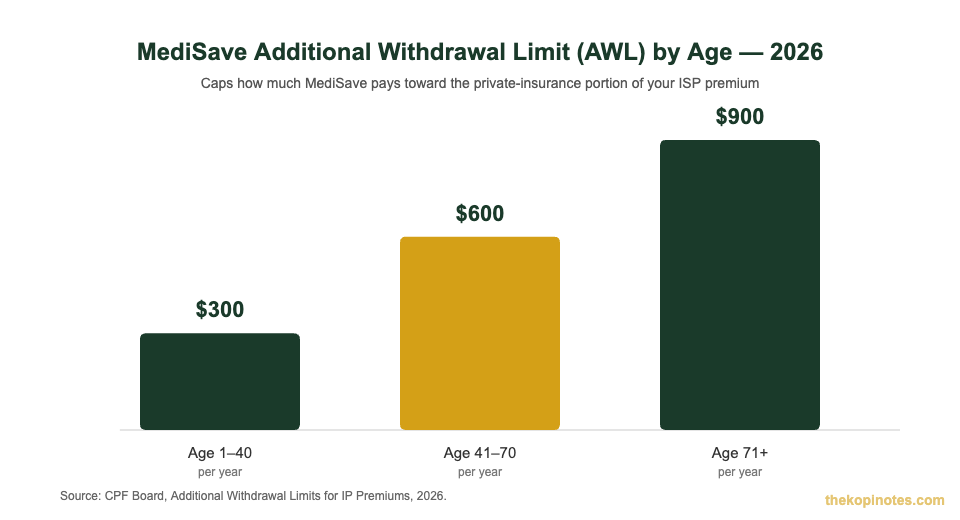
The Additional Withdrawal Limit sets a ceiling on how much MediSave can go toward the private-insurance part of your ISP premium each year. It rises with age, in fixed bands, because premiums generally rise with age too.
| Age Next Birthday | Additional Withdrawal Limit (AWL) |
|---|---|
| 1 – 40 | $300 per year |
| 41 – 70 | $600 per year |
| 71 and above | $900 per year |
Source: CPF Board, Additional Withdrawal Limits for IP Premiums, 2026.
Notice what’s missing from that table: your account balance. A 45-year-old with $2,000 in MediSave and a 45-year-old with $150,000 in MediSave face the exact same $600 cap. The AWL is set purely by age next birthday, full stop.
Rider Premiums: Always 100% Cash, Even With a Full MediSave Account
Riders are the add-ons that cover your deductible and co-payment, so an “as-charged” claim feels closer to fully paid. Many ISP holders assume MediSave chips in here too, if the balance is big enough.
It doesn’t, and a bigger balance changes nothing. Under MOH rules, rider premiums must always be paid in cash, regardless of your age or how much MediSave you hold.
This matters more since 1 April 2026. New riders sold from that date can no longer cover the minimum deductible MOH sets, and the co-payment cap was raised to at least $6,000 a year. Riders got a bit cheaper for some policyholders as a result — but the premium itself is still a 100% cash line item, every single year.
Your MediSave does still help when you actually make a claim: the deductible and co-payment portions of a hospital bill can be paid from MediSave, subject to their own separate withdrawal limits. That’s a different pot of rules from the AWL covered here. For the full breakdown of how the April 2026 changes affect rider pricing and coverage, see our guide on choosing the best rider for your Integrated Shield Plan.
A Simple Worked Example
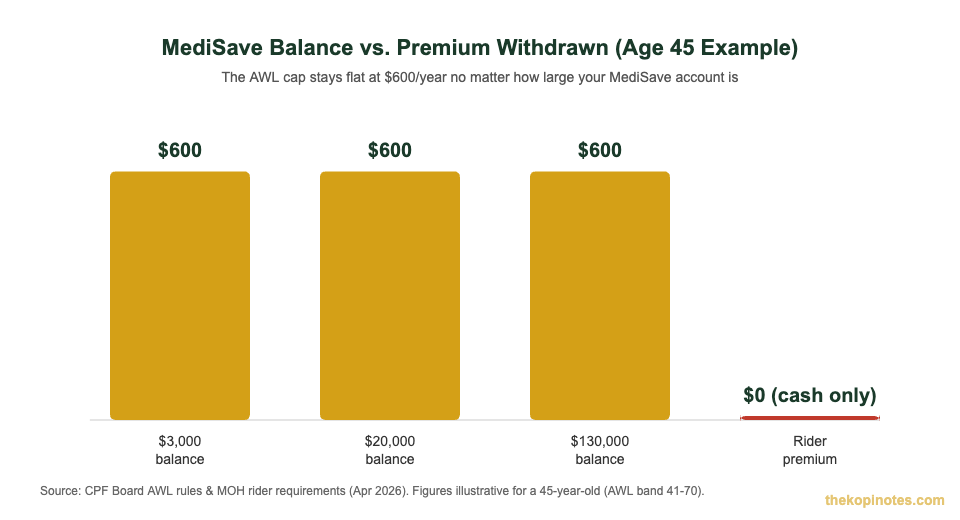
Here’s an illustrative scenario using round numbers, so the mechanics are easy to follow. Say you’re 45 — that puts you in the 41-70 AWL band, a $600 annual cap.
Your insurer’s total ISP premium works out to $1,750 a year: your MediShield Life portion, plus a $1,150 private-component top-up for private hospital coverage.
- MediShield Life portion: fully MediSave-payable, no cap applies here.
- Private component, first $600: MediSave-payable — this is your AWL.
- Private component, remaining $550: billed to you in cash by your insurer.
Now imagine three different versions of you: one with $3,000 in MediSave, one with $20,000, and one with $130,000. Every single one pays exactly the same $600 from MediSave and exactly the same $550 in cash. The extra $127,000 in the third scenario didn’t move the needle at all.
The One Case Where Your MediSave Balance Actually Matters
There’s one genuine exception. CPF withdrawals can never exceed what’s actually sitting in your account. If your MediSave balance is thinner than your AWL, you simply can’t withdraw the full amount — there isn’t enough there to take.
Say your AWL is $600 but your MediSave account only holds $180. You can only withdraw that $180. The rest of the private component, even the part that would normally sit within your AWL, becomes a cash payment by default.
This is the one scenario where topping up genuinely helps: it doesn’t raise your AWL, but it lets you actually use the full AWL you’re already entitled to. In practice, this mostly affects younger workers early in their careers, people returning after a career break, and newer Permanent Residents who haven’t built up years of CPF contributions yet. Most working adults in their late 30s onward already clear the $300-$900 bands comfortably through ordinary monthly contributions.
What a MediSave Top-Up Actually Helps You Pay For
None of this means topping up MediSave is pointless. It just doesn’t do what most people assume it does for premiums. Here’s where a bigger balance genuinely makes a difference.
| Affected by a MediSave top-up | Not affected by a MediSave top-up |
|---|---|
| Hospital claim deductible & co-payment (own withdrawal limits) | Your Additional Withdrawal Limit for premiums |
| A family member’s ISP premium, if you transfer to their account | Any rider premium (always 100% cash) |
| Reaching your Basic Healthcare Sum (BHS) — $79,000 for under-65s in 2026 | The size of your AWL band (set by age only) |
| Using your full AWL if your current balance is thinner than the cap | How much of the private-component premium above the AWL you owe |
Source: The Kopi Notes analysis of CPF Board and MOH policy publications, August 2026.
Two of these deserve a closer look. First, the Basic Healthcare Sum: for 2026, it’s $79,000 for members under 65, up from $75,500. Contributions above your BHS get automatically redirected to your other CPF accounts, so you can’t stockpile unlimited MediSave through top-ups — but interest keeps compounding on whatever sits inside. Read our full guide to the Basic Healthcare Sum for how this cap works.
Second, family transfers. If you’re helping a parent or spouse with their ISP premium, MediSave rules let you use your own account for certain family members’ premiums, subject to the same AWL logic on their policy. See our guide on using MediSave to pay a family member’s Integrated Shield Plan premium for the eligibility rules.
What to Do If Your Premium Outgrows Your AWL
Once you know a top-up won’t cover a bigger private-component premium, the useful question becomes: how do you actually plan for the cash portion?
Start by checking your renewal letter. It should already split your premium into “MediSave” and “cash” lines. That cash figure is what you need to budget for, every year, and it typically grows as you move into the next AWL age band or as your insurer repriced.
If the cash portion feels heavy, review whether your rider is worth its full premium relative to what it actually saves you at claim time — especially after the April 2026 changes to minimum deductibles and co-payment caps. Our guide to choosing a rider after MOH’s reform walks through that trade-off.
If you’re supporting a parent’s premium, check whether transferring from your own MediSave under the family-premium rules makes more sense than them paying in cash. And if you’re early in your career with a thin MediSave balance, a modest top-up can still help — not by raising your AWL, but by letting you use all of the AWL you’re already entitled to. You can start with our step-by-step guide to topping up MediSave.
What doesn’t help: assuming a lump-sum top-up before renewal will shrink the cash bill on a premium that’s already above your AWL. It won’t — plan the cash into your budget instead.
Frequently Asked Questions
Does topping up my MediSave let me pay more of my Integrated Shield Plan premium?
No. The private-insurance component of your premium is capped by your Additional Withdrawal Limit (AWL), which is set by your age, not your MediSave balance. A bigger balance doesn’t raise the cap.
What is the Additional Withdrawal Limit (AWL) in 2026?
It’s $300 a year if you’re 40 or below (age next birthday), $600 a year if you’re 41 to 70, and $900 a year if you’re 71 or above. It applies only to the private-insurance portion of your ISP premium, as set by CPF Board.
Can I use MediSave to pay my rider premium?
No. Under MOH rules, rider premiums must always be paid in cash, regardless of your age or MediSave balance. Your MediSave can still help pay the deductible and co-payment when you make a claim, under separate withdrawal limits.
If a top-up doesn't raise my AWL, what does it actually help with?
It helps with hospitalisation claim withdrawal limits, paying a family member’s ISP premium via transfer, and building toward your Basic Healthcare Sum. It also matters if your current balance is below your AWL, since you can only withdraw what’s actually in your account.
What happens if my MediSave balance is lower than my AWL?
You can only withdraw what’s actually in your MediSave account. If your balance is thinner than your AWL, the shortfall is billed to you in cash by default, even though it would normally have been covered within your AWL.
Does the AWL rise automatically with premium inflation?
No. The AWL is fixed by age band and isn’t indexed to how much your insurer raises premiums each year. MOH reviews AWL levels periodically, but any changes are set separately, not tied to your specific policy’s premium increases.
Know Your AWL Before You Top Up
A top-up is still useful savings — just budget the cash portion of your premium separately, and put spare MediSave to work where it actually counts.
Get Free Insurance Advice
Speak with a licensed insurance advisor. No obligation, no cost.
By submitting this form, you agree to our Privacy Policy.
This article was researched with the help of AI. While we strive to keep all information accurate and up to date, there may be errors. If you notice any discrepancies, please contact us.