ISP GUIDE · 2026
What Is an Integrated Shield Plan (ISP)? Singapore’s Complete 2026 Guide
Everything you need to know about ISPs — how they work, which providers offer them, and how the April 2026 rider changes affect your out-of-pocket costs.
An Integrated Shield Plan (ISP) is a private health insurance policy that sits on top of MediShield Life — Singapore’s compulsory base health insurance. ISPs extend your coverage to higher ward classes (Class A or private hospitals), which MediShield Life alone does not fully cover. As at September 2026, there are seven MOH-approved ISP providers, and your premiums can be paid using your CPF MediSave account.
Not financial or medical advice. All figures are for educational reference only. Data sourced from MOH Singapore and CPF Board, verified as at 9 September 2026.
- MediShield Life is compulsory for all Singapore Citizens and PRs — an ISP upgrades this base coverage
- ISPs cover Class A ward or private hospital stays, which MediShield Life does not fully pay for
- 7 approved insurers: AIA, Great Eastern, HSBC Life, Income Insurance, Prudential, Raffles Health Insurance, Singlife
- From 1 April 2026, new ISP riders can no longer cover your deductible ($1,500–$3,500); co-pay cap raised to $6,000/year
- ISP premiums are payable via MediSave, within annual withdrawal limits set by MOH
What Is an Integrated Shield Plan?
An Integrated Shield Plan (ISP) — sometimes called an IP, Integrated Plan, or Shield Plan — is a private health insurance policy approved by Singapore’s Ministry of Health (MOH). It is sold by private insurers and designed to work on top of MediShield Life, the compulsory national health insurance scheme that every Singapore Citizen and Permanent Resident is automatically enrolled in.
The key word is integrated: the plan bundles the government’s MediShield Life component with a private insurer’s additional coverage into a single policy. You don’t need to manage two separate plans — your ISP insurer handles the full premium (both MediShield Life and their own additional layer) through a single annual bill.
Without an ISP, MediShield Life only covers hospitalisation in subsidised Class B2 and Class C wards at restructured hospitals. If you want to stay in a Class A ward, a B1 ward, or in a private hospital, MediShield Life will cover only a portion of the bill — and the remaining balance can be significant. An ISP bridges that gap.
Not everyone needs an ISP, but for Singaporeans who want flexibility in choosing their doctor, ward class, or hospital, an ISP is often the most practical way to manage healthcare costs.
How an ISP Works: The 3-Layer Coverage Stack
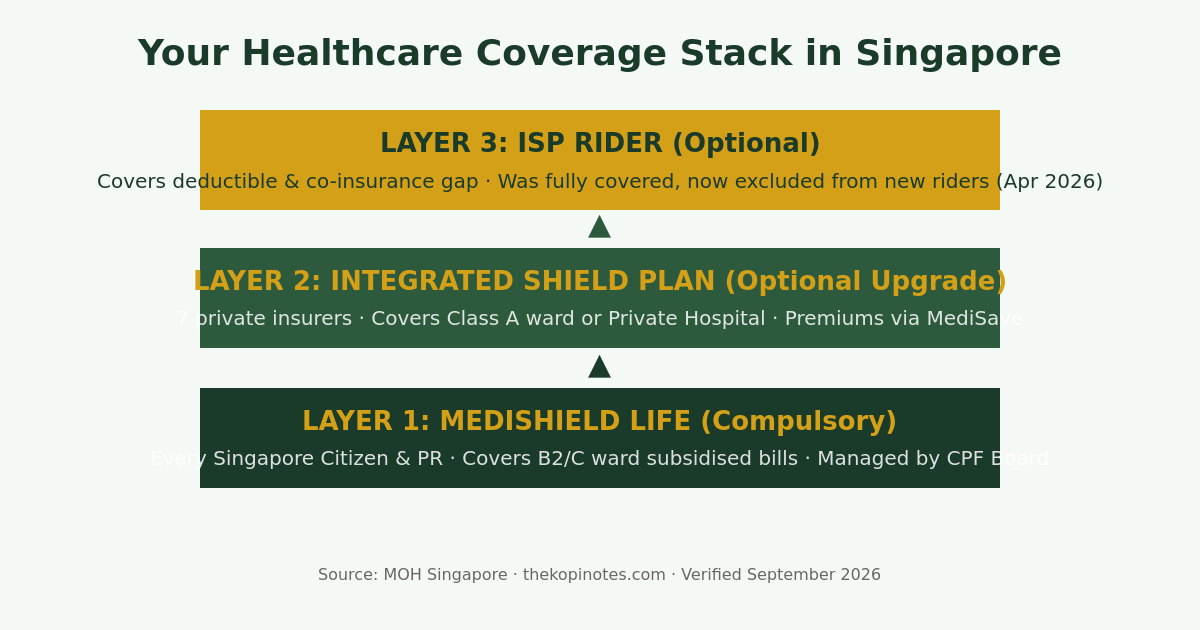
Singapore’s hospital insurance system works in three layers. Understanding each layer is crucial before you decide whether to get an ISP — and which type of rider to add.
Layer 1: MediShield Life (Compulsory)
Every Singapore Citizen and PR is automatically enrolled in MediShield Life. It pays for large hospitalisation bills at subsidised Class B2/C wards. Premiums are paid via MediSave and increase with age. MediShield Life has a deductible (the amount you pay first before insurance kicks in) and co-insurance (a percentage of the remaining bill you share). It does not cover private hospitals beyond basic limits.
Layer 2: Integrated Shield Plan (Optional)
An ISP upgrades your coverage to Class A wards or private hospitals, depending on which plan you choose. Your ISP insurer pays the MediShield Life component and adds their own additional coverage on top. Premiums are higher than MediShield Life alone, but are payable via MediSave within MOH-set withdrawal limits. ISPs also come with their own deductibles and co-insurance structure.
Layer 3: ISP Rider (Optional)
A rider is an add-on policy that sits on top of your ISP. Historically, riders covered the deductible and co-insurance, which meant policyholders paid very little or nothing out of pocket for large bills. However, as of 1 April 2026, new ISP riders are no longer allowed to cover the minimum deductible. The co-payment cap has also been raised from $3,000 to $6,000 per year. See Section 5 for full details on the 2026 changes.
If you haven’t reviewed your ISP recently, our guide to the best Integrated Shield Plans in Singapore compares all seven providers side by side.
ISP Tiers: Standard, Class A Ward & Private Hospital
ISPs come in different tiers based on the highest ward class they cover. Choosing the right tier depends on your budget, lifestyle, and how important hospital choice is to you.
| ISP Tier | Max Ward Covered | Hospital Type | Typical Annual Premium (Age 35) |
|---|---|---|---|
| Standard (Integrated) | Class B1 or B2+ | Restructured hospital (subsidised) | ~$300–$500/year |
| Class A Ward | Class A | Restructured hospital (private room) | ~$500–$900/year |
| Private Hospital | Private ward / Private hospital | Any private hospital in Singapore | ~$700–$1,200/year |
Premium estimates are indicative for a healthy 35-year-old as at September 2026. Actual premiums vary by insurer and plan tier. Verify with your insurer or a licensed financial adviser.
Most Singaporeans who upgrade to an ISP choose either a Class A or Private Hospital plan. The Standard tier (B2+) is less common because the premium savings are modest relative to what MediShield Life already provides, and Class A plans offer substantially better ward access at a reasonable additional cost.
If you’re specifically comparing Class A ward coverage, our ISP comparison guide breaks down each provider’s plan benefits, riders, and premiums in detail.
The 7 ISP Providers Approved by MOH
As at September 2026, MOH has approved seven private insurers to offer Integrated Shield Plans in Singapore. All seven plans include the MediShield Life component plus the insurer’s own additional benefits.
| Insurer | ISP Plan Name | Key Features |
|---|---|---|
| AIA Singapore | AIA HealthShield Gold Max | Plans A (private), B+ (Class A), B; panel and non-panel options |
| Great Eastern Life | GREAT SupremeHealth | Plans P Plus (private), A Plus (Class A), B Plus; extensive panel network |
| HSBC Life | HSBC Life Shield | Standard and enhanced plans; competitive premiums |
| Income Insurance | Enhanced IncomeShield | Preferred (private), Advantage (Class A), Basic; strong policyholder base |
| Prudential Singapore | PRUShield | Plus (private), Premier (Class A), Standard; flexible riders available |
| Raffles Health Insurance | RafflesShield | Private and Class A tiers; strong at Raffles Hospital network |
| Singlife | Singlife Shield | Plans 1 (private), 2 (Class A), 3 (B1); strong digital experience |
Source: Ministry of Health Singapore (moh.gov.sg), September 2026.
All seven plans cover hospitalisation and surgery (including day surgery) at their respective ward tiers. Key differences lie in the panel of doctors and hospitals, premium pricing, pre-authorisation requirements, and the riders available to supplement the base plan.
For provider-specific deep dives, see our reviews of AIA HealthShield Gold Max, GREAT SupremeHealth, Singlife Shield, and PRUShield.
ISP Riders & the April 2026 Changes
An ISP rider is an add-on insurance policy that covers the deductible and co-insurance portions of your ISP — the parts your base ISP does not pay. Before April 2026, you could buy a rider that effectively left you with zero or near-zero out-of-pocket costs for any hospitalisation, regardless of bill size.
This changed significantly in 2026.
What Changed on 1 April 2026
MOH announced changes in November 2025, effective from 1 April 2026. The key changes for new ISP riders purchased from this date:
- Riders can no longer cover the minimum deductible — you must pay $1,500–$3,500 per year out of pocket before insurance pays
- The co-payment annual cap has been raised from $3,000 to $6,000 per year (excluding the deductible)
- The minimum 5% co-insurance remains in place — riders still cannot cover this portion below 5%
- Premiums dropped by approximately 30% for new riders to reflect the reduced coverage
What This Means in Practice
If you are hospitalised in a private hospital with a new (post-April 2026) rider, your out-of-pocket costs could include:
- Your full deductible (up to $3,500, depending on plan and ward used)
- 5% co-insurance on the remaining bill
- Up to $6,000/year in total co-pay (capped)
For a major surgery with a $50,000 bill, this means you could pay the $3,500 deductible plus your co-insurance — but total out-of-pocket is capped at $6,000 (excluding deductible) under the rider.
Existing Riders Are Grandfathered
If you purchased your rider before 27 November 2025, your existing benefits are grandfathered — the old terms continue for your policy. You do not need to change your rider unless you choose to.
Source: MOH Singapore press release, November 2025; effective 1 April 2026.
Using MediSave to Pay ISP Premiums
One of the most practical features of ISPs is that you can pay your premiums using your CPF MediSave account — you don’t need to write a cheque or set up a GIRO for the basic ISP portion. MOH sets annual MediSave withdrawal limits by age band, and your ISP insurer will automatically deduct from your MediSave each year.
MediSave Withdrawal Limits for ISP Premiums (2026)
ISP premiums are funded from MediSave in two parts: (1) the MediShield Life component, which is fully payable from MediSave, and (2) the Additional Withdrawal Limit (AWL), which covers the private insurer’s additional coverage layer.
MOH sets the AWL in three age bands (measured by age next birthday):
| Age (Next Birthday) | AWL — Additional MediSave for Private ISP Layer |
|---|---|
| 40 and below | $300/year |
| 41 to 70 | $600/year |
| 71 and above | $900/year |
Source: CPF Board (cpf.gov.sg), verified September 2026. The MediShield Life base component is payable from MediSave separately and in full. The AWL covers only the private insurer’s additional layer. Always verify current limits at cpf.gov.sg before purchasing or renewing.
If your ISP premium exceeds the MediSave withdrawal limit for your age band, you pay the excess in cash. This becomes a consideration when you choose Private Hospital plans in your 40s and 50s, as premiums can exceed the MediSave limit.
Riders are generally paid separately — a portion may be payable via MediSave (within the Additional Withdrawal Limit for riders), and the rest in cash. The rider MediSave limit is separate from the ISP plan premium limit above.
For a full breakdown of MediSave withdrawal limits, see our guide on MediSave withdrawal limits 2026.
Who Should Get an ISP?
An ISP is worth considering if any of the following apply to you:
- You want to choose your doctor or specialist — with an ISP, you’re not limited to whichever doctor is on duty in a subsidised ward
- You prefer shorter waiting times — Class A and private wards typically have faster access to elective procedures and specialists
- You have a family history of serious illness — having private hospital access already set up means you’re not scrambling to upgrade your plan when a diagnosis arrives (pre-existing conditions are typically excluded after purchase)
- You’re self-employed or don’t have employer-sponsored group insurance — without group coverage, an ISP provides your main safety net
- Your MediSave balance can cover the premium increase — for most working Singaporeans under 50, the MediSave contribution is sufficient to cover ISP premiums
Who Might Not Need to Upgrade
If you’re comfortable being treated in subsidised wards, already have strong employer-provided group health insurance, or are on a very tight budget, the standard MediShield Life coverage (or a low-tier ISP) may be sufficient. Singapore’s restructured hospitals provide excellent care across all ward classes — ward type mainly affects comfort and choice of doctor, not quality of medical treatment.
Need help figuring out whether to upgrade? Connect with a licensed financial adviser or use MOH’s official ISP comparison tool on the MOH website.
Frequently Asked Questions
What is the difference between MediShield Life and an Integrated Shield Plan?
Is an Integrated Shield Plan compulsory in Singapore?
How much does an Integrated Shield Plan cost?
Can I use MediSave to pay for my ISP?
What happened to ISP riders in April 2026?
How many ISP providers are there in Singapore?
Do ISPs cover pre-existing conditions?
Can PRs buy an Integrated Shield Plan?
Get Free Insurance Advice
Speak with a licensed insurance advisor. No obligation, no cost.
By submitting this form, you agree to our Privacy Policy.
This article was researched with the help of AI. While we strive to keep all information accurate and up to date, there may be errors. If you notice any discrepancies, please contact us.