ISP Rider Comparison 2026: Which New Shield Plan Rider Should You Get After April’s Changes?
As of 1 April 2026, all new Integrated Shield Plan (ISP) riders sold in Singapore must follow MOH’s new rules: riders can no longer cover the deductible, and the co-payment cap has risen from $3,000 to $6,000 per year. The upside? Premiums have dropped by 30% to 84% across the board. This ISP rider comparison covers every insurer’s new rider so you can decide whether to switch, stay, or start fresh.
Not financial advice. All figures are for educational reference only. Data verified as at 26 August 2026.
- From April 2026, your new ISP rider won’t cover your deductible ($1,500-$3,500). Your worst-case out-of-pocket is now $7,500-$9,500/year.
- New rider premiums are 30-84% cheaper than legacy riders. Singlife delivered the largest cuts.
- If you bought your old rider before 27 November 2025, it is grandfathered – do not switch without doing the maths first.
What Changed with ISP Riders in April 2026
Before April 2026, most Singaporeans with a full rider were effectively fully covered. You paid almost nothing out-of-pocket. It was the reason private hospital bills were not scary.
MOH changed that on 1 April 2026. Here is what the new rules mean in plain English.
1. Riders can no longer cover your deductible. Every ISP has a minimum deductible – the first chunk of your hospital bill that you must pay before insurance kicks in. Your new rider cannot cover this amount. You pay it yourself, every policy year.
2. The co-payment cap doubled from $3,000 to $6,000. After the deductible, you still pay 5% co-insurance on your bill. Previously, the most you would pay in co-insurance was $3,000 per year. Now it is $6,000. Once you hit that cap, your insurer covers the rest.
3. Premiums dropped significantly. Because you now bear more risk, insurers charge less. New rider premiums are 30% to 84% lower than legacy riders, depending on the insurer and plan tier.
The logic from MOH: when patients bear some cost, they are less likely to over-consume healthcare. This is meant to break the cycle of rising claims, rising premiums, and rising private hospital bills.
What You Now Pay Out-of-Pocket
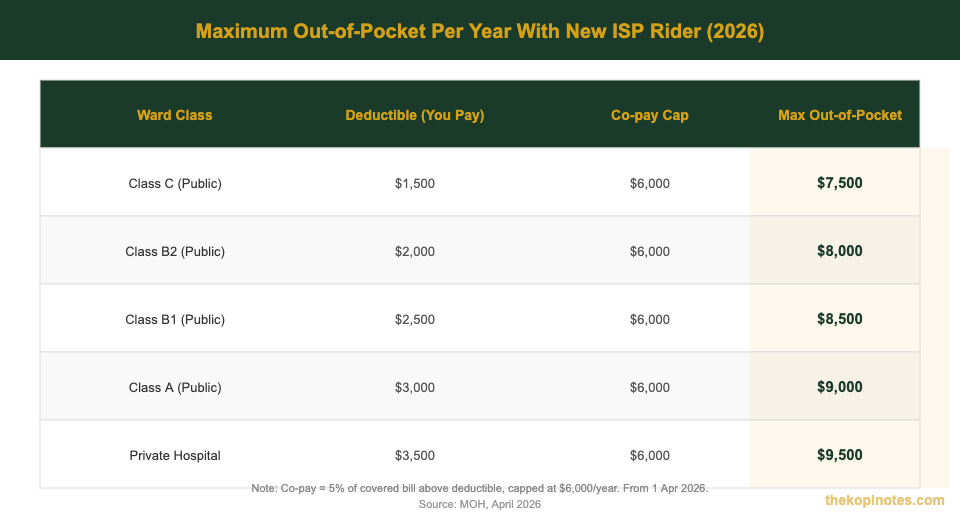
The deductible you pay depends on the ward class you are admitted to. Here is the breakdown:
| Ward Class | Deductible (You Pay First) | Co-pay Cap | Max Out-of-Pocket/Year |
|---|---|---|---|
| Class C (Public) | $1,500 | $6,000 | $7,500 |
| Class B2 (Public) | $2,000 | $6,000 | $8,000 |
| Class B1 (Public) | $2,500 | $6,000 | $8,500 |
| Class A (Public) | ~$3,000 | $6,000 | ~$9,000 |
| Private Hospital | $3,500 | $6,000 | $9,500 |
Source: Ministry of Health, April 2026. Deductible applies per policy year. Co-pay = 5% of covered bill above deductible, capped at $6,000/year. Class A deductible is indicative – confirm the exact amount with your insurer. Co-pay cap excludes the deductible.
Here is a practical example. You are admitted to a private hospital and your bill is $20,000.
- You pay the $3,500 deductible first.
- The remaining $16,500 triggers 5% co-insurance = $825.
- Total you pay: $3,500 + $825 = $4,325.
- Insurance covers the rest: $15,675.
If your bill were $160,000, the 5% co-insurance would hit the $6,000 cap. You would pay $3,500 + $6,000 = $9,500 total. Insurance covers the remaining $150,500. That is genuine catastrophic coverage at work.
New Rider Comparison: All 7 ISP Insurers
All seven ISP insurers in Singapore had to comply with the April 2026 changes. Here is how each responded.
Singlife: Health Plus Riders
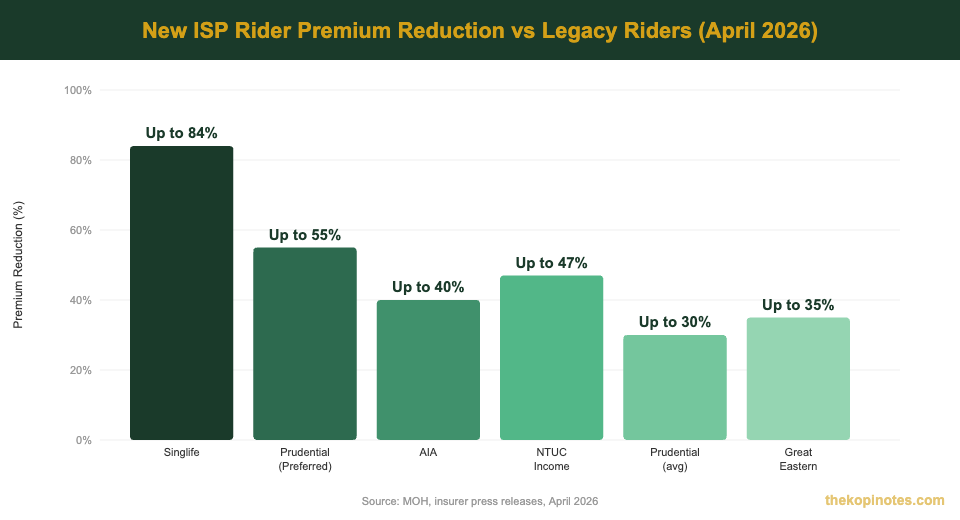
Singlife delivered the largest premium cuts of any insurer, with reductions ranging from 30% to 84%. Their new riders are called Health Plus Private, Health Plus Public, and Health Plus B1.
The rider structure follows the April 2026 rules: no deductible coverage, $6,000 co-pay cap, 5% co-insurance. The dramatic premium savings reflect how expensive legacy Singlife riders had become relative to competitors. For a full breakdown, see our Singlife Shield Plan 2026 review.
Prudential: PRUExtra Care Suite
Prudential launched a refreshed suite under the PRUExtra Care name. The flagship rider for private hospital coverage, PRUExtra Preferred Care, costs at least 45% less than its predecessor across all age groups. Some age groups see savings of up to 55%.
Other riders in the suite are at least 30% cheaper. Prudential noted that benefits were maintained or improved despite the cuts. See our Prudential ISP guide for details.
AIA: Max VitalHealth Pro Series
AIA launched the Max VitalHealth Pro series in three tiers: Pro A (private hospital), Pro B (Class A ward), and Pro B Lite.
AIA’s new riders include a notable perk: earn 15% of VitalHealth Pro premiums back as eCapitaVouchers, plus up to 6% back in Vitality coins with a valid AIA Vitality membership. Average premium reduction is around 35 to 40%. See our AIA Max VitalHealth Pro review for the full picture.
NTUC Income: Optima Care and Essential Care
NTUC Income replaced its Deluxe Care and Classic Care riders with Optima Care and Essential Care, effective 1 April 2026. Premiums are 23% to 47% cheaper than the old riders.
Income also offers a 15% welcome discount on first-year premiums for new IncomeShield Standard Plan applications between 1 April 2026 and 31 March 2027. Our NTUC Income IncomeShield review covers the full picture.
Great Eastern: GREAT SupremeHealth Riders
Great Eastern updated its SupremeHealth rider lineup in line with the April 2026 requirements. Their new riders no longer cover the deductible and feature the $6,000 co-payment cap. Premium reductions are broadly in line with the ~30% industry average. Read our Great Eastern SupremeHealth review for a detailed comparison.
HSBC Life and Raffles Health
Both HSBC Life and Raffles Health updated their riders to comply with the April 2026 rules. These insurers have smaller market share but offer competitive premiums for specific needs, particularly Raffles Health for those who prefer the Raffles hospital network.
| Insurer | New Rider Name | Coverage Tier | Premium Reduction vs Legacy |
|---|---|---|---|
| Singlife | Health Plus Private/Public/B1 | Private / Class A / B1 | 30-84% |
| Prudential | PRUExtra Preferred/Premier Care | Private / Class A | 30% to 55% |
| AIA | Max VitalHealth Pro A/B/B Lite | Private / Class A | ~35 to 40% |
| NTUC Income | Optima Care / Essential Care | Private / Class A | 23 to 47% |
| Great Eastern | GREAT SupremeHealth Riders | Private / Class A / B1 | ~30% |
| HSBC Life | Updated rider suite | Private / Class A | ~30%+ |
| Raffles Health | Updated rider suite | Private | ~30%+ |
Source: Insurer press releases, MOH, August 2026. Premium reductions vs. pre-April 2026 legacy riders. Exact % varies by age band and plan tier. All new riders: no deductible coverage, $6,000 co-pay cap, 5% co-insurance.
Old Rider vs New Rider: Should You Switch?
This is the most important question. If you bought your ISP rider before 27 November 2025, you are grandfathered. Your old rider stays as-is, with the deductible covered and the $3,000 co-pay cap intact.
Keep your grandfathered rider if:
- You are older or have pre-existing conditions. A $9,500 annual out-of-pocket maximum is financially painful if you are hospitalised regularly.
- The premium savings do not cover the coverage gap. If you save $800/year but now face a $3,500 deductible, you need 4+ years without hospitalisation to break even.
- You value certainty. The old rider gives you a known, low cost per hospitalisation.
The new rider probably makes sense if:
- You are young and healthy. If you rarely get hospitalised, lower premiums are a clear win.
- You have sufficient savings. If you can comfortably absorb a $9,500 out-of-pocket scenario, the lower premium is attractive.
- Your legacy rider premium became very expensive. For some older policyholders, legacy riders became extremely costly. The 30-84% reduction may be worth accepting the new structure.
The bottom line: run the numbers for your situation. Do not switch purely because premiums are lower. The coverage gap is real and permanent once you give up grandfathered status.
For a full guide on choosing the right ISP ward class for your needs, read our guide to the best ISP for Class A ward coverage.
Which Rider Is Best for Your Situation?
There is no single best rider for everyone. Here is a simple decision framework.
Targeting private hospital coverage? Compare Singlife Health Plus Private, Prudential PRUExtra Preferred Care, and AIA Max VitalHealth Pro A. Get premium quotes for your age band from each insurer’s website – the gap varies significantly by age.
Targeting Class A ward in a public hospital? Singlife Health Plus Public, AIA Max VitalHealth Pro B, and NTUC Income Optima Care are solid options. These are noticeably cheaper than private-hospital riders while still giving you single-bedded Class A accommodation.
Happy with Class B1? Singlife Health Plus B1 or Great Eastern’s B1 rider. You pay the $2,500 deductible but enjoy much lower premiums and covered for a decent ward standard.
Want extra perks? AIA’s Vitality programme lets you earn back cashback on premiums through health activities. Worth considering if you are motivated by rewards and willing to engage with the programme.
Want the simplest experience? NTUC Income has the largest agent network in Singapore and straightforward rider options – a good fit if you value face-to-face advice.
Whichever insurer you choose, make sure your ISP base plan matches the ward class your rider targets. A mismatch creates gaps in coverage that can be costly at claim time.
Frequently Asked Questions
What is the new ISP rider deductible from April 2026?
What is the co-payment cap for new ISP riders in 2026?
My rider was bought before November 2025 - do I need to switch?
How much cheaper are the new ISP riders compared to old riders?
Can I use Medisave to pay for ISP rider premiums?
Which ISP insurer had the biggest premium reduction in 2026?
Not financial advice. ISP premiums and benefits vary by insurer, age, and plan selection. Always consult your insurer or a licensed financial adviser before making changes to your coverage. Data verified as at 26 August 2026.
Get Free Insurance Advice
Speak with a licensed insurance advisor. No obligation, no cost.
By submitting this form, you agree to our Privacy Policy.
This article was researched with the help of AI. While we strive to keep all information accurate and up to date, there may be errors. If you notice any discrepancies, please contact us.