Singlife Shield Plan 2 Review 2026: Class A Coverage, Premiums & Rider Changes
A complete guide to Singlife Shield Plan 2 — what it covers, how much it costs, and what the April 2026 rider changes mean for you.
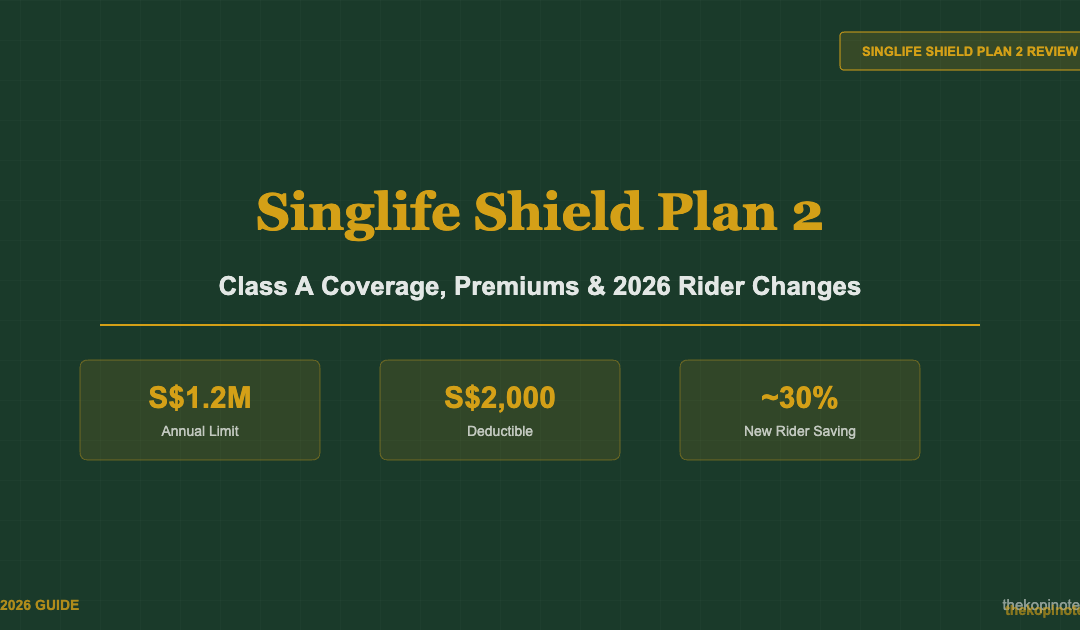
Singlife Shield Plan 2 is an Integrated Shield Plan (ISP) that covers Class A ward stays at restructured hospitals in Singapore. It provides an annual claim limit of S$1,200,000, a deductible of S$2,000 per policy year, and is fully payable by MediSave. From April 2026, new Health Plus riders for Plan 2 no longer cover the deductible — but premiums drop by approximately 30%.
Not financial advice. All figures are for educational reference only. Data as at June 2026 unless noted.
- Singlife Shield Plan 2 covers Class A wards at restructured hospitals — a meaningful upgrade from base MediShield Life at B2/C wards
- Annual claim limit is S$1,200,000 with a S$2,000 deductible; premiums are fully MediSave-payable for most age groups
- From April 2026, new Health Plus riders no longer cover the deductible — but cost ~30% less and add a S$20,000 Recovery Support benefit
Table of Contents
Contents — Click to expand
What Is Singlife Shield Plan 2?
Singlife Shield Plan 2 is one of three tiers of the Singlife Shield Integrated Shield Plan (ISP) — the others being Plan 1 (private hospitals) and the Standard Plan (Class B1 wards). Plan 2 sits in the middle, designed for Singaporeans who want a meaningful upgrade from base MediShield Life without paying the higher premiums of private hospital coverage.
In practical terms: your mandatory MediShield Life only covers subsidised Class B2 and C wards at restructured hospitals. Plan 2 upgrades you to a Class A ward — a single-bedded room — at Singapore’s restructured hospitals like Singapore General Hospital (SGH), National University Hospital (NUH), and Tan Tock Seng Hospital. You get more privacy, a better amenity tier, and the same specialist care as higher wards.
Singlife Shield Plan 2 is sold by Singlife (formerly NTUC Income’s insurance arm), one of five insurers approved by the Ministry of Health (MOH) to offer Integrated Shield Plans in Singapore. The plan sits on top of your MediShield Life, extending both your ward entitlement and your annual claim limit well beyond what base MediShield Life alone provides.
Like all ISPs, premiums for the base Plan 2 are payable entirely by MediSave — you don’t need to spend cash on the base plan for most age groups. If you want to add a Health Plus rider for additional co-insurance protection, that rider premium may require partial cash payment depending on your age and MediSave balance.
Plan 2 Coverage: What It Includes
Here are the key coverage details for Singlife Shield Plan 2 as at June 2026:
| Feature | Singlife Shield Plan 2 (2026) |
|---|---|
| Hospital Entitlement | Class A ward at restructured hospitals |
| Annual Policy Limit | S$1,200,000 |
| Deductible (per policy year) | S$2,000 |
| Co-Insurance (without rider) | 10% of bill after deductible |
| Living Donor Organ Transplant | S$30,000 (lifetime) |
| Critical Illness Benefit | Up to S$100,000 per year |
| MediSave Payable | Yes (base plan, up to MediSave withdrawal limits) |
| Optional Rider | Singlife Health Plus (reduces co-insurance) |
| Approved by MOH | Yes — MediSave-approved ISP |
Source: Singlife Shield Plan 2 product brochure and policy contract, June 2026
The S$1,200,000 annual limit is far higher than what MediShield Life provides — MediShield Life’s annual claim limits are much lower and would be quickly exhausted by a serious illness or prolonged hospitalisation. With Plan 2, you’re covered for virtually any realistic inpatient bill at a Class A restructured hospital ward.
The S$2,000 deductible means you pay the first S$2,000 of your hospitalisation bill yourself each policy year. Once you’ve paid that, insurance kicks in. If you add a Health Plus rider (old-style, pre-November 2025), the rider covers that deductible for you. Under the new April 2026 riders, you pay the S$2,000 yourself but benefit from lower rider premiums — more on this below.
Singlife Shield Plan 2 vs Plan 1
The most common question about Singlife Shield is whether to choose Plan 2 (Class A) or Plan 1 (private hospitals). Here’s a direct side-by-side:
| Feature | Plan 2 (Class A) | Plan 1 (Private Hospital) |
|---|---|---|
| Hospital Coverage | Class A, restructured hospitals | Private hospitals (Gleneagles, Mount Elizabeth, Parkway, etc.) |
| Annual Policy Limit | S$1,200,000 | S$2,000,000 |
| Annual Deductible | S$2,000 | S$3,500 |
| Critical Illness Benefit | Up to S$100,000/year | Up to S$150,000/year |
| Living Donor Transplant | S$30,000 (lifetime) | S$50,000 (lifetime) |
| Premium (Age 40, indicative) | ~S$325/year | ~S$565/year |
| Best For | Those happy with restructured hospitals, value-focused | Private hospital preference, highest coverage |
Source: Singlife Shield product brochure, June 2026. Premiums are indicative — verify at singlife.com for your exact age.
The key trade-off is clear: Plan 1 costs roughly 70–80% more in premiums than Plan 2. In exchange, you get private hospital access, a higher annual limit, and a larger critical illness benefit. Plan 2 is meaningfully cheaper, and for most Singaporeans, a Class A ward at a well-equipped restructured hospital provides excellent care — the trade-off is no access to private hospitals.
If you’re deciding between the two, it’s worth considering which hospitals are actually in your area, and whether you have a strong preference for private hospital care. A good way to weigh the options is our full Singlife Shield Plan complete guide, which covers all three tiers in detail.
Singlife Shield Plan 2 Premiums (2026)
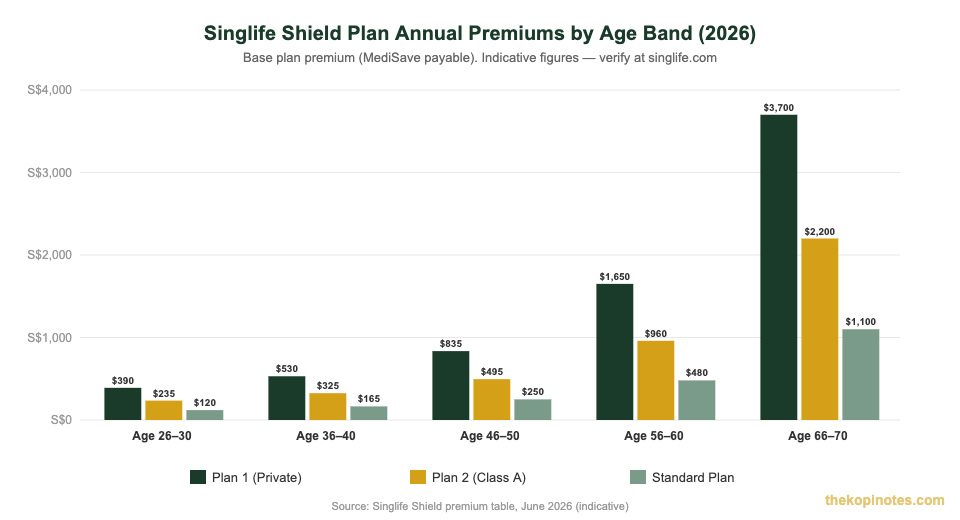
Singlife Shield Plan 2 premiums are tiered by age and are fully payable by MediSave — meaning you don’t need to spend any cash on the base plan, as long as your MediSave balance is sufficient and within the annual withdrawal limits set by MOH.
Here are indicative annual premiums for Plan 2 by age band as at 2026:
| Age Band | Plan 2 Annual Premium (Indicative) | Fully MediSave Payable? |
|---|---|---|
| Age 1–20 | ~S$90–S$180 | Yes |
| Age 21–30 | ~S$210–S$260 | Yes |
| Age 31–40 | ~S$270–S$370 | Yes |
| Age 41–50 | ~S$430–S$560 | Yes (check MediSave limits) |
| Age 51–60 | ~S$820–S$1,100 | Partially — may need cash top-up |
| Age 61–70 | ~S$1,900–S$2,500 | Partially — cash top-up likely |
| Age 71+ | ~S$3,000–S$5,500+ | Partial — check with Singlife |
Source: Singlife Shield premium schedule, June 2026. Indicative ranges only — visit singlife.com for your exact premium based on date of birth and entry age.
A few things to note. First, premiums rise sharply with age — this is standard across all ISPs, reflecting higher medical risk at older ages. Second, the MediSave withdrawal limits set by MOH cap how much you can use. For younger Singaporeans (under 50), the base Plan 2 premium is typically within MediSave limits. From your 50s onwards, you may need to top up with cash for the base plan itself — let alone the rider.
The Health Plus rider premium is separate on top of the base plan figures above. If you want to understand how your ISP premiums fit into your overall retirement cost picture, the Singapore retirement calculator on TKN can help you model long-term healthcare costs alongside your CPF and investment projections.
One more important point: ISP premiums are not guaranteed. Singlife can revise premiums at renewal. If you’re comparing Plan 2 against other ISPs purely on price, remember that today’s lower-priced plan may not stay cheaper in future years. The claims experience across the whole ISP pool — not just your individual health — affects future premium levels.
April 2026 Rider Changes: What Changed for Plan 2?
From 1 April 2026, MOH implemented major reforms to ISP riders across all insurers, including Singlife. These changes affect what the Health Plus rider covers and how much it costs. Here’s exactly what changed for Plan 2 policyholders:
1. New riders no longer cover the S$2,000 deductible. Under the old Health Plus rider, your S$2,000 annual deductible on Plan 2 was covered — you paid almost nothing out of pocket even for significant bills. Under new riders sold from April 2026, you must pay the S$2,000 deductible yourself every policy year, before insurance and the rider kick in.
2. The co-payment cap doubled from S$3,000 to S$6,000. After paying the deductible, your remaining out-of-pocket co-insurance is now capped at S$6,000 per year (excluding the deductible), up from S$3,000. For Plan 2 policyholders who get hospitalised with a large bill, the worst-case annual out-of-pocket is now S$2,000 (deductible) + S$6,000 (co-pay cap) = S$8,000 — versus S$3,000 under the old rider.
3. Premiums drop by approximately 30%. The trade-off is meaningfully lower rider premiums. MOH estimates the new riders cost about 30% less than old-style riders with maximum coverage. For public hospital riders (which Plan 2 uses), the saving is estimated at around S$200 per year on average. Over 10–15 years, that adds up.
4. New Recovery Support Benefit added. New Health Plus riders include up to S$20,000 (lifetime) for home nursing care and rehabilitation services after hospitalisation. This is a new benefit that wasn’t in old riders — particularly useful for Plan 2 policyholders recovering from surgery at restructured hospitals.
These changes were implemented by MOH because private hospital IP policyholders with old-style “near-zero out-of-pocket” riders were 1.4 times more likely to make claims, with average claim sizes 1.4 times higher than those without riders. MOH’s goal is to bring cost discipline back to the system and moderate the spiral of rising premiums. For the full background on why these changes happened, see our ISP rider changes 2026 guide.
Old Health Plus Rider vs New Health Plus Rider: Which Is Better?
This is the most important question for existing Singlife Shield Plan 2 policyholders. The answer depends almost entirely on when you bought your rider.
- Bought before 27 Nov 2025: Fully grandfathered — keep your old rider indefinitely. Do not switch.
- Bought 27 Nov 2025 – 31 Mar 2026: Keep current benefits until your first renewal after 1 April 2028, then transition.
- Bought from 1 April 2026: New rules apply immediately. S$2,000 deductible not covered, S$6,000 co-pay cap, ~30% lower premiums.
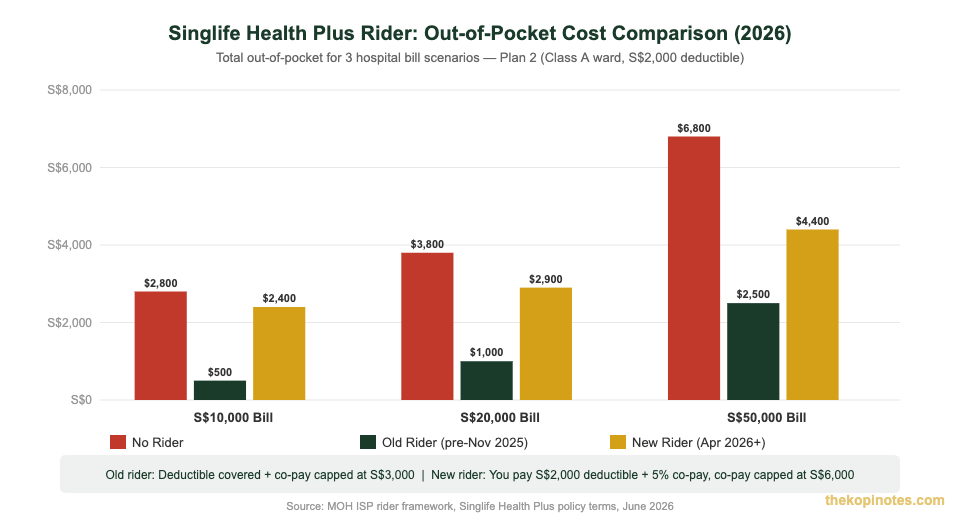
Here’s a worked example for a Plan 2 policyholder hospitalised with a S$20,000 bill under each scenario:
| Cost Component | No Rider | Old Health Plus Rider | New Health Plus Rider (Apr 2026) |
|---|---|---|---|
| Deductible (S$2,000) | S$2,000 | Covered by rider | S$2,000 (you pay) |
| Co-Insurance | S$1,800 (10% of S$18,000) | S$1,000 (5% of S$20,000, capped at S$3,000) | S$900 (5% of S$18,000, capped at S$6,000) |
| Total Out-of-Pocket | S$3,800 | S$1,000 | S$2,900 |
| Insurance Pays | S$16,200 | S$19,000 | S$17,100 |
Source: MOH ISP rider framework, Singlife Health Plus policy terms, June 2026. Note: deductible and co-payments are MediSave-eligible up to prevailing withdrawal limits.
The old rider saves you S$1,900 in out-of-pocket costs compared to the new rider on a S$20,000 bill. However, you’re paying more in annual premiums to keep that old rider. Whether it’s worth it depends on how often you’re hospitalised.
MOH’s data shows an average 40-year-old is hospitalised once or twice in a 20-year period. If you’re hospitalised once in 10 years, and the old rider costs S$200 more per year, you’re paying S$2,000 extra in premiums for one hospitalisation where it saves you S$1,900. The numbers are close — but the peace of mind value of the old rider is real, especially as you get older and hospitalisation becomes more likely.
Bottom line: If you have an old Health Plus rider on Plan 2, don’t switch unless a licensed financial adviser specifically reviews your situation and recommends it. The deductible protection and lower co-pay cap are genuinely valuable. You can use your MediSave to cover the deductible under the new rider — but it still reduces your MediSave balance that you may need for other healthcare costs.
Who Should Choose Singlife Shield Plan 2?
Plan 2 is the right choice for a specific type of Singaporean. Here’s a practical framework to decide:
Choose Singlife Shield Plan 2 if:
- You’re happy receiving treatment at restructured hospitals like SGH, NUH, TTSH, or KKH
- You want a single-bedded Class A room rather than sharing a ward
- You’re looking for the middle ground — more than basic MediShield Life, but not paying private hospital premiums
- You’re in your 20s to 40s and want meaningful long-term coverage at affordable premiums
- You’re comfortable with restructured hospital specialists and the public hospital system
Choose Plan 1 instead if:
- You have a strong preference for private hospitals and private specialists
- You want the highest possible annual claim limit (S$2M vs Plan 2’s S$1.2M)
- You can afford the higher premium and want maximum flexibility in hospital choice
Consider a different ISP if:
- Singlife’s panel network or specific pre-authorisation rules don’t suit your needs
- Another insurer offers a meaningfully better Class A plan at the same price point
- You have pre-existing conditions that may be excluded from a new Singlife policy
If you’re comparing Singlife Shield Plan 2 against the equivalent Class A plans from AIA, Prudential, or Great Eastern, use our integrated shield plan comparison guide to see them side by side. Each insurer has slightly different panel networks, pre-authorisation requirements, and benefit limits that affect real out-of-pocket costs.
One thing to be careful about: don’t switch ISP providers purely based on premiums. Switching requires new underwriting — any health conditions that developed while you were on your old plan could be excluded from the new policy. This is a major risk that often outweighs any premium saving. Always speak to a licensed financial adviser before switching ISPs. For planning how your ISP fits into your overall financial picture, the integrated shield plan explainer walks through where ISP coverage ends and what else you need.
Not financial advice. Always consult a licensed financial adviser before making insurance decisions. Data as at June 2026.
Frequently Asked Questions
What does Singlife Shield Plan 2 cover?
Singlife Shield Plan 2 covers Class A ward hospitalisation at restructured hospitals in Singapore, with an annual policy limit of S$1,200,000. It covers inpatient treatment, day surgery, and pre- and post-hospitalisation expenses (within policy limits), and includes a critical illness benefit of up to S$100,000 per year. It also covers living donor organ transplants up to S$30,000 (lifetime). The base plan premium is fully payable by MediSave for most age groups.
What is the difference between Singlife Shield Plan 1 and Plan 2?
Plan 2 covers Class A ward at restructured hospitals (like SGH or NUH), with a S$1,200,000 annual limit and a S$2,000 deductible. Plan 1 covers private hospitals (Gleneagles, Mount Elizabeth, Parkway East, etc.), with a higher S$2,000,000 annual limit and a S$3,500 deductible. Plan 1 costs roughly 70–80% more in annual premiums than Plan 2. Choose Plan 1 if private hospital access is a priority; Plan 2 if you’re happy with restructured hospitals and want lower premiums.
Did the Singlife Shield Plan 2 rider change in 2026?
Yes. From 1 April 2026, new Singlife Health Plus riders for Plan 2 no longer cover the annual S$2,000 deductible, and the co-payment cap rose from S$3,000 to S$6,000 per year. However, premiums for the new riders are approximately 30% lower, and a new Recovery Support Benefit of up to S$20,000 (lifetime) for home nursing and rehabilitation was added. If you purchased your existing rider before 27 November 2025, your old terms are grandfathered — you don’t need to switch.
Should I switch from my old Health Plus rider to the new one?
In most cases, no — if you bought your rider before 27 November 2025, keep it. The old rider covers your S$2,000 deductible and caps your co-insurance at S$3,000 per year, giving you much lower out-of-pocket costs if hospitalised. The new rider’s ~30% premium saving is unlikely to outweigh the loss of deductible coverage for most Plan 2 policyholders, especially if you use your ISP regularly. Always consult a licensed financial adviser before switching.
Can I pay for Singlife Shield Plan 2 using MediSave?
Yes. The Singlife Shield Plan 2 base premium is fully payable by MediSave up to the withdrawal limits set by MOH. For younger Singaporeans (under 50), the base Plan 2 premium is typically within MediSave limits — no cash needed. From your 50s onwards, the premium may exceed MediSave limits and require a partial cash top-up. The Health Plus rider premium may also require cash payment depending on your age. Check your MediSave balance and the current MOH withdrawal limits at cpf.gov.sg before committing.
How does Singlife Shield Plan 2 compare to other Class A ISPs?
Singlife, AIA, Prudential, Great Eastern, and Raffles Health Insurance all offer Class A tier Integrated Shield Plans. They share broadly similar structures — base plan plus optional rider — but differ in panel doctor networks, pre-authorisation requirements, specific benefit limits, and premium pricing. Singlife’s new Health Plus rider adds the Recovery Support Benefit (S$20,000 lifetime), which not all ISPs offer. For a full side-by-side comparison, see our integrated shield plan comparison guide.
What happens if I get hospitalised in a private hospital while on Plan 2?
If you’re on Singlife Shield Plan 2 and you choose to be hospitalised in a private hospital, your Plan 2 will only pay out up to the Class A ward benefit levels — not the full private hospital bill. You would face a significant shortfall and pay a large portion of the bill out of pocket. If private hospital access is something you want covered, you should upgrade to Singlife Shield Plan 1 (or the equivalent from another insurer). Plan 2 is specifically designed for Class A ward coverage at restructured hospitals.
Compare All Shield Plans in Singapore
See how Singlife Plan 2 stacks up against AIA, Prudential, and Great Eastern — side by side.
Get Free Insurance Advice
Speak with a licensed insurance advisor. No obligation, no cost.
By submitting this form, you agree to our Privacy Policy.
This article was researched with the help of AI. While we strive to keep all information accurate and up to date, there may be errors. If you notice any discrepancies, please contact us.