Integrated Shield Plan Rider Switch Deadline: What You Need to Know (2026-2028)
MOH changed the rules for Integrated Shield Plan riders in April 2026. Here’s exactly when you need to switch, and what it means for your wallet.
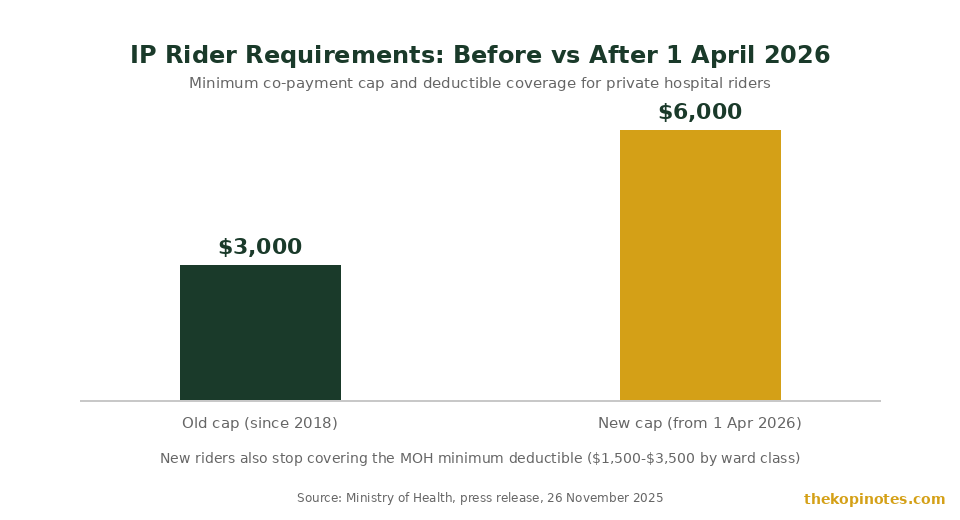
From 1 April 2026, new Integrated Shield Plan (IP) riders in Singapore no longer cover the MOH minimum deductible, and the co-payment cap rose from $3,000 to $6,000 a year. If you bought your rider on or after 27 November 2025, your insurer must move you to a compliant rider by your first policy renewal after 1 April 2028. If you bought before that date, the switch is optional — for now.
Not financial advice. All figures are for educational reference only. Data verified as at 8 August 2026 against official MOH sources.
- New IP riders sold from 1 April 2026 skip the deductible and cap your co-payment at a minimum of $6,000 a year — about 30% cheaper on average.
- If your rider was bought on or after 27 November 2025, your insurer must switch you to a compliant version by your first renewal after 1 April 2028.
- If you bought before 27 November 2025, there’s no forced deadline yet — but it’s worth comparing your options now.
What Changed for IP Riders on 1 April 2026?
An Integrated Shield Plan (IP) rider is the add-on that sits on top of your base ISP. It’s what lets you pay little to nothing out of pocket for a private hospital stay. But that “almost free” coverage came at a cost — literally.
MOH found that private hospital IP policyholders with a rider were 1.4 times more likely to make a claim, and their average claim was 1.4 times bigger than policyholders without a rider. More claims and bigger bills pushed rider premiums up every year. So on 26 November 2025, MOH announced new design rules for riders sold from 1 April 2026.
Here’s the deal in plain English. New riders can no longer cover your IP deductible — the fixed amount you must pay first before insurance kicks in. That deductible ranges from $1,500 to $3,500 a year depending on your ward class. On top of that, the minimum co-payment cap — the most you’d pay in co-insurance for the rest of the bill — went up from $3,000 to $6,000 a year.
In exchange, MOH says these new riders should cost about 30% less on average. That works out to roughly $600 a year in savings for private hospital rider holders, and around $200 a year for public hospital rider holders, according to MOH’s own modelling. You can read the full breakdown of the ISP rider changes if you want the history of how this rule came about.
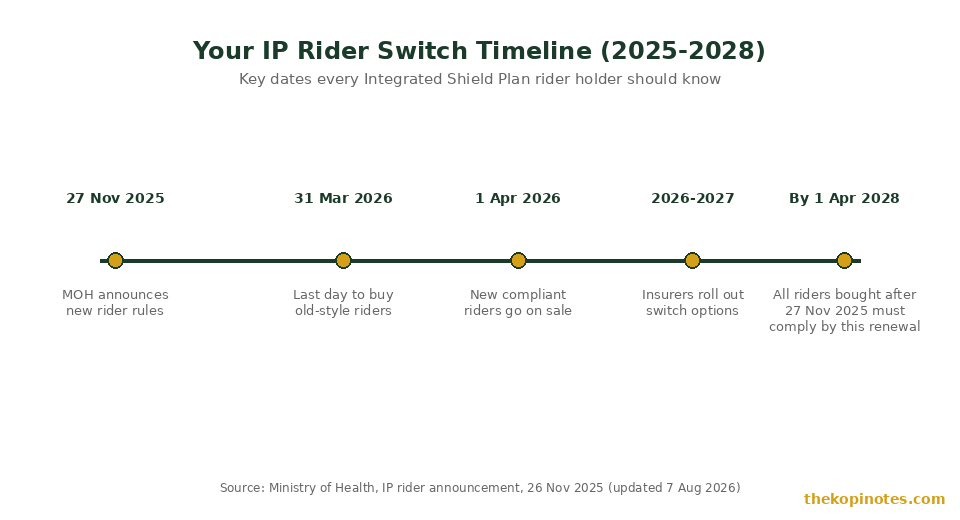
Key Dates at a Glance
| Date | What Happens |
|---|---|
| 26 Nov 2025 | MOH announces the new rider design rules. |
| 27 Nov 2025 | Cut-off date — riders bought from this date onward are flagged for future transition. |
| 31 Mar 2026 | Last day insurers can sell the old-style riders. |
| 1 Apr 2026 | New compliant riders go on sale across all insurers. Old riders can no longer be sold. |
| By 1 Apr 2028 | Anyone who bought a rider on or after 27 Nov 2025 must be moved to a compliant rider by their first policy renewal after this date. |
Source: Ministry of Health, “New Requirements for Integrated Shield Plan Riders”, 26 November 2025 (page last updated 7 August 2026).
Do You Need to Switch? Two Scenarios
Not everyone is affected the same way. It comes down to when you bought your rider.
Scenario 1 — you bought your rider on or after 27 November 2025. Your insurer is required to tell you that you’ll be moved to a compliant rider no later than your first policy renewal after 1 April 2028. This isn’t optional. You don’t need to do anything right now, but expect a letter from your insurer closer to your renewal date.
Scenario 2 — you bought your rider before 27 November 2025. There’s no forced switch date for you yet. MOH has left it to individual insurers to “study and determine their own approach” for these existing policyholders. In practice, this means your current rider keeps running as-is unless you choose to switch voluntarily.
That said, if you’re on an older rider with a low deductible and full coverage, switching isn’t automatically the smart move. You’d trade a lower premium for a higher share of any future hospital bill. It depends on your age, your claims history, and how much cash buffer you’re comfortable holding.
Old Rider vs New Rider: Side by Side
Here’s how the two rider generations actually differ once you strip out the jargon.
| Feature | Old Rider (before 1 Apr 2026) | New Rider (from 1 Apr 2026) |
|---|---|---|
| Deductible coverage | Often covered in full by the rider | Not covered — you pay it yourself |
| Minimum co-payment cap | $3,000 a year | $6,000 a year |
| Minimum co-payment % | 5% | 5% (unchanged) |
| Average premium (private hospital rider) | Baseline | ~30% lower |
| Can pay deductible/co-payment via MediSave? | Yes, within limits | Yes, within limits (unchanged) |
Source: Ministry of Health, IP rider announcement, 26 November 2025.
What It Looks Like in Real Numbers
MOH published two worked examples in its announcement. Here’s what they mean for you in plain terms.
A 60-year-old switching to the new rider saves about 30% in premiums right away — around $1,600 a year in cash. Three years later, if he needs a $56,900 knee replacement at a private hospital, he pays $6,170 out of the deductible and co-payment (covered by MediSave). That’s about $3,330 more than he’d have paid under his old rider. But he’s already banked $4,800 in premium savings over those three years — so he’s still ahead.
A 40-year-old who never bought a rider before can now add one for about $500 less a year than what her peers paid for the old-style rider. If she later needs a $38,700 ACL reconstruction, her deductible and co-payment come to $5,260, of which $3,900 can be paid from MediSave. Her out-of-pocket cash outlay is $1,360 — versus $3,120 if she’d had no rider at all.
| Example | Bill Size | Out-of-Pocket (New Rider) | Premium Savings |
|---|---|---|---|
| 60yo, knee replacement | $56,900 | $6,170 (via MediSave) | $1,600/yr |
| 40yo, ACL surgery | $38,700 | $1,360 cash (after MediSave) | $500/yr vs old rider |
Source: MOH illustrative case examples, Annex B, IP rider announcement, 26 November 2025. Actual bills and payouts vary by individual case.
How to Decide If You Should Switch Now
If you’re not forced to switch yet, here’s a simple way to think about it. Ask yourself three questions.
How healthy is your claims history? If you rarely claim, the lower premium on a new rider is close to free money — you’re unlikely to hit the higher deductible anyway.
Can you comfortably cover a $3,500 to $6,000 surprise bill? If a sudden hospital stay would strain your finances, the peace of mind from a fuller old-style rider might be worth the higher premium — at least until MOH or your insurer forces a change.
How much MediSave do you have available? Since the deductible and co-payment can usually be paid via MediSave within the prevailing withdrawal limits, your out-of-pocket cash impact may be smaller than it first looks.
For a full side-by-side of what each insurer now offers, see our integrated shield plan comparison across all 7 insurers, and check current Integrated Shield Plan premiums by insurer before you decide. If you’re new to how ISPs work at all, start with what an Integrated Shield Plan actually covers.
It’s also worth thinking about this alongside your broader retirement healthcare budget — see our CPF investment strategy guide for how MediSave fits into the bigger picture, and try the Singapore retirement calculator to see how healthcare costs affect your retirement number.
Disclaimer: This article is for educational purposes only and is not financial or insurance advice. Speak to a licensed financial adviser before switching or cancelling any insurance policy. Data verified as at 8 August 2026 against official MOH sources; insurers may update their products over time.
Frequently Asked Questions
What is the Integrated Shield Plan rider deadline in 2026?
Insurers had until 31 March 2026 to sell old-style riders. From 1 April 2026, only riders that comply with the new MOH design rules — no deductible coverage, minimum $6,000 co-payment cap — can be sold. There’s no deadline forcing existing policyholders to switch immediately.
Do I have to switch my ISP rider by 1 April 2026?
Not necessarily. If you bought your rider before 27 November 2025, there’s no forced switch date yet — your insurer decides its own approach. If you bought on or after that date, you’ll be moved to a compliant rider by your first policy renewal after 1 April 2028.
What happens if I bought my rider after 27 November 2025?
Your insurer must inform you that you’ll transition to a rider meeting the new MOH requirements no later than your first policy renewal after 1 April 2028. You don’t need to take action now, but watch for a notice from your insurer as that date approaches.
How much will I save by switching to a new IP rider?
MOH estimates new private hospital riders are about 30% cheaper on average, saving around $600 a year. Public hospital rider holders can expect to save around $200 a year on average. Actual savings depend on your age, insurer, and existing plan.
What is the new co-payment cap for IP riders?
The minimum co-payment cap rose from $3,000 to $6,000 a year for new riders sold from 1 April 2026. This cap excludes the IP deductible, which new riders no longer cover. The 5% minimum co-payment rate is unchanged.
Can I still buy old-style ISP riders after March 2026?
No. Insurers stopped selling non-compliant riders from 1 April 2026. If you already hold an old-style rider bought before that date, you can typically keep it until your insurer requires a transition, subject to their own policy terms.
Not Sure If You Should Switch Your Rider?
Compare all 7 insurers’ new riders before you decide, and see how your MediSave and retirement savings line up.
Get Free Insurance Advice
Speak with a licensed insurance advisor. No obligation, no cost.
By submitting this form, you agree to our Privacy Policy.
This article was researched with the help of AI. While we strive to keep all information accurate and up to date, there may be errors. If you notice any discrepancies, please contact us.