Is MediShield Life Compulsory in Singapore? (2026 Guide)
Your complete guide to MediShield Life — who must enrol, what it covers, and how the April 2026 rider changes affect you.
Yes — MediShield Life is compulsory for all Singapore Citizens and Permanent Residents (PRs). There is no opt-out option. The scheme provides basic hospitalisation coverage funded through mandatory MediSave contributions. Most Singaporeans then layer an Integrated Shield Plan (ISP) on top for private hospital or higher ward coverage. From April 2026, new ISP riders come with lower premiums but higher out-of-pocket costs.
Not financial advice. All figures are for educational reference only. Data as at June 2026 unless noted.
- MediShield Life is mandatory for all Singaporeans and PRs — you cannot opt out.
- It covers basic Class B2/C ward treatment. For private hospitals, you need an ISP top-up.
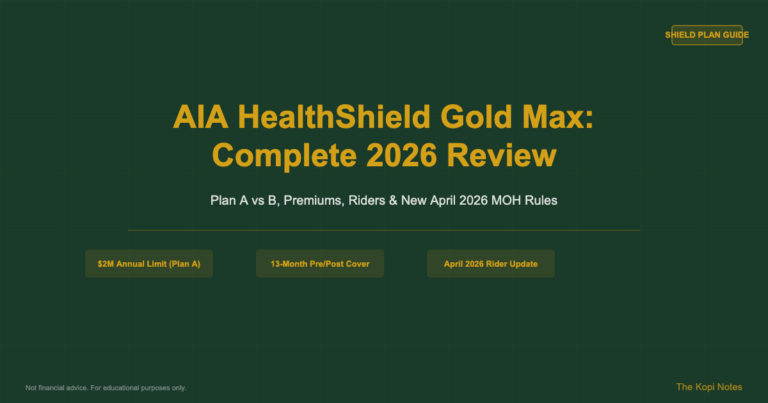
- From April 2026, ISP riders changed: premiums are ~30% cheaper but deductibles are no longer covered by riders.
Is MediShield Life Compulsory in Singapore?
Yes — and unlike most insurance products, you do not have a choice. MediShield Life is a mandatory national health insurance scheme administered by the CPF Board. Every Singapore Citizen and PR is automatically enrolled and must pay premiums for life.
This was a deliberate policy decision. Before MediShield Life launched in November 2015, the old MediShield scheme was optional — and many Singaporeans simply did not enrol. MOH redesigned the system to ensure universal baseline coverage, so no one is left without health insurance because they forgot to sign up or could not afford to at the time.
The premiums are funded from your MediSave account, so you do not need to pay out of pocket for the base MediShield Life premium — at least in most cases. If your MediSave balance is insufficient, you can pay in cash. Singaporeans aged 65 and below also receive government subsidies that significantly reduce the net premium burden.
Who Is Covered by MediShield Life?
MediShield Life covers two groups automatically — no application needed:
Singapore Citizens: Enrolled at birth (for babies born to Singaporean parents) or upon citizenship. Coverage lasts for life, including when you are living overseas, though you can apply to suspend premium payments if you are permanently abroad.
Singapore Permanent Residents: Enrolled automatically upon receiving PR status. Coverage is identical to Citizens in terms of benefits. PRs must pay the full premium without the Pioneer Generation or Merdeka Generation subsidies that older Citizens receive.
What about foreigners? Work Pass holders and other foreigners are NOT covered by MediShield Life. They must arrange their own medical insurance, or rely on employer-provided coverage. A very small legacy group of foreigners who held MediShield coverage before the 2015 transition were allowed to continue, but new foreigners cannot enrol.
| Residency Status | MediShield Life Coverage | Subsidies Available? |
|---|---|---|
| Singapore Citizen | Yes — compulsory | Yes (age-based + Pioneer/Merdeka generation) |
| Singapore PR | Yes — compulsory | No (full premium applies) |
| Foreigner / EP / S Pass holder | Not covered | N/A |
Source: CPF Board / MOH, June 2026
What Does MediShield Life Cover?
MediShield Life is designed for large, catastrophic medical bills. It is not meant to cover every doctor’s visit or minor procedure. Think of it as your financial safety net when a serious hospital stay threatens to wipe out your savings.
Coverage applies to hospitalisation and selected outpatient treatments at public hospitals. The key protections include:
- Daily ward and treatment charges — Class B2 or C wards at public hospitals
- Intensive Care Unit (ICU) charges
- Surgical procedures in hospitals
- Outpatient chemotherapy and radiotherapy for cancer
- Outpatient kidney dialysis
- Psychiatric treatment (selected inpatient care)
- Outpatient scans and procedures related to a hospitalisation
What it does NOT cover: private hospital treatment (unless you have an ISP on top), dental procedures, cosmetic surgery, outpatient GP visits, and most specialist outpatient consultations unrelated to a hospitalisation episode.
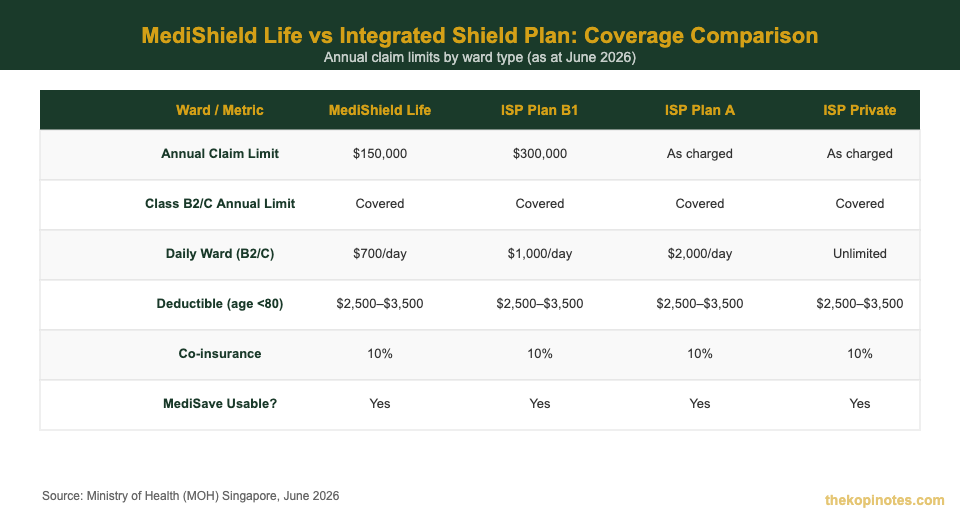
The annual claim limit is $150,000 — which sounds like a lot, but complex cancer treatment or prolonged ICU stays can easily exceed this in a private hospital setting. That is one reason many Singaporeans choose to add an ISP top-up.
MediShield Life Premiums in 2026
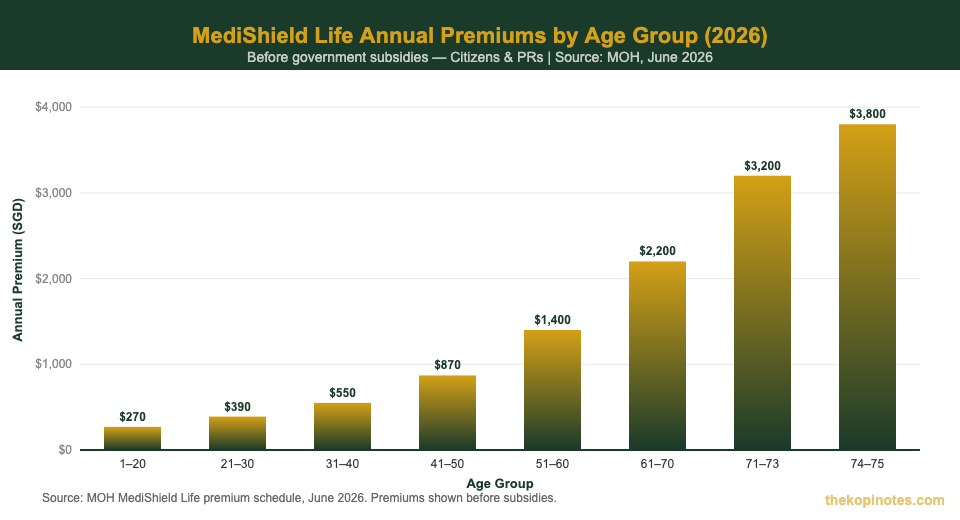
Your MediShield Life premium is determined by your age — older policyholders pay more because they are statistically more likely to make claims. The premiums are deducted directly from your MediSave account each year, so most people never feel the cash impact directly.
Here is a summary of the 2026 annual premium schedule before subsidies:
| Age Next Birthday | Annual Premium (Before Subsidies) | Typical Subsidy (Citizens) |
|---|---|---|
| 1 – 20 | ~$270 | Up to $100 |
| 21 – 30 | ~$390 | Up to $150 |
| 31 – 40 | ~$550 | Up to $200 |
| 41 – 50 | ~$870 | Up to $300 |
| 51 – 60 | ~$1,400 | Up to $500 |
| 61 – 70 | ~$2,200 | Up to $1,000 (Merdeka gen: higher) |
| 71 – 73 | ~$3,200 | Pioneer gen: significant subsidy |
| 74 – 75 | ~$3,800 | Pioneer gen: significant subsidy |
Source: MOH MediShield Life premium schedule, June 2026. Exact figures subject to annual review.
For most working-age Singaporeans, the net premium after subsidies is quite manageable — often under $500 per year for those in their 30s and 40s. The real cost concern arises in your 60s and 70s, when premiums rise sharply. This is where Pioneer Generation and Merdeka Generation subsidies make a significant difference.
If you are a PR, you pay the full premium with no government subsidy. A PR in their 50s, for example, would pay the full ~$1,400 annual premium for MediShield Life alone, before any ISP top-up costs.
Should You Top Up with an Integrated Shield Plan?
MediShield Life alone only covers Class B2 and C ward treatment at public hospitals. If you want access to Class A wards, restructured hospital private wards, or fully private hospitals — you need to add an Integrated Shield Plan (ISP).
An ISP is a private insurance policy sold by insurers like AIA, Great Eastern, Prudential, Singlife, and Income. It wraps around your MediShield Life coverage and extends it to higher tiers of care. Part of the ISP premium can be paid from MediSave.
Whether you need an ISP depends on your priorities:
- You mainly want lower-cost public care: MediShield Life alone may be sufficient. Class B2/C wards at public hospitals are well-staffed and subsidised heavily.
- You want a choice of doctor or private hospital: An ISP covering private hospitals gives you flexibility, though costs are higher.
- You are concerned about serious illness: ISPs with “as charged” coverage remove the annual claim limits that MediShield Life imposes.
For a full breakdown of which ISP offers the best value in 2026, check out our integrated shield plan comparison guide.
You should also check out our detailed review of the AIA Integrated Shield Plan and the Prudential PRUShield review if you are comparing providers.
April 2026 ISP Rider Changes — What Changed?
This is the biggest development in Singapore’s health insurance landscape in years. From 1 April 2026, MOH mandated new rules for all ISP riders sold in Singapore. Here is what changed:
1. Riders no longer cover the deductible. Previously, you could buy a rider that paid your deductible for you — meaning zero out-of-pocket costs. From April 2026, new riders cannot cover the deductible. You must pay the first $1,500 to $3,500 of your hospital bill yourself (depending on ward class) before insurance kicks in.
2. The co-payment cap doubled. The annual cap on your co-insurance payments (the 10% you pay after the deductible) has risen from $3,000 to $6,000. However, this cap applies to co-payments that meet insurer requirements, such as using panel doctors.
3. Premiums fell by ~30%. The upside of the new structure: new riders are around 30% cheaper on average than the old “full coverage” riders. For example, Prudential’s new PRUExtra Preferred Care rider is up to 55% cheaper for some age groups than the predecessor product.
This is a good time to review your overall ISP coverage. You may want to consider whether your emergency fund is large enough to cover the deductible if you are hospitalised. Our Singapore retirement calculator can help you think through your long-term healthcare cost planning.
Using MediSave for MediShield Life and ISP Premiums
Both MediShield Life premiums and most ISP premiums can be paid from your MediSave account — you do not need to dip into your cash savings for this. Here is how it works:
MediShield Life: The full premium is deducted automatically from MediSave each year. If your MediSave balance is insufficient, you pay the shortfall in cash. Most working Singaporeans accumulate more than enough MediSave to cover this easily.
ISP base plan: The portion of your ISP premium equivalent to MediShield Life can be paid from MediSave. The additional “top-up” premium for the private hospital coverage is also payable from MediSave, up to specific annual limits that vary by age.
ISP rider: Riders (add-ons that reduce your co-payment and deductible) must be paid in cash. You cannot use MediSave for rider premiums.
This MediSave structure is one reason why Singapore’s healthcare financing is considered well-designed — mandatory savings build up over your working life, then fund your healthcare costs in old age. It is part of the same system that underpins your CPF investment strategy.
Disclaimer: This article is for educational purposes only. It is not financial or insurance advice. Speak to a licensed financial adviser before making decisions about your health insurance coverage.
Frequently Asked Questions
Is MediShield Life compulsory for Singapore PRs?
Yes. MediShield Life is compulsory for all Singapore Permanent Residents, just as it is for Citizens. PRs are automatically enrolled when they receive PR status and must pay premiums for as long as they hold PR status. Unlike Citizens, PRs do not receive government premium subsidies, so they pay the full schedule premium.
Can you opt out of MediShield Life in Singapore?
No — there is no opt-out option for MediShield Life. The only exception is for Singapore Citizens who are permanently residing overseas. They can apply to the CPF Board to suspend premium payments if they have no intention of returning to live in Singapore. This is a suspension, not a cancellation — coverage ends while payments are suspended.
What does MediShield Life not cover?
MediShield Life does not cover outpatient GP visits, dental treatment, cosmetic procedures, private hospital treatment (without an ISP top-up), or most specialist outpatient consultations. It is specifically designed for large, unexpected hospitalisation bills. For day-to-day medical costs, you pay out of pocket or use MediSave for eligible outpatient treatments.
What is the difference between MediShield Life and an Integrated Shield Plan?
MediShield Life is the mandatory base layer — it covers Class B2/C ward hospitalisation at public hospitals with an annual limit of $150,000. An Integrated Shield Plan (ISP) is an optional private insurance policy sold by insurers like AIA, Prudential, or Great Eastern. An ISP extends your coverage to Class A wards, private hospitals, and often removes the annual claim limit by covering costs “as charged”. You pay an additional ISP premium on top of MediShield Life.
How much does MediShield Life cost per year in 2026?
MediShield Life annual premiums in 2026 range from about $270 (for those aged 1–20) to $3,800 (for those aged 74–75), before government subsidies. The premium is age-banded and rises as you get older. Most working-age Singaporeans pay between $390 and $1,400 per year. Government subsidies reduce the net cost for Citizens significantly, especially for older Singaporeans and Pioneer/Merdeka Generation members.
What changed about ISP riders in April 2026?
From 1 April 2026, new ISP riders sold in Singapore can no longer cover the minimum deductible portion of your hospital bill. This means you must pay the first $1,500 to $3,500 yourself before your insurance pays. The co-payment cap also doubled from $3,000 to $6,000 per year. In exchange, new rider premiums are approximately 30% lower on average. If you purchased an old rider before 27 November 2025, you can keep it until your first renewal after 1 April 2028, then must switch to a compliant new rider.
Plan Your Healthcare Coverage Today
Compare ISPs, review your MediShield Life coverage, and use our tools to plan for the long term.
Get Free Insurance Advice
Speak with a licensed insurance advisor. No obligation, no cost.
By submitting this form, you agree to our Privacy Policy.
This article was researched with the help of AI. While we strive to keep all information accurate and up to date, there may be errors. If you notice any discrepancies, please contact us.