MariBank + IBKR: The Cash-Plus-Growth Two-Platform Strategy for Singapore Savers (2026)
MariBank’s savings rate has quietly dropped to 0.88% p.a. Here’s how to size your cash sleeve correctly and route the rest into growth.
MariBank’s Mari Savings Account now pays a flat 0.88% p.a. on all balances, effective 1 June 2026 — down sharply from the 3%+ headline rates it launched with. Pairing a small MariBank cash sleeve with Interactive Brokers (IBKR) for everything above your liquidity needs lets you keep instant access to spending cash while your surplus grows through a globally diversified brokerage instead of sitting idle.
Not financial advice. All figures are for educational reference only. Data as at August 2026 unless noted.
- MariBank’s base rate is now 0.88% p.a. on every balance tier — the same as GXS’s Main Account, and well below Trust Bank’s 2.40% p.a. Flex Plan.
- On a S$24,000 emergency fund, that gap costs you S$364.80 a year versus Trust Bank — keep MariBank for what it’s genuinely good at: instant liquidity and a zero-friction Shopee-linked app, not yield.
- Size your MariBank balance to your real liquidity need, then route surplus cash into IBKR for globally diversified growth — leaving S$50,000 idle for 20 years costs roughly S$100,780 in forgone growth versus investing it.
Table of Contents
Contents u2014 Click to expand
MariBank’s Rate Reality Check in 2026
MariBank launched in 2023 as one of Singapore’s most talked-about digital banks. It’s fully owned by Sea Limited, the tech group behind Shopee and Garena, and it received one of only four full digital banking licences MAS issued in 2022. At launch, and through several promotional periods since, MariBank’s headline savings rate touched as high as 3.21% p.a.
That’s not the rate you’ll get today. We checked MariBank’s official rates page directly, and as at 1 June 2026, the Mari Savings Account pays a flat 0.88% p.a. on all balances — no tiers, no bonus conditions, but also no premium for size. Several third-party sites and even older articles still quote the old 2.5–3.21% figures. Always verify against MariBank’s own fees and rates page before you plan around a specific number.
Here’s the thing: 0.88% p.a. isn’t a bad rate for a zero-friction account with S$0 minimum balance, no fall-below fees, and free local transfers. It’s just not a rate you should be treating as a growth engine. That distinction is the whole point of this guide.
Sizing Your MariBank Cash Sleeve
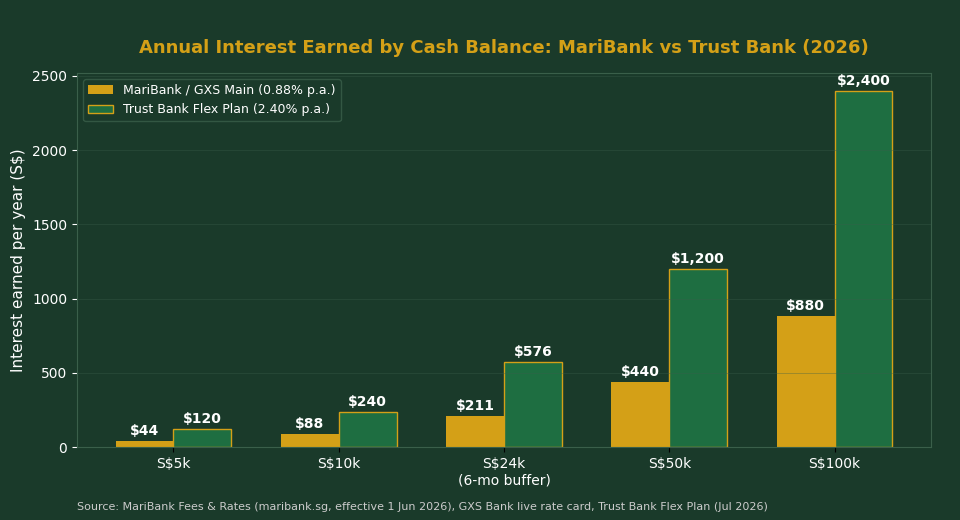
Say you spend S$4,000 a month and want a 6-month emergency buffer. That’s S$24,000 sitting in MariBank. At 0.88% p.a., that buffer earns S$211.20 a year. If the same S$24,000 sat in Trust Bank’s Flex Plan at 2.40% p.a. instead, it would earn S$576 a year — a gap of S$364.80, just for choosing where you park the exact same emergency fund.
That gap gets bigger as your balance grows. Here’s the annual interest earned at different balance levels, comparing MariBank’s flat 0.88% p.a. against Trust Bank’s 2.40% p.a. Flex Plan rate.
| Balance | MariBank (0.88% p.a.) | Trust Bank (2.40% p.a.) | Annual Gap |
|---|---|---|---|
| S$5,000 | S$44.00 | S$120.00 | S$76.00 |
| S$10,000 | S$88.00 | S$240.00 | S$152.00 |
| S$24,000 (6-mo buffer) | S$211.20 | S$576.00 | S$364.80 |
| S$50,000 | S$440.00 | S$1,200.00 | S$760.00 |
| S$100,000 | S$880.00 | S$2,400.00 | S$1,520.00 |
Source: MariBank Fees & Rates (maribank.sg, effective 1 Jun 2026), Trust Bank Flex Plan rate as at July 2026. Calculations are simple annual interest, not compounded.
That doesn’t mean you should abandon MariBank. It means you should ask a sharper question: how much of your cash genuinely needs to be instantly liquid, with zero withdrawal friction and Shopee integration? Use our emergency fund calculator to work out your exact number, then size your MariBank balance to that figure — typically 1–3 months of expenses for day-to-day spending — and treat anything beyond that as capital that should either sit in a higher-yielding account or start working for you through investing.
MariBank vs GXS vs Trust Bank: Base Rates Compared
MariBank isn’t alone in cutting rates. Digital bank savings rates across Singapore have compressed sharply through 2026 as interest rate expectations shifted. We checked all three major digital banks’ live rate pages on the same day for this article.
| Digital Bank | Base Rate | Structure | Cap for Top Rate |
|---|---|---|---|
| MariBank (Mari Savings) | 0.88% p.a. | Flat, no conditions | No cap |
| GXS Bank (Main Account) | 0.88% p.a. | Flat, up to S$95,000 total deposit | S$95,000 |
| Trust Bank (Flex Plan) | 2.40% p.a. | Top tier, up to S$1.2M | S$1,200,000 |
Source: MariBank Fees & Rates, GXS Bank live rate card, Trust Bank Flex Plan rate card (all fetched August 2026). Rates subject to change without notice.
MariBank and GXS’s Main Account now sit at the identical 0.88% p.a. base rate, while Trust Bank has held its Flex Plan meaningfully higher at 2.40% p.a. If yield is genuinely your priority for a large cash buffer, Trust Bank currently wins outright — and if you want the Trust Bank version of this same two-platform playbook, see our Trust Bank + IBKR strategy guide. But MariBank still has a real edge for a specific job: it has S$0 minimum balance, no fall-below fees, free local PayNow/FAST transfers, and a clean single-account app tightly integrated with the Shopee ecosystem — useful if you’re already a heavy Shopee user or simply want the least complicated banking app on your phone.
Why IBKR for the Growth Sleeve
Interactive Brokers (IBKR) is a US-headquartered global brokerage, publicly listed on NASDAQ, regulated in Singapore by MAS under a Capital Markets Services licence. It’s the natural complement to a MariBank cash sleeve because the two platforms serve opposite jobs: MariBank optimises for instant liquidity, IBKR optimises for low-cost, globally diversified growth.
Key facts that matter for this pairing:
- US$0 commission on US-listed stocks and ETFs under the IBKR Lite tier
- SGX Fixed pricing at 0.08% per trade (minimum S$2.50) for Singapore-listed shares and S-REITs
- 150+ markets across 33 countries from a single multi-currency account
- No CPF or SRS support — like MariBank, IBKR is a cash-funded platform only
- No custody fees or inactivity fees for holding your investments long-term
That last point about CPF/SRS matters: neither side of this pairing touches your CPF Ordinary Account or SRS funds. If you want to structure a CPF-linked or SRS-linked strategy, see our CPF investment strategy guide instead — this MariBank + IBKR pairing is purely for cash outside those schemes.
The Real Cost of Leaving Surplus Cash Idle
Let’s put a number on it. Say you’ve sized your emergency buffer correctly and you still have S$50,000 sitting in MariBank beyond what you need for liquidity. What does leaving it there actually cost you, compared to investing it via IBKR?
We ran this as a straightforward compounding comparison: S$50,000 left in MariBank at a constant 0.88% p.a., versus the same S$50,000 invested via IBKR at an illustrative 6% p.a. (a reasonable long-run assumption for a globally diversified equity portfolio, though not guaranteed — markets can and do fall).
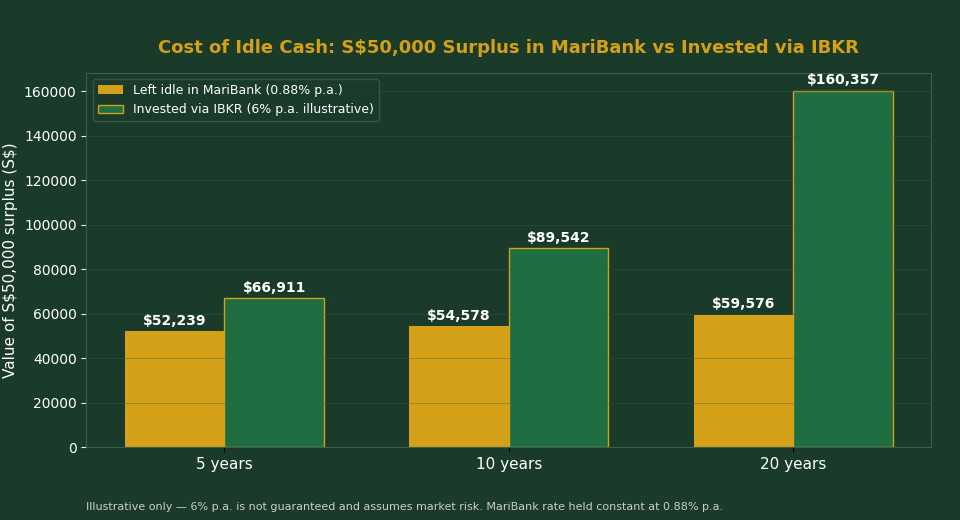
Over 5 years, that S$50,000 grows to S$52,239 in MariBank versus S$66,911 invested via IBKR — a S$14,672 gap. Stretch it to 20 years and MariBank grows to S$59,576 while the IBKR path reaches S$160,357, a gap of over S$100,000 on capital that started out identical. This isn’t MariBank being a bad product — it was never built to be a growth vehicle. It’s built to be liquid, simple, and safe. The mistake is using it for a job it wasn’t designed for.
How to Set Up the Two-Platform Strategy
- Calculate your true liquidity need. Add up 1–3 months of essential expenses. This is the number that should live in MariBank — not your entire cash pile.
- Open (or keep) your Mari Savings Account. Sign up with Singpass MyInfo, no minimum balance, no salary crediting needed.
- Open an IBKR account for everything above your liquidity number. Fund it via bank transfer from MariBank, DBS, OCBC, or UOB.
- Set a monthly or quarterly sweep. Once your MariBank balance exceeds your target buffer, move the surplus into IBKR rather than letting it accumulate at 0.88% p.a.
- Review both rates every quarter. Digital bank rates move without notice — what’s true today may not hold in three months.
Ready to set this up? Grab your MariBank referral code and IBKR referral link below.
Risks and Limitations
Before you set this up, be clear-eyed about the trade-offs on both sides. If you want to see how this cash-plus-growth split affects your long-term retirement number, run it through our retirement planning calculator first.
- MariBank’s SDIC cover caps at S$100,000 per depositor. If your cash sleeve genuinely needs to exceed that, consider splitting across multiple SDIC-insured banks.
- MariBank has no debit card and a limited product range as at August 2026 — it’s purely a savings account, not a full banking relationship.
- IBKR carries real market risk. The 6% p.a. illustrative return used in this guide is not guaranteed — equity markets can and do decline, sometimes sharply and for extended periods.
- Neither platform supports CPF or SRS funds. This strategy only applies to cash outside those schemes.
- Digital bank rates change without notice. MariBank’s own rate has fallen from over 3% to 0.88% within roughly a year — don’t assume today’s numbers hold indefinitely.
Frequently Asked Questions
What is MariBank's current savings interest rate?
Is MariBank still worth using if the rate has dropped so much?
How does MariBank compare to GXS and Trust Bank?
Can I use CPF or SRS funds with MariBank or IBKR?
How much should I keep in MariBank versus invest through IBKR?
Is my money safe in MariBank?
What does IBKR charge for Singapore investors?
This article was researched with the help of AI. While we strive to keep all information accurate and up to date, there may be errors. If you notice any discrepancies, please contact us.