Best Student Credit Card Singapore 2026: Top Picks for Young Adults
Zero annual fees, cashback on everyday spend, and low income requirements — here are the best student credit cards in Singapore for 2026.
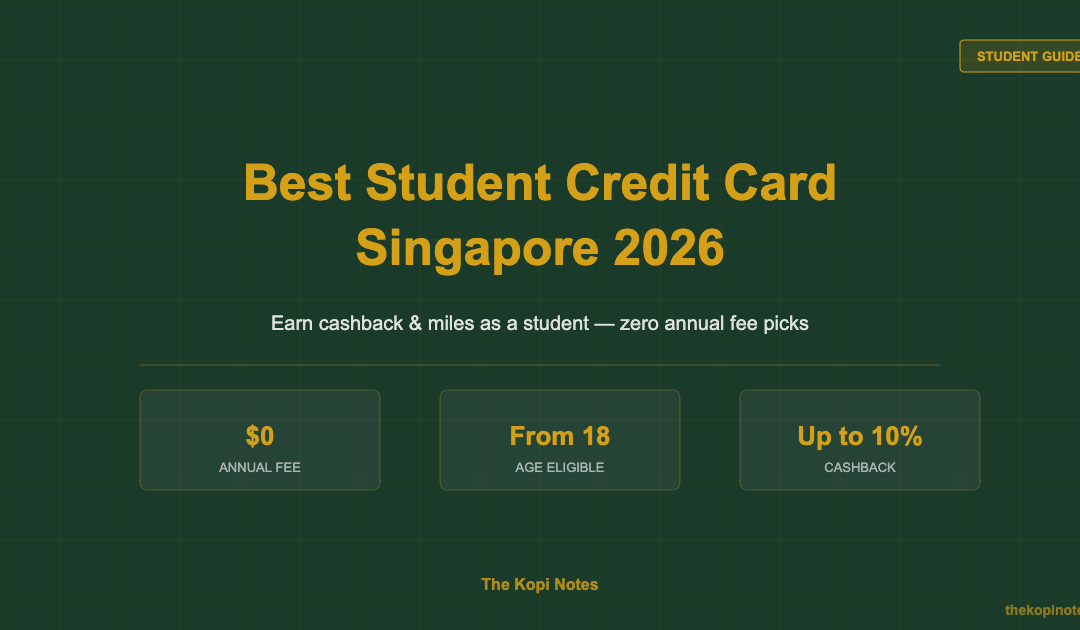
The best student credit card in Singapore for 2026 is the OCBC Frank Card or UOB YOLO Card — both offer up to 8% cashback on online and entertainment spending, require no minimum income for full-time students, charge zero annual fees, and have a minimum age of 18. They let you earn real rewards while building your credit history from day one.
Not financial advice. All figures are for educational reference only. Data as at June 2026 unless noted.
- OCBC Frank and UOB YOLO are the top picks — 8% cashback, $0 annual fee, no income requirement for students
- Full-time students at local universities qualify even with zero income — banks use supplementary card pathways or student-specific programmes
- Start with one card, use it for a single spending category, and pay in full every month to build your credit score
Can Students Get a Credit Card in Singapore?
Yes — but there are rules. The Moneylenders Act and credit card regulations in Singapore set the minimum age at 21 for applicants without a regular income. However, most banks have student-specific programmes that lower the entry bar to 18 for full-time students enrolled at local universities, polytechnics, or approved institutions.
Here’s how banks make it work for students:
- Supplementary card pathway — your parent holds the principal card; you get a supplementary card in your own name
- Student programme — banks like OCBC and UOB have dedicated student card products with lower credit limits (typically S$500–S$2,000) and waived income requirements
- SingPass MyInfo verification — banks verify your student status via your institution’s enrolment records, so the application is entirely digital
One important rule: you cannot hold more than 4 credit cards across all banks in Singapore once you reach the credit limit cap (set by MAS at 4x your monthly income). For students with zero income, this cap doesn’t apply the same way — but banks will still limit your total credit exposure. Start with one card.
Top 5 Student Credit Cards in Singapore 2026
Here are the best picks based on cashback rates, spending fit for students, annual fees, and ease of application as of June 2026.
1. OCBC Frank Card — Best for Online Spending
The OCBC Frank Card is arguably the best first credit card for Singapore students. It offers 8% cashback on all online spending including food delivery (Grab, Deliveroo), streaming (Netflix, Spotify), and e-commerce (Shopee, Lazada). The minimum spend to unlock the 8% rate is S$600/month — achievable for most university students who spend online regularly.
- Annual fee: $0
- Minimum age: 18 (full-time student)
- Minimum income: None required for students
- Cashback cap: S$60/month on the 8% tier
- Base cashback: 0.3% on all other spend
The Frank Card also doubles as a debit card alternative — you can load it and use it for day-to-day transactions while earning cashback. It’s available via digital application through the OCBC app with SingPass MyInfo.
2. UOB YOLO Card — Best for Dining and Entertainment
UOB YOLO (You Only Live Once) is designed precisely for young spenders. It offers 8% cashback on dining, entertainment, transport, and online fashion — the spending categories that define student life in Singapore. Minimum spend is S$600/month to unlock the higher tiers.
- Annual fee: $0 (first year waived; waived with S$3,600 annual spend)
- Minimum age: 18 (full-time NUS/NTU/SMU/SIT/SUTD/UniSIM student)
- Minimum income: None required for qualifying students
- Cashback cap: S$60/month
UOB’s student programme requires proof of enrolment. Once approved, you’ll get a physical card and access to UOB TMRW for digital management. This card is especially strong if your highest spend is on bubble tea, hawker meals, and cinema trips — which are all eligible under the dining and entertainment categories.
3. DBS Live Fresh Student Card — Best for Eco Spenders
The DBS Live Fresh card is the bank’s youth-targeted card, with a unique angle: 5% cashback on online spending and 5% on eco-eatery and sustainable merchants. It’s less generous than Frank or YOLO on raw cashback, but it works well for students who care about sustainability and want a DBS/POSB account bundle.
- Annual fee: $0
- Minimum age: 18 (full-time student)
- Minimum income: None for students
- Minimum spend: S$600/month for the 5% rate
- Credit limit: From S$500
You can pair the DBS Live Fresh with a DBS Multiplier savings account to boost your savings interest rate — a smart combo if you’re already banking with DBS. If you’re interested in maximising your savings alongside your card spend, the Singapore retirement calculator can help you model how even small monthly cashback earnings compound over time.
4. Standard Chartered Simply Cash Card — Best for No-Fuss Cashback
The Simply Cash card from Standard Chartered gives you a flat 1.5% unlimited cashback on all spend — no category restrictions, no minimum spend, no cashback cap. While the rate is lower than the other picks, the simplicity is its superpower. You don’t need to think about spend categories; everything earns 1.5%.
- Annual fee: $0
- Minimum age: 21 (or 18 as supplementary cardholder)
- Minimum income: S$20,000/year (for principal card)
- Cashback: Unlimited 1.5%, no cap
This card is better suited to students who are working part-time and meet the income requirement, or those who apply as supplementary cardholders under a parent’s principal account. It’s also a solid option for students transitioning to full-time employment after graduation.
5. Citi Clear Card — Best Starter Card
The Citi Clear Card is Citibank’s entry-level offering for young adults. It offers 3% cashback on dining and entertainment with a low minimum spend of S$300/month. The credit limit is typically S$500, making it a low-risk first card that banks are willing to approve for students.
- Annual fee: $0 (waived permanently)
- Minimum age: 18 (full-time student)
- Minimum income: None for qualifying students
- Credit limit: S$500 (expandable after 6 months of good repayment)
The Citi Clear Card is ideal if you want to build your credit score conservatively. A S$500 limit means you literally can’t overspend too badly. After 6–12 months of on-time full payments, Citibank will typically offer a credit limit increase and you can apply for a higher-tier card like the Citi Cashback+.
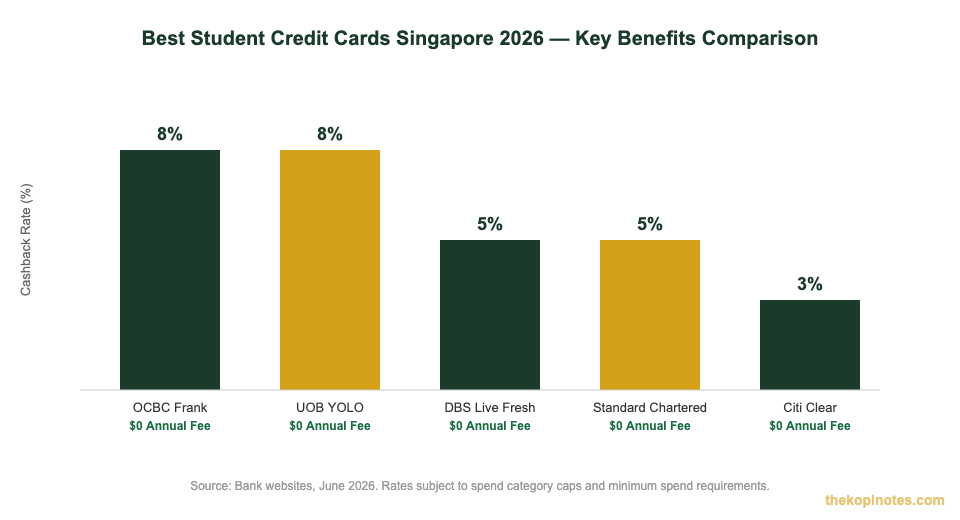
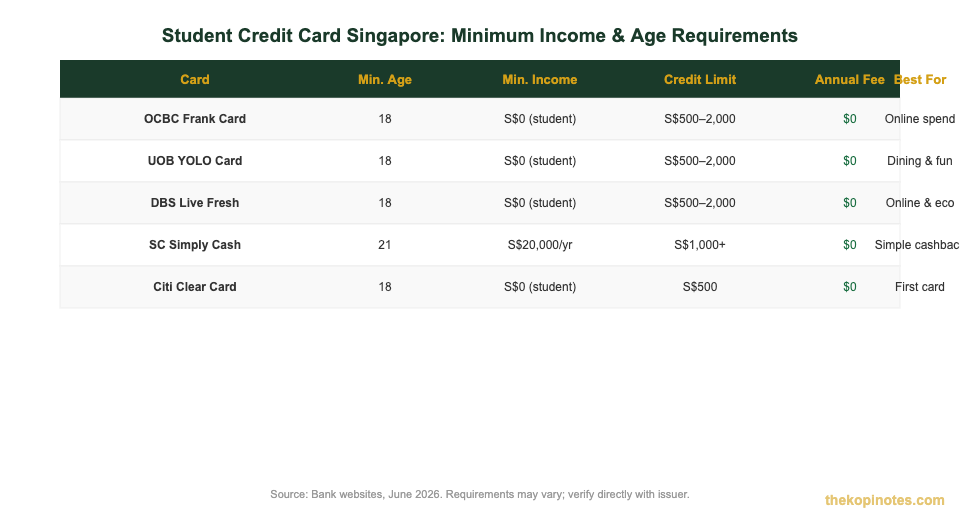
Full Comparison Table: Student Credit Cards Singapore 2026
Here’s how the top five student credit cards stack up across all key criteria as at June 2026.
| Card | Min. Age | Min. Income | Top Cashback | Annual Fee | Best Category |
|---|---|---|---|---|---|
| OCBC Frank | 18 | None (student) | 8% | $0 | Online spending |
| UOB YOLO | 18 | None (student) | 8% | $0 | Dining & entertainment |
| DBS Live Fresh | 18 | None (student) | 5% | $0 | Online + eco |
| SC Simply Cash | 21 | S$20k/yr | 1.5% unlimited | $0 | All spend (no cap) |
| Citi Clear | 18 | None (student) | 3% | $0 | Dining |
Source: Bank websites (OCBC, UOB, DBS, Standard Chartered, Citibank), June 2026. Rates and terms subject to change.
How to Choose the Right Student Credit Card
With five solid options, the right pick comes down to your actual spending habits. Here’s a simple framework:
You spend mostly online (Shopee, Grab Food, Netflix)? → OCBC Frank Card. The 8% online cashback is unbeatable for digital-native spenders.
You eat out and go out a lot? → UOB YOLO Card. Dining, entertainment, and transport all qualify. Perfect for the typical NUS or NTU student on a weeknight out.
You want everything simple? → SC Simply Cash. No tracking categories, no minimum spend per category. Just spend and earn 1.5% on everything.
You’re very new to credit? → Citi Clear Card. The S$500 limit forces discipline. It’s the training wheels of credit cards — and that’s a feature, not a bug.
A few rules to keep in mind before choosing:
- Only get a credit card if you’ll pay the bill in full every month. Interest rates on Singapore credit cards run at 26–28% per annum — enough to wipe out a year’s worth of cashback with one month of unpaid balance
- Pick a card that matches your existing spending, not aspirational spending. If you rarely eat out, UOB YOLO’s dining cashback won’t help you
- Start with one card. Managing multiple cards increases the risk of missing a payment
If you’re also thinking about building long-term wealth alongside your card habits, read our guide on CPF investment strategy Singapore — it’s never too early to think about compounding.
How to Apply for a Student Credit Card in Singapore
The application process is fully digital for most banks in 2026. Here’s the standard flow:
- Check eligibility — confirm your age (minimum 18 for student cards), enrolment status at a recognised institution, and Singapore citizenship/PR or valid student pass
- Prepare documents — NRIC or FIN, student matriculation card or acceptance letter, and (for non-zero income applicants) last 3 months’ payslips or CPF statement
- Apply via the bank’s app — all five banks above support SingPass MyInfo for auto-fill. The application takes 5–10 minutes online
- Wait for approval — student card approvals typically take 3–7 business days. You’ll receive an SMS and email
- Activate and use — once your physical card arrives, activate it via the bank’s app and add it to Apple Pay or Google Pay for contactless use immediately
If you’re a foreign student on a student pass (DP/SP), the process is slightly different — you’ll need to visit a branch in person with your passport, IPA letter, and proof of enrolment. Some banks (notably DBS and OCBC) accept online applications for student pass holders; others require branch visits.
For those already thinking beyond credit cards into investing, check out the passive income Singapore 2026 guide — building early cash flow habits while a student pays dividends for decades.
Tips for Using Your First Credit Card Wisely
A credit card is a tool — it builds your credit score and earns you rewards if used correctly, or it traps you in debt if misused. Here are the rules that matter most for first-time cardholders:
1. Set up GIRO autopay for the full statement balance. This is the single most important habit. Never pay the minimum — always pay the full amount. Set up GIRO to your bank account so the payment happens automatically on the due date.
2. Use it like a debit card. Only spend money you already have. The cash should be sitting in your bank account before you swipe the card. This mental model prevents overspending.
3. Check your statement every month. Fraudulent charges happen. A 5-minute monthly review catches problems before they compound. All five banks above have clear mobile apps that make this easy.
4. Don’t apply for too many cards at once. Each credit card application triggers a credit bureau inquiry. Multiple applications in a short window signal financial stress and lower your credit score. Apply for one card, use it for 6–12 months, then evaluate.
5. Understand your credit score from day one. Singapore uses the CBS (Credit Bureau Singapore) score, ranging from 1,000 to 2,000. Paying on time and keeping utilisation below 30% of your credit limit are the fastest ways to build a strong score. A good score gets you better rates on home loans later — something that will matter enormously in your 30s.
For students also exploring investment options alongside credit, the moomoo Singapore review is worth reading — moomoo is one of the most accessible platforms for young Singapore investors starting with small amounts.
Disclaimer: This article is for informational purposes only and does not constitute financial advice. Credit card terms, cashback rates, and eligibility criteria change frequently — always verify directly with the issuing bank before applying. The Kopi Notes may earn referral fees from some links in this article.
Frequently Asked Questions
What is the best student credit card in Singapore for 2026?
The OCBC Frank Card and UOB YOLO Card are the top picks for most students in Singapore. Both offer up to 8% cashback, charge zero annual fees, and require no minimum income for full-time students aged 18 and above. The OCBC Frank is better for online spending; UOB YOLO is better for dining and entertainment.
Can I get a credit card as a student in Singapore?
Yes. Full-time students at local universities, polytechnics, and ITE can apply for student credit cards from age 18. Banks like OCBC, UOB, DBS, and Citibank have dedicated student programmes that waive the usual minimum income requirement (which is S$30,000/year for regular cards). You’ll need to show proof of enrolment and a valid NRIC or FIN.
What is the minimum age to get a credit card in Singapore?
The minimum age is 18 for student credit cards in Singapore. For regular credit cards with no student programme, the minimum age is 21 (with a minimum annual income of S$30,000). As a supplementary cardholder on a parent’s account, there is typically no minimum age restriction, though banks set their own policies.
Do I need a job to get a student credit card in Singapore?
No. Student-specific credit cards from OCBC, UOB, DBS, and Citibank do not require a minimum income for full-time students. You only need to prove your student status via a matriculation card or enrolment letter. However, the Standard Chartered Simply Cash Card requires S$20,000/year minimum income, making it suitable for students with part-time income rather than pure full-time students.
Should I get the OCBC Frank Card or the UOB YOLO Card?
It depends on how you spend. If most of your money goes to online purchases — food delivery apps, streaming services, online shopping — choose the OCBC Frank Card for 8% online cashback. If you spend more on physical dining, entertainment venues, and transport, the UOB YOLO Card is the better fit. Both cards offer the same headline cashback rate and zero annual fees, so your spending pattern is the deciding factor.
How do student credit cards in Singapore help build credit?
Every on-time payment you make is reported to the Credit Bureau Singapore (CBS) and improves your credit score (rated from 1,000 to 2,000). A higher CBS score gets you better mortgage rates, higher credit limits, and faster loan approvals when you need them. Starting a student card at 18–21 and paying in full every month means you arrive at your first home loan application with 5–7 years of excellent credit history already on record.
Ready to Start Investing as a Student?
Your credit card earns cashback — now make that money work harder. Explore Singapore’s top investment platforms and start building wealth early.
This article was researched with the help of AI. While we strive to keep all information accurate and up to date, there may be errors. If you notice any discrepancies, please contact us.