FSMOne + MariBank: Where Your Cash Stops and Your Investing Starts (Singapore 2026)
One app holds your cash. The other holds everything your bank legally cannot. Here is exactly where the line sits in 2026 — with the real rates, the real fees, and the promo maths nobody shows you.
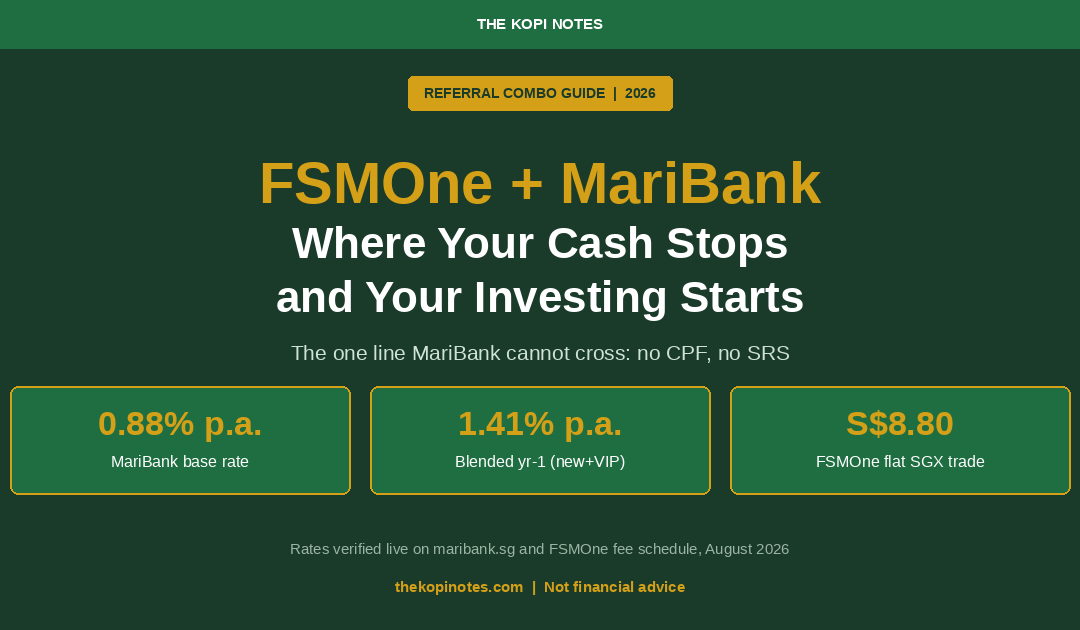
FSMOne and MariBank are not competitors. MariBank is a MAS-licensed digital bank paying 0.88% p.a. base on SDIC-insured cash, plus an in-app money market fund. FSMOne is a fund and share platform with 0% sales charge, a flat S$8.80 SGX trade, and — critically — the ability to hold CPF and SRS money. MariBank cannot hold either. That single rule decides which app gets which dollar.
Not financial advice. All figures are for educational reference only. Rates and fees verified live in August 2026 and can change without notice.
- MariBank’s headline “up to 2.88% p.a.” is a 30-day promo. Blended across a full year it works out to roughly 1.41% p.a. — and only if you keep a ShopeeVIP membership.
- MariBank accepts no CPF and no SRS money at all. Every SRS dollar you want invested has to sit on a platform like FSMOne.
- For plain idle SGD cash, MariBank is the cheaper wrapper. Do not move cash to FSMOne just to chase yield — move it there when you need SRS, CPF, SGX shares or funds Mari Invest does not offer.
Table of Contents
Contents — Click to expand
- The Split: What Each Platform Is Actually For
- MariBank: The Cash Floor and the 30-Day Promo Cliff
- FSMOne: What a Banking App Cannot Give You
- The Hard Line: No CPF, No SRS at MariBank
- Which Wrapper Is Cheaper for Plain Idle Cash?
- Worked Example: Splitting S$45,000
- How to Open Both Accounts
- Who This Combo Suits (And Who Should Skip It)
- Frequently Asked Questions
The Split: What Each Platform Is Actually For
Most “two-platform” guides tell you to open both accounts and leave it there. That is not useful. What you actually need is a rule for deciding where each dollar goes.
Here is the rule. MariBank handles money you might need in the next 12 months. FSMOne handles money that is already committed to a long-term goal — especially money inside a tax wrapper. The boundary is not about yield. It is about what each licence permits.
MariBank is a digital full bank regulated by the Monetary Authority of Singapore. Your Mari Savings Account balance is protected by the Singapore Deposit Insurance Corporation up to S$100,000 per depositor. That protection is the product. It is also the ceiling of what a bank app can do for you.
FSMOne is a fund and securities platform. No deposit insurance on your investments, because they are not deposits. What you get instead is access: over a thousand unit trusts at 0% sales charge, SGX shares held under CDP, bonds, and the two tax wrappers Singapore actually gives you — CPF and SRS.
| Job to be done | Which platform | Why |
|---|---|---|
| Emergency fund | MariBank (Mari Savings) | SDIC-insured, instant PayNow access |
| Cash you will not touch for 6–12 months | MariBank (Mari Invest SavePlus) | 0.25% p.a. all-in, no lock-in, S$1 minimum |
| SRS contributions | FSMOne | MariBank cannot accept SRS money |
| CPF-OA investing | FSMOne | 0% platform fee on CPF-funded unit trusts |
| SGX shares and REITs | FSMOne | Flat S$8.80 per trade, CDP-held |
Source: maribank.sg product pages and FSMOne fee schedule, both verified August 2026.
MariBank: The Cash Floor and the 30-Day Promo Cliff
This is the part where you need to read the small print carefully, because the advertised number and the number you will actually earn are very different.
The Mari Savings Account pays a base rate of 0.88% p.a., credited daily, with no minimum deposit, no salary crediting and no card spend requirement. That is confirmed directly on MariBank’s own rate card as at August 2026. The simplicity is genuinely good — there are no hoops.
On top of that sit two bonuses. New account holders get an extra 1.60% p.a. for the first 30 days only, taking them to 2.48% p.a. on the first S$100,000. Customers with an active ShopeeVIP membership get a further 0.40% p.a. Stack both and you reach the advertised “up to 2.88% p.a.” headline.
Our own calculation: what the headline is really worth
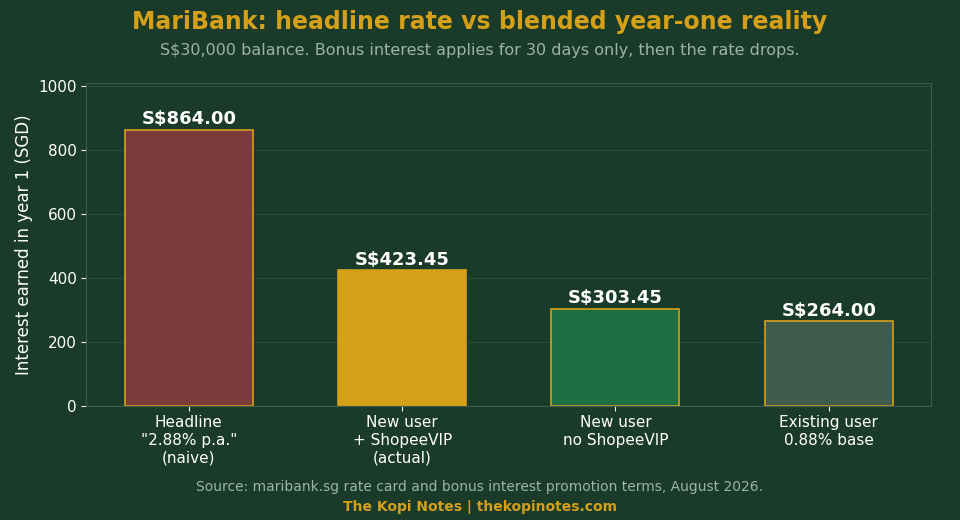
We ran the blend. Thirty days at the promo rate, then 335 days at the standing rate:
- New user with ShopeeVIP: 2.88% for 30 days, then 1.28% → a blended 1.41% p.a. across year one
- New user, no ShopeeVIP: 2.48% for 30 days, then 0.88% → a blended 1.01% p.a.
On a S$30,000 balance, the “2.88%” headline suggests S$864 of interest. The realistic year-one figure for a new ShopeeVIP customer is S$423.45. Without ShopeeVIP it is S$303.45. An existing customer on the plain base rate earns S$264.
That gap of roughly S$440 is not MariBank being dishonest — the terms are published. It is simply the difference between an introductory rate and a standing rate, and it is the single most common mistake we see Singapore savers make when comparing digital banks. If you want the fuller rate-by-rate picture, we broke down the same trap in our MariBank and GXS Bank two-platform cash comparison.
Mari Invest SavePlus: the second cash tier
MariBank also offers Mari Invest SavePlus, which puts your money into the Lion-MariBank SavePlus Fund — a money market fund holding mostly MAS bills and short-dated paper. Minimum investment is S$1, there is no lock-in, and the management fee is 0.25% p.a. with no platform fee on top.
Be precise about the returns, though. MariBank’s own indicative figure is around 2.09% p.a. net of fees, but that is a projection, not a promise. The fund’s actual published performance as at 31 May 2026 was 1.70% over the past year and 2.80% since launch, per the official Mari Invest SavePlus page. We use the 1.70% realised figure in our worked example below, because past performance is at least a real number.
One thing that matters more than the yield: SavePlus is an investment product, so it is not covered by SDIC. Your Mari Savings deposit is. Keep your true emergency fund in the deposit account and use SavePlus for the tier above it. Our full breakdown of all four options lives in the MariBank Invest review covering SavePlus, Income, Gold and Equity.
FSMOne: What a Banking App Cannot Give You
FSMOne’s pitch is boring in the best way: flat, predictable pricing across a very wide product shelf.
Unit trusts carry a 0% sales charge — no upfront commission on the way in, on the way out, or when switching between funds. The platform earns instead through a quarterly platform fee: 0.0875% per quarter (0.35% per year) on most funds bought with cash or SRS, and 0.05% per quarter (0.20% per year) on fixed income funds. Buy a unit trust with CPF money and the platform fee is zero.
On shares, FSMOne charges a flat S$8.80 per SGX trade regardless of size, S$3.80 for SGX-listed ETFs, and US$3.80 for US ETFs. All figures are from the FSMOne fee schedule as at August 2026.
| FSMOne charge | Cash | SRS | CPF |
|---|---|---|---|
| Unit trust sales charge | 0% | 0% | 0% |
| Platform fee — fixed income funds | 0.20% p.a. | 0.20% p.a. | 0% |
| Platform fee — all other funds (≤ S$300k) | 0.35% p.a. | 0.35% p.a. | 0% |
| SGX share trade | Flat S$8.80 | Flat S$8.80 | Flat S$8.80 |
| SGX ETF trade | Flat S$3.80 | Flat S$3.80 | Flat S$3.80 |
Source: FSMOne fee schedule, verified August 2026. A fuller breakdown sits in our complete FSMOne fees guide.
The flat share fee is the part worth dwelling on. Most CDP-linked Singapore brokers charge around 0.28% with a S$25 minimum. FSMOne’s S$8.80 beats that at every trade size — and the saving compounds if you buy monthly.
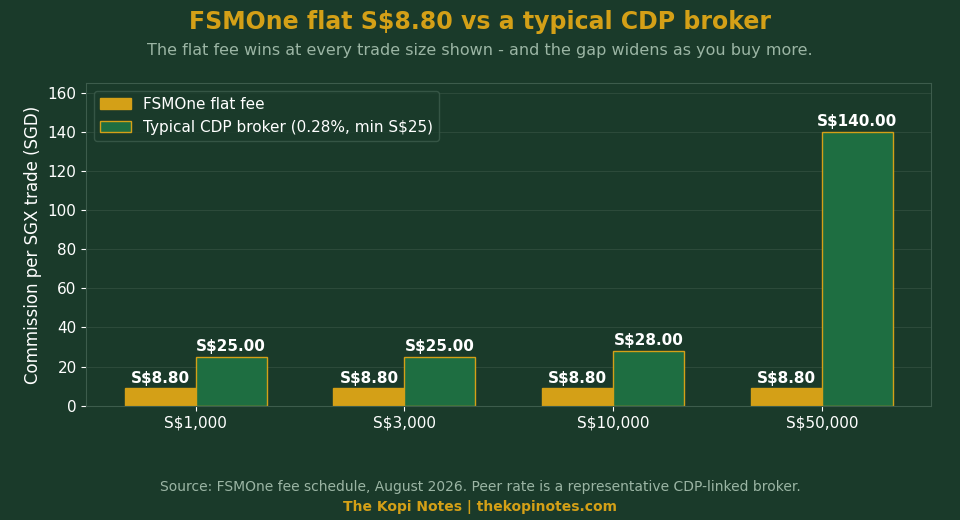
Here is the arithmetic. Buy S$3,000 of an S-REIT once a month for a year. FSMOne charges 12 × S$8.80 = S$105.60. A broker on 0.28% with a S$25 minimum charges 12 × S$25 = S$300. You keep S$194.40 — on identical trades.
The Hard Line: No CPF, No SRS at MariBank
Everything above is about optimising a few hundred dollars. This section is about a few thousand.
MariBank does not accept CPF or SRS funds for any of its products. Not Mari Savings, not Mari Invest. If you want SRS money invested, a bank app cannot do it — you need an approved investment platform, and FSMOne is one of them.
Why that matters: the annual SRS contribution cap is S$15,300 for Singapore Citizens and Permanent Residents, and every dollar you contribute reduces your chargeable income, per IRAS. If your marginal tax rate is 11.5% — the band covering chargeable income of S$80,001 to S$120,000 — a full S$15,300 contribution cuts your tax bill by S$1,759.50 in one go.
That single move is worth more than several years of optimising your savings rate. But there is a catch most people miss: SRS cash sitting uninvested earns just 0.05% p.a. at the operator bank. On S$15,300 that is S$7.65 a year. The tax relief is real; the idle cash is dead money.
Investing that same S$15,300 through FSMOne costs 0.35% p.a. in platform fee — S$53.55 a year — plus the fund’s own expense ratio. Whether that is worth paying depends on the fund’s return, which is not guaranteed. But comparing S$53.55 of fees against 0.05% of interest is not a close call for a multi-decade holding period. We walk through the mechanics step by step in our FSMOne SRS account guide.
Two honest caveats. SRS money is locked until the statutory retirement age prevailing when you make your first contribution, and 50% of withdrawals at that point are taxable. Early withdrawals are hit with a 5% penalty and 100% of the sum is taxable. Contribute only what you genuinely will not need.
Which Wrapper Is Cheaper for Plain Idle Cash?
Now the question this combo actually turns on — and the answer runs against what you might expect from an investing platform.
For plain idle Singapore dollars, MariBank is the cheaper home. Mari Invest SavePlus costs 0.25% p.a. all-in: the fund’s management fee, no platform fee, no sales charge.
The nearest FSMOne equivalent is a short-duration fixed income or cash fund bought with cash. That carries FSMOne’s 0.20% p.a. platform fee plus the fund’s own expense ratio, which typically runs 0.30% to 0.55% p.a. for this category. Total: roughly 0.50% to 0.75% p.a.
| S$50,000 of idle cash | All-in annual cost | Annual fee drag |
|---|---|---|
| Mari Invest SavePlus | 0.25% p.a. | S$125 |
| FSMOne fixed income fund (0.30% TER) | 0.50% p.a. | S$250 |
| FSMOne fixed income fund (0.55% TER) | 0.75% p.a. | S$375 |
Source: TKN calculation using published MariBank and FSMOne fee schedules, August 2026. Fund expense ratios are illustrative for the short-duration SGD category.
So you would pay between S$125 and S$250 a year extra in fee drag to hold the same job — parking cash — on the wrong platform. The practical rule: do not migrate plain cash to FSMOne. Move money there when you need something MariBank structurally cannot provide.
Worked Example: Splitting S$45,000
Take a Singapore Citizen with S$45,000 in idle money and a chargeable income in the 11.5% tax band. Here is one way to divide it.
| Bucket | Where | Year-1 value |
|---|---|---|
| S$15,000 emergency fund | Mari Savings (blended 1.41%) | S$211.73 interest |
| S$15,000 medium-term cash | Mari Invest SavePlus (1.70% realised) | S$255.00 (not guaranteed) |
| S$15,300 into SRS | FSMOne, invested | S$1,759.50 tax relief |
| Less FSMOne platform fee | 0.35% on S$15,300 | −S$53.55 |
| Combo total, year 1 | — | S$2,172.68 |
| All S$45,000 in one bank account | 0.88% base rate | S$396.00 |
Source: TKN original calculation. Interest and tax figures are not directly comparable — see the note below.
Read that table carefully. The S$1,759.50 is a one-off tax saving, not an investment return, and it is only available if you can afford to lock S$15,300 away until retirement age. Strip the tax relief out and the two cash buckets alone still produce S$413.18 versus S$396 in a single account — a marginal win, which is exactly the honest answer.
The combo’s real value is not yield. It is access. Without FSMOne, that S$15,300 SRS contribution — and its S$1,759.50 of relief — is not available to you at all through a banking app. If retirement timelines are what you are modelling, our Singapore retirement calculator will show you how a repeated annual contribution compounds.
How to Open Both Accounts
Both take minutes with Singpass. Do MariBank first — the 30-day new-user bonus starts from the day the account opens, not the day you fund it, so transfer your cash in straight away.
MariBank
Download the MariBank app, verify with Singpass via MyInfo, and enter referral code 2DCT80WQ during sign-up to claim the welcome reward. There is no minimum deposit. If you shop on Shopee, link the account and claim the ShopeeVIP bonus in-app — that is the 0.40% p.a. that keeps your rate at 1.28% instead of 0.88% after the promo lapses. Full terms are on our MariBank referral code page.
FSMOne
Open an FSMOne account online with Singpass, then link your CDP account if you plan to trade SGX shares. Use referral code P0544985 at sign-up. For SRS investing you first need an SRS account with DBS, OCBC or UOB, then nominate FSMOne as the platform. Details are on our FSMOne referral code page.
The Kopi Notes may earn a referral fee if you sign up through these codes. It does not change what you pay, and it has not changed what we wrote above — we have just told you not to move your cash to one of them.
Who This Combo Suits (And Who Should Skip It)
This combo makes sense if:
- You pay income tax at 7% or more and are not yet using your SRS allowance
- You hold more than roughly S$20,000 in idle cash and want it split between an insured deposit and a money market fund
- You buy SGX shares or REITs regularly and are paying a percentage-based commission today
- You want CPF-OA invested at a 0% platform fee
Skip it if:
- Your total savings are under S$10,000 — one account is enough, and the admin is not worth it
- You have no taxable income, which removes most of the SRS benefit
- You would be tempted to raid an SRS balance early, where the 5% penalty applies
- You already run a broker that handles CPF and SRS well — adding FSMOne then only saves on commission
Not financial advice. Rates, fees and promotional terms were verified live in August 2026 and change frequently — always confirm on the provider’s own site before committing money. Investment values can fall as well as rise.
Frequently Asked Questions
Can I use MariBank for SRS or CPF investing?
No. MariBank does not accept CPF Ordinary Account, CPF Special Account or SRS funds for any of its products, including Mari Savings and Mari Invest. Only cash can be used. If you want SRS or CPF money invested, you need an approved investment platform such as FSMOne, which supports both.
Is Mari Invest SavePlus covered by SDIC?
No. Mari Invest SavePlus is an investment in the Lion-MariBank SavePlus Fund, not a bank deposit, so it falls outside the Deposit Insurance Scheme. Only your Mari Savings Account balance is SDIC-insured, up to S$100,000 per depositor per Scheme member. Keep your true emergency fund in the deposit account.
What is MariBank's interest rate really, after the promotion ends?
The standing base rate is 0.88% p.a. as at August 2026. The new-user bonus of 1.60% p.a. applies for only the first 30 days after account opening. Blended across a full year, a new customer who also holds ShopeeVIP earns roughly 1.41% p.a., and one without ShopeeVIP earns roughly 1.01% p.a. — not the 2.88% headline.
What does FSMOne charge to invest SRS money?
There is no sales charge on unit trusts. FSMOne charges a platform fee of 0.35% per year on most funds bought with SRS (0.0875% per quarter), or 0.20% per year on fixed income funds. On a S$15,300 SRS contribution, the 0.35% fee works out to S$53.55 a year, plus the fund’s own expense ratio.
Is FSMOne cheaper than my bank's brokerage for SGX shares?
Usually yes. FSMOne charges a flat S$8.80 per SGX share trade regardless of size, while most CDP-linked Singapore brokers charge around 0.28% with a S$25 minimum. On twelve S$3,000 purchases in a year, that is S$105.60 versus S$300 — a saving of S$194.40 on identical trades.
Should I move my emergency fund from MariBank to FSMOne?
No. For plain idle Singapore dollars, MariBank is the cheaper wrapper. Mari Invest SavePlus costs 0.25% p.a. all-in, while a comparable FSMOne fixed income fund costs roughly 0.50% to 0.75% p.a. once you add the 0.20% platform fee to the fund’s expense ratio. Move money to FSMOne for access to SRS, CPF and shares, not for cash yield.
Do I really need both accounts, or is one enough?
One is enough if your total savings are under about S$10,000 or you have no taxable income. The combo starts paying off when you have idle cash to split between an insured deposit and a money market fund, and taxable income that makes the SRS relief worth claiming. At that point MariBank alone cannot do the job, because it cannot hold SRS money.
Set Up Both Sides of the Split
MariBank for the cash floor. FSMOne for everything a bank app cannot hold. Both open in minutes with Singpass.
This article was researched with the help of AI. While we strive to keep all information accurate and up to date, there may be errors. If you notice any discrepancies, please contact us.