Leveraged ETFs in Singapore: Why Daily Resets Can Wreck Long-Term Holders (2026 Guide)
TQQQ, SOXL, UPRO and SGX’s own LSS/SSS products explained — plus the volatility decay math every Singapore trader needs to see before buying.
A leveraged ETF is a fund that uses derivatives to deliver a multiple (typically 2x or 3x) of an index’s daily return — not its long-term return. Because the leverage resets every day, a volatile but flat index can still cause a leveraged ETF to lose money over weeks or months, a phenomenon called volatility decay. Singapore investors can access US-listed leveraged ETFs like TQQQ and SOXL via MAS-regulated brokers, or SGX’s own locally domiciled LSS and SSS products — but both are classified as Specified Investment Products requiring extra broker checks before you can trade them.
Not financial advice. All figures are for educational reference only. Data verified as at October 2026 unless otherwise noted.
Table of Contents
Contents — Click to expand
- Why Leveraged ETFs Look Tempting (And Why That’s the Trap)
- How Leveraged ETFs Actually Work: The Daily Reset Explained
- Singapore Context: MAS Rules, Brokers and the SGX-Listed Alternative
- Costs: Leveraged ETFs vs Plain Vanilla Index Funds
- What Singapore Investors Should Actually Do
- Frequently Asked Questions
Why Leveraged ETFs Look Tempting (And Why That’s the Trap)
Scroll through any Singapore investing forum during a semiconductor rally or a gold breakout and you’ll see it: screenshots of 300% one-year returns from tickers like SOXL (Direxion Daily Semiconductor Bull 3X) or TQQQ (ProShares UltraPro QQQ). The pitch is simple — if you believe the Nasdaq-100 or the semiconductor sector is going up, why settle for 1x exposure when you can get 3x for roughly the same capital outlay?
The mechanics answer that question, and the answer is uncomfortable for anyone planning to hold for more than a few days. A leveraged ETF is not a bet on where an index ends up next month or next year — it is a bet on the index’s daily return, re-made every single trading day. Over a single session, a 3x fund genuinely delivers close to three times the index’s move. Over weeks of up-and-down trading, the compounding of those daily resets produces a result that can look nothing like 3x the index’s actual change — and in a genuinely flat, choppy market, it can be reliably negative even while the index itself ends up roughly unchanged.
This isn’t a flaw or a mis-sold product. It’s disclosed clearly in every leveraged ETF prospectus, and Singapore’s Monetary Authority of Singapore (MAS) treats these funds seriously enough to classify them as Specified Investment Products (SIPs) — a category that requires your broker to check your knowledge before letting you trade them, as outlined on the government’s own MoneySense Specified Investment Products explainer. Understanding exactly why daily compounding punishes volatility — not just direction — is the difference between using leveraged ETFs as a precision trading tool and using them as an accidental portfolio-wrecking machine.
How Leveraged ETFs Actually Work: The Daily Reset Explained
Every leveraged ETF — whether it’s a 2x fund tracking the STI or a 3x fund tracking the Nasdaq-100 — uses swaps and futures to reset its exposure back to its target multiple at the end of each trading day. This daily rebalancing is what makes the “3x” promise true for a single day and increasingly unreliable the longer you hold.
Here’s the worked example. Suppose an index starts at 100 and swings +5% one day, then -5% the next (a genuinely plausible pattern in a volatile but directionless market):
| Day | Index Value (1x) | 3x Leveraged ETF Value |
|---|---|---|
| Start | 100.00 | 100.00 |
| Day 1 (+5%) | 105.00 | 115.00 (+15%) |
| Day 2 (-5%) | 99.75 | 97.75 (-15%) |
| 2-Day Result | -0.25% (nearly flat) | -2.25% (9x the index loss) |
Source: Illustrative calculation by The Kopi Notes using standard leveraged ETF daily-reset mechanics, October 2026.
After just two days, the plain index is down a trivial 0.25% — but the 3x fund is down 2.25%, nine times worse than the simple “3x the index” math would suggest. Run this same choppy pattern for ten trading days and the gap widens dramatically, as the chart below shows: the index ends essentially where it started (98.8, down 1.2%), while the simulated 3x fund is down 10.8% — despite the index never trending anywhere.
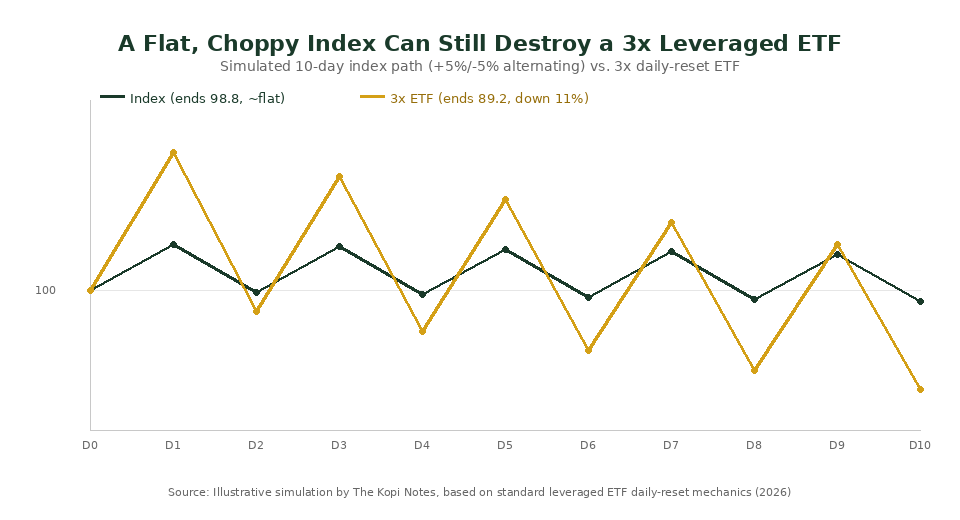
This effect — called volatility decay or “beta slippage” — is why leveraged ETF providers like Direxion and ProShares state explicitly in their fund literature that these products are designed for sophisticated investors who actively monitor and typically hold positions for one day or a few days at most, not for buy-and-hold investing. The math works for you only when the index moves in a sustained, low-volatility trend in one direction. It works against you whenever the index chops sideways, even mildly — and markets spend a lot of time chopping sideways.
It’s worth being fair to the other side of the ledger too. Run the same mechanics through a trending market — say, the index rising 2% on five consecutive days with no reversals — and a 3x fund doesn’t just match 3x the cumulative return, it can modestly exceed it, because each day’s gain compounds on a larger base. This is the exact mirror image of the decay problem: compounding amplifies returns in a sustained trend just as reliably as it erodes them in a choppy one. The practical implication is that a leveraged ETF’s suitability has almost nothing to do with whether you’re right about the direction of the market, and almost everything to do with whether the path to get there is smooth or volatile. Nobody can reliably predict which of those two paths a market will take over the coming weeks — which is precisely why issuers frame these as short-dated tactical instruments rather than conviction-expressing, buy-and-hold positions.
Singapore Context: MAS Rules, Brokers and the SGX-Listed Alternative
For a Singapore investor holding a SGD 10,000 position in TQQQ or SOXL, three local realities apply that don’t show up on a US brokerage’s order screen.
MAS classification and the Customer Account Review. Leveraged and inverse ETFs are classified by MAS as Specified Investment Products (SIPs) because of their derivative-based structure and the risk that returns can diverge sharply from simple multiples of the index. Before a Singapore-regulated broker — Interactive Brokers (IBKR), Saxo, Tiger Brokers or moomoo among them — lets you trade a listed SIP like TQQQ or SOXL, it must run you through a Customer Account Review (CAR) to assess your product knowledge, as set out on the government’s MoneySense SIP explainer. This is a one-time check, not a recurring approval, but it means a brand-new brokerage account cannot buy these tickers on day one without completing it.
Tax treatment is the same as any other US-domiciled ETF. TQQQ, SOXL and UPRO are all domiciled in the United States, which means Singapore investors face the standard 30% US withholding tax on any distributions (most leveraged ETFs pay minimal or no distributions, so this is a smaller drag than it is for dividend ETFs) and, more importantly, the same US estate tax exposure that applies to any US-situs security — a non-resident alien’s US assets above USD 60,000 can be subject to US estate tax of up to 40%. This is the same risk Singapore investors already navigate with CSPX vs VOO-style decisions; leveraged ETFs don’t get a pass just because they’re a trading tool.
SGX has its own locally domiciled leveraged and inverse products. Less well known: Singapore investors don’t have to go to the US market at all to get leveraged exposure. Phillip Capital Management’s LSS/LSU (2x daily leveraged) and SSS/SSU (-1x daily inverse) products, listed on SGX since December 2021, track the SGX MSCI Singapore Free Index Futures (SiMSCI) — giving 2x or inverse daily exposure to the Singapore market itself, domiciled and regulated locally, according to Phillip Nova’s ETP product page. These carry the exact same daily-reset mechanics and volatility decay risk as their US counterparts — they are not a “safer” leveraged product — but they do sidestep US withholding tax and US estate tax exposure, and they’re designed explicitly as short-term tactical tools for traders who already understand the mechanics above.
| Product | Ticker | Exposure | Domicile | US Tax Exposure |
|---|---|---|---|---|
| TQQQ | NASDAQ | 3x Nasdaq-100, daily | USA | Yes (30% WHT, estate tax) |
| SOXL | NYSE Arca | 3x NYSE Semiconductor Index, daily | USA | Yes (30% WHT, estate tax) |
| UPRO | NYSE Arca | 3x S&P 500, daily | USA | Yes (30% WHT, estate tax) |
| LSS / SSS | SGX | 2x / -1x SiMSCI (Singapore), daily | Singapore | None |
Source: Direxion SOXL fact sheet (Oct 2026); ProShares TQQQ & UPRO fund pages (Oct 2026); Phillip Nova ETP page (Oct 2026).
Costs: Leveraged ETFs vs Plain Vanilla Index Funds
Leverage isn’t free, and the cost shows up in two places: the expense ratio (TER) and the implicit financing cost of the swaps and futures used to create the leverage. The TER alone tells a clear story — leveraged funds cost roughly 4 to 14 times what a plain index fund charges.
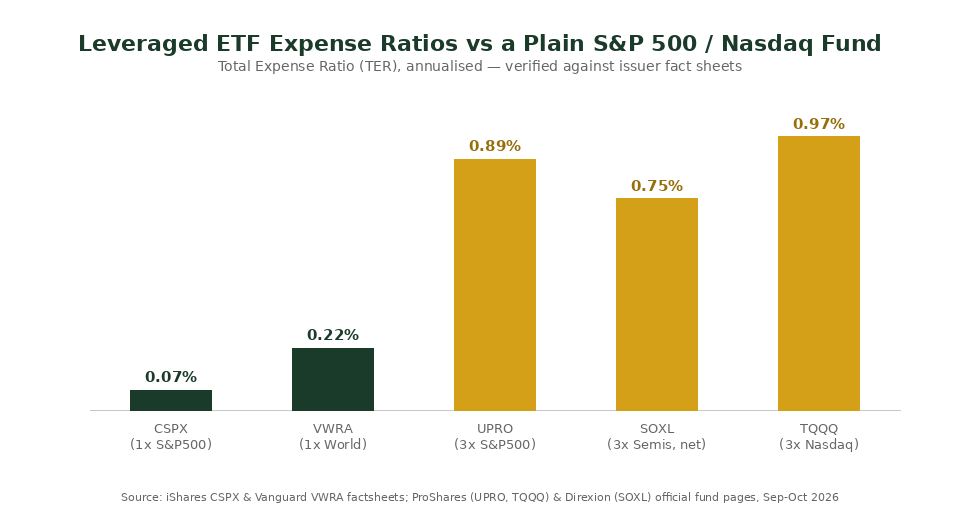
| Fund | TER (annualised) | On a SGD 10,000 Position |
|---|---|---|
| CSPX (1x S&P 500) | 0.07% | ~SGD 7/year |
| VWRA (1x World) | 0.22% | ~SGD 22/year |
| SOXL (3x Semiconductors, net) | 0.75% (0.91% gross) | ~SGD 75/year |
| UPRO (3x S&P 500) | 0.89% | ~SGD 89/year |
| TQQQ (3x Nasdaq-100) | 0.97% | ~SGD 97/year |
Source: iShares CSPX factsheet; Vanguard VWRA factsheet; Direxion SOXL fact sheet (gross/net 0.91%/0.75%, waiver through Sep 2027); ProShares UPRO fund page (0.89%, waiver through Sep 2026); Vanguard/Pensions & Investments TQQQ data (0.97%, Sep 2026).
The TER gap matters, but it’s a rounding error next to the volatility decay risk shown earlier. A trader holding SOXL for three days pays a trivial fraction of 0.75% in fees — but could easily lose 5–10% to decay in a choppy week regardless of fees. For anyone evaluating factor investing ETFs — quality, value and momentum as a lower-risk way to tilt a portfolio, the cost and risk profile is simply not comparable to leveraged products.
What Singapore Investors Should Actually Do
Leveraged ETFs are appropriate if: you are an active trader who checks positions daily, you have a specific short-term thesis (days, not months), you size the position as a small percentage of your portfolio you can afford to lose entirely, and you fully understand that holding through a volatile, range-bound period can produce losses even if your long-term directional call turns out correct.
Consider alternatives if: you are building a retirement or long-term wealth portfolio, you want to “buy and forget,” or you’re tempted by the headline returns without having modelled what a sideways month does to the position. For long-term core holdings, a plain 1x fund like CSPX or VWRA captures the same underlying index exposure without the daily-reset decay, at a fraction of the cost.
If you’ve weighed this and still want exposure, a few practical risk-management habits separate disciplined leveraged ETF use from an accidental blow-up. First, size the position as a fixed, small percentage of total portfolio value — many traders cap single leveraged positions at 1–5% of the portfolio precisely because the downside in a bad week can be severe and fast. Second, set a hard exit rule before you enter, whether that’s a percentage stop-loss or a maximum holding period measured in days, and follow it mechanically rather than hoping a losing position “comes back” — the daily-reset mechanics mean waiting often makes the mathematics worse, not better, if the index stays volatile. Third, check your broker’s margin and financing costs for these specific tickers; some platforms apply extra margin requirements to Specified Investment Products that can change your effective cost of holding. Finally, track the fund’s actual multi-day return against the index yourself for a week before committing real capital, so the volatility decay effect in the chart above stops being an abstraction and becomes something you’ve watched happen with real numbers.
Leveraged ETFs are not CPF Investment Scheme (CPFIS) approved and most brokers restrict SRS funds from being used to buy listed SIPs, so this is money that sits outside your CPF and SRS tax-advantaged accounts regardless of broker — for SRS-eligible core holdings, see our guide on ETFs you can actually buy with SRS funds. If you do decide to trade leveraged products, compare execution and margin costs across brokers first — our IBKR vs moomoo comparison for Singapore investors covers commission and FX spread differences that matter more for frequent traders than for buy-and-hold investors. For the full universe of what’s listed and accessible from Singapore, our complete Singapore ETF list is a useful starting reference.
Frequently Asked Questions
What is a leveraged ETF and how is it different from a normal ETF?
A leveraged ETF uses swaps, futures and other derivatives to deliver a multiple — usually 2x or 3x — of an underlying index’s daily return, rather than simply holding the index’s constituent stocks like a normal ETF does. Because the fund resets its exposure every trading day, its return over weeks or months can differ substantially from the index’s return multiplied by the stated leverage factor, especially when the index is volatile.
Can Singapore investors buy TQQQ, SOXL or UPRO?
Yes, through MAS-regulated brokers that offer US market access, such as Interactive Brokers, Saxo, Tiger Brokers or moomoo. Because these are classified as Specified Investment Products (SIPs), your broker must first run a Customer Account Review to confirm you understand the product before you can place a trade — a one-time check, not a per-trade approval.
Can I buy leveraged ETFs using my CPF or SRS funds?
No. Leveraged and inverse ETFs are not approved under the CPF Investment Scheme (CPFIS), and most brokers do not permit SRS funds to be used for listed Specified Investment Products. Leveraged ETF trading sits entirely outside Singapore’s tax-advantaged retirement accounts.
What is volatility decay in a leveraged ETF?
Volatility decay (also called beta slippage) is the gap between a leveraged ETF’s actual multi-day return and the naive “leverage factor times index return” calculation, caused by daily compounding. In a volatile, range-bound market, this gap is consistently negative — the leveraged fund tends to lose value even when the underlying index ends up roughly flat, as shown in the worked example above.
Is there a Singapore-listed alternative to US leveraged ETFs?
Yes. Phillip Capital Management’s LSS/LSU (2x leveraged) and SSS/SSU (-1x inverse) products, listed on SGX since December 2021, offer leveraged and inverse daily exposure to the Singapore market (tracking SiMSCI futures) without US withholding tax or US estate tax exposure. They carry the same daily-reset volatility decay risk as US leveraged ETFs and are designed as short-term tactical tools, not long-term holdings.
How long should I hold a leveraged ETF?
Issuers like Direxion and ProShares generally design and market these products for holding periods of a single trading day, with some traders extending to a few days around a specific, actively monitored thesis. Holding through weeks or months of normal market volatility exposes you to compounding decay that can erode returns even if your directional view on the underlying index is ultimately correct.
Building a Long-Term Portfolio Instead?
For core holdings, a plain 1x world or S&P 500 ETF beats a leveraged fund on cost and predictability. Open a brokerage account and start with the basics.
This article was researched with the help of AI. While we strive to keep all information accurate and up to date, there may be errors. If you notice any discrepancies, please contact us.