Best Miles Travel Credit Card Singapore 2026: HSBC, UOB, DBS & OCBC Compared
Earn miles on every dollar you spend — locally and overseas — then redeem for business-class flights. Here’s which card wins in 2026.
The best miles travel credit cards in Singapore for 2026 are the HSBC TravelOne (best overall perks, 2.4 mpd overseas, 4 lounge visits, no transfer fee), the UOB PRVI Miles (best earn rate at 1.4 mpd local / 2.4 mpd overseas with 4 lounge visits), and the DBS Altitude (best for simplicity, non-expiring points, 2 lounge visits). All three carry a S$196–S$262 annual fee and reward loyal spenders who redeem miles for flights.
Not financial advice. All figures are for educational reference only. Data verified as at October 2026. Always confirm current rates on the issuer’s official website before applying.
Table of Contents
Contents — Click to expand
- Our Quick Picks for 2026
- What to Look for in a Miles Card
- Head-to-Head Comparison Table
- HSBC TravelOne — Best Overall Perks
- UOB PRVI Miles — Best Earn Rate
- DBS Altitude — Best for Simplicity
- OCBC 90°N — Best for Hotel Stays
- Miles Cards vs Cashback Cards
- How to Maximise Your Miles
- Frequently Asked Questions
Our Quick Picks for 2026
| Goal | Best Card | Why |
|---|---|---|
| Best overall travel perks | HSBC TravelOne | 2.4 mpd overseas, 4 lounge visits, 9 airline partners, zero transfer fee |
| Best earn rate (S$30k income) | UOB PRVI Miles | 1.4 mpd local, 2.4 mpd overseas, 3 mpd in SEA, 4 lounge visits |
| Best for simplicity / no expiry | DBS Altitude | Points never expire, S$196.20/yr, 2 lounge visits, pool across DBS cards |
| Best for hotel bookings | OCBC 90°N | Up to 7 mpd on Agoda stays, miles never expire, 9 transfer partners |
Source: Official bank websites, SingSaver, The MileLion — October 2026
What to Look for in a Miles Card
A miles credit card makes sense when you travel at least 2–3 times a year and spend enough to redeem a meaningful flight award. Before picking a card, weigh these five factors:
Earn rate (mpd = miles per dollar): The headline number is the overseas earn rate, but your local rate matters more for everyday spend. Singapore is a small city where most daily spending is in SGD — so a 0.1 mpd difference in local earn rate is worth more than you think. On S$4,000 of monthly local spend, 1.4 mpd vs 1.2 mpd earns you 9,600 extra miles per year.
Annual fee and break-even: Most travel cards charge S$196.20–S$261.60 per year. At a conservative redemption value of S$0.015 per mile (business-class redemption on SIA), you need to earn roughly 13,000–17,000 miles to cover the fee. That’s achievable in under a year for moderate spenders.
Transfer partners and fees: Points are only as valuable as the programmes you can transfer to. HSBC TravelOne waives all conversion fees across 9 airline + 3 hotel partners — the most in Singapore. DBS Altitude charges S$27.25 per transfer. OCBC 90°N waives fees for most partners except KrisFlyer. UOB PRVI Miles charges approximately S$27.25 per transfer.
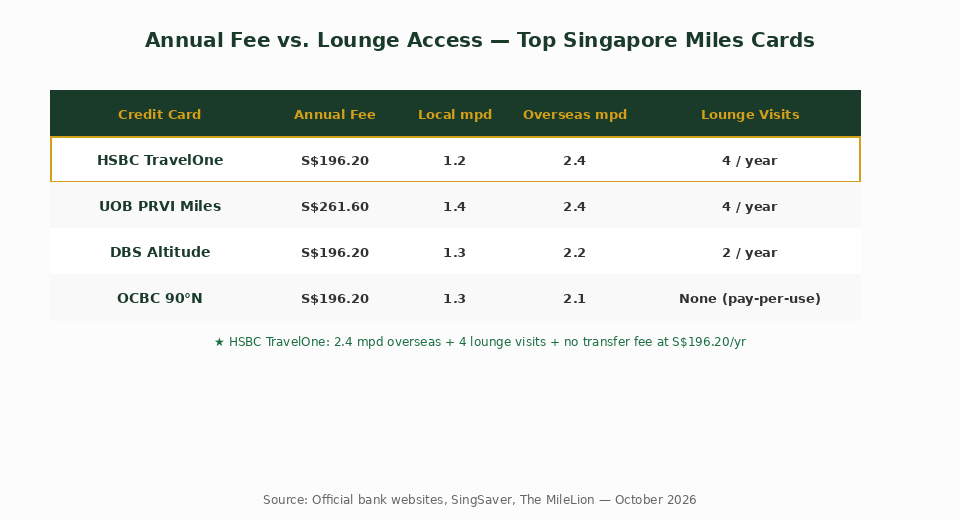
Lounge access: Airport lounge access is the most tangible perk for frequent flyers. HSBC TravelOne and UOB PRVI Miles both give 4 complimentary Priority Pass visits per year (worth approximately S$240). DBS Altitude gives 2 visits. OCBC 90°N only provides pay-per-use DragonPass access — not a complimentary benefit.
Miles expiry: UNI$ from UOB PRVI Miles expire 2 years after the end of the earning quarter — this can catch infrequent redeemers off guard. DBS Points and OCBC 90°N miles never expire, giving you full flexibility to save up for premium redemptions.
If you prioritise avoiding foreign currency fees over earning miles, the best credit card for overseas spending Singapore article covers zero-FX-fee alternatives like the Mari Credit Card and Trust Cashback Card.
Head-to-Head Comparison Table
| Feature | HSBC TravelOne | UOB PRVI Miles | DBS Altitude | OCBC 90°N |
|---|---|---|---|---|
| Annual Fee | S$196.20 | S$261.60 | S$196.20 | S$196.20 |
| 1st Year Waiver | Yes | Yes | Yes | Yes |
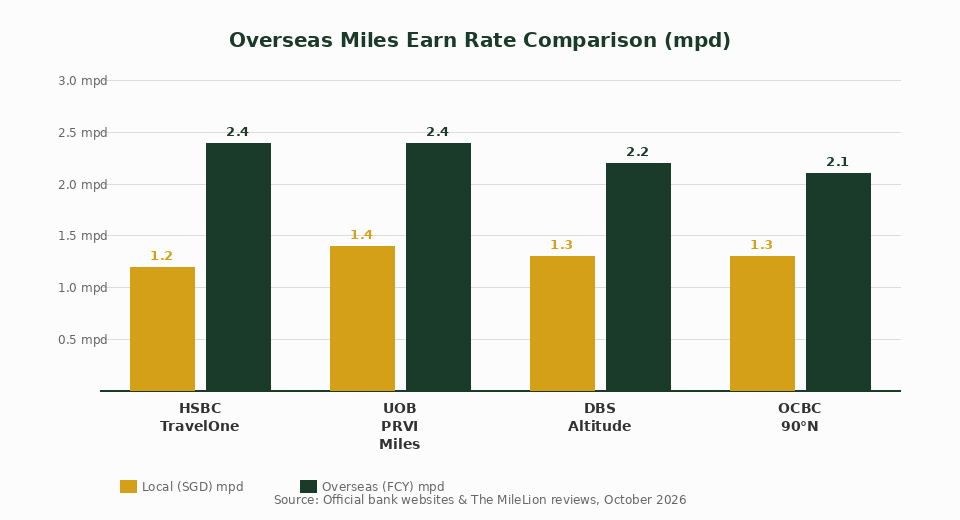
| Local Earn (SGD) | 1.2 mpd | 1.4 mpd | 1.3 mpd | 1.3 mpd |
| Overseas Earn (FCY) | 2.4 mpd | 2.4 mpd | 2.2 mpd | 2.1 mpd |
| Bonus Categories | None | 3 mpd SEA (ID, MY, TH, VN) | Promo-based 5 mpd | Up to 7 mpd Agoda |
| Lounge Visits / Yr | 4 | 4 | 2 | None (pay) |
| Transfer Partners | 9 airlines + 3 hotels | Multiple (confirm with bank) | 4 airlines | 6 airlines + 3 hotels |
| Transfer Fee | None | ~S$27.25 | S$27.25 | S$25 (most partners) |
| Miles Expiry | Confirm with HSBC | 2 yrs after quarter | Never | Never |
| Min Annual Income | S$65,000 | S$30,000 | S$30,000 | S$30,000 |
Source: Official bank websites (HSBC, UOB, DBS, OCBC), SingSaver, The MileLion — October 2026
HSBC TravelOne — Best Overall Perks
The HSBC TravelOne is Singapore’s best-rounded travel miles card for 2026, particularly for those who value lounge access and flexibility in how they redeem miles. It offers 1.2 mpd on local spend and 2.4 mpd on all foreign currency transactions — one of the highest overseas earn rates in Singapore — with no bonus-category complexity.
Where HSBC TravelOne truly stands out is transfer partners: it supports 9 airline partners and 3 hotel loyalty programmes, the widest selection of any bank card in Singapore, and critically, it charges zero conversion fees. Competitors typically charge S$25–S$27 per transfer. For someone who transfers 100,000 miles per year across two programmes, that’s an instant S$50–S$55 saving.
4 complimentary Priority Pass lounge visits per year (shared across the account) are included — worth approximately S$180–S$240 at typical lounge rates. Minimum income requirement is S$65,000, which is higher than competitors, but the card is available to Singaporeans, PRs, and EP/SP holders who meet it.
The welcome offer as of October 2026 includes up to 20,000 bonus miles plus a Samsonite luggage promotion for new-to-HSBC cardholders. Welcome offers change frequently — verify with HSBC or SingSaver before applying.
Best for: Mid-to-high earners (S$65k+) who travel frequently and want the most flexibility in redeeming miles across airlines and hotels without paying conversion fees.
UOB PRVI Miles — Best Earn Rate
The UOB PRVI Miles card consistently tops earn-rate rankings in Singapore. Its 1.4 mpd on local SGD spend is the highest of any general-spend travel card, and its 2.4 mpd on overseas transactions matches HSBC TravelOne. Travellers to Southeast Asia get an extra boost — spending in Indonesia, Malaysia, Thailand, or Vietnam earns 3 mpd.
To illustrate the value: a Singapore resident spending S$4,000 per month locally earns 67,200 miles per year on UOB PRVI Miles vs 57,600 on HSBC TravelOne (at 1.2 mpd local) — a difference of 9,600 miles, which is enough for a one-way SIA economy short-haul redemption.
The card also provides 4 Priority Pass lounge visits per year and travel insurance coverage up to S$500,000. Annual fee is S$261.60 — approximately S$65 more than other cards on this list. However, the higher earn rate can more than offset this for regular spenders.
Watch out for: UNI$ (the underlying points) expire 2 years after the end of the earning quarter. If you accumulate miles slowly and plan for a big redemption, you may lose points before transferring. Set a calendar reminder or transfer to your preferred airline programme when you have enough for a meaningful redemption.
Best for: Everyday Singapore spenders who want the highest base earn rate and frequently travel to SEA destinations like Jakarta, Kuala Lumpur, Bangkok and Ho Chi Minh City.
DBS Altitude — Best for Simplicity
The DBS Altitude Visa Signature has been a staple in Singapore wallets for years. It offers 1.3 mpd locally and 2.2 mpd overseas — slightly below the leaders but with one compelling advantage: DBS Points never expire. If you’re a cautious or infrequent traveller building towards a business-class redemption over several years, this matters enormously.
On a S$196.20 annual fee, DBS Altitude awards you 10,000 miles when you pay the annual fee — effectively giving you S$100–S$150 worth of KrisFlyer miles before you swipe the card once in Year 2. Points pool across all your DBS cards, making it easy to consolidate.
The card includes 2 complimentary Priority Pass lounge visits per year (Visa version). Transfer to 4 airline partners at S$27.25 per transfer. The KrisFlyer auto-conversion programme costs S$43.60 per year and automatically sends your points to KrisFlyer monthly.
The review from The MileLion (May 2026) rates the card “Take It Or Leave It” — no single outstanding feature, but no weakness either. For a new-to-miles investor using a retirement planning calculator for Singapore and thinking long-term about building their points balance, the no-expiry feature is genuinely valuable.
Best for: Conservative accumulators who want a set-and-forget card with non-expiring points and a low-maintenance structure.
OCBC 90°N — Best for Hotel Stays
The OCBC 90°N card earns 1.3 mpd on local spend and 2.1 mpd on overseas foreign currency — the lowest overseas rate on this list. Where it shines is hotels: Agoda bookings earn up to 7 mpd in foreign currency and 6 mpd in SGD (subject to the Agoda promotion, valid until October 2026 for check-outs before December 2026).
For a Singapore traveller spending S$10,000 on Agoda hotel stays over a year, the 7 mpd rate generates 70,000 miles vs 22,000–24,000 miles on a general-spend card — a difference worth approximately S$700–S$1,400 in flight redemptions at S$0.01–S$0.02 per mile.
The card’s 9 transfer partners (6 airlines including KrisFlyer, Flying Blue, British Airways Avios, Cathay Asia Miles, Etihad Guest, United MileagePlus, plus Accor Live Limitless, IHG One Rewards, and Marriott Bonvoy) rival HSBC TravelOne’s breadth. Miles never expire. Transfer fee is S$25 for most partners (waived for most; confirm KrisFlyer).
Lounge access caveat: Despite advertising DragonPass, OCBC 90°N’s access is pay-per-use — there are no complimentary lounge visits. This is a meaningful downgrade versus HSBC and UOB for frequent travellers who rely on lounges.
If you hold an Trust Freedom Card or another digital bank card for everyday cashback spending, pairing it with the OCBC 90°N for hotel bookings is an efficient stack.
Best for: Hotel loyalists and Agoda users who want to maximise miles on accommodation bookings.
Miles Cards vs Cashback Cards: Which Should You Get?
The miles-vs-cashback debate divides Singapore personal finance enthusiasts every year. Here’s an honest breakdown for 2026:
| Factor | Miles Card | Cashback Card |
|---|---|---|
| Value per dollar spent | S$0.015–S$0.05 (business class) if redeemed well | S$0.01–S$0.02 (fixed, predictable) |
| Complexity | High — requires research on redemptions | Low — cash back automatically applied |
| Foreign currency fee | 3.25% (all four cards here) | 0% (Mari, Trust) or 3.25% (others) |
| Best use case | Business class flights, luxury hotels via transfers | Everyday spend, groceries, dining, online shopping |
| Who wins | High spenders, frequent flyers, patient redeemers | Moderate spenders, those who prefer certainty |
Source: The Kopi Notes analysis, October 2026
The practical answer for most Singapore households: if you spend more than S$3,000 per month and travel at least twice a year, a miles card likely beats cashback in long-run value — especially for premium cabin flights to Europe or Australia. If you travel rarely or prefer simplicity, a zero-FX-fee cashback card wins on practical grounds.
How to Maximise Your Miles in 2026
Miles cards reward strategy, not just spending. Here are five ways Singapore cardholders consistently get outsized value:
1. Spend on overseas transactions whenever possible. All four cards earn 2.1–2.4 mpd on foreign currency spend vs 1.2–1.4 mpd locally. Booking international flights, hotels, or SaaS subscriptions billed in USD, EUR, or GBP on your miles card adds up quickly.
2. Leverage sign-up bonuses. Sign-up bonuses of 20,000–45,000 miles are common and often exceed a full year of organic earning. Time card applications strategically — apply just before a big expense month (e.g. insurance renewal, property deposit) to hit minimum spend requirements.
3. Transfer to the right programme. Singapore Airlines KrisFlyer is the most popular transfer partner but often the worst value for short-haul economy. United MileagePlus, Flying Blue (Air France/KLM), and British Airways Avios regularly offer better per-mile redemption rates for specific routes. Research before transferring — miles are one-way and generally not reversible.
4. Stack your cards. Use a miles card for dining, travel, and overseas spending. Pair it with a cashback card for groceries and utilities (where merchant codes often exclude miles bonuses). This is how serious miles collectors get 3–5% effective returns on total spending.
5. Use an OCBC 90°N for Agoda + a UOB PRVI for everyday spend. This two-card stack captures 7 mpd on hotel bookings and 1.4 mpd on all other local spend — a strong combination without needing to track multiple card categories.
Frequently Asked Questions
Which is the best travel credit card in Singapore for 2026?
For most Singaporeans earning S$30,000 or more, the UOB PRVI Miles offers the best base earn rate (1.4 mpd local, 2.4 mpd overseas) with 4 lounge visits per year. For those earning S$65,000 or more who value maximum flexibility across airline programmes, the HSBC TravelOne is the top choice — it earns 2.4 mpd overseas, provides 4 lounge visits, and charges zero transfer fees across 9 airline and 3 hotel partners.
What is the earn rate for miles credit cards in Singapore?
As at October 2026, the top earn rates for Singapore miles credit cards are: HSBC TravelOne (1.2 mpd local / 2.4 mpd overseas), UOB PRVI Miles (1.4 mpd local / 2.4 mpd overseas, 3 mpd in SEA), DBS Altitude (1.3 mpd local / 2.2 mpd overseas), and OCBC 90°N (1.3 mpd local / 2.1 mpd overseas, up to 7 mpd on Agoda). All four charge a 3.25% foreign currency transaction fee.
Are miles credit cards worth it in Singapore?
Yes, for regular travellers who spend strategically. Miles typically deliver S$0.015–S$0.05 in value per mile when redeemed for business-class flights, versus a fixed S$0.01–S$0.02 from cashback. The catch is complexity — you need to research redemption sweet spots and understand transfer partners. If you travel at least twice a year and can spend S$3,000 or more monthly, a miles card generally beats cashback over the long term.
Can I use CPF or SRS to earn miles on credit cards?
You cannot directly earn credit card miles on CPF transactions. However, some CPF-related online payment portals accept credit card payments for certain top-ups; always check for exclusions in the card’s terms. For SRS (Supplementary Retirement Scheme) contributions, whether you earn miles depends on the merchant code assigned by the receiving institution. Check with your bank before making large SRS contributions, as these are often excluded from miles earning.
How do I transfer miles to KrisFlyer from my credit card?
Each bank has a slightly different process. For DBS Altitude: log in to the DBS digibank app, go to Rewards, select Redeem, and choose KrisFlyer. A S$27.25 transfer fee applies per transaction (or enrol in the KrisFlyer auto-conversion programme at S$43.60/year). For OCBC 90°N: transfer via the OCBC app. For UOB PRVI Miles: log in to UOB PRVI Miles via the UOB TMRW app. Minimum transfer amounts and block sizes vary — check with your bank. Note: miles transferred to KrisFlyer cannot be returned to the credit card.
Is the HSBC TravelOne annual fee worth it?
At S$196.20 per year (first year free), the HSBC TravelOne breaks even on fee alone through 4 lounge visits (worth approximately S$40–S$60 each) plus the welcome miles bonus. On top of that, the zero transfer fee advantage saves S$25–S$27 every time you move miles to an airline programme — two transfers per year already cover a third of the annual fee. For cardholders who actively earn and transfer miles, the fee is well-justified. For light spenders who travel once a year, consider whether the annual fee vs earn rate arithmetic works in your favour.
Ready to Start Earning Miles?
Compare your options and apply for your chosen travel card. Pair it with a zero-FX-fee card for maximum value when travelling overseas.
This article was researched with the help of AI. While we strive to keep all information accurate and up to date, there may be errors. If you notice any discrepancies, please contact us.