Best Credit Card for Overseas Spending Singapore (2026 Guide)
Zero FX fees, cashback, and miles compared — find the right card for your next trip.
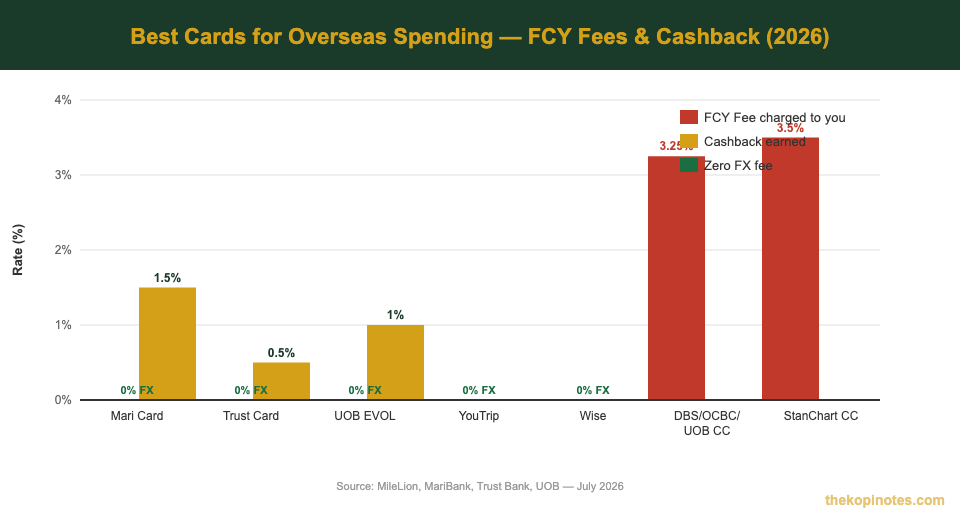
The best credit card for overseas spending in Singapore in 2026 depends on what you value most. For pure cost savings, the Mari Credit Card (0% FX fee + 1.5% cashback), Trust Cashback Card (0% FX fee + 0.5% cashback), and UOB EVOL Card (0% FX fee + 1% cashback) are the top picks. If you want miles, cards like the Citi PremierMiles or DBS Altitude earn 2.2 mpd on foreign spend — but you pay a 3.25% FCY fee. Multi-currency wallets like YouTrip offer wholesale rates with zero fees but no rewards.
Not financial advice. All figures are for educational reference only. Data as at July 2026 unless noted.
- Most Singapore credit cards charge 3.25% on overseas spend — that’s S$97.50 on a S$3,000 holiday.
- In 2026, zero-FX-fee credit cards (Mari, Trust, UOB EVOL) now beat multi-currency wallets on net value — you save AND earn cashback.
- Best strategy: use a zero-FX-fee card for all overseas taps, and keep YouTrip as a backup for currencies where you want to lock in rates.
Table of Contents
Contents — Click to expand
- The 3.25% Problem Most Singaporeans Don’t Notice
- Best Zero FX Fee Cards for Overseas Spending (2026)
- Full Card Comparison Table
- If You Want Miles: Best FCY Miles Cards
- Multi-Currency Wallets: YouTrip, Wise & Revolut
- The Real SGD Cost of Overseas Spending
- Best Strategy for Singapore Travellers
- Frequently Asked Questions
The 3.25% Problem Most Singaporeans Don’t Notice
Every time you swipe a Singapore credit card overseas, your bank charges a foreign currency (FCY) transaction fee on top of the exchange rate. Most banks — DBS, OCBC, UOB, Citi, HSBC, Maybank — charge 3.25%. Standard Chartered charges 3.5%.
That might sound small. But it adds up fast. Spend S$3,000 on a two-week Europe trip and you’ve quietly paid S$97.50 in fees you never saw. Spend S$6,000? That’s S$195 gone.
Here’s the thing: the fee is charged on the transaction amount in SGD — after the bank converts the foreign currency at its own rate. So you’re paying 3.25% on a number that may already include a 0.3–0.5% Mastercard or Visa exchange rate spread. Two layers of cost, neither of which are clearly shown at the point of payment.
The good news? In 2026, there are now genuinely better options. A new wave of zero-FX-fee cards has changed the game for Singapore travellers.
Best Zero FX Fee Cards for Overseas Spending (2026)
These three credit cards charge 0% in FCY fees on overseas transactions. That means you pay the Mastercard exchange rate with no surcharge on top. Two of them also pay cashback, which means you’re actually getting paid to spend overseas.
1. Mari Credit Card — Best Overall for Overseas Cashback
Since 1 January 2026, the Mari Credit Card waives all FCY fees on overseas spend. On top of that, it pays 1.5% cashback on foreign currency transactions, capped at S$1,500 of overseas spend per calendar month. That cap resets monthly, so for most travellers, you’ll never hit it on a single trip.
There is no annual fee, ever. MariBank also promises best-in-class FX rates for seven selected currencies (updated hourly in the app), and falls back to Mastercard rates for others.
One thing to watch: if a merchant overseas offers to charge you in Singapore Dollars (a practice called Dynamic Currency Conversion, or DCC), a 1% fee applies. Always choose to pay in the local foreign currency, not SGD.
The catch? MariBank is a digital bank only accessible via app. There’s no physical branch. For most Singapore residents comfortable with digital banking, this is a non-issue.
2. Trust Cashback Card — Best for ATM Withdrawals Overseas
The Trust Cashback Card from Trust Bank (a Standard Chartered and FairPrice joint venture) also charges 0% FCY fees. Cashback is 0.5% on overseas spend — lower than Mari — but Trust has one distinct advantage: unlimited free ATM withdrawals overseas, including from overseas bank ATMs.
YouTrip only gives you S$400 free withdrawals per month before a 2% fee kicks in. If you withdraw cash regularly while travelling, Trust is the better card to carry.
3. UOB EVOL Card — Best Zero-Fee Card with Simple Rewards
From 19 June 2025, UOB EVOL waives FCY fees on all overseas foreign currency spend. You earn 1% cashback on eligible overseas spend with no minimum spend required. There is no annual fee if you make at least 3 transactions per statement month — a very low bar.
UOB EVOL also earns up to 10% cashback on local online and mobile spend with a minimum spend of S$800, making it a strong dual-purpose card for both local and overseas use.
Full Card Comparison Table
| Card | FCY Fee | Overseas Cashback | Annual Fee | Best For |
|---|---|---|---|---|
| Mari Credit Card | 0% | 1.5% (cap S$1,500/mth) | Free forever | Max cashback on overseas spend |
| Trust Cashback Card | 0% | 0.5% | Free forever | Free overseas ATM withdrawals |
| UOB EVOL Card | 0% | 1% | Free (3 txn/mth) | Dual local + overseas cashback |
| YouTrip | 0% | None | Free forever | Lock in FX rates in advance |
| Wise Card | ~0% | None | Free (card) | International transfers + spending |
| Citi PremierMiles | 3.25% | 2.2 mpd on FCY | S$196.20/yr | Miles collectors with high spend |
| DBS Altitude | 3.25% | 2.2 mpd on FCY | S$196.20/yr | Miles collectors with high spend |
Source: MileLion, MariBank, Trust Bank, UOB, Citibank, DBS — July 2026. FCY = foreign currency transaction fee charged by the bank.
If You Want Miles: Best FCY Miles Cards
Zero-FX-fee cards are the smart choice for most travellers. But if you’re a miles collector and regularly spend large amounts overseas, miles cards can still make sense — provided you choose ones with a high enough earn rate to justify the 3.25% cost.
Here’s the rough maths. If you value a mile at S$0.02 (a common benchmark for economy redemptions), then to break even on the 3.25% FCY fee, you need to earn at least 1.625 mpd. Cards earning 2 mpd or above can be worthwhile for big spenders who actively redeem for flights.
| Card | FCY Earn Rate | FCY Fee | Est. Cost Per Mile | Cap |
|---|---|---|---|---|
| DCS Imperium | 4 mpd | 3.25% | 0.81¢ | Min S$4,000 FCY/mth |
| Citi Rewards | 4 mpd (online) | 3.25% | 0.81¢ | S$1,000/mth |
| Maybank World MC | 3.2 mpd | 3.25% | 1.02¢ | Min S$4,000/mth |
| Citi PremierMiles | 2.2 mpd | 3.25% | 1.48¢ | Uncapped |
| DBS Altitude | 2.2 mpd | 3.25% | 1.48¢ | Uncapped |
Source: The MileLion, July 2026. Cost per mile based on 3.25% FCY fee at midmarket rate. Min spend requirements apply — see individual card T&Cs.
A word of caution: most of these high-earn-rate cards have minimum spend requirements or monthly caps. For example, the DCS Imperium’s 4 mpd only activates if you spend S$4,000 in FCY that month. For a typical Singapore traveller spending S$1,000–3,000 on an overseas trip, a zero-FX-fee cashback card will almost always beat these miles cards in net dollar terms.
Multi-Currency Wallets: YouTrip, Wise & Revolut
Before zero-FX-fee credit cards existed in Singapore, multi-currency debit wallets were the only way to avoid the 3.25% bank surcharge. YouTrip, Wise, and Revolut still have a place in your wallet — but they’re no longer the clear winner they once were.
Here’s what they still do well. Multi-currency wallets typically offer wholesale Mastercard or mid-market exchange rates. That means a slightly better rate than you’d get from a standard Mastercard credit card (typically 0.3–0.5% better). YouTrip also lets you lock in exchange rates in advance — if you see a great JPY or KRW rate today, you can top up that currency and hold it for your trip six months from now.
However, multi-currency wallets are debit cards, not credit cards. That comes with three practical downsides:
First, fraud protection is weaker. Fraudulent charges are deducted immediately from your wallet balance. With a credit card, disputed transactions don’t touch your cash — you dispute and get a temporary credit while the bank investigates. There have been documented cases of Singapore YouTrip users losing their entire wallet balance to rapid fraudulent transactions and waiting months for recovery.
Second, hotels and rental cars prefer credit cards. Rental companies and hotels place authorisation holds — typically US$200–500 — that reduce your available debit balance immediately. On a YouTrip card, that money is locked up until the hold is released. On a credit card, no funds are deducted.
Third, no rewards. YouTrip and Wise earn zero cashback or miles. If the Mari Credit Card now gives you 0% FX fees AND 1.5% cashback, using YouTrip instead actually costs you money in forgone rewards.
The best use case for YouTrip in 2026 is locking in exchange rates for currencies you know you’ll need — particularly JPY and KRW, which fluctuate significantly. You can also use your YouTrip referral code to get S$5 when you sign up and top up. Use code from TKN’s YouTrip page for the bonus.
The Real SGD Cost of Overseas Spending
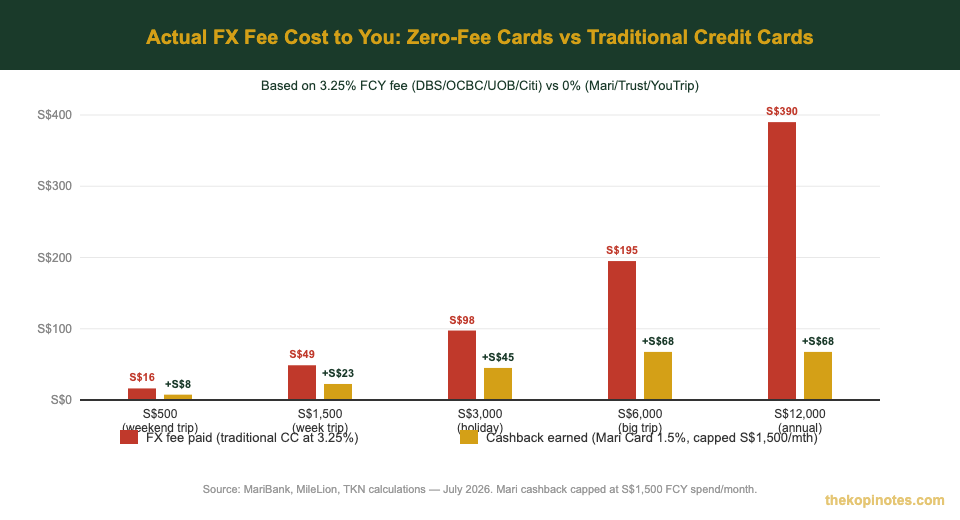
Let’s make this concrete. Here’s what a typical Singapore traveller actually pays at different spend levels, comparing a traditional bank credit card (3.25% FCY fee) against the Mari Credit Card (0% FCY fee + 1.5% cashback):
| Overseas Spend | FCY Fee Paid (Traditional CC) |
Cashback Earned (Mari Card) |
Net Difference |
|---|---|---|---|
| S$500 (weekend trip) | –S$16.25 | +S$7.50 | Save S$23.75 |
| S$1,500 (week trip) | –S$48.75 | +S$22.50 | Save S$71.25 |
| S$3,000 (holiday) | –S$97.50 | +S$45.00 | Save S$142.50 |
| S$6,000 (big trip) | –S$195.00 | +S$67.50* | Save S$262.50* |
| S$12,000 (annual spend) | –S$390.00 | +S$67.50* | Save S$457.50* |
Source: TKN calculations, July 2026. *Mari cashback capped at S$1,500 FCY spend per calendar month (S$22.50 max per month). Savings include both avoided FCY fee + cashback earned.
These numbers assume you avoid DCC (always pay in local currency, not SGD). The savings are real and recurring — every year you travel on a traditional bank card, you’re leaving hundreds of dollars on the table.
Best Strategy for Singapore Travellers in 2026
The optimal approach for most Singaporeans in 2026 is a two-card setup. Here’s how to think about it:
Card 1 — Your main overseas card: Mari Credit Card. Use this for all in-person overseas spending — restaurants, shops, transport, convenience stores. You earn 1.5% cashback on every foreign currency transaction, and pay 0% FX fees. It’s the closest thing to a free lunch in personal finance: you’re literally getting paid to spend.
Card 2 — Backup: YouTrip or Trust. Keep YouTrip if you want to pre-load currencies and lock in rates (especially useful for Japan and Korea trips). Use Trust if you need free ATM cash withdrawals. For everything else, the Mari card wins on net value.
If you’re a miles collector and your annual overseas spend is above S$20,000, a high-end miles card (Citi Prestige, DCS Imperium) may still make sense — but run the actual maths for your spend level. The 3.25% fee is a real cost that eats into the value of your miles.
One more tip: always decline Dynamic Currency Conversion (DCC). When a merchant overseas offers to show you the SGD amount and charge in SGD, say no. Always choose the local currency. DCC rates are significantly worse than your card’s rates, and there is no benefit to you whatsoever — the profit goes to the merchant’s payment processor.
If you’re building a broader investment strategy alongside your travel, consider using an Endowus referral code for SRS or CPF investing, or explore passive income strategies in Singapore to build income alongside your savings on travel costs.
You might also want to look at a Singapore retirement calculator to see how much your annual FCY fee savings (S$100–400 per year) compound into your retirement target. Small savings, reinvested consistently, matter more than people think.
For those comparing platforms to hold investments funded by travel savings, the moomoo Singapore review covers their 2026 fee structure, and CPF investment strategy covers how to deploy OA savings productively.
Reminder: Not financial advice. Card terms change — always verify current fees and cashback rates directly with the issuing bank before applying. Data as at July 2026.
Frequently Asked Questions
What is the best credit card for overseas spending in Singapore in 2026?
The Mari Credit Card is the best overall credit card for overseas spending in Singapore in 2026. It charges 0% FCY fees on all foreign currency transactions and earns 1.5% cashback on overseas spend, capped at S$1,500 of FCY spend per calendar month. There is no annual fee. The Trust Cashback Card and UOB EVOL Card are strong alternatives also offering 0% FCY fees with cashback.
How much does it cost to use a regular Singapore credit card overseas?
Most Singapore credit cards (DBS, OCBC, UOB, Citi, HSBC, Maybank) charge a 3.25% foreign currency (FCY) transaction fee on all overseas purchases. Standard Chartered charges 3.5%. On a S$3,000 holiday, that’s S$97.50 in fees. The fee is charged in addition to the Mastercard or Visa exchange rate spread (typically 0.3–0.5%), so the real cost of using a traditional card overseas is closer to 3.5–3.75% above mid-market rates.
Is YouTrip still worth it in 2026 if there are now zero-FX-fee credit cards?
YouTrip is worth keeping as a secondary card, but it’s no longer the clear winner for overseas spending in Singapore. Zero-FX-fee credit cards like Mari (1.5% cashback) now offer equal or better exchange rates AND pay you cashback — so using YouTrip instead of Mari actually costs you money in forgone rewards. The two cases where YouTrip still wins: locking in exchange rates in advance (e.g. buying JPY months before your Japan trip) and if you need more than S$400/month in free ATM withdrawals overseas (where Trust Card is actually the better option).
What is Dynamic Currency Conversion (DCC) and should I avoid it?
Dynamic Currency Conversion (DCC) is when an overseas merchant offers to charge your card in Singapore Dollars instead of the local foreign currency. It sounds convenient, but DCC exchange rates are significantly worse than what your bank or Mastercard would give you — the merchant’s payment processor pockets the difference. Always choose to pay in the local currency (JPY, EUR, USD, etc.) and decline DCC. On a Mari Card, DCC also triggers a 1% fee, making it doubly bad. If a receipt is handed to you with SGD already pre-selected, ask the merchant to re-run it in local currency.
Can I use the Mari Credit Card or Trust Card at overseas ATMs for free?
Trust Cashback Card offers unlimited free overseas ATM withdrawals (from your Trust savings account via debit mode — not cash advance mode). Mari Credit Card can be used at ATMs but standard credit card cash advance fees apply, so it’s not recommended for ATM use. YouTrip gives S$400 of free ATM withdrawals per calendar month, after which a 2% fee applies. For overseas cash needs, Trust is the best card to carry.
What cards do Singapore travellers use for miles while spending overseas?
Singapore miles collectors typically use cards like Citi PremierMiles (2.2 mpd on FCY) or DCS Imperium (4 mpd with min S$4,000 FCY spend) for overseas spending. However, all miles cards charge a 3.25% FCY fee. To break even on that fee (assuming a mile is worth S$0.02), you need to earn at least 1.625 mpd. Cards earning 2 mpd or above can justify the cost for high-volume travellers who actively redeem miles for business class flights. For most Singaporeans spending under S$3,000 per trip, a zero-FX-fee cashback card delivers better net value.
Is the best card for overseas spending different from the best travel credit card Singapore?
Yes — they serve different goals. The best card for overseas spending minimises FX costs and maximises cashback on in-person overseas transactions. The best travel credit card Singapore typically means a miles card with strong welcome bonuses, lounge access, and airline partnerships — often at the cost of high annual fees and 3.25% FCY charges. For everyday overseas spending (restaurants, transport, shopping), a zero-FX-fee cashback card like Mari beats travel credit cards. For flight and hotel bookings charged in SGD, a miles card can add value without the FCY fee burden.
Save More When You Travel — and When You Invest
Stop losing 3.25% on every overseas transaction. Switch to a zero-FX-fee card today, and put those savings to work with the right investment platform.
This article was researched with the help of AI. While we strive to keep all information accurate and up to date, there may be errors. If you notice any discrepancies, please contact us.