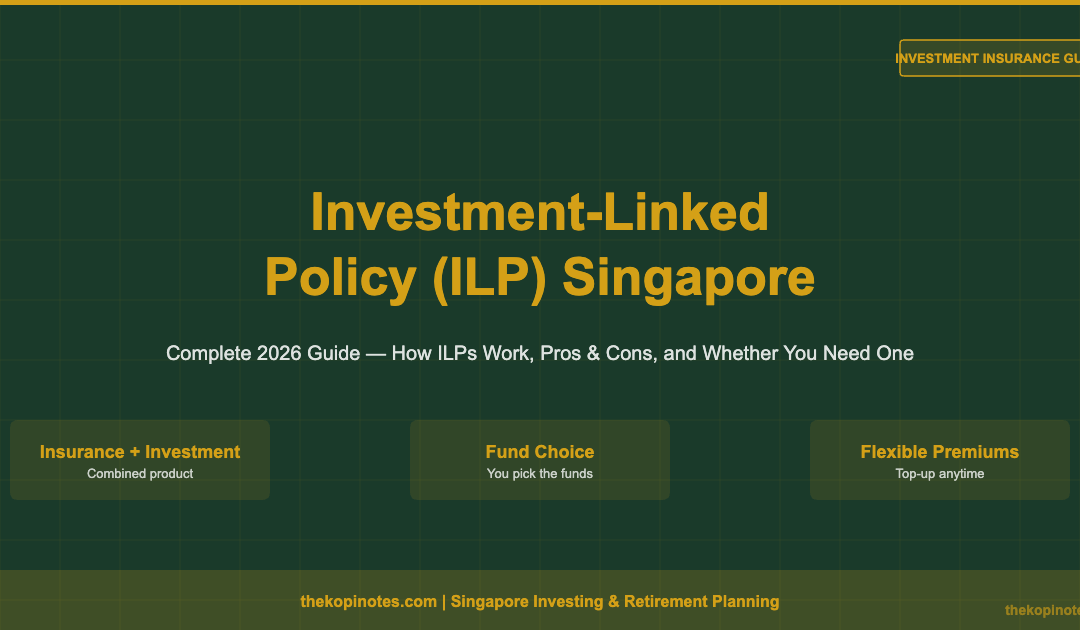
Investment-Linked Policy (ILP) Singapore: Complete 2026 Guide
How ILPs work, what they cost, and whether buying one makes sense for you — honest breakdown for Singapore investors.
An investment-linked policy (ILP) is a life insurance product sold in Singapore that combines term life coverage with a unit trust investment component. You pay a single premium — part buys insurance protection, and the rest is invested in funds you choose. ILPs are regulated by MAS under the Financial Advisers Act. Whether they make financial sense depends heavily on your charges, fund selection, and investment horizon.
Not financial advice. All figures are for educational reference only. Data as at July 2026 unless noted.
- An ILP bundles life insurance + fund investment into one product — premiums split between coverage charges and fund units.
- Total charges (insurance + fund management) typically run 2–3% p.a., significantly higher than buying term life separately and investing in low-cost ETFs.
- ILPs suit specific situations (estate planning, CPF/SRS top-up with insurance riders) — but for most long-term wealth builders, “buy term and invest the rest” delivers better net returns.
Table of Contents
Contents — Click to expand
- What Is an Investment-Linked Policy?
- How an ILP Works: The Mechanics
- Types of ILPs in Singapore
- ILP Charges Explained (The Part They Don’t Highlight)
- ILP Pros and Cons
- ILP vs Buy Term and Invest the Rest
- Who Should (and Shouldn’t) Buy an ILP?
- Popular ILPs in Singapore 2026
- Frequently Asked Questions
What Is an Investment-Linked Policy?
An investment-linked policy (ILP) is a life insurance contract that also acts as an investment vehicle. When you pay your premium each month, your insurer splits the money two ways: one portion pays for your life insurance cover, and the rest buys units in a fund of your choosing.
This differs from a traditional whole life or endowment plan, where the insurer manages a pooled participating fund and you get a guaranteed sum plus (non-guaranteed) bonuses. With an ILP, your investment returns depend entirely on how the funds you picked perform — for better or worse.
MAS requires all ILPs to be sold by licensed financial advisers. Your adviser must provide a Product Summary and a Fund Summary before you sign. These documents contain the charges, fund performance history, and risk disclosures you need to evaluate the product properly.
| Feature | ILP | Whole Life / Endowment |
|---|---|---|
| Investment risk | You bear it (fund-linked) | Insurer bears it (par fund) |
| Returns | Non-guaranteed, market-linked | Guaranteed + non-guaranteed bonuses |
| Fund choice | Yes — you choose from a fund menu | No — insurer manages the par fund |
| Flexibility | Premium holidays possible | More rigid premium schedule |
| Transparency | High (fund prices published daily) | Lower (par fund opaque) |
Source: MAS Life Insurance Regulatory Framework, 2026
How an ILP Works: The Mechanics
Understanding the mechanics is key — because this is where many buyers get a surprise years later.
When you pay your monthly premium (say SGD 500), the insurer first deducts the cost of insurance (COI) — this covers your death benefit. The remaining amount buys units in your chosen fund at the current bid price. Your policy’s value is simply the number of units you hold multiplied by the current unit price.
Here’s the critical part: the COI is not fixed. As you age, the cost to insure your life rises. So a larger slice of your premium goes to insurance cover and a smaller slice gets invested. By your 50s and 60s, the COI can consume most of your premium — and if your fund value drops, the insurer may liquidate your units to pay the insurance charges. This is called a policy lapse, and it can wipe out your investment.
Your ILP account also has a bid-offer spread (typically 3–5%) built into the unit price. This means your fund needs to gain more than that spread before you break even from day one. Many ILPs also impose an initial allocation period — often the first 18 months of premiums — where units are credited at a reduced rate (e.g. 25–30% of premium) or go entirely to cover sales charges. This is how upfront commission costs are structured.
Types of ILPs in Singapore
There are two main types of ILPs in Singapore, and they work differently:
Single Premium ILPs: You pay one lump sum upfront. A large portion is immediately invested in your chosen funds, and a small amount covers a death benefit (usually 101–105% of account value). These are essentially investment products with a thin insurance wrapper. They’re often sold to higher net worth clients as an alternative to unit trusts, sometimes with a capital guarantee feature.
Regular Premium ILPs: You pay monthly or annually. These are the more common type sold to retail investors. As explained above, early years are charge-heavy and your fund value builds slowly. These are better suited for long-term coverage + investment goals.
There are also Investment-Linked Policy Singapore variants that allow you to use your CPF investment strategy allocation under CPFIS (CPF Investment Scheme) — though this requires the specific ILP to be CPFIS-approved, and not all are.
ILP Charges Explained (The Part They Don’t Highlight)
This is the section your financial adviser is least likely to walk you through in detail. ILPs have multiple layers of charges that compound to reduce your net returns significantly.
| Charge Type | What It Is | Typical Range |
|---|---|---|
| Cost of Insurance (COI) | Monthly charge for life coverage — rises with age | Varies by age / sum assured |
| Fund Management Fee | Annual % charged by the fund manager (like a TER) | 1.0% – 1.75% p.a. |
| Policy Fee | Fixed monthly admin charge on the policy itself | SGD 5–10 per month |
| Bid-Offer Spread | Difference between buying and selling price of fund units | 3–5% on each premium |
| Surrender Charge | Penalty for cancelling in early years | Up to 100% in Year 1, tapering |
| Rider Charges | Optional add-ons (critical illness, TPD, waiver of premium) | Varies |
Source: MAS Consumer Guide to ILPs, 2026
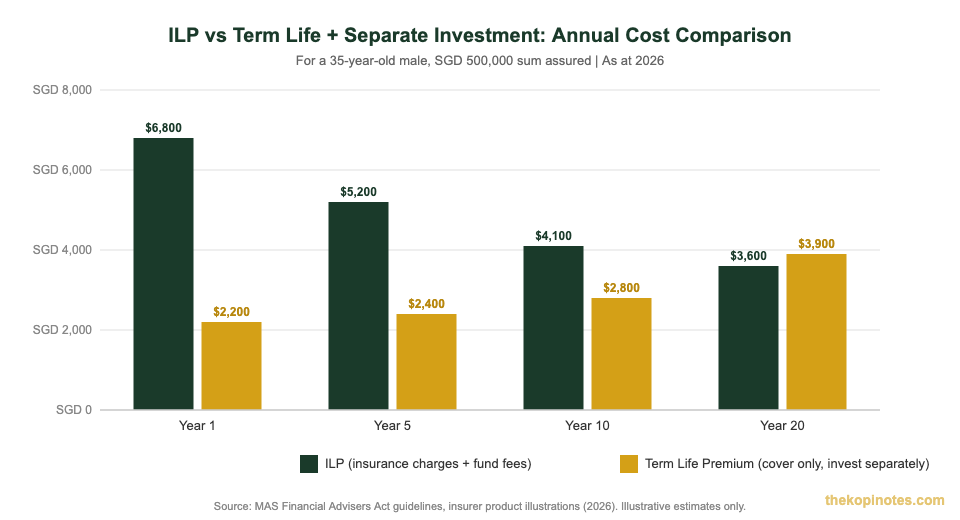
When you add these up — fund fee (~1.5%) + policy fee + bid-offer spread amortised over years + COI — the total effective annual charge on an ILP typically runs 2.5–3.5% per year in the early years. Compare that to buying a low-cost ETF through a robo-adviser like Endowus referral code at around 0.5–0.65% all-in, and the drag on long-term returns becomes significant.
ILP Pros and Cons
ILPs aren’t inherently bad products — they just get mis-sold and misunderstood. Here’s an honest assessment:
What ILPs do well:
The fund switching feature is genuinely useful. Most ILPs let you switch between funds (e.g. from an equity fund to a bond fund) with no transaction costs and no capital gains implications — because Singapore has no capital gains tax anyway, but the administrative ease matters. This lets you adjust your risk profile over time without selling and rebuying. You can also add riders like critical illness or waiver of premium, bundling more protection into one contract — convenient if you want a single product to manage.
Some ILPs allow premium holidays — you stop paying premiums for a period and the insurer continues your coverage by liquidating units. For irregular income earners (freelancers, commission-based workers), this flexibility has real value.
What ILPs do poorly:
The charge structure heavily favours the insurer in early years. If you surrender within the first 5–7 years, you may get back significantly less than you put in. The ILP fund menu is also limited — typically 20–40 funds from the insurer’s approved list, not the full market. You can’t buy a Vanguard VWRA or iShares CSPX through an ILP. And the fund management fees within ILP platforms are higher than buying the same underlying strategy through a Syfe referral code account or FSMOne.
ILP vs Buy Term and Invest the Rest
“Buy term and invest the rest” (BTIR) is the most common alternative to an ILP. The idea: buy a cheap term life policy for pure coverage, then invest the premium difference yourself in low-cost ETFs or a robo-adviser.
Let’s run the numbers for a 35-year-old male, SGD 500,000 sum assured:
| Scenario | Annual Premium | Est. 20-Year Portfolio Value | Net of charges |
|---|---|---|---|
| Typical ILP | SGD 6,000 | ~SGD 118,000 | 3.5% net return |
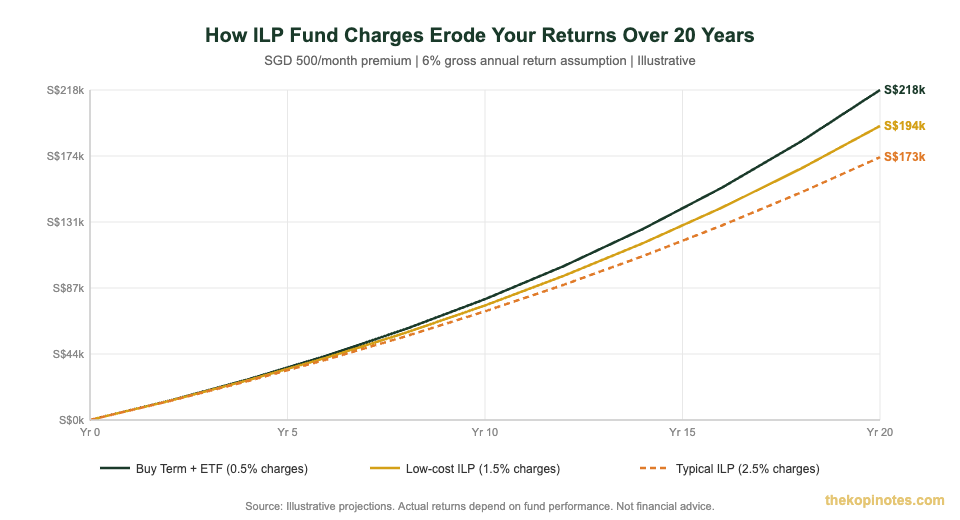
| Term + ETF (Endowus/Syfe) | SGD 2,200 (term) + SGD 3,800 (invest) | ~SGD 156,000 | 5.5% net return |
| Term + Direct ETF (IBKR) | SGD 2,200 (term) + SGD 3,800 (invest) | ~SGD 168,000 | 5.8% net return |
Source: Illustrative projections based on 6% gross annual return. Actual results will vary. Not financial advice.
Over 20 years, the BTIR approach outperforms the typical ILP by SGD 38,000–50,000 on the same total premium outlay. That’s the cost of bundling — convenience and flexibility come at a price. If long-term wealth accumulation is your primary goal, the numbers strongly favour separating insurance from investment. You can explore your projected returns using our Singapore retirement calculator.
Who Should (and Shouldn’t) Buy an ILP?
An ILP may make sense if:
You need life cover but lack the discipline to invest separately — an ILP forces both. Or you need a single product for estate planning purposes (the death benefit of an ILP is generally not subject to estate duty in Singapore and pays out directly to nominees). High net worth individuals sometimes use single-premium ILPs as an alternative to unit trusts because ILP gains are not subject to Singapore’s income tax treatment for personal insurance payouts. If your priority is critical illness cover bundled with investment flexibility, an ILP rider structure can be efficient.
An ILP is probably not right for you if:
Your primary goal is long-term wealth accumulation for retirement. You can commit to investing regularly through a low-cost platform like FSMOne referral code or a robo-adviser. You may need access to your funds before 10 years are up — surrender penalties in early years can be severe. You want maximum flexibility in what you invest in (ILPs restrict you to their approved fund list). You’re building a passive income Singapore strategy based on dividends or REITs — ILPs don’t work well for income-oriented investing.
Popular ILPs in Singapore 2026
Several major insurers offer ILPs in Singapore. Here’s a quick overview — always request the actual product illustration and Fund Summary before making any decision:
| Insurer | Product | Type | Notable Feature |
|---|---|---|---|
| Manulife | Manulife Investment Plus | Regular Premium | Wide fund menu, CPFIS-approved options |
| AIA | AIA Investment-Linked Plan | Regular / Single Premium | Capital guarantee option on single premium |
| Prudential | PruLink / PruFlexiCash | Regular Premium | Premium holiday feature |
| Great Eastern | GREAT Flexi Link | Regular Premium | Fund switching flexibility |
| NTUC Income | VivoWealth Saver | Regular Premium | Income-focused fund options |
Source: Insurer product pages, MoneySense Singapore, July 2026
Before committing, always compare the effect of deductions shown in your product illustration — MAS requires insurers to show you two scenarios (4% and 8% gross return) and the net value after all charges. Study those numbers carefully. If you’re unsure, consider an independent financial adviser who charges a fee rather than commissions, or use a comparison platform regulated by MAS.
For comparison, using our Singapore REIT ETF guide alongside a low-cost investment account often gives you better transparency on costs and returns than any bundled insurance product. The best S-REITs in Singapore 2026 currently yield 5–7%, which compares favourably to most ILP fund performance after charges are deducted.
Disclaimer: The information above is for general educational purposes only and does not constitute financial advice. Consult a licensed financial adviser before making any insurance or investment decision. ILP charges, fund menus, and product structures vary by insurer and policy — always read your policy documents carefully.
Frequently Asked Questions
What is an investment-linked policy (ILP) in Singapore?
An investment-linked policy (ILP) is a life insurance product sold in Singapore that combines life cover with a unit trust investment. Part of your premium pays for the insurance, and the rest buys fund units of your choosing. ILPs are regulated by MAS under the Financial Advisers Act, and all sales must be accompanied by a Product Summary and Fund Summary document disclosing charges and risks.
Is an investment-linked policy a good investment in Singapore?
That depends on your goals. ILPs are not optimised for pure investment returns — their total charges (fund fees + insurance charges + policy fees) typically run 2–3% per year, which significantly drags net performance. For most investors focused on long-term wealth accumulation, buying a term life policy separately and investing in low-cost ETFs or a robo-adviser delivers better net returns. ILPs do have legitimate uses in estate planning and for investors who need flexibility with bundled coverage.
Can I use CPF to buy an investment-linked policy?
Some ILPs are approved under the CPF Investment Scheme (CPFIS), which allows you to invest your CPF Ordinary Account funds. However, not all ILPs qualify — the product must appear on the CPFIS-approved list. Check the CPF Board website for the current approved list. Note that CPFIS funds are also subject to the 2.5% floor return guarantee on OA — carefully compare whether an ILP is likely to outperform that benchmark net of charges before proceeding.
What happens if I stop paying my ILP premiums?
If you stop paying premiums, the insurer will liquidate your fund units to cover the cost of insurance (COI). As long as you have sufficient fund value, your coverage continues — this is called a premium holiday. However, if your fund value falls low enough that it can no longer cover the COI, your policy will lapse and your coverage ends. You lose all the insurance protection and whatever fund value remains. This risk increases as you age and the COI rises.
What is the difference between a regular premium and single premium ILP?
A regular premium ILP requires ongoing monthly or annual payments that split between insurance cover and fund investment. These are suitable for people wanting both long-term coverage and a gradual savings habit. A single premium ILP takes a lump sum upfront — most of it is immediately invested in your chosen funds, and a minimal death benefit is added (often 101–105% of account value). Single premium ILPs function more like packaged investments and are often sold to higher net worth individuals seeking tax-efficient investment wrappers.
Why is an investment-linked policy considered bad by some advisers?
The main criticism is the high total cost of ownership. Between the fund management fee (1–1.75% p.a.), the bid-offer spread on premiums (3–5%), the policy fee, and rising insurance charges with age, the effective charge on your investment portion can be very high — especially in the first 10 years. This charge drag, combined with a limited fund menu and substantial surrender penalties for early exit, means ILPs are often outperformed by simpler combinations of term insurance plus low-cost index funds. The critique is not that ILPs are fraudulent — they serve a purpose — but that they are frequently sold to people whose goals would be better served by cheaper alternatives.
Can I switch funds within my investment-linked policy?
Yes — fund switching is one of the few genuine advantages of ILPs. Most insurers allow you to switch between funds in their approved menu at no transaction cost, and since Singapore has no capital gains tax, there are no tax implications either. This means you can move from, say, a global equity fund to a more defensive bond fund as you approach retirement without triggering a taxable event. The limitation is that you’re restricted to the insurer’s fund menu — you can’t access ETFs or funds outside that list.
Compare Your Options Before You Decide
Whether you choose an ILP or buy term and invest the rest, use our tools and referral links to make your money work harder.
Get Free Insurance Advice
Speak with a licensed insurance advisor. No obligation, no cost.
By submitting this form, you agree to our Privacy Policy.
This article was researched with the help of AI. While we strive to keep all information accurate and up to date, there may be errors. If you notice any discrepancies, please contact us.