Prudential Endowment Plan Singapore 2026: PRUAssure Growth & PRUWealth Plus Reviewed
Guaranteed 1.70% p.a. over 3 years, a par-fund plan that locks capital after 10 years, and how both stack up against CPF, SSB and T-bills.
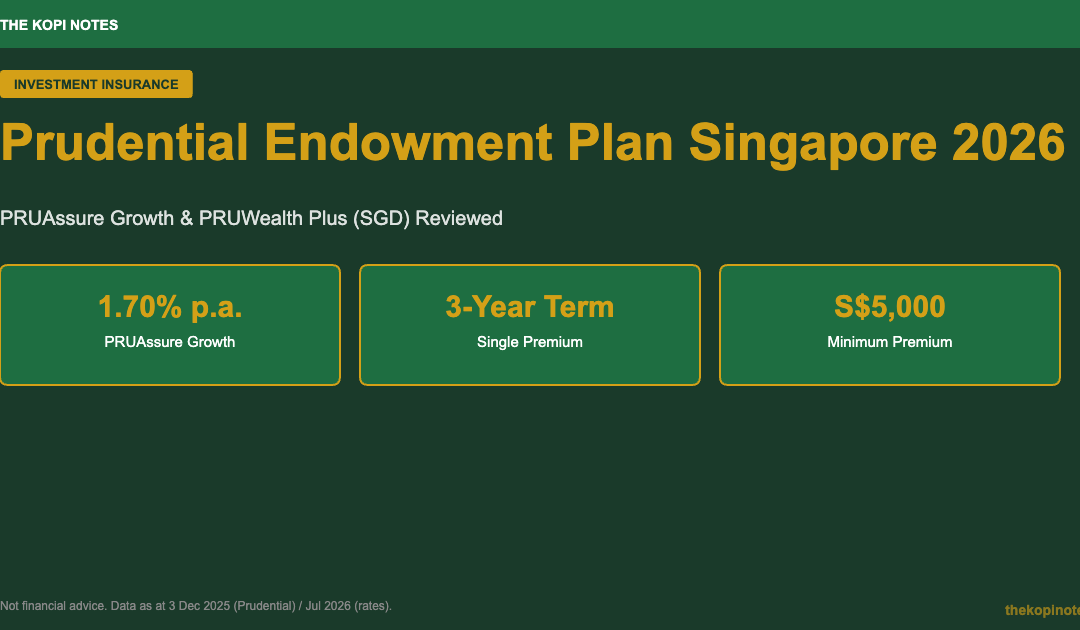
Prudential’s main endowment plan in Singapore is PRUAssure Growth, a 3-year single-premium plan offering 1.70% p.a. guaranteed returns with capital guaranteed at maturity, starting from S$5,000. Prudential also offers PRUWealth Plus (SGD), a longer-term participating savings plan where capital is guaranteed only after the 10th policy year. Both are listed on the Singapore Deposit Insurance Corporation’s Policy Owners’ Protection Scheme.
Not financial advice. All figures are for educational reference only. Data verified as at 19 July 2026 unless otherwise noted.
- PRUAssure Growth guarantees 1.70% p.a. over 3 years (min S$5,000) — beats today’s best fixed deposit (1.60%) and the Singapore Savings Bond’s 3-year average (1.67%), but loses badly to CPF Special Account (4.00% p.a.).
- PRUWealth Plus (SGD) is a different animal — a long-term participating plan where growth depends on non-guaranteed bonuses, and your capital isn’t guaranteed until year 10 (or later for regular-premium terms).
- Both plans are protected under SDIC’s Policy Owners’ Protection Scheme, but only up to S$500,000 sum assured and S$100,000 surrender value per insurer.
Table of Contents
Contents — Click to expand
- What Is Prudential’s Endowment Plan Lineup?
- PRUAssure Growth: Guaranteed 1.70% p.a. Over 3 Years
- PRUWealth Plus (SGD): Long-Term Participating Plan
- Prudential Savings Plans Compared
- Prudential vs CPF, SSB & T-Bills
- S$20,000 Over 3 Years: A Worked Example
- Pros and Cons
- Who Should (and Shouldn’t) Buy This?
- Prudential vs Great Eastern, Manulife & NTUC Income
- 5 Things to Know Before You Buy
- Alternatives to Consider
- FAQ
What Is Prudential’s Endowment Plan Lineup?
Prudential Assurance Company Singapore is one of the country’s biggest life insurers. It’s an indirect wholly-owned subsidiary of UK-listed Prudential plc, has been operating here for 95 years, and manages S$66.3 billion in assets as at 31 December 2025. It holds an ‘AA’ financial strength rating from S&P and serves more than one million customers through 5,400 financial representatives.
Unlike Great Eastern’s GREAT SP or NTUC Income’s endowment range, Prudential doesn’t market a single flagship “endowment plan.” Instead, it runs several savings insurance products under its Wealth Accumulation range. The two most relevant for someone comparing endowment options are:
- PRUAssure Growth — a short 3-year, single-premium, capital-guaranteed plan. This is the closest match to a classic endowment plan.
- PRUWealth Plus (SGD) — a longer-term participating (par fund) savings-with-protection plan, where growth comes from non-guaranteed bonuses.
Prudential also lists PRUWealth (USD), PRUActive Saver III and PRUSave Max Limited Pay (USD) in its official savings comparison tool, but these are either foreign-currency variants or products without the capital guarantee that most endowment buyers are looking for. This guide focuses on the two SGD, capital-guaranteed options.
PRUAssure Growth: Guaranteed 1.70% p.a. Over 3 Years
PRUAssure Growth is Prudential’s short-term, single-premium endowment plan. You pay once, wait 3 years, and get your capital back plus a guaranteed 1.70% p.a. — no market exposure, no medical underwriting.
Here’s Prudential’s own worked example from its product brochure: a 38-year-old places a S$25,000 single premium into PRUAssure Growth. After 3 years, she receives S$26,297 — a maturity value of 105.2% of what she put in. That’s the compounding effect of 1.70% p.a. over 3 years (1.017³ ≈ 1.052) doing its work.
| Feature | PRUAssure Growth |
|---|---|
| Premium type | Single premium |
| Policy term | 3 years |
| Guaranteed return | 1.70% p.a., capital guaranteed at maturity |
| Minimum premium | S$5,000 |
| Payment methods | Cash or SRS funds |
| Medical underwriting | Not required |
| Death benefit | 101% of single premium (105% if accidental) |
Source: Prudential Singapore, PRUAssure Growth brochure and product page, information correct as at 3 December 2025.
You should also know PRUAssure Growth is a limited-time offer product — Prudential runs it as a tranche-based promotion rather than a permanently open plan, so the 1.70% rate and its availability can change without much notice. Always check the current PRUAssure Growth page before assuming the rate quoted here still applies.
PRUWealth Plus (SGD): Long-Term Participating Savings Plan
PRUWealth Plus (SGD) is a completely different product. It’s a participating (par fund) plan, which means your returns depend partly on non-guaranteed bonuses that Prudential declares based on how its par fund performs. There’s no single “1.70%-style” headline rate here — it’s a longer horizon, longer commitment plan.
You can pay a single premium, or spread payments over 5, 10, 15 or 20 years. If you pay via a single premium, your capital is only guaranteed after the 10th policy year. For a 5-year regular-premium term, the guarantee kicks in after year 15; for a 10-year term, after year 18; and for 15- or 20-year terms, after year 19 — all assuming you haven’t made any partial withdrawals.
For context on how Prudential’s par fund has historically performed relative to peers: third-party reviews of insurer bonus filings have noted Prudential’s par fund among the higher performers on 3, 5 and 10-year geometric net investment returns in recent years. That’s a useful data point, but it isn’t a promise — bonuses are declared yearly and can be cut if fund performance weakens.
- Flexibility: Partial withdrawals are allowed (as a partial surrender), and you can pay via cash or SRS for single-premium policies.
- Protection built in: Death benefit coverage, optional Crisis Waiver III (35 critical illnesses), Early Stage Crisis Waiver, and Payer Security Plus riders.
- Job-loss support: A one-time payout of up to 50% of your annual premium (or 10% of single premium) if you’re retrenched, capped at S$100,000 per policyholder across all such policies.
- Premium deferment: You can defer premiums for up to 2 years if your surrender value covers at least 2 years of instalments.
Source: Prudential Singapore, PRUWealth Plus (SGD) product page and compare-savings-plans tool, information correct as at 9 September 2024 — confirm current terms with Prudential before applying, as some product details may have been refreshed since.
Prudential Savings Plans Compared
| Plan | Type | Payment Term | Capital Guaranteed |
|---|---|---|---|
| PRUAssure Growth | Non-participating | Single premium, 3-yr term | Yes, at maturity (yr 3) |
| PRUWealth Plus (SGD) | Participating | Single or 5/10/15/20-yr regular | After yr 10 (single) to yr 19 (15/20-yr term) |
| PRUWealth (USD) | Participating | Single or 5/10-yr regular | After yr 10 (single) or yr 20 (regular) |
| PRUActive Saver III | Participating | Single or 5–30-yr regular | Only at maturity |
| PRUSave Max Limited Pay (USD) | Participating | Regular 5/10/15-yr | Not capital guaranteed |
Source: Prudential Singapore, Compare Savings Insurance Plans tool, thekopinotes.com research July 2026.
Prudential vs CPF, SSB & T-Bills
A 1.70% p.a. guaranteed rate sounds good until you line it up against everything else a Singapore saver could do with the same money. Here’s how PRUAssure Growth’s rate compares to the main “guaranteed” options as at July 2026.
| Option | Guaranteed Rate | Accessible? |
|---|---|---|
| CPF Special/MediSave/Retirement Account | 4.00% p.a. | No — locked until 55 or later |
| CPF Ordinary Account | 2.50% p.a. | No — restricted to CPF-eligible uses |
| PRUAssure Growth | 1.70% p.a. | Only at 3-year maturity (or surrender, at a loss) |
| Singapore Savings Bond (SBAUG26), 3-yr average | 1.67% p.a. | Yes — redeemable any month, no penalty |
| Best market fixed deposit (GXS Boost Pocket, 12-mth) | 1.60% p.a. | Yes, at the end of each 12-month tenor |
| 6-month T-bill (latest auction) | 1.55% p.a. | Yes, at each 6-month maturity |
Sources: CPF Board (rates 1 Jul–30 Sep 2026), MAS/ilovessb.com (SBAUG26 step-up schedule), Growbeansprout (FD rates, July 2026), MAS (T-bill auction BS26114W, 16 Jul 2026). SSB Year 1 and 10-year average figures are MAS-confirmed; the 3-year average shown uses ilovessb.com’s SGS-yield-based interpolation for years 2–3.
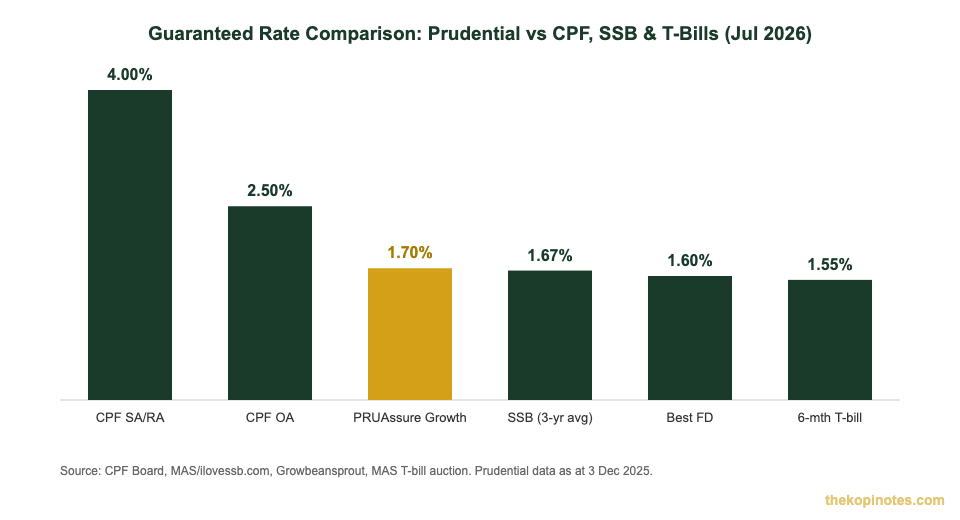
Read plainly: PRUAssure Growth beats every liquid, on-demand alternative today — the best fixed deposit, the SSB’s own 3-year average, and the latest T-bill. But it loses decisively to CPF’s official Special, MediSave and Retirement Account rate, which you simply can’t touch if you’re not yet eligible to withdraw. That’s the real trade-off with any endowment plan: a modest edge over cash-like instruments, in exchange for locking your money away.
S$20,000 Over 3 Years: A Worked Example
Say you have S$20,000 you don’t need for at least 3 years. Here’s what it would grow to under each option, assuming rates stay constant for illustration (in reality, T-bill and FD rates reset every roll, and SSB step-ups are fixed for the bond you buy).
| Option | Rate | Value After 3 Years | Growth |
|---|---|---|---|
| CPF SA/RA (illustrative, inaccessible) | 4.00% p.a. | S$22,497 | +S$2,497 |
| CPF OA (illustrative, restricted use) | 2.50% p.a. | S$21,538 | +S$1,538 |
| PRUAssure Growth | 1.70% p.a. | S$21,037 | +S$1,037 |
| SSB SBAUG26 (3-yr average) | 1.67% p.a. | S$21,019 | +S$1,019 |
| Best FD (GXS, rolled 3x at 1.60%) | 1.60% p.a. | S$20,975 | +S$975 |
Compounded annually. CPF, SSB, FD and T-bill rates shown are current snapshots, not guaranteed for a full 3-year hold — only PRUAssure Growth’s 1.70% is contractually locked for the full term. Source: thekopinotes.com calculation, July 2026.
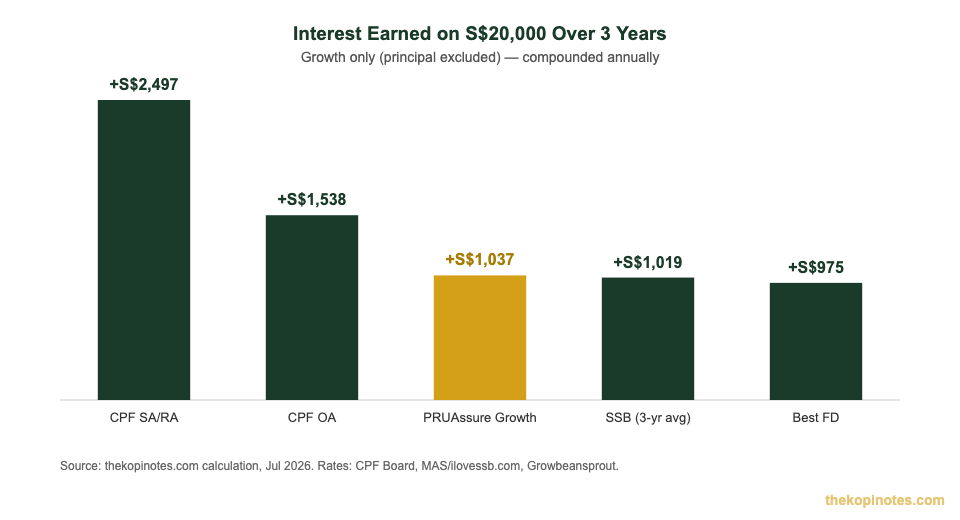
The gap between PRUAssure Growth and the SSB is tiny — about S$19 over 3 years on a S$20,000 sum. The real decision isn’t “which earns more,” it’s whether you want the certainty of a locked-in rate (PRUAssure Growth) or the flexibility to redeem early without penalty if rates rise or you need the cash (SSB).
Pros and Cons of a Prudential Endowment Plan
| Pros | Cons |
|---|---|
| PRUAssure Growth’s rate is contractually guaranteed, not illustrated | 1.70% barely beats the SSB, and loses to every CPF account |
| No medical underwriting on PRUAssure Growth — easy to apply | Early surrender usually returns less than what you paid in |
| Low entry point — from S$5,000 single premium | PRUAssure Growth is a limited-time tranche, not always on sale |
| Can pay with SRS funds — useful for tax-relief planning | PRUWealth Plus’s growth depends on non-guaranteed bonuses |
| Built-in death benefit — money doesn’t just disappear if you pass away | SDIC protection is capped, not a full guarantee on large sums |
Who Should (and Shouldn’t) Buy This?
| You should consider it if… | You should skip it if… |
|---|---|
| You want a fixed, guaranteed rate you don’t have to monitor or roll over | You might need the money before the 3-year mark |
| You’ve maxed out CPF top-ups and SSB allocation for the year | You haven’t topped up CPF SA/RA — that 4.00% beats this easily |
| You want an existing relationship with Prudential (e.g. bundled with other policies) | You’re chasing growth, not capital preservation — an ILP or ETF suits you better |
| You want to use idle SRS funds without market exposure | You’re not comfortable with a product structured as insurance, not a bank deposit |
Prudential vs Great Eastern, Manulife & NTUC Income
Prudential isn’t the only insurer running a short-term, capital-guaranteed single-premium plan. Here’s how PRUAssure Growth’s 1.70% p.a. stacks up against the other insurer-specific endowment reviews on this site.
| Insurer | Plan | Term | Guaranteed Rate |
|---|---|---|---|
| Prudential | PRUAssure Growth | 3 years | 1.70% p.a. |
| Great Eastern | GREAT SP | 2 years | 0.70% p.a. |
Rates and terms differ across insurers and change with each campaign tranche, so this isn’t a like-for-like race — a 3-year lock-in and a 2-year lock-in aren’t directly comparable, and both figures move whenever the insurer launches a new tranche. For the full picture on Manulife’s plan specifically, see the Manulife endowment plan guide. The lesson holds across every insurer we’ve reviewed: campaign-based guaranteed rates move constantly, so always check the live rate before committing rather than trusting any article’s headline number, including this one.
5 Things to Know Before You Buy
- Surrendering early usually costs you. Both PRUAssure Growth and PRUWealth Plus warn explicitly that early termination “usually involves high costs,” and your surrender value may be less than what you paid in. Don’t put in money you might need before maturity.
- “Capital guaranteed” has a specific meaning. For PRUAssure Growth, it means guaranteed at the 3-year maturity date — not at any point before that. For PRUWealth Plus, the guarantee only kicks in after year 10 (or later), so cashing out early on a par-fund plan is a real risk to your principal.
- SDIC protection is capped, not unlimited. Under the Policy Owners’ Protection Scheme administered by SDIC, coverage is automatic but capped at S$500,000 sum assured and S$100,000 surrender value per policy owner, per insurer. If you’re putting in a large sum, check how this cap applies to you.
- PRUAssure Growth’s rate is a tranche offer, not a permanent product feature. Prudential can and does change the guaranteed rate when it opens a new sign-up window. The 1.70% p.a. cited here is what was live as at 3 December 2025 — verify the current rate before applying.
- Bonuses on participating plans are never guaranteed. If you’re considering PRUWealth Plus for its growth potential rather than just its late-stage capital guarantee, remember Prudential can revise annual and terminal bonus rates based on how its par fund performs.
Alternatives to Consider
Before locking money into PRUAssure Growth or PRUWealth Plus, it’s worth checking whether these alternatives fit your timeline better:
- CPF top-ups. If you’re eligible, topping up your Special or Retirement Account earns 4.00% p.a. — more than double PRUAssure Growth’s rate — though it’s locked up for retirement, not 3 years.
- Singapore Savings Bonds. Near-identical returns to PRUAssure Growth over 3 years, but redeemable any month with no penalty. See our full endowment plan vs SSB comparison for the complete breakdown.
- Robo-advisor cash management. Endowus and Syfe both run cash and short-duration bond portfolios that track T-bill and money market yields without a fixed lock-up.
- A broader retirement plan. If you’re weighing this against other guaranteed-return products for retirement specifically, our Best Investment Plan for Retirement guide ranks six options side by side.
Want to see how a Prudential-style guaranteed plan fits into your overall retirement number? Use the retirement calculator linked below to see how a locked-in 1.70% return compares to investing the same sum over a longer horizon.
Frequently Asked Questions
What is Prudential's endowment plan called in Singapore?
What is the guaranteed return on PRUAssure Growth?
Is PRUWealth Plus (SGD) capital guaranteed?
What is the minimum premium for PRUAssure Growth?
Can I use SRS funds for a Prudential endowment plan?
What happens if I surrender a Prudential endowment plan early?
Is a Prudential endowment plan protected under SDIC?
How does Prudential's guaranteed rate compare to CPF, SSB and T-bills?
Is Prudential's endowment plan better than a fixed deposit?
How does Prudential compare to Great Eastern, Manulife and NTUC Income endowment plans?
Explore More Ways to Grow Your Savings
Compare Prudential’s guaranteed rate against robo-advisor cash portfolios and other referral offers below.
Get Free Insurance Advice
Speak with a licensed insurance advisor. No obligation, no cost.
By submitting this form, you agree to our Privacy Policy.
This article was researched with the help of AI. While we strive to keep all information accurate and up to date, there may be errors. If you notice any discrepancies, please contact us.