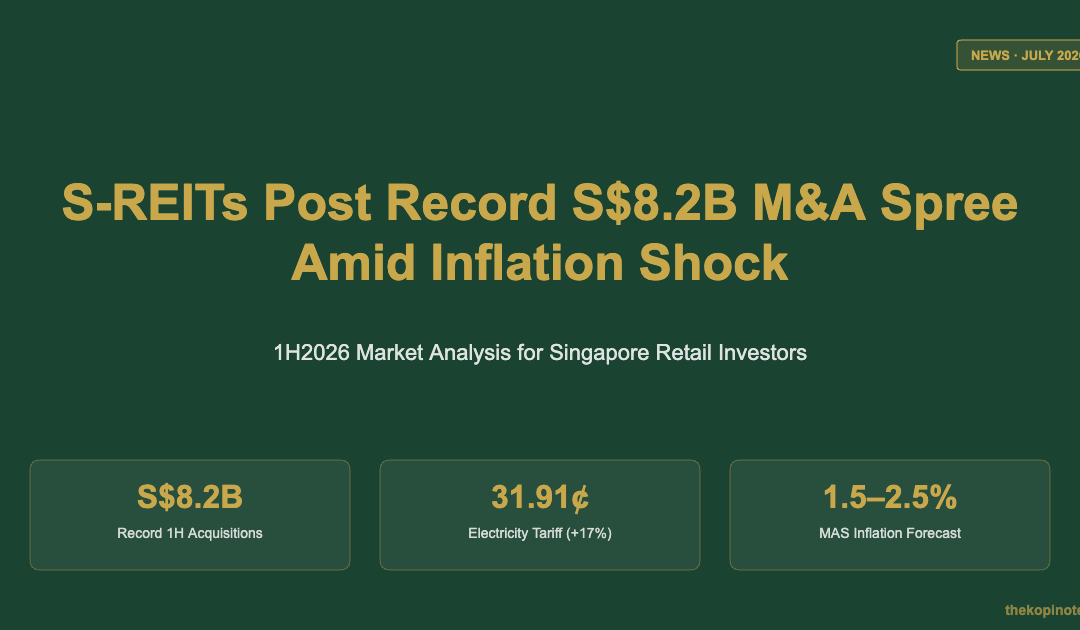
S-REITs Post Record S$8.2B M&A Spree Even as Inflation Bites (2026)
1H2026 acquisitions hit their highest since 2021 — but a 17% electricity tariff hike and a rising MAS inflation forecast are squeezing S-REIT operating costs. Here’s what it means for your portfolio.
Singapore REITs closed 1H2026 with a record S$8.2 billion in acquisitions across 17 deals, even as a 17% electricity tariff hike and MAS’s raised inflation forecast squeezed operating costs. Oil prices surged past US$100 a barrel after Middle East tensions erupted in February 2026. For SG dividend investors, the message is mixed: deal-making confidence is high, but near-term distribution pressure is real.
This is an editorial analysis. Not financial advice. Data verified as at 19 July 2026.
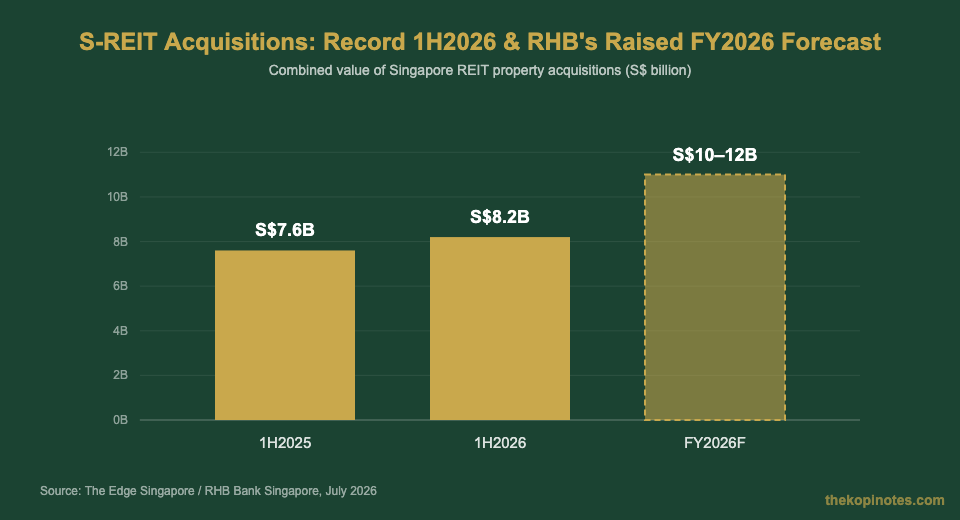
- S-REITs booked S$8.2 billion in acquisitions in 1H2026 — the highest since 2021 — and RHB has raised its full-year forecast to S$10–12 billion.
- Electricity tariffs rose 17% to 31.91 cents/kWh for Jul–Sep 2026, and MAS lifted its 2026 core inflation forecast to 1.5–2.5%, adding cost pressure on REIT operating expenses.
- CapitaLand Ascendas REIT’s S$200.4 million divestment shows managers actively recycling capital — a sign of financial discipline, not distress.
Table of Contents
Contents — Click to expand
- What Happened: S-REITs Face Cost Pressure Even as Deals Hit a Record
- Why Electricity Tariffs and Inflation Are Squeezing REITs
- The Record S$8.2 Billion Acquisition Spree — What’s Driving It
- Case Study: CapitaLand Ascendas REIT’s S$200.4 Million Divestment
- New Capital Keeps Flowing In: The JD.com-Backed REIT IPO
- 2026 S-REIT Metrics at a Glance
- Bottom Line for SG Investors
- Frequently Asked Questions
What Happened: S-REITs Face Cost Pressure Even as Deals Hit a Record
The FTSE ST REIT Index underperformed the Straits Times Index in the first half of 2026. If you hold S-REITs for income, you’ve likely felt this — unit prices have been choppy even though most REITs kept paying distributions on schedule.
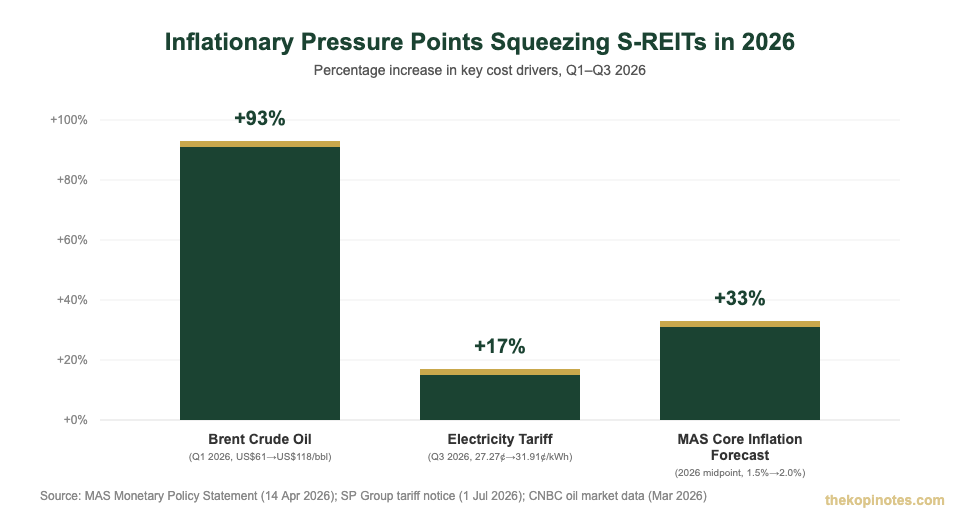
The root cause traces back to the Middle East. Fighting that began in late February 2026 disrupted shipping through the Strait of Hormuz. Brent crude, which started the year near US$61 a barrel, broke above US$100 on 12 March 2026 and peaked near US$120. The quarter closed at roughly US$118 a barrel — Brent’s steepest monthly surge since the contract began in 1988.
Higher oil prices don’t stay contained to the petrol pump. They flow into shipping costs, electricity generation, and eventually into the price of almost everything else.
For SG retail investors: a REIT index dip during a macro shock isn’t automatically a reason to sell. What matters more is whether the REITs you hold can keep covering their distributions as costs rise — which is what the rest of this article digs into.
Why Electricity Tariffs and Inflation Are Squeezing REITs
SP Group raised the regulated electricity tariff by 17% for the July–September 2026 quarter, to 31.91 cents per kWh before GST (about 34.78 cents with GST). That’s a record high, driven by the same oil shock described above.
Separately, the Monetary Authority of Singapore (MAS) raised its 2026 core inflation forecast to a range of 1.5% to 2.5%, up from 1.0% to 2.0%, in its April 2026 Monetary Policy Statement. MAS also tightened monetary policy slightly, increasing the rate of appreciation of the Singapore dollar’s policy band to manage imported inflation.
Electricity is a real line item for REITs. Retail and hospitality REITs typically absorb more of the utility bill for common areas and shared cooling, while industrial and logistics REITs often pass utility costs through to tenants under net leases. Data centre assets are the most electricity-intensive of all, though many long leases include cost pass-through clauses that limit direct hit to distributable income.
For SG retail investors: when you’re screening S-REITs right now, check whether the trust discloses “same-store” net property income growth net of utility costs. REITs that can pass tariff increases to tenants are better insulated than those that can’t. Our Singapore REIT sector outlook 2026 breaks down which sub-sectors are more exposed.
The Record S$8.2 Billion Acquisition Spree — What’s Driving It
Here’s the surprising part. Despite the cost pressure above, S-REITs booked S$8.2 billion in acquisitions across 17 deals in the first half of 2026 — the highest six-month total since 2021, and up from S$7.6 billion in 1H2025, according to RHB Bank Singapore data reported by The Edge Singapore.
RHB has since raised its full-year 2026 forecast for S-REIT acquisitions to S$10–12 billion, nearly double its earlier estimate of S$5–8 billion.
Why buy now? A few reasons line up. Unit price weakness has widened the spread between REIT acquisition yields and funding costs, making deals more accretive to distribution per unit (DPU) — basically, the cash each unit pays you per period. Singapore dollar funding costs have also stayed relatively contained versus offshore alternatives, and managers are using the window to diversify into logistics, data centres, and business parks ahead of AI-driven demand.
For SG retail investors: acquisitions can lift DPU over time, but they usually mean higher gearing (debt load) in the near term. Before you buy into a REIT on acquisition headlines alone, check its gearing ratio against the regulatory 50% ceiling and its interest coverage ratio. Our REIT gearing ratio guide shows how to compare this across peers.
Case Study: CapitaLand Ascendas REIT’s S$200.4 Million Divestment
Not every S-REIT headline this month was about buying. On 15 July 2026, CapitaLand Ascendas REIT (CLAR) announced it is divesting Kim Chuan Telecommunications Complex — a 10-storey data centre building in Singapore — for approximately S$200.4 million.
That price is double the S$100.0 million CLAR paid for the property in March 2005, and a 32% premium over its independent valuation of S$151.8 million as at 30 June 2026. Estimated net proceeds are about S$180.0 million. If CLAR uses those proceeds to pay down debt, its pro forma aggregate leverage would fall to approximately 41.4%, down from 42.0% as at 31 March 2026. The deal is expected to close in the second half of 2026.
This is portfolio recycling, not distress selling. CLAR is trading an older, single-tenant asset for capital it can redeploy into higher-growth opportunities — which lines up with the broader acquisition wave described above.
For SG retail investors: if you hold CLAR, this divestment is mildly leverage-reducing and DPU-neutral in the near term. It’s a useful example of what “disciplined capital recycling” looks like in practice — worth understanding if you’re comparing CLAR against peers. See our CapitaLand Ascendas REIT dividend history for the DPU trend.
New Capital Keeps Flowing In: The JD.com-Backed REIT IPO
Fresh institutional money is also eyeing Singapore’s REIT market. A group backed by JD.com’s asset management arm and Switzerland’s Partners Group is reportedly preparing to confidentially file for a REIT IPO in Singapore that could raise about S$1 billion, according to Bloomberg. Bank of America, DBS Group Holdings, and UBS are said to be working on the deal.
A new listing doesn’t help existing unitholders directly, but it’s a signal. Global institutions don’t commit IPO capital to a market they think is broken — they’re betting Singapore’s REIT structure (SGX-listed, 90% income distribution requirement, established regulatory framework) still offers durable long-term value, even through a rough patch.
For SG retail investors: a new IPO usually means more sector choice down the line, and possibly a new theme (data centres and logistics are the likely focus, given the sponsor’s background). Worth watching for retail tranche access once it’s formally announced.
2026 S-REIT Metrics at a Glance
| Metric | Value | Change |
|---|---|---|
| Brent crude, Q1 2026 open | ~US$61/barrel | — |
| Brent crude, Q1 2026 close | ~US$118/barrel | +93% QoQ |
| Electricity tariff, Jul–Sep 2026 | 31.91 cents/kWh (ex-GST) | +17% QoQ |
| MAS core inflation forecast, 2026 | 1.5%–2.5% | Up from 1.0%–2.0% |
| S-REIT acquisitions, 1H2026 | S$8.2 billion / 17 deals | +7.9% YoY |
| RHB FY2026 acquisition forecast | S$10–12 billion | Up from S$5–8 billion |
| CLAR Kim Chuan Complex sale | S$200.4 million | 32% above valuation |
Source: MAS Monetary Policy Statement (14 Apr 2026), SP Group tariff notice (1 Jul 2026), The Edge Singapore / RHB Bank Singapore (Jul 2026), CapitaLand news release (15 Jul 2026), CNBC oil market coverage (Mar 2026).
Bottom Line for SG Investors
Don’t read the FTSE ST REIT Index’s soft 1H2026 purely as a red flag. Underneath the index-level weakness, REIT managers are actively acquiring, recycling capital, and — in the case of the pending IPO — attracting fresh institutional interest.
That said, the inflation and tariff story is real and will show up in distributable income for some REITs this year. Favour REITs with lower gearing, tenant leases that pass through utility costs, and a track record of accretive (not just large) acquisitions. If you’re building a cash buffer while waiting for clarity, competing yields on Singapore T-bills remain a reasonable short-term parking spot.
For a broader view of where the sector stands, see our best REITs Singapore 2026 guide and dividend stocks Singapore 2026 guide for names that screen well on both yield and balance sheet strength. We also track how Singapore rates and Fed policy affect S-REITs if you want the interest-rate side of this story.
This is an editorial analysis. Not financial advice. All figures cited are sourced and dated above; verify current data before making investment decisions.
Frequently Asked Questions
Why did Singapore REITs underperform the Straits Times Index in 1H2026?
Geopolitical tensions in the Middle East that began in late February 2026 pushed Brent crude oil above US$100 a barrel by March, driving up inflation expectations and electricity costs across Singapore. The FTSE ST REIT Index (SGX: FSTAS351020) fell behind the broader Straits Times Index as investors priced in higher operating costs and a firmer interest rate backdrop for REITs.
How does the 17% electricity tariff hike affect S-REIT investors?
SP Group raised the regulated tariff to 31.91 cents per kWh (before GST) for July–September 2026. REITs that can pass utility costs to tenants through net leases — common in industrial, logistics, and data centre assets — are less exposed than retail and hospitality REITs, which typically absorb more common-area utility costs themselves.
Why are S-REITs still making record acquisitions despite rising costs?
Weaker unit prices have widened the spread between acquisition yields and funding costs, making deals more accretive to distribution per unit. S-REIT managers booked S$8.2 billion in acquisitions in 1H2026, and RHB Bank Singapore has raised its full-year forecast to S$10–12 billion, betting that Singapore dollar funding costs stay relatively contained even as global rates stay elevated.
Is CapitaLand Ascendas REIT's divestment a bad sign for the REIT?
No — CLAR’s S$200.4 million sale of Kim Chuan Telecommunications Complex was at double its original 2005 purchase price and a 32% premium to independent valuation. It’s a disciplined capital recycling move, not distress selling, and the proceeds are earmarked to reduce gearing and fund new investments.
Should I buy S-REITs now that the sector has underperformed?
This isn’t financial advice, but the framework we’d suggest: check each REIT’s gearing ratio, its tenants’ ability to absorb rising utility costs, and whether recent acquisitions were made at accretive yields. Underperformance alone isn’t a buy or sell signal — the underlying balance sheet quality matters more right now than it did a year ago.
What is the new REIT IPO on SGX backed by JD.com?
A group including JD.com’s asset management arm and Switzerland’s Partners Group is reportedly preparing to confidentially file for a Singapore REIT IPO that could raise about S$1 billion, according to Bloomberg reporting from July 2026. Bank of America, DBS, and UBS are said to be advising on the listing, though no formal prospectus has been filed as at the time of writing.
Are Singapore electricity tariffs expected to stay high for the rest of 2026?
Tariffs are reviewed quarterly by SP Group based on fuel costs and other factors, so the July–September 2026 rate of 31.91 cents/kWh could adjust again in October. Much depends on whether Middle East oil supply disruptions continue — MAS’s April 2026 policy statement assumed elevated energy costs would persist “over the next few quarters.”
Want More S-REIT Analysis?
Explore our REIT guides to find income picks that fit your risk profile.
This article was researched with the help of AI. While we strive to keep all information accurate and up to date, there may be errors. If you notice any discrepancies, please contact us.