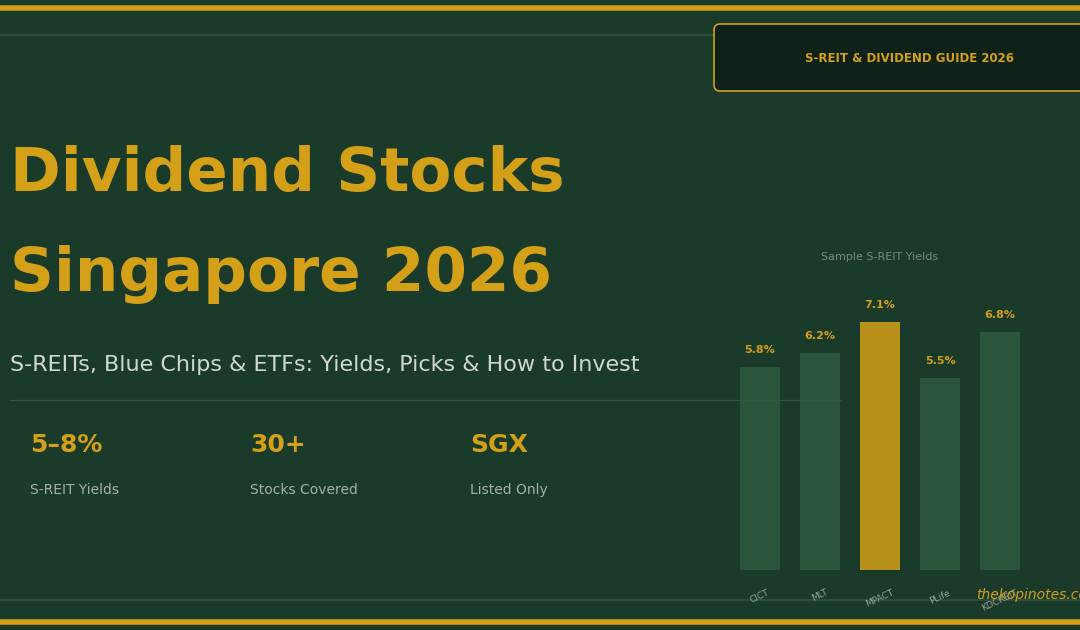
Dividend Stocks Singapore 2026: Complete Guide to Building Passive Income
Dividend stocks in Singapore include S-REITs paying 5–8% annually, blue-chip companies like DBS and Singtel, and dividend-focused ETFs — all listed on the SGX and accessible to retail investors without withholding tax on Singapore-sourced dividends. Singaporeans and PRs can also use CPF Investment Scheme (CPFIS) funds to invest in many of these stocks, compounding tax-advantaged passive income toward retirement.
Not financial advice. All figures are for educational reference only. Data as at May 2026 unless noted.
Table of Contents
📋 Quick Navigation
- What Are Dividend Stocks in Singapore?
- Why Singapore Dividend Stocks Are Unique
- S-REITs: Singapore’s Highest-Yield Dividend Assets
- Blue-Chip Dividend Stocks on SGX
- Dividend ETFs for Singapore Investors
- Full Yield Comparison Table 2026
- How to Start Investing in Dividend Stocks
- Using CPF to Invest in Dividend Stocks
- Risks Every Dividend Investor Must Know
- Frequently Asked Questions
What Are Dividend Stocks in Singapore?
Dividend stocks are shares in companies or trusts that distribute a portion of their earnings to shareholders on a regular basis — typically quarterly, semi-annually, or annually. In Singapore, dividend stocks broadly fall into three categories: S-REITs (Singapore Real Estate Investment Trusts), blue-chip SGX-listed companies, and dividend-focused ETFs.
Unlike many overseas markets, Singapore does not impose a tax on dividends received by individual investors from Singapore-resident companies — meaning every dollar distributed lands in your pocket in full. This “one-tier” tax system is a major structural advantage for income investors based here.
The typical income yield across Singapore’s dividend landscape ranges from about 3.5% (conservative blue chips like Keppel Corp) to above 7% (high-yield S-REITs and industrial REITs), with most well-diversified portfolios settling in the 5–6.5% zone annually.
Why Singapore Dividend Stocks Are Unique
Singapore’s dividend stock environment is genuinely distinctive, shaped by three structural advantages that don’t exist in most other markets:
1. Zero withholding tax on Singapore-sourced dividends. Under Singapore’s one-tier corporate tax system, dividends paid by SGX-listed Singapore companies carry no further tax obligation for the individual recipient. Compare this to the US, where dividends attract 30% withholding tax for non-residents, or Australia’s franking credit system which can still leave a net tax drag. For a Singapore investor earning SGD 6,000 per year in S-REIT distributions, that difference compounds to tens of thousands over a decade.
2. Mandatory 90% distribution requirement for S-REITs. Singapore REITs must distribute at least 90% of their taxable income each year to qualify for tax-transparent treatment under MAS regulations. This structural obligation — enforced by the Monetary Authority of Singapore — makes S-REITs inherently income-focused vehicles that cannot hoard cash at the expense of unitholders. It is the primary reason S-REITs offer some of Asia’s most consistent dividend yields.
3. CPF compatibility for many dividend stocks. Singapore citizens and PRs can invest up to SGD 35,000 of their CPF Ordinary Account (OA) savings in approved SGX-listed stocks via the CPF Investment Scheme (CPFIS-OA). Since the OA pays a base rate of 2.5% per annum, any SGX dividend stock or S-REIT yielding above that threshold potentially out-earns the CPF floor, though with added market risk. This makes dividend investing directly relevant to Singapore’s retirement savings framework.
S-REITs: Singapore’s Highest-Yield Dividend Assets
S-REITs are the backbone of dividend investing in Singapore. With 40+ REITs listed on the SGX, spanning retail malls, industrial parks, data centres, logistics warehouses, hospitals, and commercial offices, they collectively form one of Asia’s most liquid and diversified REIT markets outside Japan. As a group, S-REITs delivered an average distribution yield of approximately 6.3% in early 2026 — roughly double the SGX 30 blue-chip average.
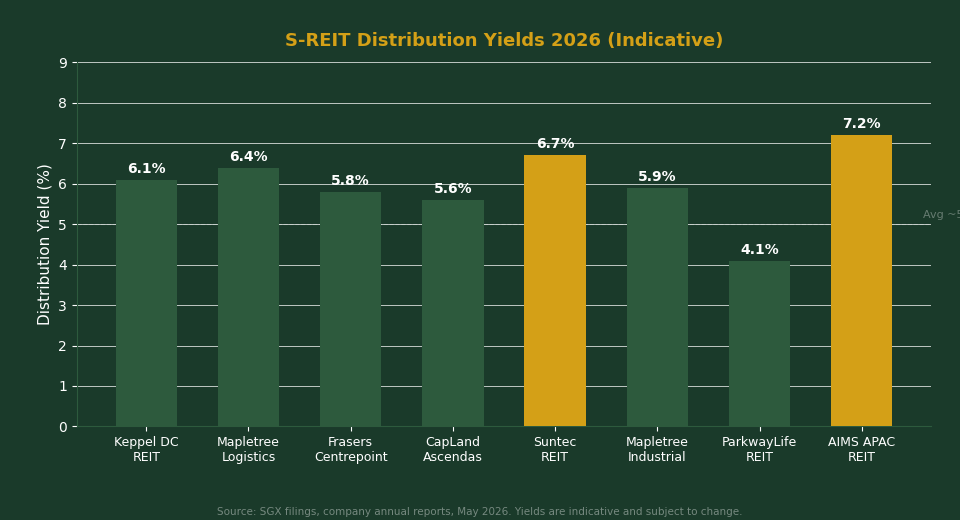
Here is a snapshot of the most widely held S-REITs and their 2026 indicative yields:
| S-REIT | Sector | Indicative Yield | SGX Code | Strength |
|---|---|---|---|---|
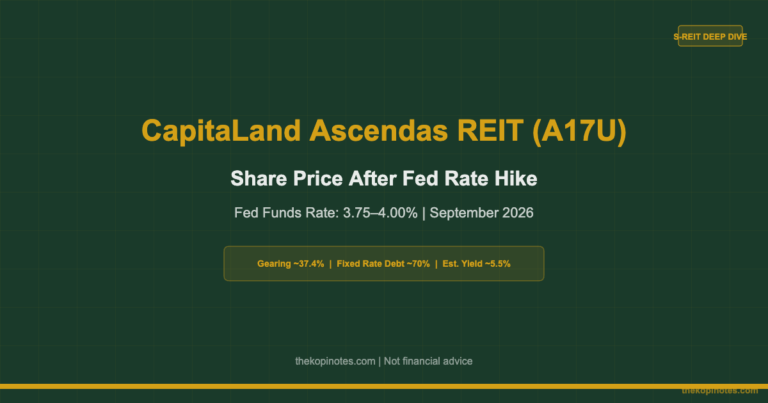
| CapitaLand Integrated Commercial Trust | Retail/Office | 5.8% | C38U | Largest SG REIT, Grade A assets |
| Mapletree Logistics Trust | Logistics | 6.4% | M44U | Pan-Asia logistics network |
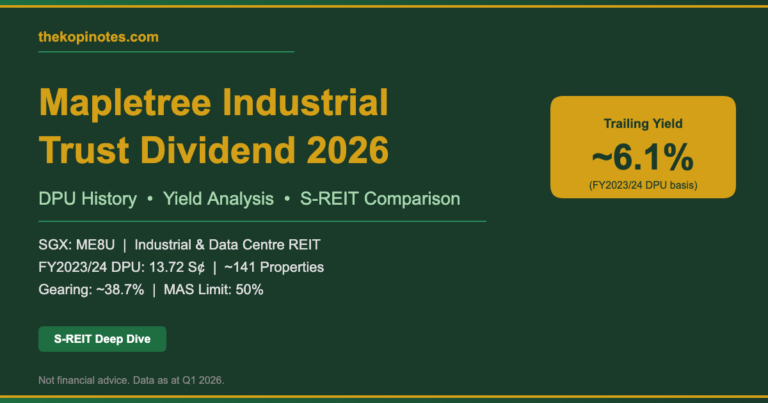
| Mapletree Industrial Trust | Industrial/Data Centres | 5.9% | ME8U | Data centre exposure |
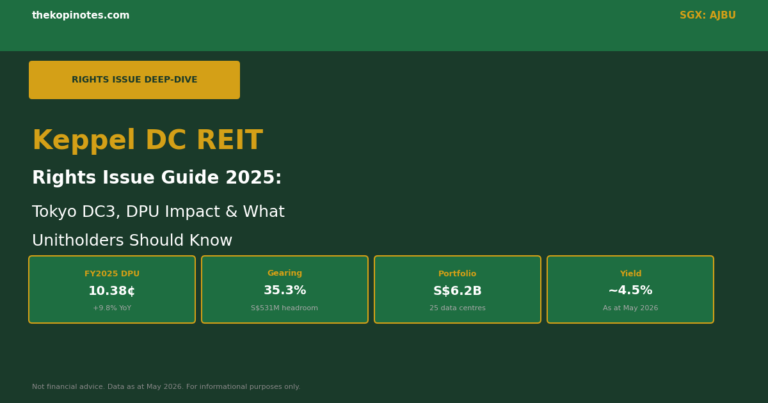
| Keppel DC REIT | Data Centres | 6.1% | AJBU | Pure-play data centre REIT |
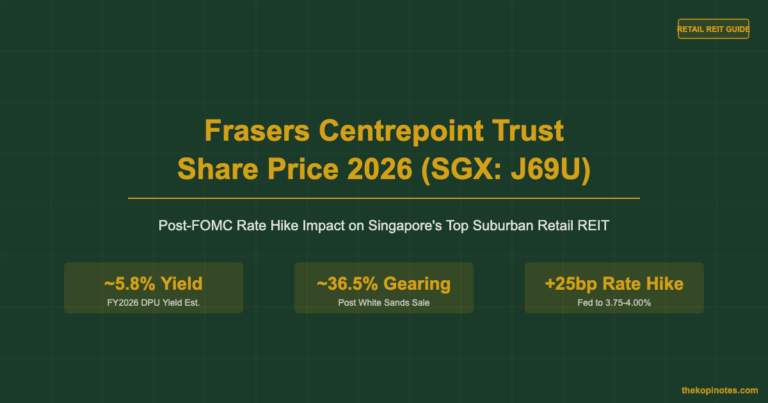
| Frasers Centrepoint Trust | Suburban Retail | 5.8% | J69U | Suburban malls, defensive |
| Suntec REIT | Office/Convention | 6.7% | T82U | Prime CBD office exposure |
| ParkwayLife REIT | Healthcare | 4.1% | C2PU | Defensive healthcare, low risk |
| AIMS APAC REIT | Industrial | 7.2% | O5RU | High yield, smaller cap |
Source: SGX filings, company annual reports, May 2026. Yields are indicative, based on trailing DPU ÷ current unit price. Subject to change with market movements and future DPU cuts or increases.
For a deeper look at individual S-REITs, see our guide to best S-REITs in Singapore 2026 which covers the top picks ranked by yield, gearing, and portfolio quality.
Blue-Chip Dividend Stocks on SGX
Beyond REITs, Singapore’s Straits Times Index (STI) contains several blue-chip companies with consistent multi-decade dividend histories. These tend to offer lower yields than S-REITs (typically 3.5–5.5%) but compensate with potential capital appreciation, stronger balance sheets, and less sensitivity to interest rate movements.
The most widely held blue-chip dividend stocks on the SGX in 2026 include:
| Company | Sector | Indicative Yield | SGX Code | Notes |
|---|---|---|---|---|
| DBS Group | Banking | 5.2% | D05 | Largest SG bank, strong DPS growth |
| OCBC Bank | Banking | 5.8% | O39 | Solid capital ratios, wealth banking |
| UOB | Banking | 5.4% | U11 | ASEAN-focused, defensive |
| Singtel | Telecoms | 4.8% | Z74 | Recovering DPS trajectory |
| Keppel Corp | Conglomerate/Infrastructure | 3.8% | BN4 | Asset-light transformation |
| Singapore Exchange (SGX) | Financial Exchange | 3.5% | S68 | Monopoly infrastructure, steady DPS |
Source: SGX, company results, May 2026. Yields based on trailing 12-month dividends ÷ current share price. Past dividends do not guarantee future distributions.
A key advantage of Singapore banks (DBS, OCBC, UOB) as dividend stocks is their consistency — all three have maintained or grown their dividends through multiple rate cycles, and all are core holdings in most Singapore passive income portfolios.
Dividend ETFs for Singapore Investors
For investors who prefer instant diversification over picking individual stocks, SGX-listed and globally accessible dividend ETFs offer a compelling alternative. These funds hold baskets of dividend-paying stocks and REITs, distributing income periodically while removing single-stock concentration risk.
The most relevant options for Singapore investors in 2026 are:
Lion-Phillip S-REIT ETF (CLR) — Tracks 30+ Singapore-listed REITs via the Morningstar Singapore REIT Index. Distributes quarterly, with a trailing yield of approximately 5.5% as at early 2026. This is the most direct way to get broad S-REIT exposure in a single trade. Our Singapore REIT ETF guide covers it in detail.
NikkoAM-Straits Trading Asia Ex Japan REIT ETF (CFA) — Broader pan-Asia REIT exposure including Hong Kong, Australia, and other APAC markets. Slightly lower yield (~4.8%) but more geographic diversification.
Syfe REIT+ / Income+ portfolios — Robo-advisory portfolios that hold a basket of S-REITs and income assets. Managed for you with automatic rebalancing. If you are new to REIT investing, the Syfe referral code unlocks fee waivers for the first SGD 30,000 managed.
Endowus Fund Smart Income portfolios — Invest CPF or cash in a curated mix of bond and dividend funds. The Endowus referral code gives new users a fee discount on the access fee for the first year.
Full Yield Comparison Table 2026
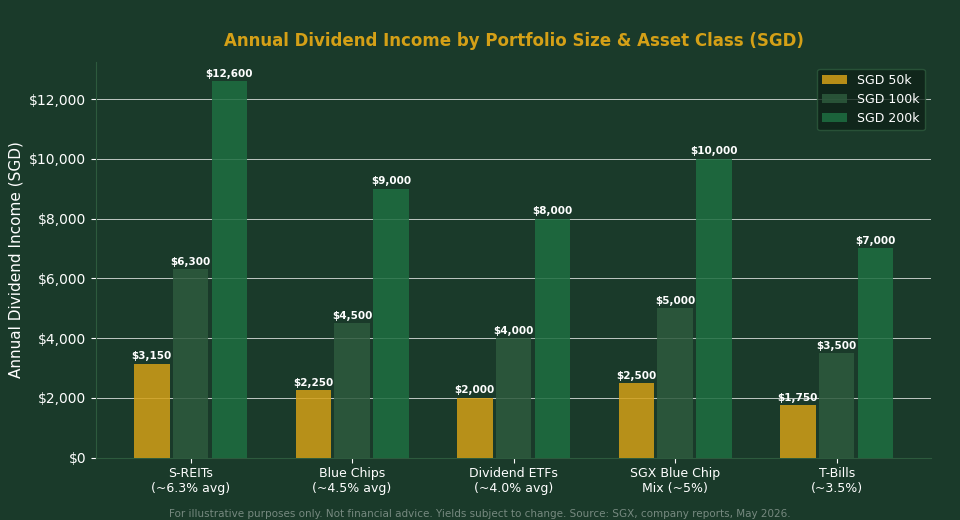
To help you benchmark different dividend asset classes side-by-side, here is a consolidated comparison of average yields and key characteristics for the main Singapore dividend investing categories as at May 2026:
| Asset Class | Avg Yield | Frequency | Tax Treatment (SG Investor) | CPF Eligible | Liquidity |
|---|---|---|---|---|---|
| S-REITs (diversified) | 6.3% | Quarterly | Tax-free (1-tier) | Yes (CPFIS) | High (SGX) |
| SG Blue Chips (banks/telcos) | 4.8% | Semi-annual | Tax-free (1-tier) | Yes (CPFIS) | High (SGX) |
| S-REIT ETFs (Lion-Phillip) | 5.5% | Quarterly | Tax-free (1-tier) | Yes (CPFIS) | High (SGX) |
| Robo-advisories (Syfe/Endowus) | 4.5–5.5% | Variable | Tax-free | Endowus (CPF) | Medium (T+2) |
| Singapore Savings Bonds | ~2.8–3.2% | Semi-annual | Tax-free | No | Medium (monthly redeem) |
| T-Bills (6-month) | ~3.5% | At maturity | Tax-free | Yes (OA/SA) | Low (no secondary) |
Source: SGX, MAS, CPF Board, company filings, May 2026. S-REIT yield is market-cap-weighted average of STI REIT component. All yields indicative and subject to change.
How to Start Investing in Dividend Stocks
Getting started with dividend investing in Singapore involves four steps: choosing a brokerage, funding your account, selecting your dividend stocks or ETFs, and setting up a system to reinvest or spend distributions.
Step 1: Open a CDP-linked brokerage account. SGX-listed dividend stocks are held via the Central Depository (CDP). Most Singapore brokers — DBS Vickers, Maybank Kim Eng, Moomoo Singapore, Saxo Markets, Tiger Brokers — are CDP-linked, meaning your shares are held in your own name rather than in a nominee account. For a comparison of broker fees for SGX stocks in 2026, see our moomoo Singapore review which benchmarks the main platforms.
Step 2: Fund your account in SGD. There is no FX conversion drag for SGX-listed Singapore stocks and REITs — you buy in SGD and receive distributions in SGD. This eliminates the currency risk that affects overseas dividend investing.
Step 3: Start with an S-REIT ETF or a blue-chip basket. For new investors, the Lion-Phillip S-REIT ETF (CLR) or a basket of 3–4 well-known S-REITs (e.g. CICT + MLT + Keppel DC REIT) provides instant diversification without needing to analyse individual REIT financials. For those using a robo-advisory, the Syfe REIT+ portfolio is a fully managed option.
Step 4: Reinvest or set a withdrawal cadence. S-REITs pay quarterly distributions. Many investors reinvest dividends during wealth accumulation years, then switch to spending distributions in retirement. Use our Singapore retirement calculator to model how different yield levels and reinvestment strategies compound over 10–30 years.
Using CPF to Invest in Dividend Stocks
The CPF Investment Scheme (CPFIS) allows Singapore citizens and PRs to invest their CPF Ordinary Account (OA) savings in approved SGX-listed stocks, REITs, and unit trusts — provided the first SGD 20,000 remains in OA and the first SGD 40,000 remains in the Special Account (SA).
For dividend investors, the key CPFIS consideration is whether the dividend yield on a chosen stock reliably exceeds the CPF OA floor rate of 2.5% per annum (or 3.5–4% for the first SGD 60,000, with the government’s extra interest). In a 2026 environment where most S-REITs yield 5.5–7%, the spread above the OA floor is substantial — but this yield must be weighed against capital volatility risk.
Approved stocks under CPFIS-OA as at May 2026 include most SGX Mainboard-listed REITs and blue chips. Units in the Lion-Phillip S-REIT ETF are CPFIS-OA approved. Units in Endowus-managed fund portfolios can be funded directly from CPF OA and SA without going through CPFIS, via Endowus’s unique CPF access licence.
For a full breakdown of CPF investment strategy options in 2026, see our CPF investment strategy guide.
Risks Every Dividend Investor Must Know
Dividend investing is not passive or risk-free. The following risks are real and affect Singapore dividend stocks regularly:
Distribution cuts: S-REITs can and do cut distributions when operating conditions deteriorate — occupancy drops, financing costs rise, or tenants default. During the 2020 COVID lockdown, retail and hospitality REITs cut DPU by 20–40%. Always check a REIT’s gearing ratio (MAS cap is 50%) and interest coverage ratio before investing; a highly geared REIT with floating-rate debt is exposed to rising rates.
Interest rate sensitivity: S-REITs are structurally sensitive to interest rates. When rates rise sharply (as they did in 2022–2023), S-REIT unit prices tend to fall as income investors rotate to safer fixed-income alternatives. In 2026, most S-REITs trade at discounts to NAV, reflecting residual rate uncertainty. This is a buying opportunity for long-term income investors but a risk for those with short horizons.
Capital value erosion: High yield does not compensate for permanent capital loss. An S-REIT yielding 9–10% is often priced that way because the market anticipates future DPU cuts or asset quality deterioration. Focus on sustainable yield, not headline yield.
Concentration risk: A portfolio of only S-REITs — or worse, only one sector of S-REITs — is more volatile than a blended dividend portfolio combining REITs, blue chips, and ETFs. Diversification across sectors (industrial, retail, healthcare, data centres) materially reduces distribution volatility.
Sponsor risk: Most Singapore REITs are sponsored by large corporates (CapitaLand, Mapletree, Keppel, Frasers). If the sponsor encounters financial difficulty, asset injection pipelines dry up and management quality can deteriorate. Always assess the sponsor’s financial health alongside the REIT itself.
Ready to Start? Tools & Resources
Use these free tools to build and track your dividend income plan:
Frequently Asked Questions
What are the best dividend stocks in Singapore for 2026?
Are dividends from Singapore stocks tax-free?
Can I use my CPF to invest in dividend stocks?
How much money do I need to start earning dividend income in Singapore?
What is the average S-REIT yield in Singapore in 2026?
What is the difference between dividend yield and distribution yield for REITs?
Is it better to invest in S-REITs directly or via a REIT ETF?
This article was researched with the help of AI. While we strive to keep all information accurate and up to date, there may be errors. If you notice any discrepancies, please contact us.