Frasers Logistics & Commercial Trust (FLCT) Share Price 2026: DPU, ~6% Yield & Investor Guide (SGX: BUOU)
A plain-English breakdown of one of Singapore’s largest overseas-focused industrial S-REITs — share price, half-year DPU, gearing, and how it stacks up against other logistics and commercial REITs.
Frasers Logistics & Commercial Trust (SGX: BUOU) is a Singapore-listed REIT holding 113 logistics, industrial and commercial properties worth S$7.0 billion across Australia, Germany, the Netherlands, Singapore and the UK. As at end-June 2026 it trades near S$0.975, yielding roughly 6% p.a., at a 0.87x discount to its S$1.12 net asset value per unit.
Not financial advice. All figures are for educational reference only. Data as at July 2026 unless otherwise noted.
- FLCT yields about 6% at today’s price, but half-year DPU has been flattish because divestment-gain top-ups have shrunk — core operating DPU is actually up close to 12% year-on-year.
- Gearing fell to 33.7% — one of the lowest among comparable industrial S-REITs and well below the MAS 50% regulatory ceiling, leaving solid headroom for acquisitions.
- You’re buying overseas diversification (five countries, no Singapore-only concentration risk) but taking on FX exposure, especially to the Australian dollar.
Table of Contents
Contents — Click to expand
- What Is Frasers Logistics & Commercial Trust?
- Share Price, Market Cap & Valuation
- DPU History & Dividend Yield
- Portfolio Breakdown: Logistics vs Commercial, 5 Countries
- Balance Sheet: Gearing & Debt Headroom
- FLCT vs Other Industrial & Overseas S-REITs
- How to Invest in FLCT
- Risks to Understand
- Frequently Asked Questions
What Is Frasers Logistics & Commercial Trust?
Frasers Logistics & Commercial Trust (FLCT) is listed on the SGX under the ticker BUOU. It’s managed by Frasers Property Limited, one of Singapore’s largest listed property groups, which also acts as sponsor. You can find its full disclosures on the FLCT investor relations site.
Unlike most S-REITs you’ll read about on this site, FLCT holds almost nothing in Singapore. Its 113 properties are spread across five developed markets: Australia, Germany, the Netherlands, Singapore and the UK. That gives you geographic diversification most local REITs simply can’t offer — but it also means your returns depend partly on how the Australian dollar, euro and pound move against the Singapore dollar.
The trust runs a “logistics-first” strategy. Around three-quarters of its portfolio by value sits in logistics and industrial (L&I) assets — think warehouses, distribution centres and light industrial parks — with the rest in commercial office and business park space.
Share Price, Market Cap & Valuation
As at end-June 2026, FLCT units traded at approximately S$0.975, giving the trust a market capitalisation of roughly S$3.69 billion. That puts it firmly in the mid-to-large-cap bracket of the S-REIT universe.
The unit price has moved between a 52-week low of S$0.815 and a high of S$1.050. However, that range doesn’t tell you whether the REIT is cheap. For that, you need to compare price against net asset value (NAV) — basically what the properties would be worth if sold and debts repaid, divided by the number of units.
A P/NAV below 1.0x means you’re paying less than book value for the underlying properties. That’s not unusual for S-REITs in 2026 — the broader sector has traded at a discount as investors price in higher-for-longer interest rates. Analyst consensus puts FLCT’s average 12-month price target at around S$1.067, implying the market broadly expects some narrowing of that discount, though targets are opinions, not guarantees.
DPU History & Dividend Yield
FLCT’s financial year runs to 30 September, so “1HFY2026” covers October 2025 to March 2026. For that half-year, FLCT declared a Distribution Per Unit (DPU) — basically how much cash each unit pays you — of 2.95 Singapore cents, down 1.7% year-on-year.
Here’s why that headline number is misleading. Strip out one-off capital gains from prior property sales, and core (operating) DPU actually rose 11.9%, from 2.52 cents to 2.82 cents. In plain terms: the properties themselves are earning more rent and paying out more cash. The flat headline DPU is because FLCT has fewer leftover divestment gains to top up distributions with, not because the business is shrinking.
| Metric (1HFY2026, Oct 2025–Mar 2026) | Value | YoY Change |
|---|---|---|
| Revenue | S$238.9 million | +2.8% |
| Adjusted net property income (NPI) | S$167.0 million | +3.6% |
| Headline DPU | 2.95 cents | -1.7% |
| Core (operating) DPU, ex-divestment gains | 2.82 cents | +11.9% |
| Portfolio occupancy | 96.1% | up from 93.9% |
Source: FLCT 1HFY2026 results announcement, The Edge Singapore — reported May 2026.
At a unit price of S$0.975, an annualised distribution around 5.9 cents works out to roughly a 6% distribution yield. Some data providers quote figures closer to 6.6% depending on the exact price and trailing period used — always check the date on any yield figure you see quoted, since it moves with the unit price daily.
Portfolio Breakdown: Logistics vs Commercial, 5 Countries
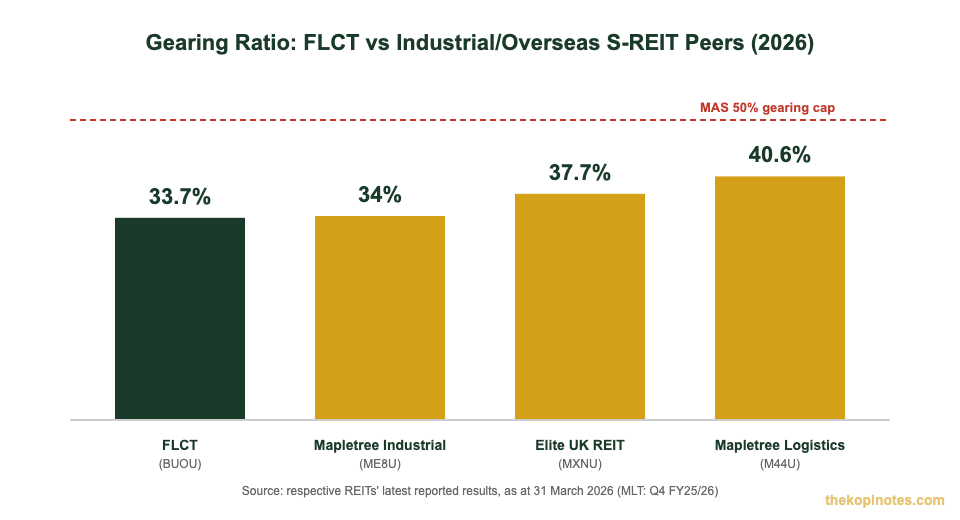
As at 31 March 2026, FLCT’s portfolio was valued at approximately S$7.0 billion across 113 properties. Here’s how that splits by asset type:
| Asset Type | % of Portfolio Value | Occupancy |
|---|---|---|
| Logistics & Industrial (L&I) | ~75.1% | 99.8% |
| Commercial (office & business park) | ~24.9% | 88.4% |
| Blended portfolio | 100% | 96.1% |
Source: FLCT 1HFY2026 results presentation, 31 March 2026.
That gap between 99.8% and 88.4% occupancy tells an important story. Warehouses and distribution centres are in high demand across all five of FLCT’s markets — e-commerce and supply-chain reshoring keep tenants queuing up. Office and business park space is a different picture, with hybrid work and cautious corporate expansion weighing on occupancy in Singapore, Australia and the UK alike.
Geographically, the trust spans Australia, Germany, the Netherlands, Singapore and the UK — a genuinely diversified footprint you won’t find in single-market REITs like Mapletree Logistics Trust, which leans more heavily on Asia-Pacific.
Balance Sheet: Gearing & Debt Headroom
Gearing — basically how much of the trust’s assets are funded by debt versus unitholder equity — is one of the clearest signals of balance-sheet health. Since November 2024, MAS applies a single aggregate leverage limit of 50% to all S-REITs (with a minimum interest coverage ratio requirement), replacing the older tiered 45%/50% system.
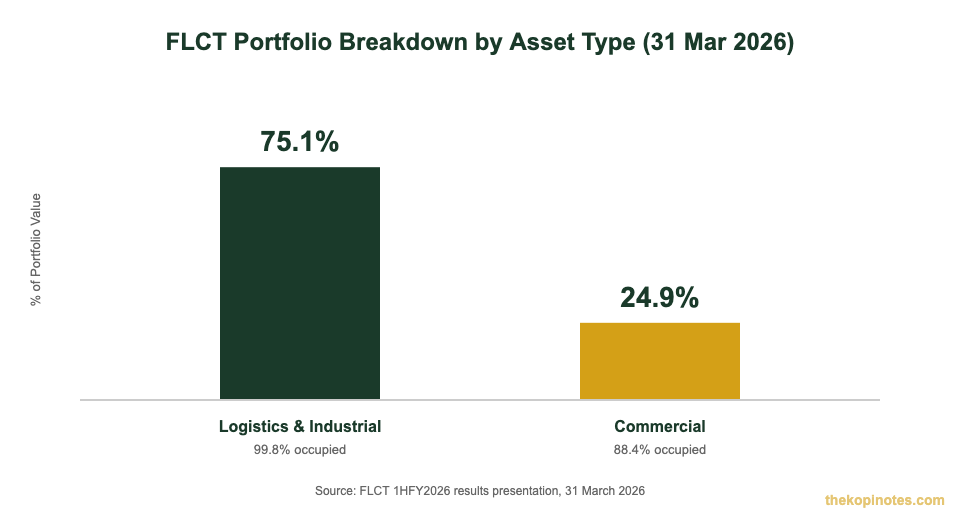
FLCT’s aggregate leverage fell to 33.7% as at 31 March 2026, down from 36.1% a year earlier — comfortably below the 50% regulatory ceiling. You can see how this stacks up against other S-REITs in our REIT gearing ratio vs peers guide.
Why does this matter to you as an investor? Lower gearing means more room to take on debt for acquisitions without a rights issue, and less refinancing risk if interest rates stay elevated. That said, lower gearing partly reflects proceeds from asset divestments over 2024–2025 reducing the loan balance — not purely organic deleveraging — so it’s worth watching whether the ratio holds steady as those divestment proceeds get redeployed.
FLCT vs Other Industrial & Overseas S-REITs
How does FLCT stack up against other logistics-and-industrial-flavoured S-REITs you might be considering instead?
| REIT | Focus | Geography | Gearing (31 Mar 2026) |
|---|---|---|---|
| Frasers Logistics & Commercial Trust (BUOU) | Logistics/industrial + commercial | Australia, Germany, Netherlands, Singapore, UK | 33.7% |
| Mapletree Industrial Trust (ME8U) | Industrial + data centres | Singapore, US | 34.0% |
| Elite UK REIT (MXNU) | UK government-let offices | United Kingdom only | 37.7% |
| Mapletree Logistics Trust (M44U) | Logistics/warehousing | Asia-Pacific (Singapore-heavy) | 40.6% (Q4 FY25/26) |
Source: respective REITs’ latest reported results, as at 2026. Gearing ratios move each quarter — always check the latest factsheet before investing. All four sit well within the MAS 50% aggregate leverage limit.
The key trade-off: FLCT gives you broader geographic spread and the lowest gearing ratio of this comparison set, at the cost of direct exposure to multiple currencies rather than just SGD. Investors who want pure Singapore/Asia-Pacific logistics exposure without FX complexity may prefer a name like Mapletree Logistics Trust; those comfortable with currency risk in exchange for diversification and balance-sheet headroom may find FLCT more appealing.
How to Invest in FLCT
FLCT is a listed ETF-style equity, not a fund, so you buy it exactly like any other SGX stock — through a brokerage account, in board lots of 100 units.
If you don’t already have a brokerage account, comparing platforms on commission rates and FX fees matters more than you’d think over a multi-year holding period. Singapore investors commonly compare moomoo Singapore against the larger brokers for lower commissions on SGX trades.
For broader REIT exposure beyond a single counter, robo-advisory portfolios and diversified S-REIT baskets are worth comparing against buying individual names like FLCT. You can also use a Singapore retirement calculator to see how a REIT’s distribution yield fits into your broader retirement income plan.
Risks to Understand
- Currency risk — FLCT earns rent in AUD, EUR, GBP and SGD. A weaker Australian dollar or pound against SGD directly reduces the SGD value of distributions, even if underlying rents are stable or rising.
- Commercial office weakness — at 88.4% occupancy versus 99.8% for logistics assets, the ~25% of the portfolio in offices and business parks is the softer part of the story. Further occupancy declines here would be a drag on overall income.
- Interest rate sensitivity — like all REITs, FLCT’s cost of debt and valuation are sensitive to interest rate expectations in each of its five markets, not just Singapore.
- No capital guarantee — both unit price and distributions can fall. NAV per unit has trended down over the past five years, driven by FX moves and softer commercial valuations, and that trend may or may not continue.
- Divestment-gain dependency — some past distributions were topped up by one-off property sale gains rather than pure rental income; as those taper off, headline DPU growth depends more heavily on organic rental growth.
Frequently Asked Questions
What is Frasers Logistics & Commercial Trust?
What is FLCT's current dividend yield?
Why did FLCT's DPU fall in 1HFY2026?
Is FLCT trading above or below its net asset value?
How much debt does FLCT carry?
What percentage of FLCT's portfolio is logistics versus commercial?
How do I buy FLCT shares in Singapore?
What are the main risks of investing in FLCT?
This article was researched with the help of AI. While we strive to keep all information accurate and up to date, there may be errors. If you notice any discrepancies, please contact us.