ParkwayLife REIT Review 2026: Share Price, Dividend Yield & Is It Still a Buy?
A plain-English look at Singapore’s largest healthcare REIT (SGX: C2PU) — DPU growth, gearing, and who it actually suits.
ParkwayLife REIT (SGX: C2PU) is Singapore’s largest listed healthcare REIT, owning three private hospitals here plus nursing homes in Japan and France. Its unit price sat near S$4.04 in 2026, with a trailing dividend yield around 3.8%. First-quarter 2026 DPU jumped 15.1% year-on-year to 4.42 cents, and gearing stayed low at 34.2% — well under the regulatory ceiling.
Not financial advice. All figures are for educational reference only. Data as at July 2026 unless noted.
- ParkwayLife REIT’s yield (around 3.8%) is lower than most S-REITs — you’re paying for stability, not income.
- DPU grew 15.1% in 1Q 2026 after a rent rebate ended in Singapore, and gearing at 34.2% leaves plenty of debt headroom.
- It suits investors who want a defensive, low-volatility REIT to anchor a portfolio — not those chasing the highest yield.
Table of Contents
Contents — Click to expand
What Is ParkwayLife REIT?
ParkwayLife REIT (ticker C2PU on the SGX) is Singapore’s largest healthcare real estate investment trust (REIT) by asset value. A REIT simply pools money from many investors to buy income-producing property, then pays out most of the rental income as dividends.
Its portfolio is worth around S$2.57 billion. That’s split across three private hospitals in Singapore — Mount Elizabeth, Gleneagles, and Parkway East — plus 60 nursing homes and care facilities in Japan, and 11 nursing homes in France.
The sponsor is IHH Healthcare, one of Asia’s largest private hospital operators. That relationship matters. It means ParkwayLife REIT has a built-in pipeline of hospital assets it can potentially acquire, and its Singapore hospital leases are tied to a healthcare group with deep pockets and a long operating track record. You can verify unit details directly on the SGX company page for C2PU or the REIT’s own investor relations site.
Unlike retail or office REITs, healthcare REITs lease to tenants who rarely move out. Hospitals don’t relocate on a whim. That’s the core appeal here: predictability over excitement.
Key Facts at a Glance
| Metric | Detail |
|---|---|
| Full Name | Parkway Life Real Estate Investment Trust |
| Ticker (SGX) | C2PU |
| Sector | Healthcare (hospitals + nursing homes) |
| Sponsor | IHH Healthcare (Parkway Pantai) |
| Portfolio Value | ~S$2.57 billion |
| Properties | 3 Singapore hospitals, 60 Japan nursing homes, 11 France nursing homes |
| WALE (by gross revenue) | ~15 years |
| Gearing (1Q 2026) | 34.2% |
| FY2025 DPU | 15.29 cents |
Source: ParkwayLife REIT 1Q 2026 business update; growbeansprout.com FY2025 dividend data, as at July 2026.
ParkwayLife REIT Share Price & Dividend Yield in 2026
ParkwayLife REIT’s unit price traded around S$4.04 in early 2026, with a 52-week range roughly between S$3.92 and S$4.44. That’s a tight band. For comparison, many cyclical S-REITs swing far more than that in a year.
Here’s the number that surprises new investors: the dividend yield is low. Trailing 12-month yield sits around 3.8%, and forward estimates from various data providers range between 3.78% and 3.88%. That’s well below the 5–7% yields you’ll see on many other S-REITs.
Why would you accept a lower yield? Because the market is pricing in stability. ParkwayLife REIT has grown its dividend for 10 straight years, with a payout ratio around 58.5% — meaning it retains a healthy chunk of income rather than paying out everything. That cushion helps it keep raising distributions even in soft years.
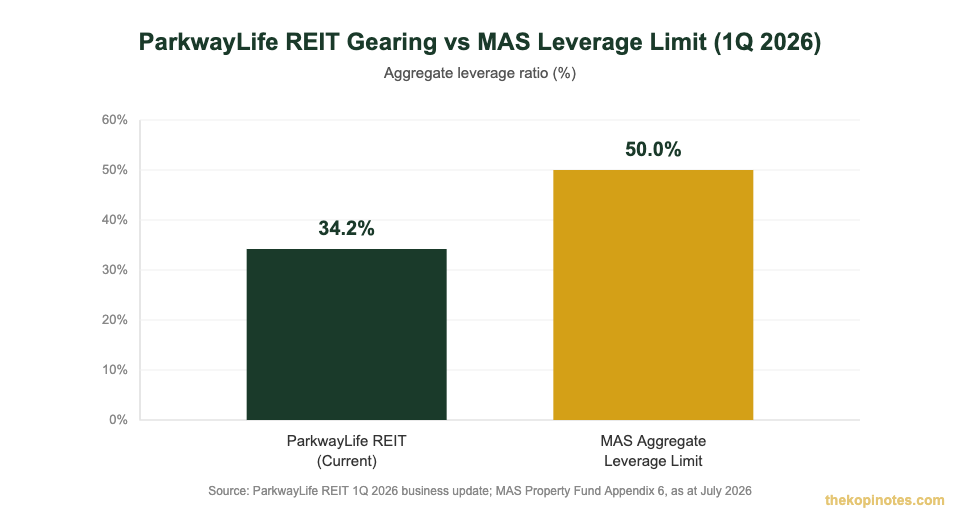
Consensus analyst forecasts put full-year 2026 DPU at around 18 cents, up from 15.29 cents in FY2025. If that holds, it would be one of the REIT’s strongest growth years in recent memory — driven largely by one-off factors in Singapore explained below.
1Q 2026 Results: DPU, Gearing & WALE
ParkwayLife REIT’s first-quarter 2026 results were strong. DPU came in at 4.42 cents, up 15.1% year-on-year. Distributable income rose by the same 15.1% to S$28.8 million.
What drove it? Two things. A three-year rent rebate on its Singapore hospitals ended, so the REIT is now collecting full rent again. On top of that, a new rent review formula kicked in, lifting the base rent it can charge. Both are structural changes, not one-off luck — though the year-on-year growth rate will likely normalise once the rebate’s absence is no longer a comparison boost. For the full quarter-by-quarter breakdown, see our dedicated ParkwayLife REIT 1Q 2026 results analysis.
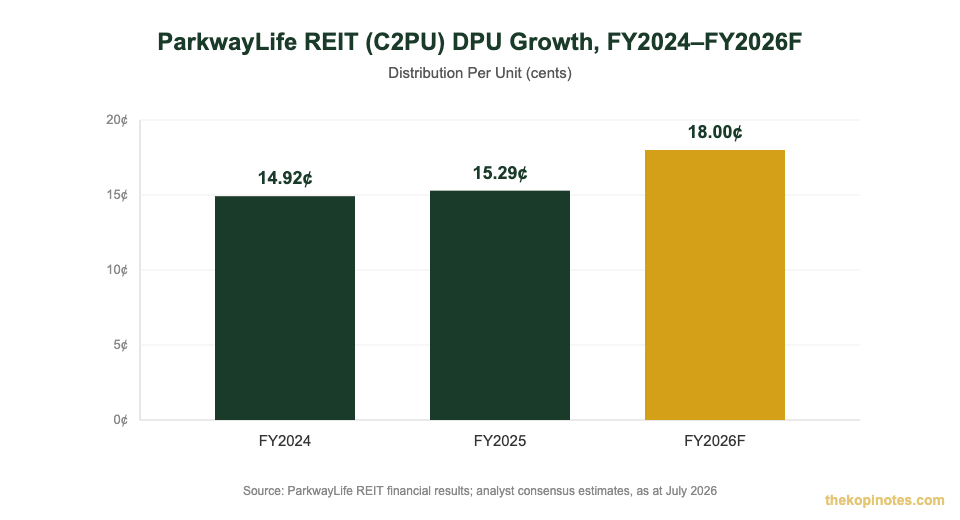
On the balance sheet, gearing (how much debt the REIT uses relative to its assets) stood at 34.2% as at 1Q 2026 — up slightly from 33.4% at end-2025, but still comfortably below the Monetary Authority of Singapore’s (MAS) 50% aggregate leverage limit for REITs. That leaves roughly S$834.2 million of debt headroom before hitting the ceiling, and S$517.9 million before the lower 45% threshold that triggers stricter interest coverage checks.
The REIT’s weighted average lease expiry (WALE) — basically how long its rental contracts run on average — is close to 15 years by gross revenue. That’s unusually long. Most of these leases also carry CPI-linked rent reviews, meaning rents adjust upward with inflation. For a Singapore investor worried about inflation eroding your passive income, that structural feature is worth noting.
How to Buy ParkwayLife REIT in Singapore
Buying ParkwayLife REIT is straightforward — it’s listed on the SGX main board like any blue-chip stock. Here’s how to do it, broker by broker.
Step 1: Fund a brokerage account. You’ll need a Central Depository (CDP) account or a custodian account with a broker, plus cash to trade with.
Step 2: Search for the ticker. Type “C2PU” or “ParkwayLife REIT” into your broker’s search bar.
Step 3: Place your order. Buy in board lots of 100 units on the SGX. At a S$4.04 unit price, one lot costs roughly S$404 before fees.
For brokers, moomoo Singapore and Syfe Brokerage are popular with beginners for their low commissions and simple apps. If you’d rather have your S-REIT exposure managed for you, you can also access ParkwayLife REIT indirectly through a diversified REIT portfolio via a robo-advisor — check the Syfe referral code and sign-up bonus if you’re opening a new account.
Note that ParkwayLife REIT is not CPF-Ordinary-Account investable through most standard CPFIS-included counters — always check your broker’s platform for current CPFIS eligibility before assuming. It is generally SRS-compatible through SRS-linked brokerage accounts, which makes it a reasonable candidate for your passive income in Singapore strategy inside a tax-deferred wrapper.
ParkwayLife REIT vs a Typical Large-Cap S-REIT
Here’s the thing about ParkwayLife REIT: it doesn’t behave like most S-REITs you’ll compare it against. Retail and office REITs typically carry shorter leases, higher gearing, and bigger swings in occupancy. ParkwayLife REIT trades those higher yields for lower risk.
| Metric | ParkwayLife REIT (C2PU) | Typical Large-Cap S-REIT |
|---|---|---|
| Sector | Healthcare (defensive) | Retail / office / industrial (cyclical) |
| Dividend Yield | ~3.8% | 5–7% |
| Gearing | 34.2% | Often 38–40% |
| WALE | ~15 years | Often 3–5 years |
| Rent Structure | CPI-linked, long-term | Market-rate renewals |
Source: ParkwayLife REIT 1Q 2026 business update; general S-REIT sector characteristics as commonly reported, July 2026. “Typical” figures are illustrative sector ranges, not a specific REIT.
If you want higher current income, our high-yield REITs in Singapore roundup covers names paying above 6%. ParkwayLife REIT is a different tool for a different job — capital preservation and steady, inflation-linked growth rather than maximum yield today.
Is ParkwayLife REIT a Good Buy? Pros and Cons
Here’s the honest picture, not a sales pitch.
ParkwayLife REIT could suit you if: you want a low-volatility anchor holding for a retirement-focused portfolio, you’re comfortable trading yield for safety, you like the idea of CPI-linked rent reviews protecting your income from inflation, and you’re investing for the long term rather than chasing quarterly income.
Consider alternatives if: you need maximum current income today, you’re uncomfortable paying a premium valuation for defensiveness, or you already hold significant healthcare or Japan-exposed assets elsewhere in your portfolio.
The main risks worth knowing: currency risk from its Japan and France properties (yen and euro movements affect returns when converted back to SGD), concentration risk since three Singapore hospitals still generate the bulk of income, and interest rate risk — though the REIT’s low 34.2% gearing and 8.6 times interest cover give it real breathing room here compared to more leveraged peers.
For most Singapore investors, ParkwayLife REIT works best as one holding within a broader, diversified income portfolio — not as your only REIT. Check out our guide to the best S-REITs in Singapore 2026 to see how it stacks up across sectors, and run the numbers through the Singapore retirement calculator to see how a defensive REIT like this fits your income timeline.
Disclaimer: This article is for educational purposes only and does not constitute financial advice. The Kopi Notes may earn a referral fee from some links above. Always do your own due diligence or consult a licensed financial adviser before investing.
Frequently Asked Questions
What is ParkwayLife REIT and what does it own?
ParkwayLife REIT (SGX: C2PU) is Singapore’s largest listed healthcare REIT. It owns three private hospitals in Singapore — Mount Elizabeth, Gleneagles, and Parkway East — along with 60 nursing homes in Japan and 11 in France, worth roughly S$2.57 billion in total.
Is ParkwayLife REIT a good dividend stock for Singapore investors?
It depends on what you’re looking for. ParkwayLife REIT offers a lower yield (around 3.8%) than most S-REITs, but it has raised its dividend for 10 consecutive years and carries low gearing at 34.2%. It suits investors prioritising stability over maximum income.
What is ParkwayLife REIT's dividend yield in 2026?
Trailing 12-month yield is around 3.8%, based on a unit price near S$4.04. Forward yield estimates from various data providers range between 3.78% and 3.88%, depending on the calculation date and DPU forecast used.
Is ParkwayLife REIT safe? What are the main risks?
ParkwayLife REIT is considered one of the more defensive S-REITs, with long lease terms (~15 years WALE), CPI-linked rent reviews, and low gearing (34.2%). Key risks include currency exposure from its Japan and France properties, and concentration in a small number of Singapore hospital assets.
How do I buy ParkwayLife REIT shares in Singapore?
Open a brokerage account with a CDP or custodian setup, search for ticker “C2PU” on the SGX, and buy in board lots of 100 units. Brokers like moomoo Singapore and Syfe Brokerage are popular choices for straightforward SGX trading.
Can I buy ParkwayLife REIT (C2PU) using my CPF or SRS?
SRS (Supplementary Retirement Scheme) accounts linked to a brokerage can generally buy SGX-listed counters like ParkwayLife REIT. CPF Ordinary Account eligibility varies by broker and CPFIS inclusion — always confirm directly with your broker before assuming a counter is CPF-investable.
Ready to Add ParkwayLife REIT to Your Portfolio?
Open a brokerage account and start building your defensive S-REIT allocation today.
This article was researched with the help of AI. While we strive to keep all information accurate and up to date, there may be errors. If you notice any discrepancies, please contact us.