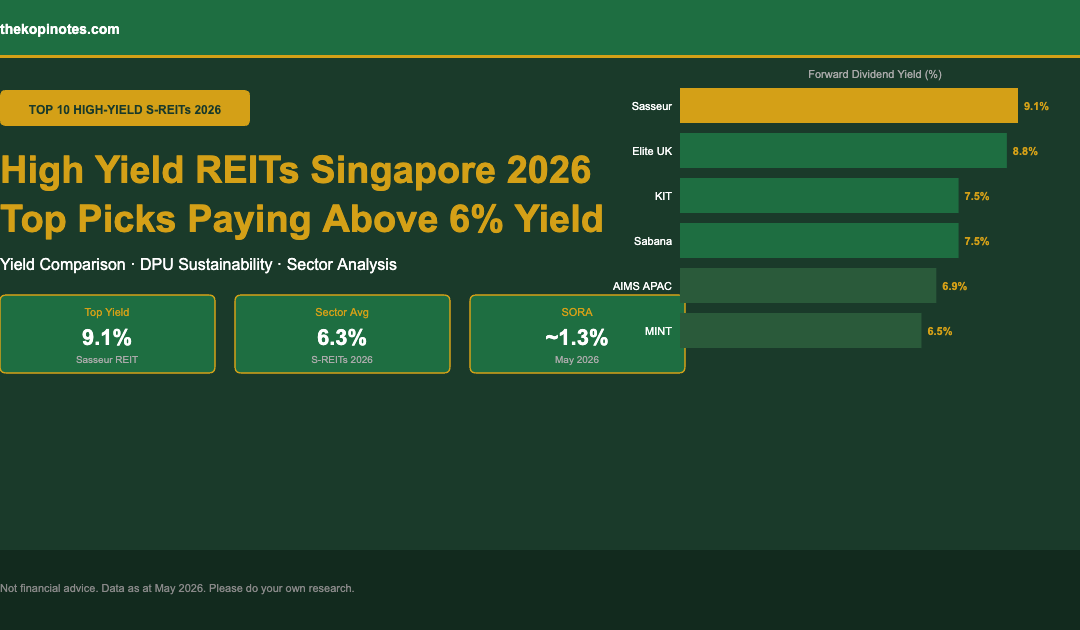
High Yield REITs Singapore 2026: Top 10 S-REITs Paying Above 6%
S-REITs are back in focus as Singapore investors hunt for sustainable passive income. With SORA near 1.3% and rate cuts filtering through, distribution yields of 6–9% now look increasingly attractive — but which high-yield S-REITs are truly worth holding? This is not financial advice. Data as at May 2026. Please do your own research.
What Is a High-Yield S-REIT?
In the Singapore REIT universe, a “high-yield” S-REIT is generally defined as one distributing above 6% on its current market price. As at May 2026, the iEdge S-REIT Index trades at roughly 0.86x P/NAV with a market-cap-weighted average yield of ~6.3%, meaning anything above 7% sits firmly in the “elevated yield” category.
High yields can arise from three sources: genuine high cash distributions from strong operating performance, a depressed unit price reflecting market concerns, or temporary boosts from capital recycling or divestment gains. Understanding which of these drives a particular S-REIT’s yield is critical before investing.
The S-REIT sector is governed by MAS regulations requiring REITs to distribute at least 90% of taxable income — meaning unitholders benefit from pass-through income without corporate-level tax. This makes high-yield S-REITs particularly attractive as a passive income vehicle for Singapore investors.
Top 10 High-Yield S-REITs 2026: Comparison Table
Ranked by forward distribution yield as at May 2026, sourced from SGX and analyst consensus.
| # | S-REIT | Sector | Yield | Gearing | DPU Trend |
|---|---|---|---|---|---|
| 1 | Sasseur REIT (SASSR) | Outlet Mall | 9.1% | 32.1% | Stable (EMA-linked) |
| 2 | Elite UK REIT (ELITE) | Office (UK) | 8.8% | 41.2% | Recovering |
| 3 | Keppel Infrastructure Trust (KIT) | Infrastructure | 7.5% | 39.1% | Stable (+1% YoY) |
| 4 | Sabana REIT (SSREIT) | Industrial (SG) | 7.5% | 38.5% | Strong (+23% FY25) |
| 5 | AIMS APAC REIT (AAREIT) | Industrial (SG/AU) | 6.9% | 26.8% | Growing (+2.6%) |
| 6 | Mapletree Industrial Trust (MINT) | Industrial/Data Centre | 6.5% | 34.0% | Stable |
| 7 | Mapletree Logistics Trust (MLT) | Logistics | 6.2% | 40.7% | Declining (-9.8%) |
| 8 | Mapletree Pan Asia Comm Trust (MPACT) | Retail/Commercial | 6.2% | 36.5% | Recovering |
| 9 | CapitaLand Ascendas REIT (CLAR) | Industrial/Logistics | 6.1% | 39.0% | Stable |
| 10 | Frasers Centrepoint Trust (FCT) | Retail (SG Suburban) | 6.0% | 39.1% | Stable |
Source: SGX, company announcements, analyst consensus. Yields indicative as at May 2026. Not financial advice.
Sector Breakdown: Which Sectors Offer the Highest Yields?
Industrial S-REITs (6–7.5% yield): AIMS APAC REIT (6.9%), MINT (6.5%), and CLAR (6.1%) sit in this cohort. Low gearing (AIMS at 26.8%), high occupancy rates above 95%, and Singapore’s manufacturing and e-commerce tailwinds make industrial the sweet spot of high yield plus sustainability.
Outlet/Specialty Retail (8–9% yield): Sasseur REIT’s 9.1% yield is supported by its Entrusted Management Agreement (EMA) structure where base distributions are locked in regardless of mall sales. Investors should note its China-focused portfolio carries FX and regulatory risk.
Infrastructure Trust (7–8% yield): Keppel Infrastructure Trust is technically a business trust but widely considered alongside S-REITs. Its FY2025 DPU of 3.94¢ was supported by divestment gains — analysts flag that organic DPU may normalise lower once these gains are exhausted.
Logistics/Commercial (6–6.5% yield): MLT and MPACT offer 6.2% yields but both face DPU headwinds — MLT from China vacancies and MPACT from Hong Kong office market softness. These are higher-quality names at a slight yield discount to the industrial cohort.
Healthcare REITs (4.5–5% yield): ParkwayLife REIT’s CPI-linked rent escalations and 18-year unbroken DPU growth justify its premium valuation. See our ParkwayLife REIT DPU guide for details.
Is the Yield Sustainable? Key Metrics to Check
1. Gearing Ratio (MAS limit: 50%)
REITs with gearing above 40% face refinancing risk. Elite UK REIT at 41.2% and MLT at 40.7% are near the cautionary threshold. AIMS APAC REIT at just 26.8% has the most headroom for acquisitions or economic shocks.
2. DPU Trend (3–5 year history)
Sabana REIT’s +23.4% FY2025 DPU jump reflects its management internalisation — a structural improvement, not just a one-off. AIMS APAC REIT has posted multiple consecutive years of stable or growing DPU.
3. Interest Coverage Ratio (ICR)
MAS requires S-REITs to maintain an ICR of at least 1.5x. Healthy REITs run at 3x or above. A declining ICR even as yield rises is a warning sign of earnings pressure. Use the S-REIT Gearing Ratio Calculator to model risk scenarios.
For deep-dives on individual names, see our Best S-REITs Singapore 2026 guide and S-REIT Outlook 2026.
2026 Rate Environment and S-REIT Outlook
The 3-month SORA rate has fallen from ~3.0% in mid-2024 to approximately 1.3% as at May 2026 — directly reducing borrowing costs for REITs with floating-rate debt and translating into higher DPU over the next 1–2 reporting cycles.
Analyst consensus points to a 5–10% uplift in sector-wide DPU over FY2026–2027 as high-cost debt matures and is refinanced at lower rates. The iEdge S-REIT Index is trading at ~0.86x P/NAV — below its 10-year average of 1.0x — suggesting potential capital upside on top of the 6%+ income yield.
Key risks: the US Federal Reserve’s rate path, US–China trade tariffs (affecting logistics REIT tenants), and Singapore’s office market absorption. For the latest T-bill comparison, see our T-Bill vs CPF OA 2026 guide and Singapore T-Bills 2026 Complete Guide.
How to Invest in High-Yield S-REITs (CPF/SRS/Cash)
Cash Account: Buy S-REITs via FSMOne (CDP-linked, 0.08% fee), Tiger Brokers, or moomoo. Distributions are paid to your bank account, tax-free at the individual level under Singapore’s REIT tax transparency rules.
CPF Investment Scheme (CPFIS-OA): Invest CPF OA savings above S$20,000 in SGX-listed REITs. Deploys 2.5% p.a. earning CPF cash into REITs yielding 6–9%. Use our CPFIS Calculator to model projected returns.
SRS: Contributions are tax-deductible at your marginal rate (up to 22%). SRS funds can be invested in SGX-listed REITs. See our SRS Tax Savings Calculator to estimate your relief.
Robo Advisors: Endowus and Syfe offer REIT-focused portfolios with CPF/SRS/cash options. Endowus provides institutional-grade REIT funds at low expense ratios (see Endowus Referral Code for S$20 fee credits). Syfe REIT+ holds the 20 largest S-REITs with quarterly rebalancing.
Risks of Chasing High Yield
1. Yield Trap: A REIT yielding 9–10% may be priced that way because the market anticipates a DPU cut. A projected 20% DPU decline turns that “9% yield” into 7.2% — with capital loss on top.
2. Currency Risk: Elite UK REIT (GBP), Sasseur REIT (RMB), and MLT (multi-currency) distribute in foreign currencies. A strengthening SGD erodes DPU — MLT’s FY2025 DPU fell partly due to RMB and AUD weakness.
3. Refinancing Wall: A concentration of debt maturing in 1–2 years is a red flag for yield sustainability. Always check the debt maturity schedule in the latest annual report.
4. Sponsor Risk: Internally-managed REITs (like post-internalisation Sabana REIT) have fewer manager conflicts of interest. For externally managed REITs, check whether the manager is incentivised to grow AUM at the expense of unitholder returns. For full sector analysis, see our S-REIT Outlook 2026.
Best Platforms to Buy S-REITs in Singapore
Choosing the right brokerage saves on transaction fees and makes CPF/SRS investing seamless.
Frequently Asked Questions
Which S-REIT has the highest dividend yield in Singapore in 2026?
As at May 2026, Sasseur REIT (SASSR) has the highest forward distribution yield at approximately 9.1%, followed by Elite UK REIT at 8.8% and Keppel Infrastructure Trust at 7.5%. Always assess alongside gearing, DPU sustainability, and sector fundamentals.
Is a 9% REIT yield safe in Singapore?
Not necessarily. A very high yield often signals anticipated DPU cuts, FX risk, or elevated gearing. Sasseur REIT’s yield is partially justified by its EMA structure, but it carries China portfolio concentration risk. Always check the DPU trend, gearing ratio, and ICR.
What is a good REIT yield in Singapore?
A yield of 5–7% from a financially sound, low-gearing S-REIT with stable or growing DPU is considered healthy. Yields above 7% deserve closer scrutiny. Prioritise DPU consistency — a REIT paying 6% reliably for 10 years outperforms one paying 9% for 2 years before cutting distributions.
Can I use CPF to invest in high-yield S-REITs?
Yes. Under CPFIS-OA, you can invest CPF Ordinary Account savings above the first S$20,000 in SGX-listed REITs — deploying 2.5% p.a. earning CPF cash into REITs yielding 6–9%. Use a CDP-linked broker like FSMOne for CPFIS trading.
Which sectors have the highest S-REIT yields in 2026?
Industrial S-REITs (6.5–7.5%) offer the best balance of yield and sustainability. Specialty retail and infrastructure trusts offer higher yields (7.5–9%) but with additional risks. Healthcare REITs are lowest-yield, highest-quality at 4.5–5.5%.
How do I compare S-REIT yields effectively?
Look at distribution yield (DPU ÷ unit price), 3-year DPU CAGR, gearing ratio, and yield spread over Singapore 10-year government bonds. A 3–4% spread above risk-free rates indicates genuine income value. Use our S-REIT Yield vs Bond Spread Calculator.
What is the average S-REIT yield in 2026?
The market-cap-weighted average yield for the iEdge S-REIT Index is approximately 6.3% as at May 2026. The equal-weighted average across all SGX-listed REITs is closer to 6.8–7.0%.
Should I pick individual high-yield REITs or a REIT ETF?
Individual stock-picking lets you concentrate in the best names. A REIT ETF provides diversification but dilutes yield to ~5–5.5%. See our Singapore REIT ETF Guide for a full breakdown.
Start Your S-REIT Research Today
Compare yields, run DPU calculations, and model your passive income portfolio with our free Singapore REIT tools.
This article was researched with the help of AI. While we strive to keep all information accurate and up to date, there may be errors. If you notice any discrepancies, please contact us.