Best Investment Plan for Retirement in Singapore (2026): 6 Options Ranked
CPF, SRS, SSB, T-Bills, Endowment Plans & Robo-Advisors — Compared Side by Side
The best investment plan for retirement in Singapore depends on how many years you have left. CPF Special and Retirement Accounts pay a guaranteed 4% p.a. — the highest safe rate on the market. Closer to retirement, Singapore Savings Bonds and T-bills add flexibility without locking up your cash. Further out, an SRS account invested through a low-fee robo-advisor like Endowus or Syfe usually builds more wealth, though it carries market risk.
Not financial advice. All figures are for educational reference only. Data verified against official sources (CPF Board, MAS, OCBC, IRAS) as at 18 July 2026 unless otherwise stated.
- CPF SA/RA’s 4% p.a. floor beats every bank account, SSB and endowment plan rate right now — top it up before looking anywhere else.
- Guaranteed-return endowment plans, like OCBC’s GREAT SP at 0.70% p.a., often pay less than CPF or T-bills. Read the guaranteed rate carefully, not just the illustrated one.
- If retirement is 15+ years away, SRS money invested through a low-cost robo-advisor typically grows faster than any guaranteed product — but your balance can fall in bad years.
Table of Contents
Contents — Click to expand
- Quick Verdict: Our Ranking
- What Actually Matters When Choosing
- CPF: Your Guaranteed Foundation
- SRS: Tax Savings Today
- Singapore Savings Bonds & T-Bills
- Guaranteed-Return Endowment Plans
- Investment-Linked Policies
- Robo-Advisors & DIY Investing
- Side-by-Side Comparison Table
- Worked Example: Allocating S$100,000
- How to Choose by Years to Retirement
- 5 Common Mistakes to Avoid
- FAQ
Quick Verdict: Our Ranking
Here’s the short answer before we go deep on each option. Ranked for most Singapore retirement savers, in order:
- CPF Special/Retirement Account top-ups — 4% p.a. guaranteed, the best safe rate available, but locked up until age 55 (SA) or 65 (RA payouts).
- SRS + robo-advisor (Endowus or Syfe) — best for growth if you have 10+ years to retirement and want tax relief today.
- Singapore Savings Bonds — best flexible, government-backed option with zero penalty for early redemption.
- T-bills — best for short 6-month or 1-year parking, slightly ahead of SSB’s first-year rate right now.
- Guaranteed-return endowment plans — only worth it if the guaranteed rate beats CPF or SSB for your specific timeframe. Often it doesn’t.
- Investment-linked policies (ILPs) — rarely the best pure retirement-investing choice once you account for fees and early surrender charges.
What Actually Matters When Choosing
Before comparing products, get clear on four things that decide which option suits you. Skip this and you’ll pick based on whichever bank teller or agent you spoke to last.
Guarantee versus growth. A guaranteed rate means you know exactly what you’ll get. Growth-oriented options like equities can beat inflation by more over time, but your balance can dip in any given year. Neither is “better” — it depends on your timeline and stomach for risk.
Liquidity and lock-in. CPF money is largely locked up until 55 or 65. Endowment plans penalise early surrender. SSBs and T-bills are far more flexible. If you might need the cash sooner, liquidity matters more than the headline rate.
Tax treatment. SRS contributions cut your taxable income today. CPF top-ups also qualify for tax relief. Robo-advisor cash accounts and endowment plans generally don’t offer this benefit.
Fees. A 1% p.a. fee difference sounds small but compounds into a large gap over 20 years. Always compare the net rate after fees, not the marketing headline.
CPF: Your Guaranteed Foundation
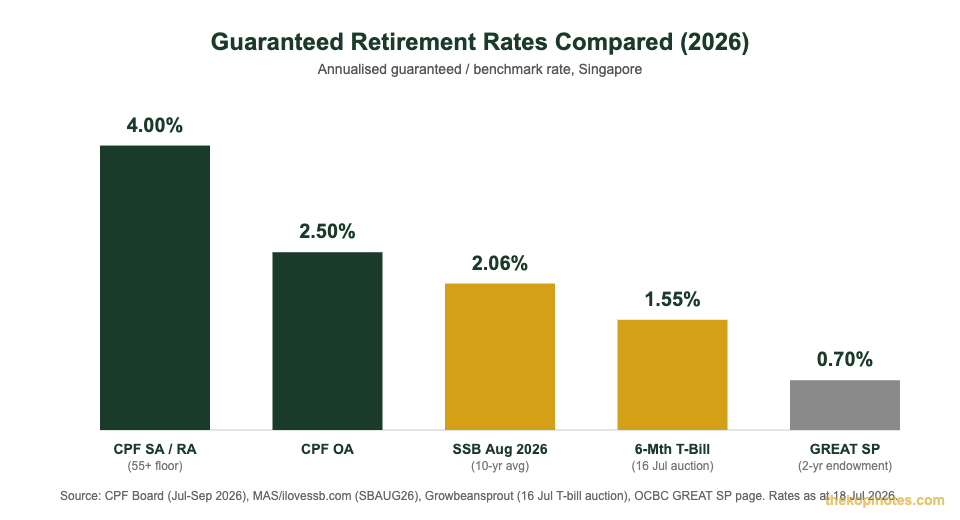
Your Central Provident Fund (CPF) savings are the single best guaranteed retirement return available to Singaporeans and PRs. As at 18 July 2026, the Special, MediSave and Retirement Accounts (SMRA) pay a floor rate of 4% p.a., unchanged from 1 July to 30 September 2026 and extended through 31 December 2026. Your Ordinary Account (OA) pays a floor of 2.5% p.a.
You also earn extra interest on top of the base rate. If you’re below 55, you get an extra 1% on the first $60,000 of your combined balances (OA capped at $20,000). If you’re 55 or older, you get an extra 2% on the first $30,000 and an extra 1% on the next $30,000 (OA also capped at $20,000). That pushes your effective SA/RA rate above 4% on smaller balances.
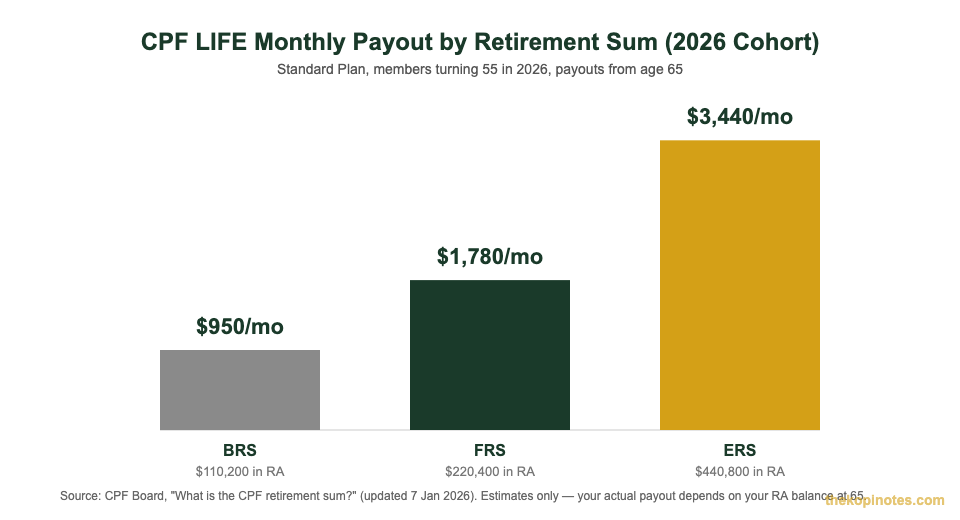
Once you turn 55, your SA (and OA, if needed) transfers into a new Retirement Account up to the Full Retirement Sum (FRS). The table below shows the 2026 retirement sums and CPF Board’s own estimated monthly payouts under the CPF LIFE Standard Plan for members turning 55 this year.
| Retirement Sum (2026) | Amount in RA at 55 | Est. Monthly Payout from 65* |
|---|---|---|
| Basic Retirement Sum (BRS) | $110,200 | $950 |
| Full Retirement Sum (FRS) | $220,400 | $1,780 |
| Enhanced Retirement Sum (ERS) | $440,800 | $3,440 |
*CPF LIFE Standard Plan, estimated for members who turn 55 in 2026 and set aside the respective amount, based on a 4% CPF interest rate. Source: CPF Board, updated 7 January 2026.
Want higher payouts? You can top up your RA up to the current ERS. Cash top-ups to your own or a loved one’s CPF account qualify for tax relief of up to $16,000 a year combined. Read our full breakdown of CPF Special Account interest rates and closure rules for the mechanics of shielding, closure at 55, and how the extra interest tiers actually get credited.
SRS: Tax Savings Today
The Supplementary Retirement Scheme (SRS) isn’t an investment itself — it’s a tax-deferred wrapper. You put cash in, get an immediate tax deduction, and then choose what to invest it in. That’s different from CPF or an endowment plan, where the return is either fixed by the scheme or the insurer.
Singapore Citizens and PRs can contribute up to $15,300 a year. Foreigners can contribute up to $35,700 a year, since they don’t get CPF tax relief. Every dollar you put in reduces your taxable income, subject to the overall $80,000 personal income tax relief cap.
Inside your SRS account, you can hold cash (near-zero return, defeats the purpose), fixed deposits, T-bills, or unit trusts through a platform like Endowus or Syfe. Withdrawals before the statutory retirement age are taxed in full plus a 5% penalty, with some exceptions — see our SRS withdrawal age rules and tax concession guide for the complete breakdown, including the 50% tax concession after your lock-in age.
Singapore Savings Bonds & T-Bills
If you want a government-backed guarantee with more flexibility than CPF, Singapore Savings Bonds (SSB) and Treasury bills (T-bills) are your next stop. Both are backed by the Singapore Government and can be sold or redeemed without a penalty on the principal.
The August 2026 SSB (SBAUG26) pays 1.46% in year one, stepping up each year to 2.72% by year ten — a 10-year average of 2.06%, down slightly from 2.11% the month before. Applications for this issue close 28 July 2026, 9pm. You can redeem an SSB in any month with no penalty, which makes it more flexible than a fixed deposit or endowment plan of the same tenor.
T-bills work differently — you commit for a fixed 6-month or 1-year term and get the return upfront at a discount to face value. The most recent 6-month T-bill auction (16 July 2026, BS26114W) cut off at 1.55%, up from 1.50% at the 2 July auction. That’s currently below the SSB’s 10-year average but similar to its first-year rate.
Guaranteed-Return Endowment Plans
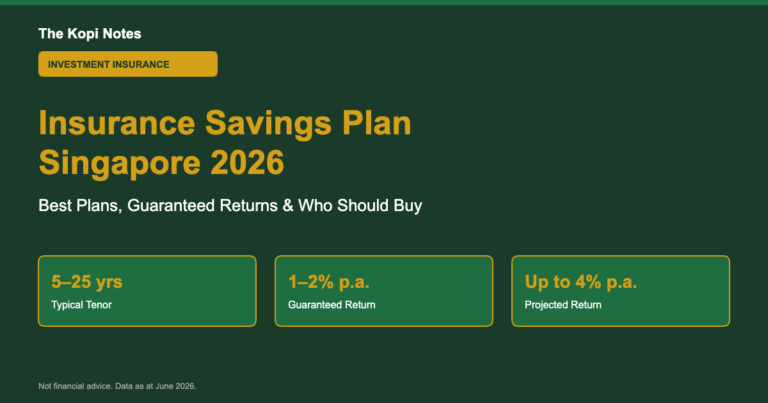
Endowment plans are insurance products that promise to return your capital plus a fixed rate at maturity. They sound safe, and they are — but the guaranteed rate is often lower than what CPF or SSBs already pay you for free.
Take OCBC’s GREAT SP, a 24-month single-premium plan underwritten by Great Eastern. As at 18 July 2026, it guarantees just 0.70% p.a. — well below CPF’s 2.5% OA floor, let alone the 4% SA/RA rate. Some plans also quote a higher “illustrated” or “non-guaranteed” accumulation rate (up to around 3% on GREAT SP) — but that portion isn’t promised and can change.
The minimum outlay for GREAT SP is $10,000 (cash or SRS funds) for ages up to 65. If you die or become totally and permanently disabled during the term, the plan pays 105% of your premium or the surrender value, whichever is higher. Like all life policies here, it’s protected under the Policy Owners’ Protection Scheme administered by SDIC.
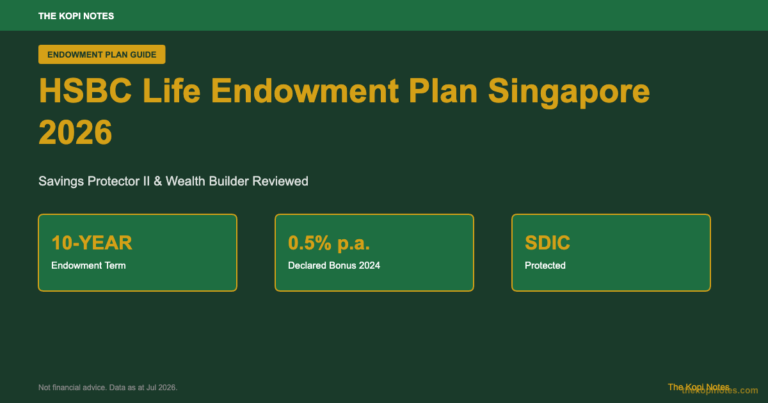
Before buying any endowment plan for retirement, check the guaranteed rate specifically — not the illustrated total — and compare it against CPF and the current SSB rate above. If the guarantee doesn’t beat those, you’re paying for a lock-in period you don’t need. Read our full explainer on how endowment plans work for the mechanics of guaranteed versus non-guaranteed bonuses.
Investment-Linked Policies: Why They Rarely Make the Cut
An investment-linked policy (ILP) bundles life insurance with investment in unit trusts. On paper, that sounds efficient — one product, two goals. In practice, ILPs are usually a weaker choice for retirement investing specifically.
Here’s why. ILPs charge mortality fees (the cost of the insurance component) on top of fund management fees, and many older-style ILPs deduct heavy premium charges in the first few years — sometimes over 50% of your premium in year one. That’s a steep hole to climb out of before your money starts compounding.
There’s also no guaranteed return. Your cash value moves with the underlying funds, so you carry market risk without CPF’s guarantee or a robo-advisor’s lower fee structure. For most people, buying cheap term life insurance separately and investing the rest through SRS or a low-cost robo-advisor works out ahead over 20-plus years.
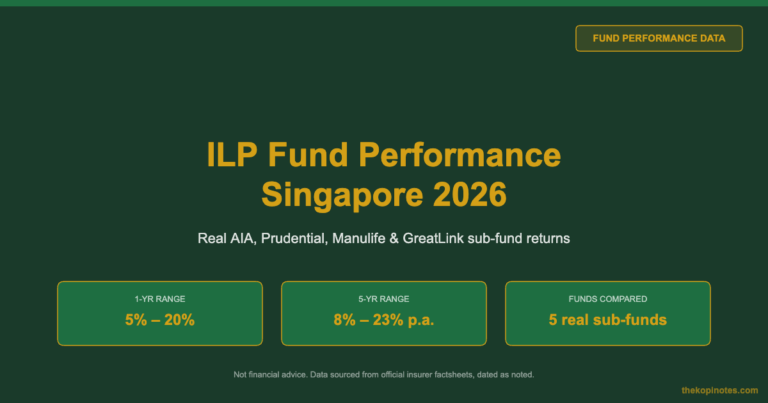
ILPs can still make sense if you know you won’t invest disciplined amounts on your own and want the insurance bundled in. If you’re set on an ILP, compare providers first — see our best ILPs in Singapore 2026 comparison for fee structures across insurers.
Robo-Advisors & DIY Investing for Growth
If your retirement is 10 or more years away, growth matters more than a guarantee. This is where a low-fee robo-advisor comes in, investing your SRS, CPF-OA, or cash in diversified unit trust or ETF portfolios instead of a single fixed-rate product.
Endowus charges 0.40% p.a. for CPF and SRS multi-fund portfolios, and 0.25%–0.60% p.a. for cash portfolios depending on the amount invested. It’s the only major platform that lets you invest your CPF-OA savings alongside SRS and cash in one place. Syfe charges 0.35%–0.65% p.a. with no CPF-OA support, but does accept SRS funds.
| Platform | Fee Range (p.a.) | CPF-OA | SRS | Cash |
|---|---|---|---|---|
| Endowus | 0.25%–0.60% | Yes | Yes | Yes |
| Syfe | 0.35%–0.65% | No | Yes | Yes |
Source: Endowus and Syfe official fee pages, verified 18 July 2026. Underlying fund expense ratios apply on top of the platform fee.
Neither platform guarantees a return, and unlike CPF, SSBs or endowment plans, your balance can fall in a bad year. But over long horizons, a globally diversified equity and bond portfolio has historically outpaced every guaranteed product on this list — the tradeoff is volatility along the way, not a free lunch. See our full best robo-advisors in Singapore comparison for portfolio options and historical performance by risk level.
Side-by-Side Comparison: All 6 Options
| Option | Guaranteed? | Rate / Return | Liquidity | Best For |
|---|---|---|---|---|
| CPF SA/RA top-up | Yes | 4% p.a. | Locked to 55/65 | Guaranteed core retirement income |
| SRS + robo-advisor | No | Market-linked | Locked to statutory age* | Long-horizon growth + tax relief |
| Singapore Savings Bond | Yes | 2.06% (10-yr avg) | Redeem any month, no penalty | Flexible safe parking |
| 6-month T-bill | Yes | 1.55% | Locked 6 months | Short-term guaranteed parking |
| Endowment plan (e.g. GREAT SP) | Yes | 0.70% p.a. | Penalty if surrendered early | Forced savings only if rate beats CPF/SSB |
| Investment-linked policy | No | Market-linked minus fees | High early surrender penalty | Rarely the best pure retirement pick |
*Withdrawals before your SRS statutory retirement age incur full tax plus a 5% penalty, with limited exceptions. Rates verified 18 July 2026 — see sections above for sources.
Worked Example: Allocating S$100,000
Numbers make this concrete. Here’s how two different Singapore savers, both with S$100,000 in spare cash, might split it based on their timeline to retirement.
Saver A, 20 years from retirement: $30,000 as a CPF RA/SA top-up (locked in, earning 4% p.a. guaranteed), $40,000 into SRS invested through Endowus in a globally diversified portfolio, $20,000 in the current SSB for a flexible safety buffer, and $10,000 in a 6-month T-bill for near-term needs. This mix leans into growth while keeping a guaranteed floor.
Saver B, 4 years from retirement: $50,000 as a CPF top-up if not yet at FRS, $30,000 laddered across SSBs and T-bills for capital preservation, and $20,000 kept liquid in a high-yield savings account for near-term needs. At this stage, protecting capital matters more than chasing growth.
Neither allocation is a universal rule — your own mix depends on your CPF balance, risk tolerance, and how much liquidity you need before age 55 or 65.
How to Choose by Years to Retirement
| Years to Retirement | Suggested Emphasis |
|---|---|
| 15+ years | Max out CPF top-up tax relief, then prioritise SRS + robo-advisor for growth. SSB/T-bills only for your near-term buffer. |
| 5–15 years | Balance CPF top-ups, a moderate-risk SRS portfolio, and a growing SSB/T-bill ladder as your timeline shortens. |
| Under 5 years | Shift toward SSB, T-bills, and CPF. Avoid new market-linked commitments you can’t ride out a downturn in. |
5 Common Mistakes to Avoid
1. Ignoring CPF top-ups first. Many people chase a 2–3% endowment plan while their CPF SA/RA — already paying 4% guaranteed — sits under-topped-up.
2. Confusing “illustrated” with “guaranteed” returns. An endowment plan’s guaranteed rate might be 0.7% while the illustrated total assumes a non-guaranteed 3% bonus. Always ask for the guaranteed-only figure.
3. Locking up money you’ll need before 55 or 65. CPF top-ups can’t be undone. Only commit what you’re sure you won’t need for daily expenses, a home, or emergencies.
4. Buying an ILP purely as an “investment.” If retirement growth is your only goal, separate term insurance plus SRS or a robo-advisor usually beats a bundled ILP after fees.
5. Comparing rates without matching tenor. A 2-year endowment plan’s rate isn’t directly comparable to a 10-year SSB average — match the timeframes before deciding which one actually wins.
Frequently Asked Questions
What is the single best investment plan for retirement in Singapore?
There’s no single best plan — it depends on your timeline. CPF SA/RA top-ups offer the best guaranteed rate (4% p.a.) but lock your money until 55 or 65. If you have 10 or more years and want growth, pairing SRS with a low-fee robo-advisor like Endowus or Syfe is usually the stronger long-term choice.
Is CPF or SRS better for retirement?
They’re complementary, not competing. CPF gives you a guaranteed 4% (SA/RA) or 2.5% (OA) return with a life annuity at the end via CPF LIFE. SRS gives you a tax deduction today and lets you choose your own investments, including higher-growth options. Most people should use both.
Are endowment plans a good investment for retirement?
Only if the guaranteed rate beats your alternatives for the same tenor. As at July 2026, guaranteed-return endowment plans like OCBC’s GREAT SP pay around 0.70% p.a. — below CPF’s 2.5–4% and often below the SSB. Check the guaranteed (not illustrated) rate before buying.
Should I buy an investment-linked policy (ILP) for retirement?
Usually not as your primary retirement investment. ILPs charge mortality and fund management fees on top of market risk, with no guaranteed return. Separating term life insurance from your investments — via SRS or a robo-advisor — is typically cheaper and more transparent.
What is the CPF Special Account interest rate in 2026?
The Special, MediSave and Retirement Accounts (SMRA) pay a floor rate of 4% p.a., unchanged from 1 July to 30 September 2026 and extended through 31 December 2026. You also earn extra interest of 1–2% on top, depending on your age and balance.
How much can I contribute to SRS in 2026?
Singapore Citizens and PRs can contribute up to $15,300 a year. Foreigners can contribute up to $35,700 a year, since they don’t receive CPF tax relief. Contributions reduce your taxable income, subject to the $80,000 overall personal tax relief cap.
Is a robo-advisor safe for retirement savings?
Robo-advisors like Endowus and Syfe invest your money in regulated, diversified unit trusts or ETFs — they’re not a scam or unregulated product. But they carry market risk: unlike CPF or an SSB, your balance isn’t guaranteed and can fall in value, especially over shorter periods.
What's the difference between a Singapore Savings Bond and a T-bill?
An SSB lets you redeem in any month with no penalty and its rate steps up over 10 years. A T-bill locks your money for a fixed 6-month or 1-year term at a set rate, with no early redemption. T-bills currently offer a similar or slightly higher rate over their shorter term.
How much monthly income will CPF LIFE give me?
For members turning 55 in 2026, CPF Board estimates a Standard Plan payout from age 65 of about $950/month at the Basic Retirement Sum ($110,200), $1,780/month at the Full Retirement Sum ($220,400), or $3,440/month at the Enhanced Retirement Sum ($440,800).
Can foreigners in Singapore invest for retirement the same way?
Foreigners don’t get CPF (unless employed and contributing) but can open an SRS account with a higher $35,700 annual cap, invest through Endowus or Syfe, and buy SSBs or T-bills, which have no citizenship restriction.
Ready to Start?
Invest your SRS or cash with a low-fee robo-advisor, or plan your CPF payouts with our free calculator.
Get Free Insurance Advice
Speak with a licensed insurance advisor. No obligation, no cost.
By submitting this form, you agree to our Privacy Policy.
This article was researched with the help of AI. While we strive to keep all information accurate and up to date, there may be errors. If you notice any discrepancies, please contact us.