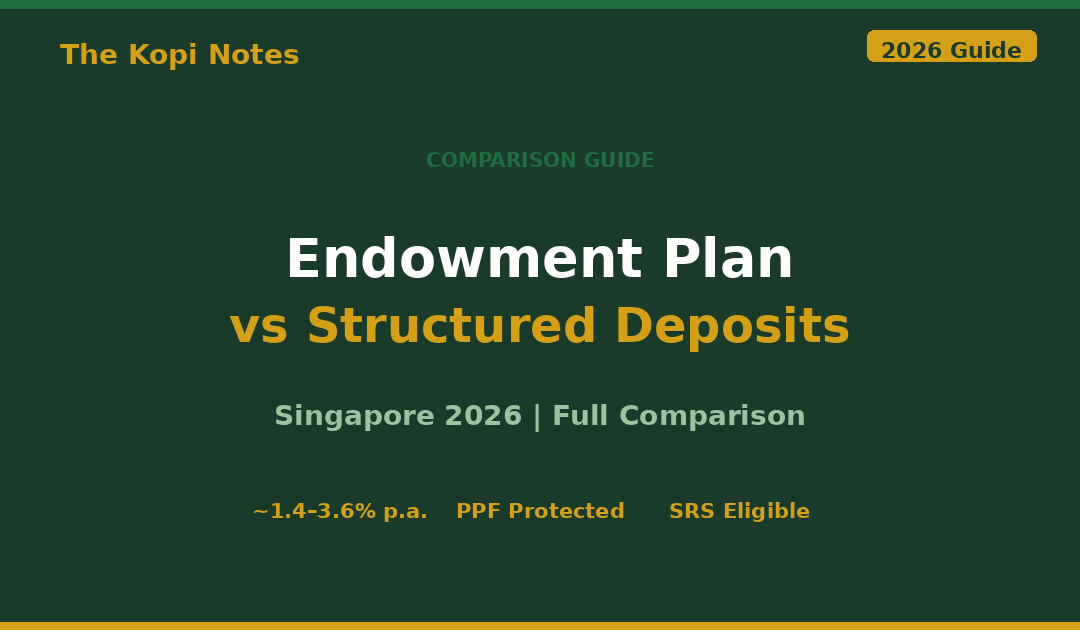
Endowment Plan vs Structured Deposits Singapore 2026
Both promise capital protection and predictable returns. But which one actually delivers more — and which carries hidden risks? We break it down for you.
Data verified as at 2026-08-24. Rates are indicative; verify current tranches before committing. This is not financial advice.
What Is an Endowment Plan?
An endowment plan is a life insurance savings product sold by licensed Singapore insurers (Manulife, NTUC Income, Great Eastern, Prudential, AIA, etc.). You pay a single premium or regular premiums over a set policy term — typically 2 to 5 years for short-term plans — and receive a guaranteed maturity benefit at the end.
Short-term single premium endowment plans offer:
- Guaranteed returns locked in at policy inception — no market risk on the guaranteed portion
- Life insurance coverage (typically 100–105% of premium paid) during the policy term
- Policy Owners’ Protection (PPF) Scheme coverage administered by SDIC
- SRS eligibility in many cases — useful for reducing taxable income
Endowment plans are regulated by MAS as life insurance products and must follow LIA (Life Insurance Association Singapore) guidelines on policy illustration and fair disclosure.
What Is a Structured Deposit?
A structured deposit is a bank product combining a fixed deposit with a derivative component. The principal-protected portion guarantees your capital back at maturity (if held to term), while the variable component links your return to a reference asset — such as an FX exchange rate, SORA, equity index, or commodity price.
Key features of structured deposits in Singapore:
- Capital protection only if held to maturity — early redemption can result in capital loss
- Offered by licensed banks: DBS, OCBC, UOB, Standard Chartered, CIMB, etc.
- Most structured deposits with investment/derivative components are NOT covered by the standard Deposit Insurance (DI) Scheme under SDIC — always check the Key Facts Statement
- Returns can be partly or fully variable depending on the product structure
- Regulated by MAS as hybrid banking products under the Banking Act
The simplest structured deposits for retail investors are “principal-guaranteed” products offering a guaranteed floor rate plus potential upside linked to a reference rate or index.
Side-by-Side Comparison
| Feature | Endowment Plan | Structured Deposit |
|---|---|---|
| Provider | Licensed life insurer | Licensed bank |
| Typical Tenor | 2–5 years | 3 months – 3 years |
| 2026 Guaranteed Returns | ~1.4–3.6% p.a. | Variable; principal-guaranteed products ~3.1% p.a. |
| Capital Protection | Yes (guaranteed sum assured) | Yes — only if held to maturity |
| Life Coverage | Yes (100–105% of premium) | No |
| SDIC/PPF Protection | Yes — PPF covers up to S$100,000 maturity value; S$500,000 death benefit | Most structured deposits excluded from DI scheme — check KFS with bank |
| SRS Eligible | Many plans: Yes | Some products: Yes |
| CPFIS Eligible | Some plans: Yes (OA/SA) | Generally: No |
| Early Exit | Surrender value below premium | May result in capital loss |
| Tax on Returns | Tax-free in Singapore | Tax-free in Singapore |
Returns Comparison 2026
Endowment Plans — Current Tranches (Aug 2026)
| Plan | Insurer | Tenor | Guaranteed Yield | Potential Yield |
|---|---|---|---|---|
| GREAT SP Series 5A | Great Eastern | 2 years | 2.60% p.a. | 2.60% p.a. |
| Manulife Goal 2026 (I) | Manulife | 2 years | 1.44% p.a. | Up to 1.88% p.a. |
| NTUC Income (prior tranche) | NTUC Income | 3 years | 3.55% p.a. | 3.55% p.a. (tranche closed) |
Sources: Manulife.com.sg, GreatEasternLife.com, MoneySmart.sg. Rates as at August 2026. Tranche availability changes frequently.
Structured Deposits — Current Market (Aug 2026)
| Product | Bank | Tenor | Guaranteed Return | Variable Upside |
|---|---|---|---|---|
| Principal Guaranteed SD 2026 – Series 1 | UOB | 2 years | 3.11% p.a. | None (fixed guarantee) |
| Market-linked structured deposits | DBS / OCBC / UOB | 3–12 months | ~0–1% p.a. floor | Linked to FX, index, or rates |
Sources: UOB.com.sg, OCBC.com. Rates as at August 2026. Subject to tranche availability.
Key takeaway: On a like-for-like basis (capital-protected, 2-year tenor), UOB’s principal-guaranteed structured deposit at 3.11% p.a. is competitive with most available endowment plan tranches. However, when high-yield endowment tranches are open — such as NTUC Income’s 3.55% p.a. — endowment plans win on guaranteed return. The comparison is tranche-dependent; always check current offerings before deciding.
SDIC/PPF Protection: The Critical Difference
Endowment Plans → Covered under PPF Scheme
Life insurance policies, including endowment plans, are covered under the Policy Owners’ Protection (PPF) Scheme administered by SDIC. If a licensed life insurer fails, PPF covers:
- Up to S$500,000 for death and total permanent disability (TPD) benefits
- Up to S$100,000 for surrender and maturity benefits per policy per insurer
For most retail investors placing S$10,000–S$100,000 in a short-term endowment plan, the maturity value is fully covered under PPF. This is a meaningful layer of safety that structured deposits typically do not provide.
Structured Deposits → Coverage Varies; Most Excluded
Standard bank deposits (savings, current, fixed deposits) are protected under the Deposit Insurance (DI) Scheme up to S$100,000 per depositor per bank. However, structured deposits with investment or derivative components are generally not covered under the DI scheme — they sit in a regulatory grey zone between deposits and investment products.
Always read the Key Facts Statement (KFS) for any structured deposit. It will explicitly state whether the product is DI-covered. If it isn’t, your principal has no SDIC safety net in the event of bank insolvency.
SRS & CPF Eligibility
Supplementary Retirement Scheme (SRS)
Most short-term endowment plans accept SRS funds — this is explicitly stated in the product brochure. Using SRS money to buy an endowment plan means you reduce taxable income in the year of contribution AND earn guaranteed returns on the invested amount. For working Singapore taxpayers in higher marginal tax brackets, the SRS top-up plus endowment combination is one of the most tax-efficient savings strategies available.
Some structured deposits also accept SRS funds, but availability is more limited and minimum placement amounts tend to be higher. If SRS eligibility is a priority, endowment plans are more reliably SRS-friendly across the market.
CPF Investment Scheme (CPFIS)
A small number of endowment plans qualify under the CPF Investment Scheme (CPFIS-OA or CPFIS-SA). This typically applies to longer-tenor participating plans rather than 2-year single premium products. Check the CPF Board’s approved investment product list for up-to-date eligibility.
Structured deposits are generally not eligible for CPFIS investment.
Liquidity & Early Withdrawal
Neither product is suited for money you may need before the maturity date. But exit mechanics differ in important ways.
Endowment Plans
Surrendering an endowment plan before maturity gives you the surrender value, which is typically below the premium paid — particularly in the first year or two. For a 2-year plan surrendered after 12 months, you may receive only 80–95% of your premium back. The exact surrender schedule must be disclosed in your policy illustration at inception, so there are no surprises if you read the documents carefully.
Structured Deposits
Early redemption of a structured deposit can result in partial or full capital loss. The capital protection guarantee applies only at maturity. The derivative component must be unwound at prevailing market prices, which may be unfavourable to you — particularly if you exit during a period of rising interest rates or adverse FX moves.
Bottom line: Treat both products as lock-up savings vehicles. For liquidity, look at high-yield savings accounts, T-Bills, or money market funds instead.
Who Should Choose What?
Choose an endowment plan if:
- You want life insurance coverage alongside guaranteed savings growth
- You have SRS funds and want guaranteed, tax-efficient returns
- You want clear PPF/SDIC protection on the maturity value up to S$100,000
- You’re planning for retirement and want a fixed return to model against your retirement planning goals
- The available tranche rate (e.g. 2.6–3.55% p.a.) is competitive with current alternatives
Choose a structured deposit if:
- You have a larger lump sum (S$25,000+) and want exposure to potential upside if rates or markets move in your favour
- You don’t need life insurance coverage and prefer a simpler bank product
- The guaranteed floor rate on a principal-guaranteed structured deposit beats available endowment tranches for the same tenor
- You’ve verified DI coverage status and are comfortable with the regulatory differences
Neither product suits you if: you need liquidity within the tenor. Both penalise early exit. For short-term cash, see our endowment plan interest rates guide for a wider comparison across alternatives including T-Bills and savings accounts.
Want Managed Returns Without Tranche-Hunting?
If comparing individual product tranches every few months feels exhausting, consider a managed income platform. Endowus (referral code: 2V343) and Syfe (referral code: SRPRFFFCD) both offer diversified income portfolios targeting 4–6% p.a. net returns across investment-grade bonds and income funds — with daily liquidity, no lock-in, and no need to chase tranches.
Frequently Asked Questions
Is an endowment plan safer than a structured deposit?
Generally yes — from a regulatory protection standpoint. Endowment plans are covered under the Policy Owners’ Protection (PPF) Scheme via SDIC, with maturity values protected up to S$100,000 per policy per insurer. Most structured deposits with investment or derivative components are excluded from the standard Deposit Insurance Scheme. Both carry early-exit risk, but for insolvency protection, endowment plans have a clearer safety net.
Which offers higher returns in 2026 — endowment plan or structured deposit?
It depends on which tranches are currently open. In August 2026, UOB’s principal-guaranteed structured deposit (3.11% p.a., 2-year) is competitive with or beats many endowment plan tranches (e.g. Manulife Goal 2026 at ~1.44% p.a.). But when top endowment tranches like NTUC Income’s 3.55% p.a. are open, they lead on guaranteed returns. Always compare current live offerings — the market changes every few weeks.
Can I use SRS funds for both products?
Many short-term endowment plans accept SRS funds — this is stated explicitly in the product brochure. Some bank structured deposits also accept SRS, but availability is more limited and minimums are higher. For most retail investors, endowment plans are the more reliably SRS-accessible option. If SRS eligibility is critical to your decision, confirm with the product provider before purchasing.
What happens if I need to exit early?
For endowment plans, early surrender returns the surrender value, which is typically below the premium paid — especially in year 1. The exact schedule is disclosed in your policy illustration before signing. For structured deposits, early redemption can result in partial or full capital loss, as the derivative component is unwound at market prices. Capital protection only applies at maturity. Neither product is suitable for money you may need during the investment period.
Are returns taxable in Singapore?
No. Singapore does not levy capital gains tax or tax on investment returns for individual investors. Maturity benefits from endowment plans and interest/returns from structured deposits are both received tax-free. If you fund either product using SRS money, withdrawals at age 62 or later receive a 50% tax concession on the amount withdrawn — a separate consideration from the product returns themselves.
Is a principal-guaranteed structured deposit the same as a fixed deposit?
No. While a principal-guaranteed structured deposit protects your capital at maturity, it differs from a fixed deposit in key ways: the return has a variable component; it is generally not covered by the Deposit Insurance Scheme; minimum placement amounts are typically higher; and early exit can cause capital loss. A fixed deposit, by contrast, has a fixed predetermined interest rate, is DI-covered up to S$100,000, and can usually be broken early with an interest penalty but no capital loss.
What is the minimum investment for each?
Short-term single premium endowment plans typically start at S$10,000 (e.g. Great Eastern GREAT SP, Manulife Goal 2026 — both accept cash or SRS funds from S$10,000). Structured deposits generally require higher minimums — S$25,000 to S$50,000 for most retail products, with some private banking structured deposits starting at S$100,000 or more. For smaller lump sums, endowment plans are more accessible.
Can I hold both an endowment plan and a structured deposit?
Yes. There is no regulatory restriction on holding both simultaneously, provided you meet each product’s minimum amount and eligibility requirements. Some Singapore investors split their capital — placing one portion in an endowment plan for PPF protection and life coverage, and another in a structured deposit for competitive guaranteed returns when available. This approach diversifies counterparty risk (insurer vs bank) while maintaining capital protection across both tranches.
How do these compare to T-Bills and fixed deposits?
Singapore 6-month T-bills in August 2026 yield approximately 2.5–2.8% p.a. (rates vary by auction). Bank fixed deposits from major banks offer around 1.1–2.0% p.a. for standard tenors. Short-term endowment plans offering 2.6–3.55% p.a. can outperform both — but require a longer lock-up (2–3 years vs 6 months for T-bills). For a full comparison across all options, see our endowment plan interest rates guide.
Get Free Insurance Advice
Speak with a licensed insurance advisor. No obligation, no cost.
By submitting this form, you agree to our Privacy Policy.
This article was researched with the help of AI. While we strive to keep all information accurate and up to date, there may be errors. If you notice any discrepancies, please contact us.