Singapore Insurance Savings Plan 2026: Best Plans, Returns & Complete Buyer’s Guide
Updated June 2026 · 8 min read
A Singapore insurance savings plan (ISP) is a participating whole life or endowment-based policy that blends capital protection with medium-term savings growth. You pay regular premiums over 5–25 years, earn a guaranteed return of 2.0–2.25% per annum, and receive projected (non-guaranteed) bonuses of 4.0–4.75% p.a. from the insurer’s participating fund. Your capital is protected as long as you hold to maturity — making ISPs a popular alternative to fixed deposits and Singapore Savings Bonds for disciplined savers.
Not financial advice. All figures are for educational reference only. Data as at June 2026 unless noted.
- ISPs offer 2.0–2.25% guaranteed + up to 4.75% projected annual returns with capital protection at maturity
- Best for disciplined savers who can lock up funds for 5–25 years and want a structured savings habit
- Use SRS contributions to fund your ISP and get an extra 14–24% tax relief on every dollar saved
Table of Contents
Jump to Section
- What Is a Singapore Insurance Savings Plan?
- How ISPs Work: Par Fund, Bonuses & Guarantees
- Best Singapore Insurance Savings Plans 2026
- Returns Comparison: ISP vs Other Savings Options
- SRS Tax Strategy: Turbocharge Your ISP Returns
- Who Should Buy an Insurance Savings Plan?
- How to Buy: 6-Step Buying Guide
- Frequently Asked Questions
What Is a Singapore Insurance Savings Plan?
A Singapore insurance savings plan is a regulated financial product sold by MAS-licensed life insurers. It combines a small life insurance component with a structured savings wrapper — so you get a death benefit while your premiums grow over time inside the insurer’s participating (par) fund.
Think of it as a forced savings account that also happens to come with some insurance coverage. You commit to paying a set premium every month or year, and in return you get:
- A guaranteed maturity value (you know the minimum you’ll receive at the end)
- Projected bonuses from the par fund (not guaranteed, but historically reliable)
- A death benefit if you pass away during the policy term
- Capital protection — you won’t lose your money if you hold to maturity
ISPs are different from investment-linked policies (ILPs), which put your money into sub-funds exposed to market risk. With an ISP, the insurer manages the par fund and smooths out returns — so you don’t see wild swings year to year.
How ISPs Work: Par Fund, Bonuses & Guarantees
Understanding how your money grows inside an ISP helps you compare plans more effectively. Here’s the mechanics in plain language.
The Participating Fund
Your premiums go into the insurer’s participating fund. This is a pooled investment portfolio that typically holds 60–80% bonds and 20–40% equities. The insurer invests conservatively because it needs to honour guaranteed returns across all policyholders.
The par fund earns investment returns, and a portion is distributed to you as bonuses. MAS requires insurers to disclose par fund performance annually — look for the illustration discount rate in your policy document.
Reversionary Bonus vs Terminal Bonus
ISPs pay two types of bonuses:
- Reversionary bonus: declared annually and added to your policy’s sum assured. Once added, it’s guaranteed — you keep it even if the insurer’s future performance drops
- Terminal bonus: paid only at maturity or claim. It’s not guaranteed — the insurer can adjust it based on par fund performance
In a good year, the terminal bonus can be substantial. In a bad year (like 2020–2021), insurers cut it significantly. That’s why projected returns are always higher than guaranteed — they assume the terminal bonus comes through.
Surrender Value
If you cancel your ISP early, you get the surrender value — which is typically lower than your total premiums paid in the first 5–7 years. Early surrender is expensive. For example, surrendering a 10-year ISP in year 3 might return only 60–70% of premiums paid.
| Year of Surrender | Typical Surrender Value (% of premiums) | What You Lose |
|---|---|---|
| Year 1–2 | 0–50% | Upfront costs, agent commissions |
| Year 3–5 | 60–80% | Par fund growth not yet credited |
| Year 6–8 | 85–95% | Terminal bonus not yet paid |
| At maturity | 100%+ (full maturity benefit) | Nothing — you receive full value |
Source: MAS par fund disclosure guidelines; insurer product illustrations, June 2026
Best Singapore Insurance Savings Plans 2026
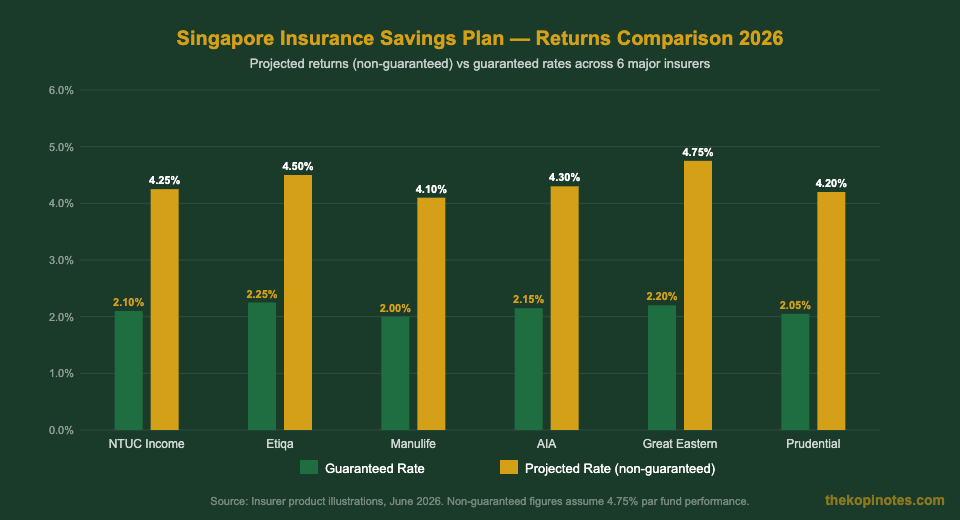
We compared the six most widely sold ISPs in Singapore across guaranteed returns, projected returns, minimum premium, and flexibility. All figures are from insurer product illustrations as at June 2026.
| Insurer / Plan | Guaranteed Return | Projected Return | Min Premium | Policy Term |
|---|---|---|---|---|
| NTUC Income Gro Saver Flex Pro | 2.10% | 4.25% | S$100/mth | 5–30 years |
| Etiqa Tiq Save | 2.25% | 4.50% | S$200/mth | 10–25 years |
| Manulife ReadyBuilder | 2.00% | 4.10% | S$150/mth | 5–25 years |
| AIA Wealth Pro Advantage | 2.15% | 4.30% | S$200/mth | 10–30 years |
| Great Eastern GREAT Wealth Advance | 2.20% | 4.75% | S$300/mth | 10–25 years |
| Prudential PRUActive Saver III | 2.05% | 4.20% | S$200/mth | 10–30 years |
Source: Insurer product illustrations, June 2026. Projected returns non-guaranteed; assume 4.75% par fund return scenario.
For the highest guaranteed rate, Etiqa Tiq Save leads at 2.25% p.a. If you’re comfortable with some variability, Great Eastern GREAT Wealth Advance has the highest projected return at 4.75% — though it requires S$300/month minimum. NTUC Income’s Gro Saver Flex Pro is popular for its low S$100/month entry point and flexible tenors from just 5 years.
Returns Comparison: ISP vs Other Singapore Savings Options
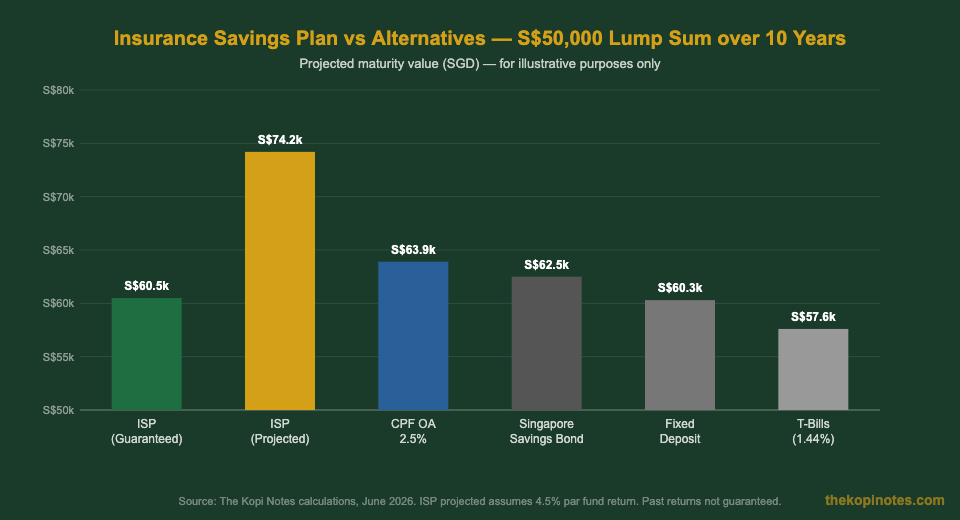
How does a Singapore insurance savings plan stack up against the alternatives? Here’s a direct comparison for a S$50,000 lump sum held for 10 years.
| Product | Return p.a. | S$50k After 10 Yrs | Capital Guaranteed? | SRS Eligible? |
|---|---|---|---|---|
| ISP (Guaranteed) | 2.10% | S$61,200 | ✓ Yes | ✓ Yes |
| ISP (Projected) | 4.50% | S$77,800 | ✓ At maturity | ✓ Yes |
| CPF OA | 2.50% | S$63,900 | ✓ Government | ✗ No |
| Singapore Savings Bonds | ~2.50% | S$63,900 | ✓ Government | ✗ No |
| Fixed Deposit (12-mth) | ~2.00% | S$61,000 | ✓ SDIC S$100k | ✗ No |
| T-Bills (Jun 2026) | 1.44% | S$57,600 | ✓ Government | ✗ No |
Source: The Kopi Notes calculations, June 2026. ISP projected assumes 4.5% long-run par fund return. Illustrative only.
The key insight: ISPs’ projected returns (4.25–4.75% p.a.) significantly outpace Singapore T-bills at 1.44% and even CPF OA at 2.5%. Even the guaranteed side beats current T-bill yields.
The trade-off is liquidity. T-bills and SSBs let you access your money quickly. An ISP locks you in — early surrender means taking a real loss. For money you won’t need for 10+ years, an ISP beats most alternatives on a risk-adjusted basis. For your emergency fund, stick to a high-yield savings account or SSB.
SRS Tax Strategy: Turbocharge Your ISP Returns
Here’s a strategy many Singapore savers overlook: funding your ISP with Supplementary Retirement Scheme (SRS) contributions. Every dollar you put into SRS reduces your chargeable income by one dollar — giving you immediate tax savings of 7–24% depending on your bracket.
You then use those SRS funds to pay your ISP premiums. Most major insurers accept SRS as a payment method for their savings plans.
| Annual Income | Marginal Tax Rate | SRS Cap (SG/PR) | Tax Saved Per Year |
|---|---|---|---|
| S$60,000 | 7% | S$15,300 | ~S$1,070 |
| S$80,000 | 11.5% | S$15,300 | ~S$1,760 |
| S$120,000 | 15% | S$15,300 | ~S$2,295 |
| S$200,000+ | 19.5–24% | S$15,300 | ~S$2,980–S$3,672 |
Source: IRAS Singapore tax brackets 2026; CPF Board SRS contribution limits 2026
Concrete example: you earn S$120,000. You contribute S$15,300 to SRS and use it for your ISP premium. You save S$2,295 in tax immediately. That upfront saving effectively adds ~1% to your overall annual return on top of the ISP’s projected 4.5%.
To calculate your exact SRS savings, try our SRS Tax Savings Calculator. Model how ISPs fit into your retirement with our Singapore retirement calculator.
Who Should Buy a Singapore Insurance Savings Plan?
ISPs are not for everyone. Here’s an honest framework to decide.
| Profile | Verdict | Why |
|---|---|---|
| Disciplined saver, 5–20 yr horizon | ✓ Strong Buy | Guaranteed capital + projected returns beat most fixed-income alternatives |
| SRS account holder, medium income | ✓ Strong Buy | Tax relief + ISP growth = significantly boosted effective return |
| Parent saving for child’s education | ✓ Suitable | Long tenor + capital guarantee matches education funding timeline |
| Risk-averse retiree seeking income | ⚠ Consider Alternatives | SSB or CPF LIFE may offer better liquidity without lock-in |
| Young investor, high risk tolerance | ⚠ Not Ideal | S-REITs or ETFs offer higher long-run returns without the penalty |
| Emergency fund / short-term savings | ✗ Avoid | High early surrender penalties — use a savings account instead |
Source: The Kopi Notes analysis, June 2026. Not personalised financial advice.
If you have a higher risk appetite, consider pairing an ISP with dividend-paying S-REITs or a Singapore REIT ETF for equity exposure alongside your guaranteed savings core.
How to Buy a Singapore Insurance Savings Plan: 6-Step Guide
Ready to get started? Follow these steps to buy an ISP the right way.
- Audit your finances first. Make sure your emergency fund covers 3–6 months of expenses before committing. You need confidence you won’t need to surrender early.
- Choose between SRS or cash premiums. If you have an SRS account, using SRS funds to pay premiums gives you immediate tax benefits. Try the SRS Tax Savings Calculator to see your exact savings.
- Compare at least 3 plans. Use the comparison table above as a starting point. Request product illustrations from at least 3 insurers to see the guaranteed and projected maturity values in writing.
- Check the par fund track record. MAS requires insurers to publish par fund performance annually. Ask for the last 5 years of par fund returns before committing.
- Buy through a fee-transparent channel. Options include an insurance agent, independent financial adviser (IFA), or directly online. Platforms like Endowus (code 2V343) and Syfe (code SRPRFFFCD) offer access to insurance savings products with transparent fee structures.
- Review annually. Once set up, review your ISP each year alongside your CPF investment strategy to ensure it still fits your goals. Use our passive income Singapore guide to see how ISPs fit your broader portfolio.
Start Your Insurance Savings Plan Today
Use these referral codes for sign-up bonuses on digital investment platforms:
Frequently Asked Questions
What is a Singapore insurance savings plan and how is it different from a regular savings account?
Are Singapore insurance savings plans safe? Is my capital guaranteed?
What is the difference between guaranteed and projected returns on an ISP?
Can I use SRS funds to pay for a Singapore insurance savings plan?
What happens if I surrender my ISP early?
How do ISPs compare to endowment plans in Singapore?
What is the minimum amount to start an insurance savings plan in Singapore?
Which Singapore insurance savings plan has the highest return in 2026?
Should I buy an ISP or invest in S-REITs or ETFs instead?
Get Free Insurance Advice
Speak with a licensed insurance advisor. No obligation, no cost.
By submitting this form, you agree to our Privacy Policy.
This article was researched with the help of AI. While we strive to keep all information accurate and up to date, there may be errors. If you notice any discrepancies, please contact us.