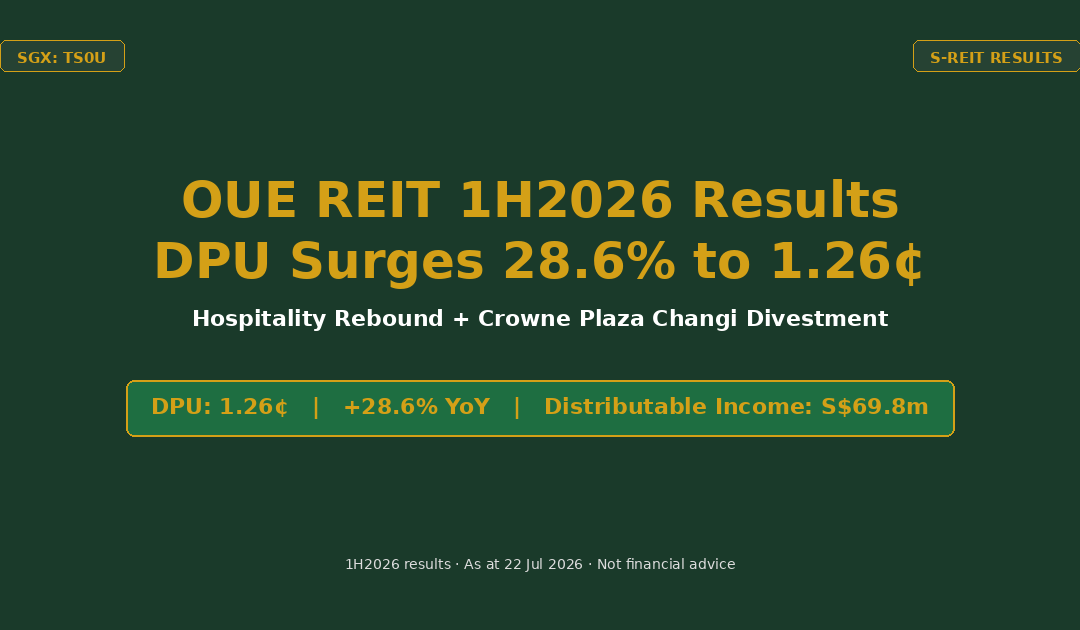
OUE REIT 1H2026 Results: DPU Surges 28.6% to 1.26 Cents on Hospitality Rebound (SGX: TS0U)
Distributable income jumped 28.6% and finance costs fell 16.6% — plus what the S$500m Crowne Plaza Changi Airport sale means for unitholders.
OUE REIT (SGX: TS0U) reported 1H2026 distribution per unit (DPU) of 1.26 Singapore cents, up 28.6% year-on-year, as distributable income rose to S$69.8 million and finance costs fell 16.6%. Hilton Singapore Orchard’s hospitality income and the pending S$500 million sale of Crowne Plaza Changi Airport were the two biggest swing factors.
Not financial advice. All figures are for educational reference only. Data as at 22 July 2026 unless noted.
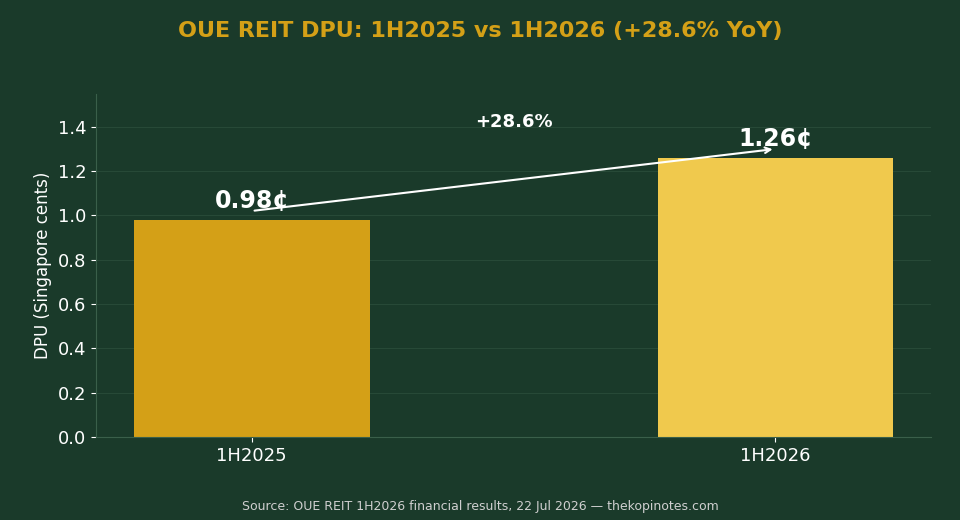
- 1H2026 DPU came in at 1.26 cents, up 28.6% year-on-year from 0.98 cents — distributable income rose to S$69.8m while finance costs fell 16.6% to S$37.8m.
- OUE REIT is selling Crowne Plaza Changi Airport for S$500m, unlocking S$498m net cash and cutting leverage by roughly 5 percentage points once completed.
- Gearing held steady at 41.5% and NAV per unit stayed at S$0.56 — at a recent price of S$0.38, that’s a meaningful discount to book value.
Table of Contents
Contents — Click to expand
- 1H2026 Results at a Glance
- What’s Driving the 28.6% DPU Growth
- Hilton Singapore Orchard: The Hospitality Engine
- The Crowne Plaza Changi Airport Divestment, Explained
- Balance Sheet and Capital Management
- Salesforce Tower Sydney: A New Growth Segment
- Portfolio Diversification and Sector Outlook
- OUE REIT Share Price and Yield: Still Worth Buying?
- How to Buy OUE REIT Units in Singapore
- FAQ
1H2026 Results at a Glance
OUE REIT released its 1H2026 financial results on 22 July 2026, covering the six months to 30 June. Here’s the headline income statement, compared with the same period last year.
| Metric | 1H2025 | 1H2026 | YoY |
|---|---|---|---|
| Revenue | S$131.1m | S$136.1m | +3.8% |
| Net Property Income | S$105.3m | S$110.3m | +4.8% |
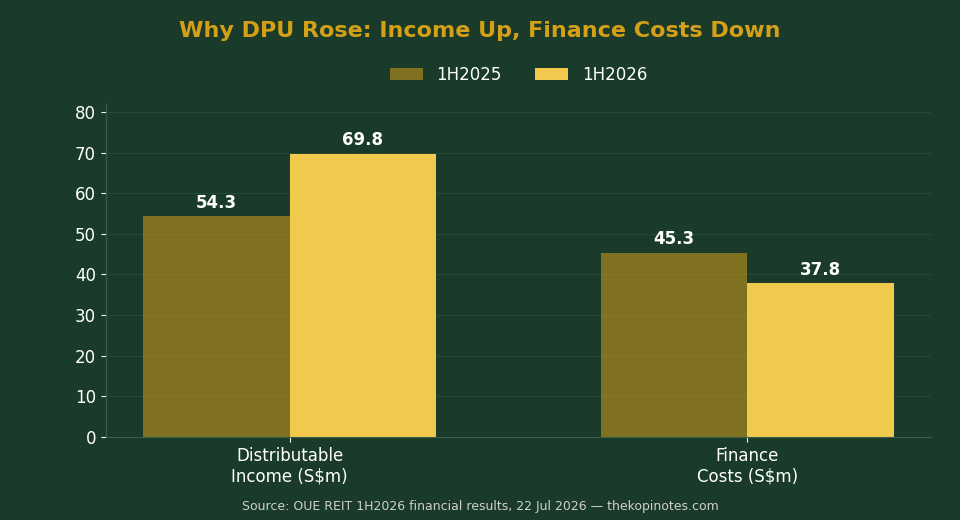
| Finance Costs | S$45.3m | S$37.8m | -16.6% |
| Distributable Income | S$54.3m | S$69.8m | +28.6% |
| DPU | 0.98¢ | 1.26¢ | +28.6% |
Source: OUE REIT 1H2026 financial results, 22 July 2026
Two numbers stand out here. Revenue and net property income — basically rental income after property expenses — both grew a modest single digit. But distributable income and DPU jumped nearly 29%. That gap is the story of this results release: it’s not really about rental growth. It’s about what happened below the operating line.
Finance costs fell 16.6% to S$37.8 million, thanks to a lower weighted average cost of debt (3.6% p.a., down from 3.7%) and proactive refinancing. That single line item explains most of the DPU jump — we’ll break down the maths in the next section.
What’s Driving the 28.6% DPU Growth
Two things did the heavy lifting. Distributable income rose S$15.5 million (from S$54.3m to S$69.8m), and finance costs fell S$7.5 million (from S$45.3m to S$37.8m). Combined, that’s why DPU grew almost 29% on revenue growth of under 4%.
The 1H2026 distribution of 1.26 cents per unit is made up of 1.00 cent taxable income and 0.26 cent tax-exempt income. Here’s the breakdown, so you know exactly what you’re being paid for:
| Component | Cents per Unit |
|---|---|
| Taxable income | 1.00¢ |
| Tax-exempt income | 0.26¢ |
| Total DPU | 1.26¢ |
Source: OUE REIT 1H2026 financial results, 22 July 2026. Exact book closure and payment dates were not detailed in the results summary reviewed — check SGXNet or OUE REIT’s investor relations page before the payout.
Unlike some S-REITs propping up DPU with capital distributions, OUE REIT’s growth this half is fully income-backed — it comes from stronger property income plus genuinely lower borrowing costs, not from returning capital to unitholders.
Hilton Singapore Orchard: The Hospitality Engine
OUE REIT runs a “barbell strategy” — pairing stable commercial income (office and retail) with higher-growth hospitality assets. This half, hospitality did most of the growing.
Hilton Singapore Orchard’s RevPAR (revenue per available room — the standard measure of hotel performance, combining occupancy and room rate) rose 10.7% year-on-year. That’s a strong number for a mature Orchard Road property, and it reflects Singapore’s continued tourism recovery plus a healthy MICE (meetings, incentives, conferences and exhibitions) pipeline.
Hospitality income is naturally more volatile than office or retail rents — it moves with tourist arrivals, corporate travel budgets, and event calendars. That’s the trade-off: hospitality assets can deliver outsized upside in a strong travel year like this one, but they can also swing the other way if travel demand softens. If you’re evaluating OUE REIT, it’s worth tracking Singapore’s visitor arrival and hotel RevPAR data alongside each results release, not just the headline DPU number.
The Crowne Plaza Changi Airport Divestment, Explained
In June 2026, OUE REIT announced the proposed sale of Crowne Plaza Changi Airport for S$500 million, unlocking approximately S$498 million in net cash proceeds. As at this results release, the deal had not yet completed.
Here’s why it matters for you as a unitholder. First, capital recycling: the proceeds free up OUE REIT to fund accretive acquisitions elsewhere, rather than raising new debt or issuing more units (which would dilute existing unitholders). Second, deleveraging: management expects the sale to cut aggregate leverage by roughly 5 percentage points once it completes. Third, NAV neutrality: because the sale price is in line with the asset’s book value, NAV per unit should stay broadly unchanged.
Crowne Plaza Changi Airport is a mature hospitality asset facing significant capital expenditure requirements ahead. Selling it now — while values are supported — lets OUE REIT crystallise value before that capex bill comes due, rather than funding renovations from unitholders’ distributions.
The trade-off is straightforward: OUE REIT loses one income-generating hospitality asset from the portfolio, but gains balance sheet flexibility and a lower leverage starting point for its next move. Watch for the completion announcement and how management redeploys the S$498 million — that will tell you whether this was a defensive deleveraging or the first step toward a new acquisition.
Balance Sheet and Capital Management
Aggregate leverage — basically how much of OUE REIT’s total assets are funded by debt rather than equity — held steady at 41.5%, unchanged from the prior quarter. That’s comfortably below the Monetary Authority of Singapore’s (MAS) 50% gearing limit for S-REITs, which you can verify directly via MAS’s REIT leverage rules.
| Metric | Prior Quarter | 1H2026 |
|---|---|---|
| Aggregate Leverage | 41.5% | 41.5% |
| Weighted Avg. Cost of Debt | 3.7% p.a. | 3.6% p.a. |
| Interest Coverage Ratio (ICR) | 2.6x | 2.8x |
| NAV per Unit | S$0.56 | S$0.56 |
Source: OUE REIT 1H2026 financial results, 22 July 2026
Interest coverage ratio (ICR) — how many times over the REIT’s earnings could cover its interest expense — improved to 2.8x, comfortably above MAS’s uniform 1.5x minimum ICR requirement that has applied to all S-REITs since November 2024. Green financing now makes up 88.1% of total debt, which can help secure better refinancing terms as lenders increasingly price in sustainability-linked incentives.
If you want to check gearing and interest coverage yourself for any S-REIT you’re comparing, our S-REIT Gearing Ratio & ICR Calculator does the maths for you.
Salesforce Tower Sydney: A New Growth Segment
OUE REIT’s stake in Salesforce Tower in Sydney’s Circular Quay contributed S$2.2 million in share of results from associate this half — its first meaningful contribution as a growth segment for the REIT.
This matters for diversification. Most of OUE REIT’s portfolio sits in Singapore, so an income stream tied to the Sydney office market gives unitholders modest geographic diversification without a large capital outlay, since it’s held through an associate structure rather than a full acquisition.
It’s a relatively small contribution today, but it’s worth watching in future results — if Sydney’s office market strengthens, this could become a more meaningful swing factor for distributable income over the next few halves.
Portfolio Diversification and Sector Outlook
OUE REIT’s portfolio is anchored in prime assets in Singapore’s CBD and Sydney’s Circular Quay, with roughly 95% of assets under management in Singapore. No single asset contributes more than about 25% of portfolio revenue, which limits concentration risk if any one property underperforms.
Weighted average lease expiry (WALE), measured by gross rental income, extended to 2.2 years. That’s on the shorter side compared with some office-heavy S-REITs, which means more leases are up for renewal (and repricing) in the near term — a double-edged sword when rents are rising, as they currently are in Singapore’s tightly supplied office and retail markets.
Singapore’s office and retail sectors are supported by tightening supply and positive rental reversions, with occupancy at or near record highs across the market. That backdrop should keep supporting OUE REIT’s commercial income even as the hospitality segment does the heavy lifting on growth this half.
OUE REIT Share Price and Yield: Still Worth Buying?
OUE REIT traded around S$0.38 as at late July 2026. Against a stable NAV per unit of S$0.56, that puts units trading at roughly a 32% discount to book value (S$0.38 ÷ S$0.56 ≈ 0.68x P/NAV) — a wider discount than many blue-chip S-REITs.
On yield: annualising the 1H2026 DPU (1.26 cents × 2 = 2.52 cents, assuming a broadly similar second half) against a S$0.38 unit price works out to roughly 6.6%. That’s a rough estimate, not a guarantee — actual full-year DPU will depend on second-half hospitality performance and how quickly the Crowne Plaza proceeds get redeployed.
The case for holding or buying: DPU growth this half was fully income-backed, not funded by capital distributions. Finance costs are falling, not rising. The Crowne Plaza sale de-risks the balance sheet ahead of a capex-heavy phase for that asset. And at a nearly one-third discount to NAV, the market may be pricing in more caution than the fundamentals currently justify.
The case for caution: hospitality income is inherently more volatile than office or retail rents, so this half’s strong RevPAR growth may not repeat every period. WALE is relatively short at 2.2 years, meaning more lease-renewal risk ahead. And a persistent discount to NAV can also reflect the market pricing in structural risks (like Singapore office oversupply concerns in past cycles) that a single strong quarter doesn’t fully resolve.
If you’re comparing OUE REIT against other hospitality-exposed and high-yield options, our OUE REIT Dividend Yield 2026 guide covers the fuller DPU history, and our Highest Yield REITs in Singapore 2026 roundup and Best S-REITs in Singapore 2026 guide are good next reads.
How to Buy OUE REIT Units in Singapore
OUE REIT trades on the SGX Mainboard under ticker TS0U, so you can buy units through any Singapore brokerage that offers SGX access — the same way you’d buy any other listed stock.
If you’re building a broader REIT income portfolio and want to fund new positions or compare platforms, TKN readers can check the Syfe referral code and sign-up bonus or the Endowus referral code for current promotions. REIT distributions like OUE REIT’s are just one building block of a Singapore passive income plan — our passive income Singapore guide covers how to combine them with CPF, SSBs, and other income sources, and the Singapore retirement calculator shows how it all fits into your retirement number.
Frequently Asked Questions
What was OUE REIT's 1H2026 DPU?
OUE REIT’s 1H2026 distribution per unit (DPU) was 1.26 Singapore cents, up 28.6% from 0.98 cents in 1H2025. That’s made up of 1.00 cent taxable income and 0.26 cent tax-exempt income.
Why did OUE REIT's DPU jump 28.6%?
Distributable income rose to S$69.8 million (from S$54.3 million) on stronger hospitality performance, while finance costs fell 16.6% to S$37.8 million thanks to a lower cost of debt and refinancing. Both factors combined drove the near-29% DPU increase.
What is the Crowne Plaza Changi Airport divestment?
In June 2026, OUE REIT announced the proposed sale of Crowne Plaza Changi Airport for S$500 million, unlocking about S$498 million in net cash. The deal is expected to cut aggregate leverage by roughly 5 percentage points once it completes, while keeping NAV per unit broadly unchanged.
Is OUE REIT's gearing ratio safe?
Aggregate leverage stood at 41.5% as at 1H2026, well within MAS’s 50% regulatory limit for S-REITs. Interest coverage ratio (ICR) improved to 2.8x, comfortably above MAS’s 1.5x minimum requirement in force since November 2024.
What is OUE REIT's dividend yield after these results?
Annualising the 1H2026 DPU (1.26 cents × 2) against a recent unit price of S$0.38 works out to a rough forward yield of about 6.6%. This is an estimate based on 1H performance repeating in 2H — actual full-year DPU may differ, so always check the current share price before relying on this figure.
When will OUE REIT pay the 1H2026 distribution?
The exact book closure and payment dates were not detailed in the results summary used for this article. Check SGXNet or OUE REIT’s investor relations page for the confirmed dates before the payout.
What is the Salesforce Tower Sydney investment?
OUE REIT holds a stake in Salesforce Tower in Sydney’s Circular Quay through an associate structure. It contributed S$2.2 million in share of results from associate in 1H2026 — a new, modest growth segment that adds geographic diversification beyond Singapore.
Is OUE REIT trading below its net asset value?
Yes. With NAV per unit at S$0.56 and a recent unit price around S$0.38, OUE REIT trades at roughly 0.68x P/NAV — about a 32% discount to book value.
Is OUE REIT a buy after the 1H2026 results?
The results show income-backed DPU growth, falling finance costs, and a deleveraging divestment in progress — all constructive signs. But hospitality income is more volatile than office or retail rents, and WALE is relatively short at 2.2 years. This isn’t personalised investment advice; weigh these factors against your own risk appetite and portfolio goals.
This article was researched with the help of AI. While we strive to keep all information accurate and up to date, there may be errors. If you notice any discrepancies, please contact us.