StashAway vs Endowus: Which Robo-Advisor Wins in Singapore (2026)?
Fees at four portfolio sizes, CPF/SRS eligibility, and portfolio construction compared side by side.
StashAway and Endowus are Singapore’s two largest robo-advisors, but they work very differently. Endowus charges a flat fee of 0.15%–0.60% p.a. and lets you invest CPF OA/SA, SRS, and cash in unit trusts with 100% trailer-fee cashback. StashAway charges a graduated fee of 0.2%–0.8% p.a., builds ETF portfolios, and supports SRS and cash — but not CPF.
Not financial advice. All figures are for educational reference only. Data verified as at 31 July 2026 unless otherwise noted.
- Endowus is cheaper than StashAway at every portfolio size we tested below S$1 million, and it’s the only one of the two that lets you invest CPF OA/SA savings.
- StashAway has no stated minimum for its core portfolios and gives you ETF-based investing with a simple, published fee table.
- Both support SRS. If CPF investing matters to you, Endowus wins by default — otherwise, compare fees at your actual balance before deciding.
Quick Answer
If you’re comparing StashAway vs Endowus purely on cost, Endowus is cheaper for most Singapore investors with balances under S$1 million, because its flat access fee starts at 0.60% and drops to 0.35% once your total assets under advice cross S$1 million. StashAway’s graduated fee starts higher, at 0.8% on your first S$25,000, and only approaches Endowus’s rate at very large balances.
However, cost isn’t the only factor. Endowus is the only platform of the two that lets you invest your CPF Ordinary Account (OA) and Special Account (SA) savings. If you’re trying to grow CPF beyond the 2.5% p.a. OA rate, StashAway simply isn’t an option — you’d need Endowus or another CPFIS-approved platform. StashAway, on the other hand, gives you direct access to ETF portfolios and a self-directed ETF Explorer tool that Endowus doesn’t offer.
Key Differences at a Glance
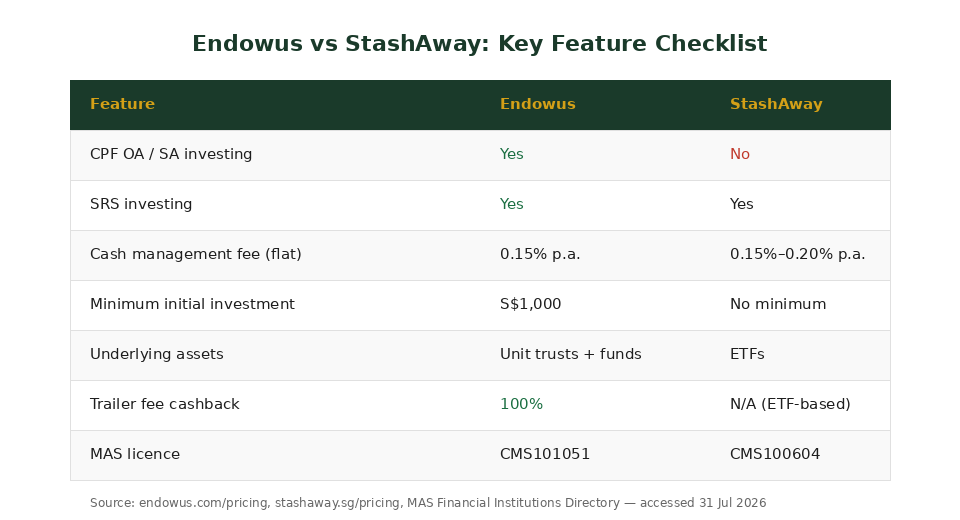
Here’s how the two platforms stack up on the metrics that actually affect your returns. Both are Monetary Authority of Singapore (MAS) regulated Capital Markets Services (CMS) Licence holders, but the similarities mostly end there.
| Feature | Endowus | StashAway |
|---|---|---|
| Operating Entity | Endowus Singapore Pte. Ltd. | Asia Wealth Platform Pte Ltd (StashAway) |
| MAS CMS Licence | CMS101051 | CMS100604 |
| Minimum Initial Investment | S$1,000 | No stated minimum (General Investing & Flexible Portfolios) |
| CPF OA / SA Investing | Yes | No |
| SRS Investing | Yes | Yes |
| General Investing Fee Range | 0.25%–0.60% p.a. (flat, by AUA tier) | 0.2%–0.8% p.a. (graduated by tranche) |
| Cash Management Fee | 0.15% p.a. flat (Cash Smart) | 0.15% (Simple) / 0.20% (Simple Plus) |
| Underlying Assets | Institutional-class unit trusts (Dimensional, PIMCO, and others) plus index funds | ETFs, allocated via StashAway’s own risk framework |
| Trailer Fee Cashback | 100% rebated to you | Not applicable — ETF structure has no trailer fees |
Source: endowus.com/pricing, stashaway.sg/pricing, MAS Financial Institutions Directory — accessed 31 July 2026
CPF, SRS and Minimum Investment
This is the single biggest structural difference between the two platforms. Endowus is one of a small number of digital advisers approved under the CPF Investment Scheme (CPFIS), which means you can invest your CPF Ordinary Account (OA) and Special Account (SA) savings — above the mandatory S$20,000 OA and S$40,000 SA buffers — into Endowus’s advised portfolios. StashAway does not currently support CPF at all. If growing your CPF beyond the OA’s 2.5% p.a. floor rate is your goal, Endowus (or another CPFIS-approved platform) is your only option between the two.
Both platforms support Supplementary Retirement Scheme (SRS) investing. On Endowus, SRS money sits in advised multi-fund portfolios at a flat 0.40% p.a., or 0.30% p.a. if you build a single-fund Fund Smart portfolio. On StashAway, SRS funds flow into the same General Investing, Income, ESG, or Flexible portfolios as cash, so the graduated 0.2%–0.8% fee schedule applies.
On minimums: Endowus requires a S$1,000 initial investment across the platform. StashAway states no minimum for its General Investing portfolios and explicitly no minimum for the Single ETF Flexible Portfolio, which makes it slightly more accessible if you’re starting with a smaller amount, say S$500 or less.
Fees Compared: What You’d Actually Pay
Fee percentages alone can be misleading because Endowus applies a flat rate based on your total assets under advice (AUA) bracket, while StashAway applies a graduated, tax-bracket-style rate across tranches of your investment. Here’s what that means in actual dollars, excluding the 9% GST that both platforms charge on top of their advisory fee.
| Portfolio Size | Endowus Rate | Endowus Annual Fee | StashAway Rate (blended) | StashAway Annual Fee |
|---|---|---|---|---|
| S$10,000 | 0.60% | S$60 | 0.80% | S$80 |
| S$50,000 | 0.60% | S$300 | 0.75% | S$375 |
| S$200,000 | 0.50% | S$1,000 | 0.59% | S$1,175 |
| S$1,000,000 | 0.35% | S$3,500 | 0.37% | S$3,675 |
Source: endowus.com/pricing, stashaway.sg/pricing — accessed 31 July 2026. Figures exclude 9% GST charged on top of the advisory fee by both platforms.
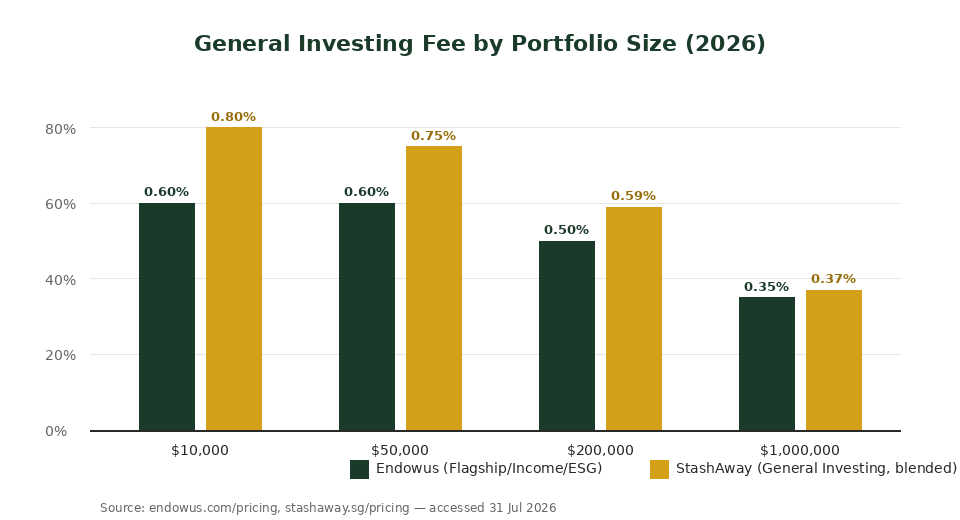
Here’s why the gap narrows at higher balances: StashAway’s graduated structure means you only pay the higher 0.8% rate on your first S$25,000, with each additional tranche billed at a lower rate. Endowus, by contrast, applies a single flat rate to your entire balance once you cross into a new tier — which is simpler to understand but can work against you right at a tier boundary. In practice, for a S$50,000 portfolio, Endowus’s S$300 annual fee is 20% cheaper than StashAway’s S$375. That’s a real S$75 difference — not huge in isolation, but it compounds over a multi-decade holding period.
Portfolio Construction: Unit Trusts vs ETFs
The fee comparison only tells half the story — the two platforms build your portfolio in fundamentally different ways.
Endowus gives you access to over 400 funds via Fund Smart, plus advised portfolios: Flagship (six globally diversified allocations from conservative to 100% equity), Income (dividend and stability focused), ESG, and thematic Satellite portfolios covering megatrends, technology, and real assets. Most of these use institutional share classes of unit trusts from managers like Dimensional and PIMCO — share classes that are typically only available to large institutions, not retail investors buying directly. Endowus also rebates 100% of any trailer fee it receives from fund managers back to you, which is how it keeps net costs low despite unit trusts usually carrying higher fund-level fees than ETFs.
StashAway builds portfolios almost entirely from ETFs, using its own Economic Regime-based Asset Allocation (ERAA) methodology, alongside a General Investing option “powered by BlackRock.” You’ll also find Income Investing, a Shariah Global Portfolio, a Singapore Investing Portfolio, Thematic Portfolios, and Flexible Portfolios that let you hold a single ETF at a flat 0.3% fee with no minimum. For investors who want to pick individual ETFs themselves, StashAway’s ETF Explorer charges $1 USD plus a 0.09% operation fee per order on SGX-listed ETFs, with no ongoing management fee — a meaningfully different model from Endowus, which doesn’t offer self-directed ETF trading at all.
Is StashAway or Endowus Safer?
Both platforms are licensed and regulated in Singapore, so neither is inherently “unsafe” in the way an unregulated crypto platform might be. Endowus operates under CMS Licence 101051 and is also an exempt financial adviser under the Financial Advisers Act. StashAway is a brand of Asia Wealth Platform Pte Ltd, which holds CMS Licence 100604. You can verify both licences directly on the MAS Financial Institutions Directory.
That said, investments on either platform are not bank deposits. They are not insured by the Singapore Deposit Insurance Corporation (SDIC), and your capital is not guaranteed — the value of your portfolio can fall as well as rise, regardless of which platform you use. This is a standard risk disclosure for any investment platform, not a knock against either provider specifically.
Who Should Pick Which?
Endowus is likely the better fit if: you want to invest your CPF OA or SA savings beyond the mandatory buffers, you prefer unit trusts managed by institutional fund houses, you want a single flat fee that’s easy to calculate, or your portfolio sits comfortably under S$1 million where Endowus is typically cheaper.
StashAway is likely the better fit if: you have no CPF-related goals and only want to invest SRS or cash, you prefer ETF-based portfolios with lower embedded fund fees, you want the flexibility of a single-ETF Flexible Portfolio with no minimum, or you want the option to self-direct trades through ETF Explorer instead of a fully advised portfolio.
Many Singapore investors actually use both: CPF and SRS on Endowus, with a smaller cash allocation on StashAway’s ETF Explorer or Flexible Portfolio for hands-on ETF picks. There’s no rule against running two robo-advisors in parallel, and doing so lets you access CPF investing on one platform while keeping ETF flexibility on the other. If you’re still deciding where to start, our best robo-advisor in Singapore guide breaks down the wider field beyond just these two.
Not financial advice. All figures in this article are for educational reference only and were verified against endowus.com/pricing and stashaway.sg/pricing as at 31 July 2026. Fees, minimums, and product availability change over time — always check the platform’s current pricing page before investing.
Frequently Asked Questions
What is the main difference between StashAway and Endowus?
Endowus builds portfolios from institutional-class unit trusts and lets you invest CPF OA/SA, SRS, and cash at a flat fee of 0.15%–0.60% p.a. StashAway builds portfolios from ETFs, supports SRS and cash but not CPF, and charges a graduated fee of 0.2%–0.8% p.a. depending on how much you invest.
Which has lower fees, StashAway or Endowus?
Endowus is cheaper at every balance we compared below S$1 million. For example, on S$50,000 Endowus charges S$300 a year versus StashAway’s S$375. The gap narrows as your balance grows because StashAway’s graduated fee tapers down for larger tranches.
Can I invest my CPF savings with StashAway?
No. StashAway does not currently support CPF Investment Scheme (CPFIS) investing. If you want to invest your CPF OA or SA savings through a robo-advisor, Endowus is the option between these two platforms — you’ll still need to keep the mandatory S$20,000 OA and S$40,000 SA buffers untouched.
Is StashAway or Endowus better for SRS investing?
Both support SRS. Endowus charges a flat 0.40% p.a. for advised multi-fund SRS portfolios (0.30% for a single Fund Smart fund). StashAway applies its usual graduated 0.2%–0.8% fee to SRS funds invested through General Investing, Income, ESG, or Flexible portfolios. Compare the fee at your actual SRS balance before choosing.
Are StashAway and Endowus safe and MAS-regulated?
Yes, both hold Capital Markets Services Licences from the Monetary Authority of Singapore — Endowus under CMS101051 and StashAway (via Asia Wealth Platform Pte Ltd) under CMS100604. Regulation doesn’t eliminate investment risk, though: neither platform’s investments are SDIC-insured or capital guaranteed.
Can I use both StashAway and Endowus at the same time?
Yes, there’s nothing stopping you from holding accounts on both. A common approach among Singapore investors is to use Endowus for CPF and SRS investing, while using StashAway’s Flexible Portfolio or ETF Explorer for a smaller, more hands-on cash allocation.
Ready to Start Investing?
Read our full platform guides before you decide, or use our referral links for sign-up perks.
This article was researched with the help of AI. While we strive to keep all information accurate and up to date, there may be errors. If you notice any discrepancies, please contact us.