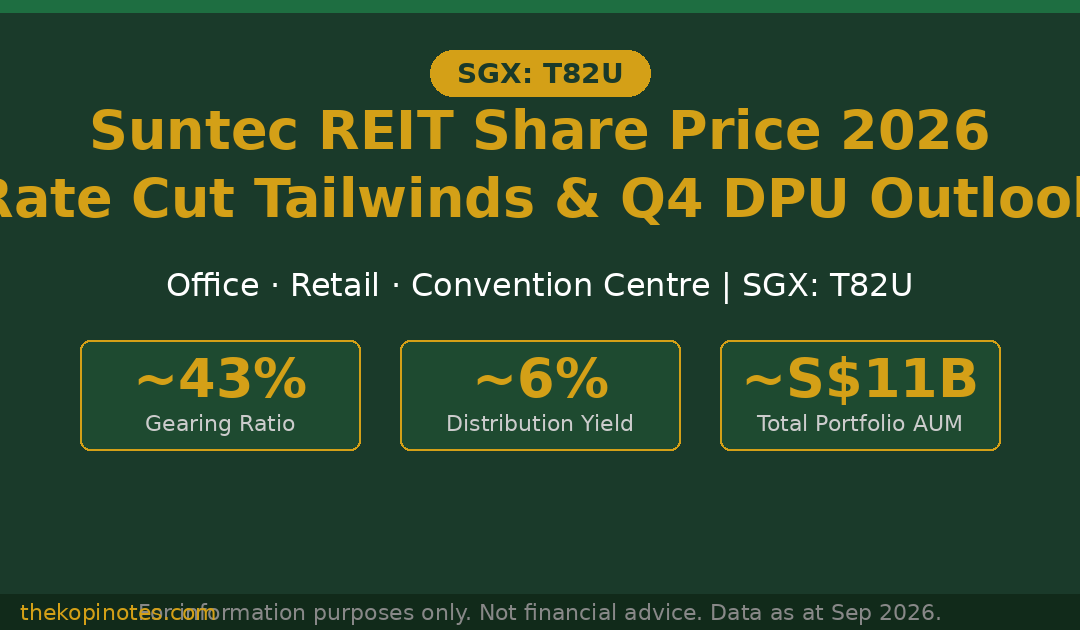
Suntec REIT Share Price 2026 (SGX: T82U): Rate Cut Tailwinds & Q4 DPU Outlook
With Singapore T-bill rates sliding to their lowest 2026 level in the Sep 25 auction (1.92%), rate-sensitive S-REITs with elevated gearing are positioned for a meaningful DPU recovery. Suntec REIT (SGX: T82U) — one of Singapore’s most integrated commercial REITs — is a key name to watch heading into Q4 2026.
Not financial advice. Data sourced from SGX filings, Suntec REIT announcements, and MAS data as at September 2026. Always conduct your own due diligence.
Table of Contents
Contents — Click to expand
Suntec REIT at a Glance
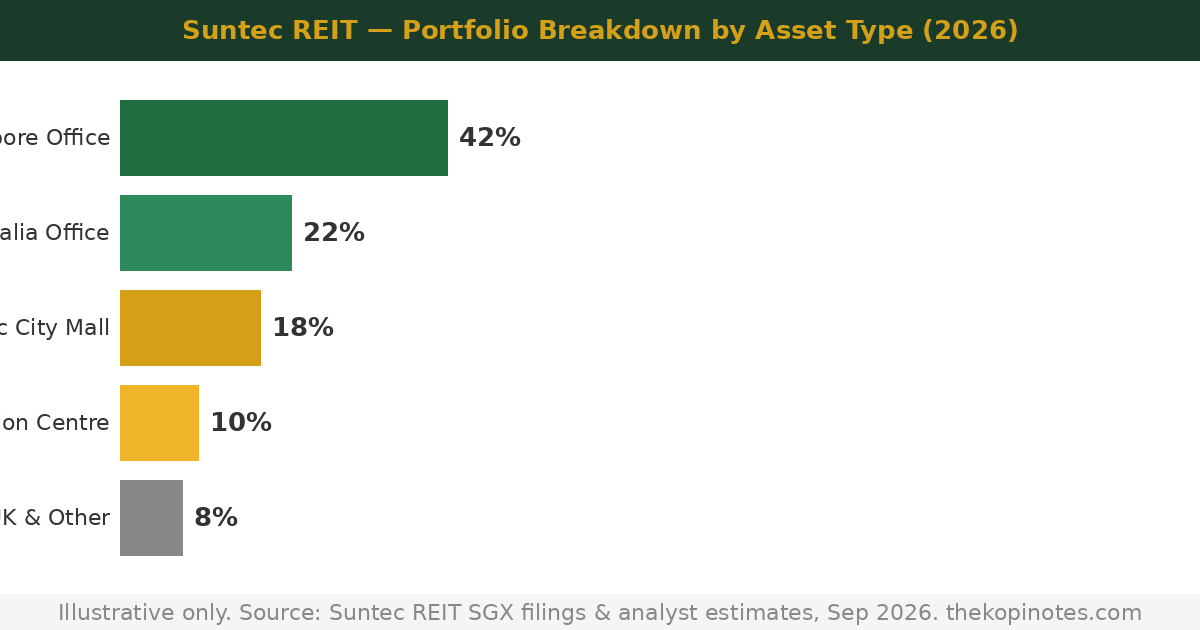
Suntec REIT (SGX: T82U) was listed on the Singapore Exchange in 2004 and is one of the largest commercial S-REITs by total assets, with an approximately S$11 billion portfolio spanning office, retail, and convention centre assets. Its unique proposition lies in the integrated nature of its flagship Suntec City development — where office towers, a regional shopping mall, and Singapore’s largest convention and exhibition centre sit side by side.
The REIT’s key assets include:
- Suntec City Office Towers (1–5) — Prime Grade A office space in the Marina Bay precinct
- Suntec City Mall — One of Singapore’s largest suburban-adjacent malls with strong F&B and experiential retail
- Suntec Singapore Convention & Exhibition Centre — The integrated venue driving footfall to the broader Suntec City ecosystem
- One Raffles Quay (partial stake) — Premium Grade A office in the Raffles Place financial district
- Marina Bay Financial Centre Towers 1 & 2 (partial stake) — Core CBD office with long-term institutional tenants
- Overseas assets — Office properties in Melbourne and Sydney, Australia, and London’s Nova Victoria
This diversified commercial mix makes Suntec REIT simultaneously exposed to office market dynamics, retail sentiment, and MICE (Meetings, Incentives, Conferences, Exhibitions) demand cycles — all of which are trending positively into Q4 2026.
Rate Cut Tailwinds: Gearing & Floating Rate Debt
Suntec REIT carries a gearing ratio of approximately 43%, positioning it among the higher-geared S-REITs. While this was a headwind during the 2022–2024 rate hike cycle, the tide has turned. Singapore’s T-bill yields have declined from above 3.5% in early 2026 to 1.92% in the September 25, 2026 auction — the lowest 2026 level — signalling a more accommodative rate environment ahead.
For a REIT like Suntec with meaningful floating-rate debt exposure, every 50 basis point reduction in SORA-linked borrowing costs can directly add to distributable income. Management has guided that its interest coverage ratio remains healthy, but the sensitivity to short rates is real. A sustained drop in Singapore Overnight Rate Average (SORA) translates to lower quarterly interest expenses and improved DPU headroom.
Suntec’s weighted average debt maturity profile has been actively managed — the REIT has refinanced key tranches into fixed-rate or hedged structures in recent quarters, which limits the immediate uplift from rate cuts but also protects against any reversal. Unitholders should track the proportion of floating-to-fixed rate debt in each quarterly results announcement, as this ratio directly determines how quickly lower rates flow through to DPU.
For investors looking to deploy capital into S-REITs with rate-cut leverage, Suntec sits at the intersection of elevated gearing + commercial exposure + SORA sensitivity — a combination that historically sees outsized DPU recovery in easing cycles. See our guide on the best S-REITs in Singapore 2026 for a broader sector comparison.
Office Portfolio: Singapore CBD & Australia
Suntec REIT’s Singapore office portfolio sits in two of the city’s most prestigious commercial precincts: the Marina Bay/City Hall corridor (Suntec City Towers) and the Raffles Place/Marina Bay financial district (One Raffles Quay, MBFC). These Grade A properties command premium rents from financial institutions, professional services firms, and multinational corporations.
The Singapore office market has shown resilience in 2026, with Grade A CBD vacancy rates remaining low as companies continue to prioritise premium, well-located space. Suntec City’s towers have benefited from the flight-to-quality trend, where tenants consolidate from older stock into the more amenity-rich, ESG-compliant buildings that Suntec offers.
On the overseas front, Suntec REIT’s Australian properties — including Olderfleet in Melbourne, Aurora Melbourne Central, and assets in Sydney’s CBD — have navigated a more challenging office market. Australian office vacancy rates remain elevated versus Singapore, reflecting the post-pandemic work-from-home normalisation trend. However, the Melbourne CBD Grade A segment has shown signs of rental floor stabilisation, and Suntec’s long-weighted-average-lease-expiry (WALE) structure in Australia provides some income visibility.
The UK’s Nova Victoria (London) asset has similarly held its income profile, with government and institutional tenants providing lease stability. The multi-geography exposure means Suntec’s income is somewhat diversified from Singapore office market swings — though it also means unitholders carry currency risk from AUD and GBP denominated income streams.
Suntec City: Retail + Convention Centre Recovery
One of Suntec REIT’s most distinctive assets is Suntec City Mall — a 1.08 million sq ft retail destination in the heart of the Marina Bay precinct. Unlike purely suburban malls, Suntec City benefits from a dual catchment: the office workers from the surrounding towers (and other nearby CBD offices) on weekdays, and the broader tourist and recreational crowd on weekends.
The mall has undergone phased Asset Enhancement Initiatives (AEIs) over the past few years, refreshing its tenant mix to lean more heavily into F&B, experiential retail, health and wellness, and lifestyle categories. These are sectors that have proven resilient against e-commerce headwinds, and early indicators show improved shopper footfall and higher tenant sales post-AEI.
The Suntec Singapore Convention & Exhibition Centre deserves special mention as a differentiated income contributor. MICE demand has rebounded strongly in 2025–2026 as international conferences and trade shows returned to Singapore. Suntec Singapore hosted major events throughout 2026, including regional financial summits, tech expos, and government events. The convention centre contributes both direct revenue (space rental, F&B) and an indirect halo effect — event attendees spill into the mall and support retail sales.
For investors interested in a S-REIT ETF approach to commercial exposure, see our Singapore REIT ETF guide for diversified exposure across commercial, industrial, and retail REITs.
DPU Outlook for Q4 2026 & Beyond
Suntec REIT’s DPU trajectory has been in recovery mode throughout 2025–2026. After several years where elevated interest expenses weighed on distributable income, the combination of lower rates, stronger office rents, and recovering MICE activity is creating a more constructive distribution environment heading into Q4 2026.
Key DPU catalysts to watch for Q4 2026 and FY2027:
- Interest cost savings: As fixed-rate debt tranches roll over into a lower rate environment, interest savings should flow through to DPU incrementally. Even a 0.5% reduction in the average cost of debt on a ~S$5 billion debt book delivers approximately S$25 million in annual savings — meaningful for distribution capacity.
- Office positive reversions: Singapore Grade A office rents have continued to hold firm in 2026. As older leases roll over at new market rates, Suntec’s Singapore office segment should deliver positive rental reversion — incrementally adding to gross revenue.
- Convention centre recovery: With MICE bookings extending well into 2027, Suntec Singapore should see consistent contribution from this segment through Q4 2026.
- AEI uplift: Completed AEI works at Suntec City Mall typically deliver 6–12 months of improved tenant sales data before full economic benefit is reflected in higher passing rents. The maturation of recent AEIs should support retail rental income into 2027.
It is worth noting that Suntec’s DPU is paid semi-annually, so unitholders will typically see two distribution events per year. The most recent 1H2026 distribution showed a meaningful year-on-year increase — for the full 2H2026 picture, investors should monitor the February 2027 results announcement.
To model your own retirement income projections based on dividend yield estimates, try our free retirement planning calculator for Singapore.
Key Risks to Monitor
No investment is without risk, and Suntec REIT has specific risk factors that investors should weigh carefully alongside the tailwinds:
- High gearing: At approximately 43% gearing, Suntec is above the sector median. While this amplifies DPU recovery in falling rate environments, it also amplifies losses if rates reverse or if asset valuations decline. The MAS 50% gearing cap provides a buffer, but leaves less room for error than lower-geared peers.
- Overseas office headwinds: Australian office markets continue to face structural vacancies in some submarkets. A prolonged period of weak leasing demand in Melbourne or Sydney could weigh on asset valuations and require capital management actions.
- Currency volatility: Suntec earns income in AUD and GBP alongside SGD. A strengthening Singapore dollar reduces the SGD value of overseas income and, ultimately, the DPU available to Singapore unitholders.
- Tenant concentration: Large financial services and professional services tenants occupy meaningful portions of the Singapore office portfolio. Any major tenant non-renewal or space reduction represents a near-term income risk.
- MICE dependency: Convention centre income is event-driven and not guaranteed on a recurring basis. If Singapore loses major annual events to competing regional venues (e.g., Bangkok or Kuala Lumpur), the convention centre contribution could disappoint.
- Refinancing risk: With approximately 43% gearing and substantial debt due for refinancing in coming years, Suntec’s ability to secure favourable refinancing terms is critical. A credit spread widening event (even if base rates are low) could negate some rate-cut benefit.
Peer Comparison: Suntec vs CICT vs MPACT
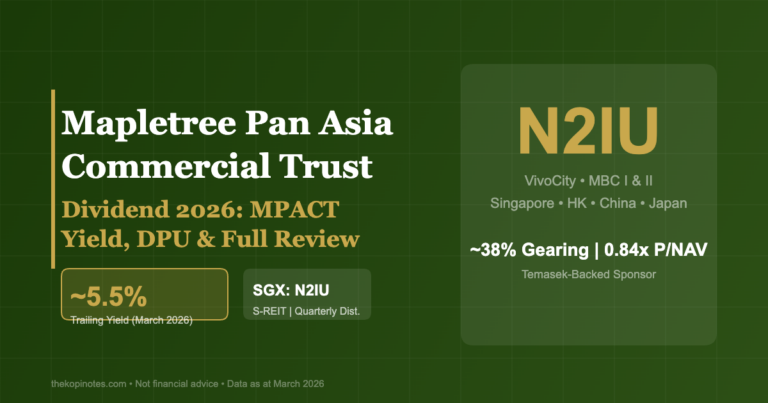
Singapore investors evaluating commercial S-REITs in Q4 2026 will inevitably compare Suntec REIT against its two primary peers: CapitaLand Integrated Commercial Trust (CICT, SGX: C38U) and Mapletree Pan Asia Commercial Trust (MPACT, SGX: N2IU). Each has a distinct risk-return profile:
| Metric | Suntec REIT (T82U) | CICT (C38U) | MPACT (N2IU) |
|---|---|---|---|
| Focus | Office + Retail + Convention | Office + Suburban Retail | Office + Retail (Pan-Asia) |
| Gearing (approx.) | ~43% | ~38% | ~40% |
| Yield Profile | Higher yield, higher gearing | Moderate yield, lower gearing | Higher yield, overseas risk |
| Rate Cut Sensitivity | High | Moderate | Moderate-High |
| Geographic Risk | SG + AUS + UK | Primarily Singapore | SG + HK + JP + FI + DE |
For deeper analysis on each of these peers, see our articles on CICT 2026 and MPACT share price 2026.
Investors considering a diversified approach to Singapore commercial property income should also explore Syfe (referral: SRPRFFFCD) or Endowus (referral: 2V343), both of which offer curated REIT-income portfolios for Singapore investors.
Frequently Asked Questions — Suntec REIT 2026
What is Suntec REIT's current gearing ratio?
How does a rate cut affect Suntec REIT's DPU?
What properties does Suntec REIT own in Singapore?
What overseas markets does Suntec REIT operate in?
How often does Suntec REIT pay distributions?
What is Suntec REIT's net asset value (NAV) per unit?
How does Suntec REIT compare to CICT and MPACT?
Is Suntec REIT suitable for passive income investors?
Disclaimer: This article is for informational purposes only and does not constitute financial advice. All data is sourced from publicly available SGX filings, REIT announcements, and market data as at September 2026. Past performance is not indicative of future results. Always conduct your own due diligence and consult a licensed financial adviser before making investment decisions.
This article was researched with the help of AI. While we strive to keep all information accurate and up to date, there may be errors. If you notice any discrepancies, please contact us.