Digital Banks & Referral Codes
TribeCar + Trust Bank + FSMOne: The Real-Rate vs Headline-Rate Savings Pipeline (2026)
Skip car ownership, bank the interest rate you’ll actually earn, then invest the surplus tax-efficiently.
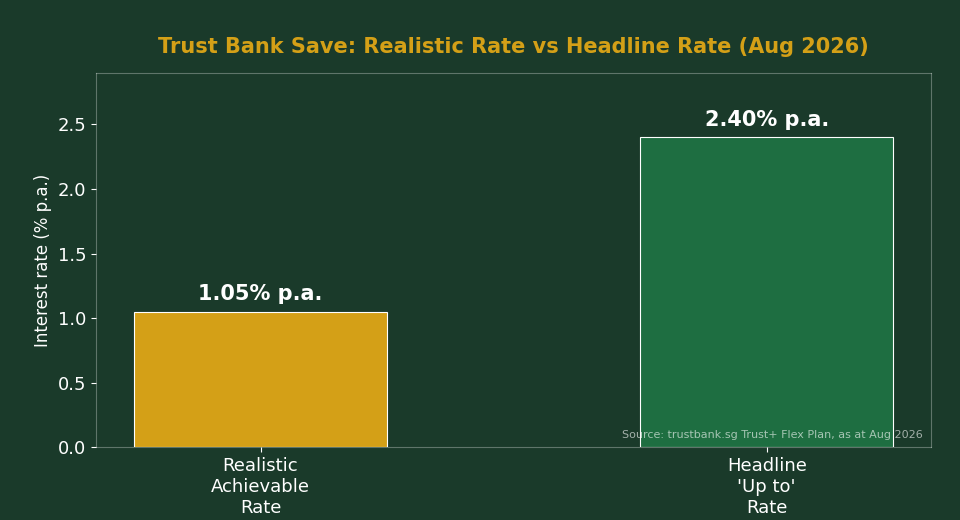
Skipping car ownership with TribeCar frees up roughly $1,250 a month. Most people then chase Trust Bank’s “up to 2.40% p.a.” headline rate and fall short, because the biggest bonus scoops need a $20,000 fund purchase or a card referral. A more realistic rate is closer to 1.05% p.a. Once your buffer is built, FSMOne lets you invest the rest through your SRS account at a permanent 0% sales charge.
Not financial advice. All figures are for educational reference only. Data as at August 2026 unless noted. The Kopi Notes may earn a referral fee if you sign up through the links on this page.
- TribeCar frees up about $1,250/month you’d otherwise spend on a car
- Trust Bank’s realistic achievable rate is about 1.05% p.a., not the “up to 2.40%” headline — you need to know which scoops are actually realistic for you
- Once your 6-month buffer is built, route the rest into FSMOne SRS for tax relief up to $15,300/year (0% sales charge on unit trusts)
Table of Contents
1. What TribeCar Frees Up Each Month
2. Trust Bank: Realistic Rate vs Headline Rate
3. FSMOne: Investing the Surplus via SRS
4. The 3-Step Pipeline
5. How This Differs From Our Other TribeCar Combos
6. Risks and Who This Is For
7. Referral Codes Summary
8. FAQ
What TribeCar Frees Up Each Month
Owning a car in Singapore is expensive. Between the COE, loan instalments, insurance, parking, and petrol, many owners spend $1,200 to $1,500 a month just to keep a car on the road.
TribeCar is a peer-to-peer car-sharing platform. Instead of owning a car, you book one by the hour or day only when you actually need it. Across our TribeCar content series, we’ve used a consistent working figure: switching from ownership to TribeCar frees up about $1,250 a month for the average Singapore driver.
That’s the starting capital for this pipeline. The question is where that $1,250 should go first. This guide walks through a realistic answer: build a cash buffer at Trust Bank using rates you can actually hit, then route the surplus into FSMOne for tax-efficient SRS investing.
Trust Bank: Realistic Rate vs Headline Rate
Trust Bank markets its Save account as earning “up to 2.40% p.a.” That number is real, but it’s also the ceiling, not the floor. You only reach it by stacking specific bonus criteria the bank calls “scoops.”
Under the Trust+ Flex Plan, you pick any 3 scoops each month. Here’s the full list, from easiest to hardest for someone who just started saving:
| Scoop (bonus condition) | Bonus rate | Realistic for a new saver? |
|---|---|---|
| 5 card spends of $30+ each | +0.30% (0.20% non-union) | Yes — daily spending |
| $1,500 salary credited via GIRO | +0.50% | Yes, if you move your salary |
| $1,500 incoming PayNow transfers | +0.20% | Yes, for most working adults |
| $500 spent in foreign currency | +0.20% | No — only if you travel monthly |
| ADB up $3,000 from prior month | +0.20% | Only in your fastest saving months |
| $100,000 Average Daily Balance | +0.40% | No — most savers aren’t near this |
| $20,000 in TrustInvest funds | +0.70% | No — big one-off commitment |
| Refer a new credit card customer | +1.20% | No — one-off, not repeatable monthly |
Source: trustbank.sg Trust+ Flex Plan terms, as at August 2026. Rates and scoops subject to change — always check the current terms before you sign up.
Notice the pattern: the two scoops that get you closest to the 2.40% ceiling — $20,000 in TrustInvest funds and a card referral — aren’t realistic for someone who just freed up cash from ditching a car. You haven’t built a fund position yet, and you can’t refer a new customer every single month.
A realistic combination for most TribeCar savers is: salary credit (+0.50%), 5 card spends (+0.30%), and PayNow $1,500 (+0.20%). That’s 3 scoops, all achievable through normal spending and banking habits, totalling +1.00% on top of the 0.05% base rate.
This isn’t a knock on Trust Bank specifically — most digital bank “up to” headlines work the same way. Our Trust Bank + GXS two-bucket guide covers the same realistic-vs-headline gap when comparing two banks side by side. The lesson here: budget your savings plan around the rate you’ll actually earn, not the number in the marketing banner.
FSMOne: Investing the Surplus via SRS
Once your Trust Bank buffer covers about 6 months of expenses, the realistic move is to stop stacking more cash there and start investing the surplus. That’s where FSMOne comes in.
The Supplementary Retirement Scheme (SRS) — a voluntary retirement account that gives you dollar-for-dollar tax relief on what you contribute — lets Singapore citizens and PRs contribute up to $15,300 a year. Every dollar you put in reduces your taxable income by the same amount.
FSMOne charges a permanent 0% sales charge on unit trusts, including those bought with SRS funds. For portfolios of $300,000 and below, you’ll pay a platform fee of about 0.35% a year on most funds (0.20% a year for fixed income funds). If you’re trading SGX stocks directly, it’s a flat $8.80 per trade.
| Item | Cost via FSMOne |
|---|---|
| Unit trust sales charge | 0% (permanent) |
| Platform fee, most funds (≤$300k AUA) | 0.0875%/quarter (~0.35%/year) |
| Platform fee, fixed income funds | 0.05%/quarter (~0.20%/year) |
| SGX stock trade | Flat $8.80/trade |
| Platform fee, Diamond tier (≥$500k AUA) | 0% on unit trusts |
Source: FSMOne fee schedule, as at August 2026.
At $1,250 a month, most of that first goes to the Trust Bank buffer. Once the buffer is done — usually around month 6 — you can redirect the full $1,250 into your SRS account and hit the $15,300 cap in a little over 12 months. How much that’s actually worth depends on your income tax bracket:
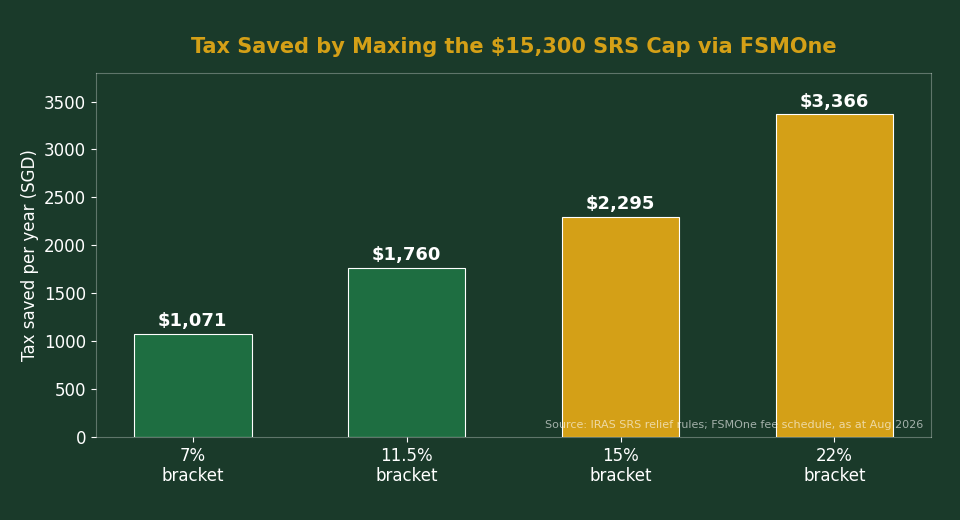
If you’re in the 15% tax bracket, maxing your SRS cap saves you about $2,295 in tax every year, on top of whatever your FSMOne investments earn. At the 22% bracket, that jumps to roughly $3,366. Use our SRS tax savings calculator to check your own bracket and confirm the exact number.
For a deeper walkthrough of opening the account and picking your first funds, see our FSMOne SRS account guide.
The 3-Step Pipeline
Here’s how the three platforms fit together in practice:
- Step 1 — Skip car ownership with TribeCar. Book a car only when you need one. This frees up roughly $1,250/month that would otherwise go to loan instalments, insurance, parking, and petrol.
- Step 2 — Bank the realistic rate with Trust Bank. Park that $1,250/month in a Trust Bank Save account. Hit the 3 realistic scoops (salary credit, card spends, PayNow) for about 1.05% p.a. — not the unrealistic 2.40% headline — until you’ve built roughly 6 months of expenses as a buffer.
- Step 3 — Invest the surplus with FSMOne. Once your buffer is done, redirect the $1,250/month into your SRS account via FSMOne. At 0% sales charge, you reach the $15,300 annual cap in a bit over 12 months and pick up the associated tax relief every year going forward.
The order matters. Skipping straight to investing without a buffer means you might have to sell investments at a bad time if an emergency comes up. Sitting on too much uninvested cash after your buffer is full means you’re leaving tax relief and long-term growth on the table.
How This Differs From Our Other TribeCar Combos
We’ve published five other TribeCar 3-way combos before this one, and each uses a different allocation logic so you can pick the one that fits your situation:
- TribeCar + Trust Bank + Endowus — a straight sequential pipeline (car savings → cash → CPF/SRS growth)
- TribeCar + GXS + Syfe — a simple buffer-then-invest, 2-step version
- TribeCar + FSMOne + IBKR — sequenced by tax cap first, then taxable investing
- TribeCar + MariBank + Endowus — a 3-tier liquidity horizon ladder
- TribeCar + MariBank + Syfe — split by SDIC deposit insurance coverage, not time or tax
This guide is the first sequenced by rate literacy — the gap between what a bank advertises and what you can actually earn. If you’ve been disappointed that your Trust Bank interest never seems to hit the number on the app’s homepage, this is the combo written for you.
Risks and Who This Is For
TribeCar works best if your driving needs are occasional rather than daily — think weekend trips and the odd errand, not a daily commute. If you drive every day, car ownership or a long-term lease may still work out cheaper.
Trust Bank Save is covered by the Singapore Deposit Insurance Corporation (SDIC) up to $100,000 per depositor, so your buffer is protected. But the bonus scoops can change — Trust Bank has adjusted its rates before, so re-check the current terms every few months rather than assuming 1.05% forever.
SRS investments through FSMOne are not capital-guaranteed. Unlike a savings account, the funds you buy can lose value, especially in the short term. SRS withdrawals before the statutory retirement age also incur a 5% penalty plus full tax on the withdrawn amount (with some exceptions), so only invest money you won’t need before retirement age.
This pipeline suits Singapore citizens or PRs who: don’t drive daily, want a savings account that pays more than a big-bank account without extra hoops, and haven’t yet started using their SRS account for tax relief.
Referral Codes Summary
| Platform | Referral code | Used for |
|---|---|---|
| TribeCar | zZDeg | Step 1 — skip car ownership |
| Trust Bank | HTWYQP95 | Step 2 — realistic-rate savings buffer |
| FSMOne | P0544985 | Step 3 — SRS investing at 0% sales charge |
Frequently Asked Questions
Is Trust Bank's 2.40% interest rate real?
How much does TribeCar actually save compared to owning a car?
What is the SRS contribution cap in 2026?
Does FSMOne really charge 0% sales charge on unit trusts?
Can I withdraw my SRS funds early if I need the cash?
Is my money safe with Trust Bank?
Why not just invest everything with FSMOne right away instead of building a Trust Bank buffer first?
How long does it take to max out the SRS cap using this pipeline?
Disclaimer: This article is for educational purposes only and does not constitute financial advice. Interest rates, fees, and referral bonuses are accurate as at August 2026 and are subject to change by the respective providers. Always verify current rates directly with Trust Bank, FSMOne, and TribeCar before signing up. SRS rules are governed by IRAS. The Kopi Notes may earn a referral fee from the links on this page, at no extra cost to you.
This article was researched with the help of AI. While we strive to keep all information accurate and up to date, there may be errors. If you notice any discrepancies, please contact us.