StashAway Singapore Review 2026: Fees, Performance & Is It Worth It?
A complete Singapore investor’s guide to StashAway — how it works, what it costs, and how it compares to Endowus and Syfe in 2026.
StashAway is a digital wealth management platform (robo-advisor) licensed by the Monetary Authority of Singapore (MAS) that automatically builds and rebalances a globally diversified portfolio for you. It charges between 0.2% and 0.8% per year depending on your portfolio size, uses its own ERAA® investment framework, and is available with no minimum investment. It supports Cash, SRS, and joint accounts — making it one of the most flexible robo-advisors in Singapore.
Not financial advice. All figures are for educational reference only. Data as at June 2026 unless noted.
- StashAway charges 0.2%–0.8% p.a. depending on portfolio size — fees drop as your balance grows
- It’s MAS-licensed, uses a macro-driven ERAA® framework, and supports SRS accounts
- Endowus is cheaper (0.25% p.a.) for large portfolios; Syfe offers more control — your choice depends on what matters to you
Table of Contents
Contents — Click to expand
- What Is StashAway?
- How StashAway Works (ERAA® Framework)
- StashAway Fees: What You Actually Pay
- StashAway Performance: Real Returns in Singapore
- Account Types: Cash, SRS & More
- Pros and Cons of StashAway Singapore
- StashAway vs Endowus vs Syfe (2026)
- Who Should Use StashAway?
- How to Open a StashAway Account in Singapore
- Frequently Asked Questions
What Is StashAway?
StashAway was founded in Singapore in 2016 and launched publicly in 2017. It holds a Capital Markets Services (CMS) licence from MAS, which means it is legally authorised to manage your money in Singapore. Your assets are held in custody by Saxo Capital Markets (a separate, regulated bank) — not by StashAway directly. So if StashAway ever went under, your investments are still protected in a segregated account.
At its core, StashAway is a digital portfolio manager. You answer a short questionnaire about your goals and risk tolerance, and it builds a globally diversified portfolio of ETFs on your behalf. It then rebalances automatically when market conditions change — you don’t need to lift a finger.
As at June 2026, StashAway manages over SGD 4 billion in assets across Singapore, Malaysia, the UAE, and Hong Kong. It is one of the largest independent robo-advisors in Southeast Asia.
| Detail | StashAway Singapore |
|---|---|
| Founded | 2016 (launched 2017) |
| MAS Licence | Capital Markets Services (CMS) — Fund Management |
| Custody | Saxo Capital Markets (segregated accounts) |
| AUM (SGD) | ~SGD 4 billion+ (as at Q2 2026) |
| Minimum Investment | SGD 0 (no minimum) |
| Investment Framework | ERAA® (Economic Regime-based Asset Allocation) |
| Account Types | Cash, SRS, Joint |
| Mobile App | iOS and Android |
Source: StashAway Singapore official website, June 2026
How StashAway Works (ERAA® Framework)
Most robo-advisors use a static asset allocation model — you pick a risk level, they invest accordingly, and rebalancing only happens when your portfolio drifts too far from the target. StashAway does something different.
It uses a proprietary framework called ERAA® — Economic Regime-based Asset Allocation. The idea is that different assets perform well in different economic environments. For example, during high inflation, commodities and Treasury Inflation-Protected Securities (TIPS) tend to outperform. During a recession, bonds and gold are more defensive.
ERAA® monitors macro signals (growth and inflation data from major economies) and shifts the portfolio’s asset allocation when the economic regime changes. This is more active than a typical passive ETF portfolio, but less speculative than stock-picking.
Here is how the four economic regimes work in ERAA®:
| Economic Regime | Growth | Inflation | Favoured Assets |
|---|---|---|---|
| Goldilocks | High | Low | Equities, REITs |
| Inflationary Growth | High | High | Commodities, TIPS, Real Assets |
| Stagflation | Low | High | Commodities, Gold |
| Recession | Low | Low | Government Bonds, Gold, Cash |
Source: StashAway ERAA® framework documentation, 2026
Whether ERAA® actually outperforms a simple passive index strategy is debated. Historically, active macro timing is hard to do consistently. But for investors who want some protection against macro shifts without managing it themselves, it is a reasonable approach.
StashAway Fees: What You Actually Pay
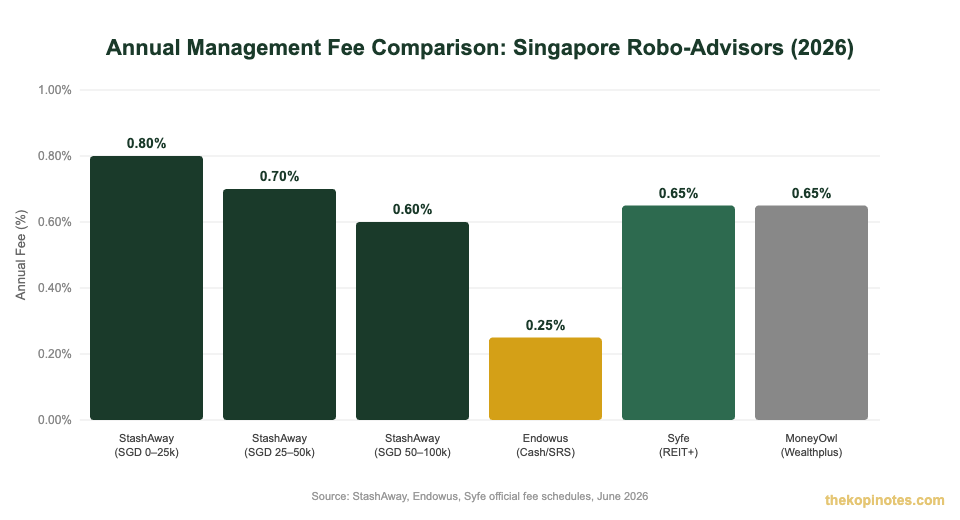
StashAway charges a single annual management fee — there are no trading commissions, no deposit or withdrawal fees, and no platform fees on top. The fee is tiered based on your total portfolio size across all your StashAway accounts.
| Portfolio Size (SGD) | Annual Fee | Annual Cost on SGD 50,000 |
|---|---|---|
| First SGD 25,000 | 0.80% p.a. | SGD 200 |
| SGD 25,001 – SGD 50,000 | 0.70% p.a. | SGD 175 |
| SGD 50,001 – SGD 100,000 | 0.60% p.a. | SGD 300 |
| SGD 100,001 – SGD 250,000 | 0.50% p.a. | SGD 500 |
| SGD 250,001 – SGD 500,000 | 0.40% p.a. | SGD 1,000 |
| SGD 500,001 – SGD 1,000,000 | 0.30% p.a. | SGD 1,500 |
| Above SGD 1,000,000 | 0.20% p.a. | SGD 2,000 |
Source: StashAway Singapore fee schedule, June 2026
On top of StashAway’s management fee, you also pay the underlying ETF expense ratios — typically 0.07% to 0.25% depending on the ETFs in your portfolio. These are charged by the ETF provider (e.g. iShares, SPDR) and are deducted from the ETF’s net asset value. StashAway does not pocket these — they go to the fund managers.
For a SGD 50,000 portfolio, the blended StashAway fee works out to roughly 0.75% p.a. Add approximately 0.15% in average ETF expense ratios, and your total cost of ownership is around 0.90% p.a. — or roughly SGD 450 per year.
StashAway Performance: Real Returns in Singapore
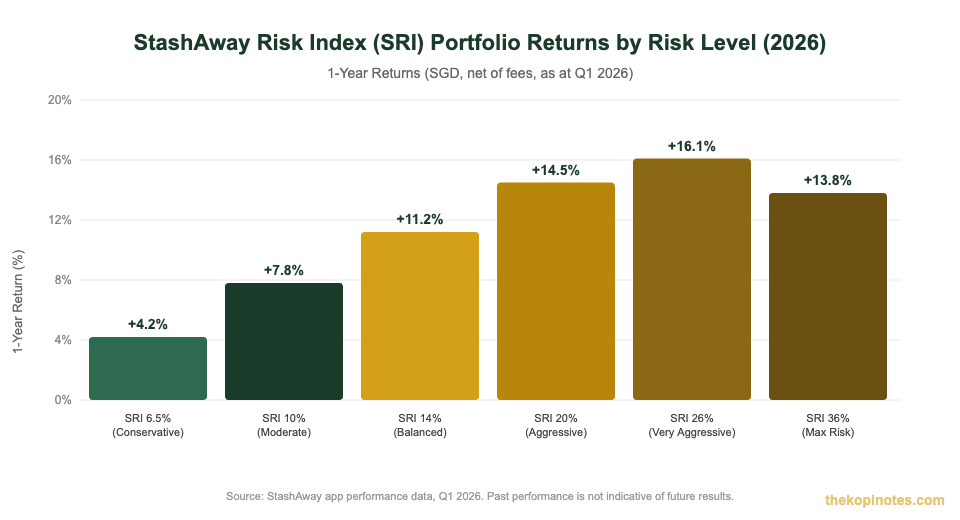
StashAway publishes historical performance data in its app and on its website. Returns vary by your chosen Risk Index (SRI) — which ranges from 6.5% (most conservative) to 36% (highest risk). The SRI number represents the maximum expected annual loss in the worst 20% of scenarios, not your target return.
For calendar year 2025 (the most recent full year), StashAway portfolios delivered the following returns (SGD, net of fees):
| Risk Index (SRI) | Risk Profile | 1-Year Return (2025) | 3-Year Annualised |
|---|---|---|---|
| SRI 6.5% | Conservative | +4.2% | +3.1% |
| SRI 10% | Moderate | +7.8% | +5.4% |
| SRI 14% | Balanced | +11.2% | +7.8% |
| SRI 20% | Aggressive | +14.5% | +9.2% |
| SRI 36% | Max Risk | +13.8% | +8.7% |
Source: StashAway app performance data, Q1 2026. Past performance is not indicative of future results.
One nuance: higher SRI does not always mean higher returns. SRI 36% underperformed SRI 20% in 2025 because the ERAA® framework shifted to a more defensive stance mid-year. This is exactly the kind of macro-timing risk you accept with a dynamic framework.
Account Types: Cash, SRS & More
StashAway supports several account types, which gives it a flexibility edge over some competitors:
General Investing — your standard cash account, funded by bank transfer or PayNow. No lock-in. Withdraw anytime.
SRS (Supplementary Retirement Scheme) — you can link your SRS account to StashAway and invest your SRS balance for potentially higher returns than fixed deposits. SRS contributions reduce your income tax in the year you contribute. This is particularly useful for higher-income earners. If you want to explore how SRS fits into a broader CPF investment strategy, TKN has a detailed guide covering both CPF and SRS planning.
Goal-Based Portfolios — you can set specific financial goals (e.g. home down payment in 5 years, retirement at 65) and StashAway builds a glide-path portfolio that de-risks as your target date approaches.
Joint Accounts — couples or business partners can open a joint StashAway account, which is rare among Singapore robo-advisors.
StashAway Simple — a cash management product (not a portfolio) that earns a projected return on idle cash, similar to a money market fund. Useful for emergency funds you want to keep liquid but earning more than a savings account.
Pros and Cons of StashAway Singapore
| Pros | Cons |
|---|---|
| MAS-licensed and regulated | Fees higher than Endowus for larger portfolios |
| No minimum investment | ERAA® framework adds active management risk |
| Supports SRS, cash, and joint accounts | No CPF-OA investment option |
| Automatic rebalancing | Less transparency on underlying ETF selection vs DIY |
| User-friendly mobile app | No access to individual stocks or bonds |
| Goal-based and thematic portfolios | Performance history shorter than a full market cycle |
StashAway vs Endowus vs Syfe (2026)
Here is how StashAway stacks up against the two most popular alternatives for Singapore investors. If you want a deeper breakdown, TKN’s syfe vs endowus 2026 comparison covers those two in detail.
| Feature | StashAway | Endowus | Syfe |
|---|---|---|---|
| Annual Fee | 0.2%–0.8% | 0.25%–0.60% | 0%–0.65% |
| Minimum Investment | None | None | SGD 1 |
| CPF Investment | No | Yes (OA & SA) | No |
| SRS Investment | Yes | Yes | Yes |
| Investment Approach | ERAA® (macro-driven) | Factor-based / Fund of Funds | Passive ETF / Thematic |
| Joint Account | Yes | No | No |
| Best For | Beginners & macro believers | Large portfolios & CPF investors | Thematic & income investors |
Source: StashAway, Endowus, Syfe official fee schedules and product pages, June 2026
The short version: if you have a large portfolio (above SGD 100,000), Endowus is typically cheaper at 0.25% p.a. flat. If you want to invest your CPF Ordinary Account savings, Endowus is the only robo-advisor that supports this. For thematic investing (e.g. a REITs-focused portfolio or ESG portfolio), Syfe has more specialised options.
StashAway makes most sense for smaller portfolios (under SGD 100,000), investors who want SRS flexibility, or those who like the idea of a macro-driven framework managing their money automatically.
Who Should Use StashAway?
StashAway is a good fit if you:
Are new to investing and want a fully automated, low-touch experience. Have a smaller portfolio (under SGD 50,000) where the fee tiers are competitive. Want to invest your SRS balance without the complexity of picking ETFs yourself. Like the ERAA® macro framework and believe active regime-based management adds value. Need a joint account for shared investing with a partner.
Consider alternatives if you:
Have a portfolio above SGD 100,000 — Endowus at 0.25% p.a. is significantly cheaper. Want to invest your CPF Ordinary Account savings — only Endowus supports this. Prefer to pick your own ETFs and control your asset allocation — a DIY approach using a brokerage account and low-cost UCITS ETFs like VWRA or CSPX may be more cost-effective long-term. You can use our Singapore retirement calculator to model how different fee levels affect your long-term wealth.
For investors who want an even more hands-on income-focused approach, exploring passive income Singapore strategies — including REITs and dividend ETFs — may complement a StashAway core portfolio nicely.
How to Open a StashAway Account in Singapore
Opening a StashAway account takes under 10 minutes. Here is the step-by-step process:
Step 1: Download the StashAway app on iOS or Android, or sign up on their website.
Step 2: Verify your identity using your Singapore NRIC or passport. StashAway uses SingPass MyInfo for instant verification if you have a Singapore ID — the process is near-instant.
Step 3: Complete the risk questionnaire. StashAway asks about your income, investment goals, and risk tolerance. Based on your answers, it recommends a Risk Index (SRI). You can override this recommendation and choose your own SRI.
Step 4: Fund your account via bank transfer or PayNow. There is no minimum deposit. Your first investment can be as small as SGD 1.
Step 5: Monitor via the app. Once funded, StashAway automatically invests into a globally diversified ETF portfolio. You can track performance, adjust your risk level, or add more funds at any time.
For SRS accounts, you will need to first open an SRS account with DBS, OCBC, or UOB, then link it to StashAway. The process adds one extra step but is straightforward. For more on how SRS investing fits into a broader best S-REITs in Singapore 2026 income strategy, TKN covers this in depth.
Frequently Asked Questions
Is StashAway Singapore safe and MAS-licensed?
Yes. StashAway holds a Capital Markets Services (CMS) licence from MAS, allowing it to manage client money. Your assets are held in segregated custody accounts at Saxo Capital Markets — separate from StashAway’s own balance sheet. This means your investments are protected even if StashAway ceases operations. StashAway is also a member of the Securities Investors Association (Singapore).
How much does StashAway charge in Singapore?
StashAway charges between 0.2% and 0.8% per year, depending on your total portfolio size. The first SGD 25,000 is charged at 0.8% p.a., dropping progressively as your portfolio grows. For a SGD 50,000 portfolio, the blended fee is approximately 0.75% p.a. — or about SGD 375 per year. You also pay underlying ETF expense ratios of roughly 0.07%–0.25%, which go to the ETF providers, not StashAway.
Can I invest my SRS funds with StashAway?
Yes. StashAway supports SRS (Supplementary Retirement Scheme) accounts. You link your SRS account (from DBS, OCBC, or UOB) directly to StashAway, and it invests your SRS balance into a diversified portfolio. SRS contributions reduce your taxable income in the year you contribute, making this a useful tax planning tool — especially for Singaporeans in the 11.5% or higher income tax bracket.
Can I invest my CPF savings with StashAway?
No. StashAway does not currently support CPF Ordinary Account (OA) investment. If you want to invest your CPF savings, Endowus is the only robo-advisor in Singapore that supports both CPF-OA and CPF-SA investment. StashAway only supports Cash and SRS accounts.
What is the minimum investment for StashAway?
There is no minimum investment for StashAway. You can start with as little as SGD 1. This makes it one of the most accessible investing platforms in Singapore for beginners or those starting with a small amount each month. You can also set up a recurring monthly top-up via PayNow or bank transfer to automate dollar-cost averaging.
Is StashAway better than Endowus or Syfe?
It depends on your situation. StashAway is best for beginners with smaller portfolios who want full automation and SRS flexibility. Endowus is typically cheaper for portfolios above SGD 100,000 and is the only option for CPF investment. Syfe offers more specialised thematic portfolios (REITs, ESG, income). There is no single “best” answer — each platform suits different investor profiles. If you are starting out and want simplicity, StashAway is a solid choice. As your portfolio grows, Endowus becomes more cost-competitive.
Ready to Start Investing in Singapore?
Open a robo-advisor account today and get your money working harder. Use our referral links for sign-up bonuses.
This article was researched with the help of AI. While we strive to keep all information accurate and up to date, there may be errors. If you notice any discrepancies, please contact us.