Critical Illness Insurance for Women in Singapore 2026: Why Standard Plans Miss Early-Stage Breast Cancer
Standard critical illness (CI) insurance in Singapore only pays out for “Major Cancer” — the advanced stage. But breast cancer, the top cancer among Singapore women, is often caught early through screening. Female-specific CI plans like Income’s Lady 360 and HSBC’s CritiCare for Her close this gap by also paying out for carcinoma-in-situ and other early-stage female conditions.
Not financial advice. All figures are for educational reference only. Data verified as at August 2026 unless noted.
- Most standard CI plans only pay when cancer reaches “major” stage — early-stage breast cancer (carcinoma-in-situ) often gets nothing.
- Female-specific plans like Lady 360 and CritiCare for Her pay 50% of your sum assured even at the early stage, then more later.
- Think of these as a top-up next to your existing CI plan, not a replacement — check your coverage gap before you buy.
Table of Contents
Why Standard Critical Illness Insurance Wasn't Built for Women's Top Cancer
Breast Cancer Is Singapore's #1 Female Cancer
The Carcinoma-In-Situ Gap: What 'Major Cancer' Leaves Out
Female-Specific Critical Illness Plans in Singapore Compared
A Real Worked Payout Example
Rider or Standalone? How to Add Female-Specific Cover
How Much Female-Specific Coverage You Actually Need
Common Mistakes Women Make When Buying CI Insurance
Frequently Asked Questions
Why Standard Critical Illness Insurance Wasn’t Built for Women’s Top Cancer
Critical illness insurance in Singapore follows a shared industry rulebook. The Life Insurance Association Singapore (LIA) sets out 37 standard critical illness definitions, last updated in 2024. Almost every CI plan you buy — from a rider on your term life policy to a big standalone plan — pays out based on these 37 definitions.
The first item on that LIA 37 critical illness list is “Major Cancer”. This is the one that matters most, because cancer, stroke, and heart attack together make up over 90% of all CI claims in Singapore. But “Major Cancer” is narrower than it sounds.
Under LIA’s definition, Major Cancer generally excludes early-stage growths. That includes carcinoma-in-situ (cancer cells still confined to their original layer of tissue) and other early or pre-invasive stages. Your policy will not pay a Major Cancer claim just because a tumour is found — it has to reach the specified severity first.
Here’s why that matters more for women than men. Breast cancer is usually caught earlier than other major cancers, largely because mammogram screening is widely recommended and used in Singapore. That means many women are diagnosed at carcinoma-in-situ or Stage 1, precisely the stage standard CI plans are least likely to pay for.
That figure comes from the Singapore Cancer Society. For women specifically, one cancer dominates the numbers — and it’s the one standard CI plans are worst at catching early.
Breast Cancer Is Singapore’s #1 Female Cancer
Breast cancer accounts for around 29.7% of all female cancer diagnoses in Singapore. That makes it by far the most common cancer among women here, well ahead of colorectal (12.9%) and lung cancer (7.9%).
One in 12 women in Singapore will get breast cancer in their lifetime, according to the Singapore Cancer Society. For men, the top cancer is prostate (16.8%), followed by colorectal (16.3%) and lung (13.5%) — a very different risk profile.
This isn’t a reason to panic. It’s a reason to check what your insurance actually covers. Early detection through mammograms means many Singaporean women are diagnosed while the cancer is still highly treatable — and standard CI insurance is least generous exactly at that stage.
| Rank | Most Common Cancers — Women | Most Common Cancers — Men |
|---|---|---|
| 1 | Breast (29.7%) | Prostate (16.8%) |
| 2 | Colorectal (12.9%) | Colorectal (16.3%) |
| 3 | Lung (7.9%) | Lung (13.5%) |
Source: Singapore Cancer Society / HealthXchange.sg, cited via Income Insurance, 2026.
The Carcinoma-In-Situ Gap: What “Major Cancer” Leaves Out
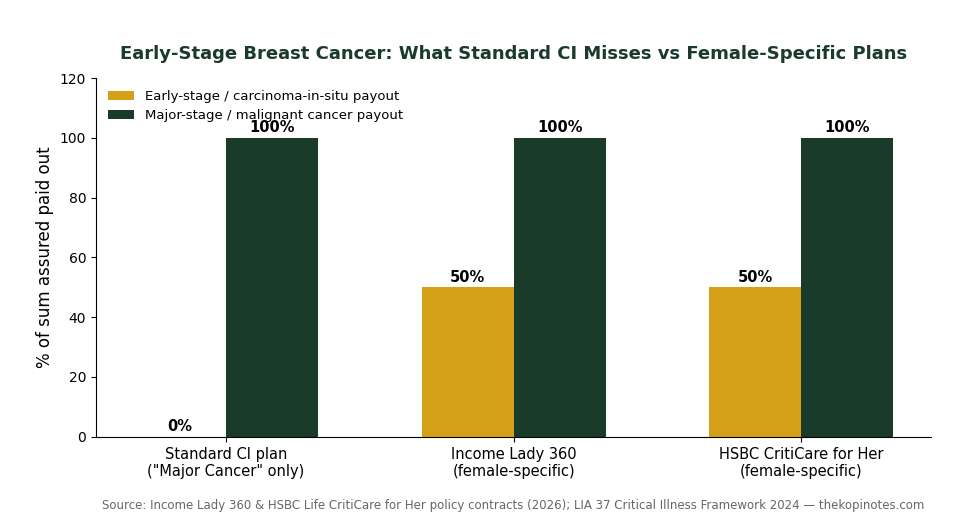
Say you’re diagnosed with carcinoma-in-situ of the breast after a routine mammogram. Your doctor calls it good news — caught early, highly treatable. Your standard CI plan may see it differently: not “Major Cancer”, so no payout.
This is where female-specific critical illness plans step in. They’re built around a “female illnesses benefit” that explicitly covers earlier stages of female-specific conditions, at a partial payout, on top of the full payout at the major stage.
Look at how this plays out across a standard CI plan versus two of the female-specific plans available in Singapore.
Female-Specific Critical Illness Plans in Singapore Compared
A handful of insurers in Singapore sell plans built specifically around female health conditions. Three you’ll come across often are NTUC Income’s Lady 360, HSBC Life’s CritiCare for Her, and AIA Glow of Life. Here’s how they stack up.
| Plan | Structure | Early-Stage Payout | Example Premium |
|---|---|---|---|
| Income Lady 360 | Standalone term plan (10yr renewable, or to age 64) | 50% of sum assured for carcinoma-in-situ of female sites | S$41.50/month for S$25,000 sum assured, non-smoker age 25 |
| HSBC Life CritiCare for Her | Standalone CI plan, 10/20yr term or to age 65 | 50% of sum assured for carcinoma-in-situ of the breast, resettable | From S$0.75/day for S$25,000 sum assured; S$1,470/year for S$100,000, 20yr term, age 30 |
| AIA Glow of Life | Standalone CI plan covering osteoporosis, rheumatoid arthritis, breast cancer | Covers breast cancer; free health check-up every 2 years from year 3 | Not published — quote via AIA adviser |
Source: Income Lady 360 product page (info as at 12 Mar 2026); HSBC Life CritiCare for Her product page (info as at 1 Feb 2026); AIA Glow of Life product page. Premiums are illustrative and subject to underwriting.
Notice the pattern. Both Income and HSBC pay 50% of your sum assured at the carcinoma-in-situ stage, then let you claim more later if the cancer progresses. That structure is exactly what a standard “Major Cancer only” CI plan doesn’t offer.
Income’s Lady 360 also covers other conditions many women don’t think to check for: chronic autoimmune hepatitis, rheumatoid arthritis, and systemic lupus erythematosus with lupus nephritis all pay 100% of your sum assured. Osteoporotic fractures of the hip and vertebra pay 50%.
A Real Worked Payout Example
Numbers on a benefit table are easy to skim past. HSBC Life publishes a worked example on its CritiCare for Her page that shows what an actual claims journey can look like — it’s illustrative, not a guarantee, but it’s useful to see the shape of it.
Sally is a 30-year-old with a HSBC CritiCare for Her policy: 20-year term, S$100,000 sum assured, paying S$1,470 a year. Here’s how her claims play out over the years, according to HSBC’s own published illustration.
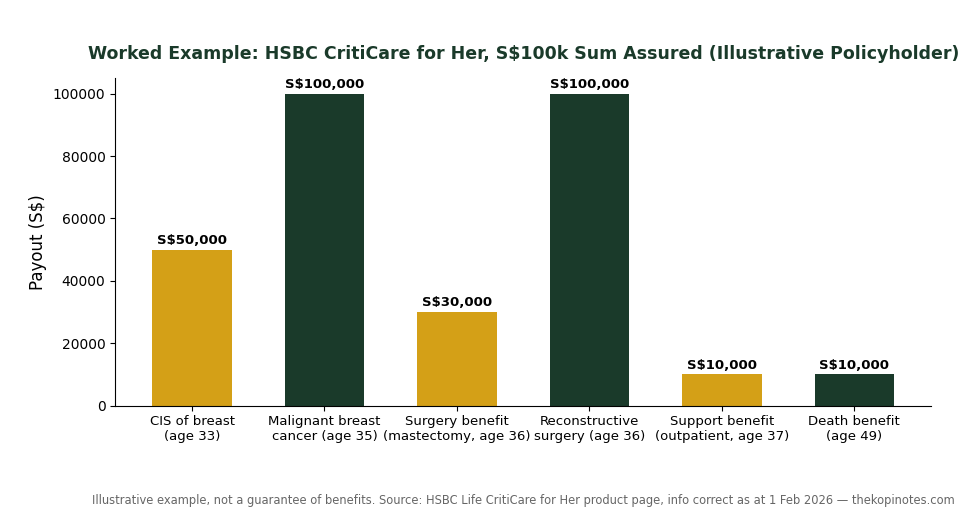
At age 33, Sally is diagnosed with carcinoma-in-situ of the breast after a routine check-up. She gets S$50,000 — 50% of her sum assured — plus a 36-month premium waiver. That’s a payout most standard CI plans would not have made at all.
At age 35, her cancer becomes malignant. She receives the remaining S$50,000, bringing her female illness benefit to the full S$100,000. Her benefit then resets after a 12-month wait, so she stays covered going forward.
Over the following years she also claims S$30,000 for a mastectomy, S$100,000 for reconstructive surgery, and S$10,000 in outpatient treatment support — separate benefit pots that don’t eat into her original female illness benefit. That’s real, multi-stage protection built around one condition.
Rider or Standalone? How to Add Female-Specific Cover
Both Lady 360 and CritiCare for Her are standalone plans — you buy them on their own, not as an add-on to an existing policy. That’s different from how most people buy CI cover, usually as a rider on term or whole life insurance.
This matters for two reasons. First, a standalone plan means your existing life or CI insurance stays untouched — a female-specific claim doesn’t eat into your life cover. Second, it also means you’re paying a separate premium on top of what you already have.
Before adding one, work out what your existing critical illness insurance actually covers. If you already hold a comprehensive multi-pay CI plan, check your critical illness insurance cost breakdown and read the policy wording for early-stage cancer coverage before assuming you need a second plan.
If your existing cover only pays at the major stage — which is common for older or basic term rider CI add-ons — a female-specific plan is a genuinely useful top-up, not a duplicate.
How Much Female-Specific Coverage You Actually Need
There’s no single right number, but three things should shape your sum assured: your existing CI coverage gap, your income replacement need during treatment, and what you can comfortably afford long-term.
Start with your critical illness coverage amount as a baseline — most guidance points to 3 to 5 years of income, covering treatment costs and lost earnings while you recover. A female-specific plan doesn’t need to replicate that whole number; it exists to plug the early-stage gap your main CI plan leaves open.
A practical starting point: S$50,000 to S$100,000 in female-specific sum assured is enough to cover a meaningful early-stage payout (S$25,000–S$50,000) plus room for surgery and support benefits, without duplicating your main CI plan’s major-stage payout.
Not sure where your overall protection stands today? Run your numbers through TKN’s insurance gap calculator first — it accounts for your existing life, CI, and income protection before you add anything new.
Common Mistakes Women Make When Buying CI Insurance
Assuming your existing CI plan covers early-stage cancer. Most don’t. Pull out your policy contract and check whether “Major Cancer” is the only cancer-related benefit, or whether there’s a separate early-stage/ECI rider.
Buying a female-specific plan as a full replacement. These plans are narrow by design — Lady 360’s death benefit, for example, is just S$10,000, nowhere near what a real life insurance need requires. Keep your term life and main CI plan in place.
Ignoring the waiting period. Most female-specific benefits require you to survive at least 7 days after diagnosis, and won’t pay if symptoms started or were investigated within 90 days of your cover start date. Buy before you need it, not after.
Overlooking self-employed and freelance status. If you’re a freelancer or gig worker, standard sick leave protections don’t apply to you. It’s worth reading how critical illness insurance works for self-employed Singaporeans alongside any female-specific cover you’re considering.
Not comparing across insurers. Payout percentages, resettable benefits, and premium waivers vary meaningfully between Lady 360, CritiCare for Her, and Glow of Life. Compare the best critical illness insurance plans in Singapore before committing to one insurer.
Frequently Asked Questions
Does standard critical illness insurance cover breast cancer in Singapore?
What is carcinoma-in-situ and why doesn't standard CI insurance cover it?
Should I buy a female-specific critical illness plan instead of a standard CI plan?
How much does a female-specific critical illness plan cost in Singapore?
Do these plans cover conditions other than breast cancer?
Can I claim more than once under a female-specific CI plan?
Is there a waiting period before I can claim on a female-specific CI plan?
What's the difference between Income Lady 360 and HSBC CritiCare for Her?
Check where your current life and critical illness coverage stands before adding a female-specific plan on top. TKN’s free insurance gap calculator factors in your existing policies first.
This article is for general educational purposes only and is not financial or medical advice. Premiums, benefit percentages, and definitions are illustrative and subject to underwriting; always read the actual policy contract and consult a licensed financial adviser before buying insurance. Data verified as at August 2026.
Get Free Insurance Advice
Speak with a licensed insurance advisor. No obligation, no cost.
By submitting this form, you agree to our Privacy Policy.
This article was researched with the help of AI. While we strive to keep all information accurate and up to date, there may be errors. If you notice any discrepancies, please contact us.