Why you need it more than salaried employees do
If you’re self-employed in Singapore, a serious illness doesn’t just bring medical bills — it stops your income overnight. Critical illness (CI) insurance pays a lump sum on diagnosis of conditions like cancer, heart attack, or stroke, so freelancers, gig workers, and sole proprietors can cover living costs and business overheads while they can’t work. Unlike salaried staff, you have no employer safety net to fall back on.
Not financial advice. All figures are for educational reference only. Data verified as at 14 August 2026.
- No employer means no paid sick leave, no group CI rider, and no salary continuation if you fall seriously ill — CI insurance is your main lump-sum safety net.
- CPF MediSave contributions are compulsory once your net trade income passes S$6,000/year, but that money pays medical bills, not living expenses — CI insurance fills that gap.
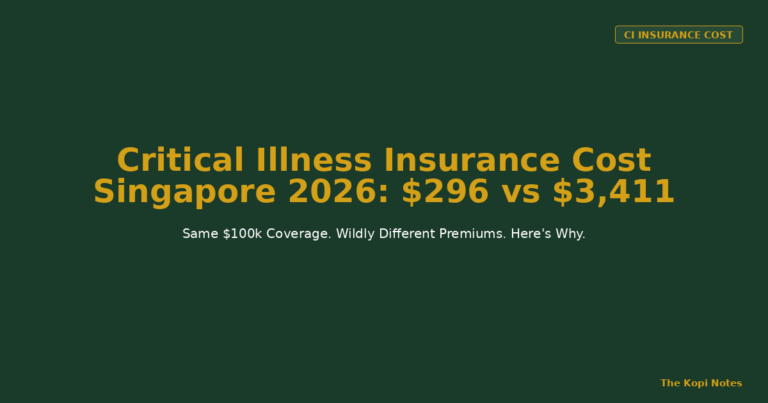
- Real 2026 quotes for S$100,000 CI cover range from S$296.20 to S$3,411 a year for the same age — shop by condition count and payout structure, not price alone.
1. Why Self-Employed Singaporeans Need CI Insurance More
2. How Much Coverage Should You Buy?
3. CPF MediSave: What It Does (and Doesn't) Cover
4. Real 2026 Premium Comparison
5. Choosing the Right CI Structure for Irregular Income
6. Common Mistakes Self-Employed Buyers Make
7. Frequently Asked Questions
1. Why Self-Employed Singaporeans Need CI Insurance More
When a salaried employee is diagnosed with cancer or has a stroke, the Employment Act still protects them. They keep drawing a salary during paid sick leave, and many companies pay for a group CI or hospitalisation rider on top of MediShield Life. That safety net doesn’t exist if you invoice clients, drive for a platform, or run your own small business.
For self-employed persons, the Employment Act’s paid sick leave provisions simply don’t apply. There’s no HR department topping up your income, and no employer-sponsored group insurance quietly protecting you in the background. If you can’t work, your income usually stops that same week.
Here’s how the two situations compare, side by side.
| Protection | Employee | Self-Employed |
|---|---|---|
| Paid sick leave | Up to 14 days outpatient / 60 days hospitalisation under the Employment Act | None — the Employment Act doesn’t cover self-employed persons |
| Employer CPF contribution | Employer contributes up to 17% of wages on top of your own share | None — you’re both employer and employee, so there’s no employer share |
| Group hospitalisation / CI insurance | Often provided or subsidised as an employee benefit | You have to buy and pay for every policy yourself |
| Income during recovery | Salary continues under the Employment Act | Stops the day you’re unable to invoice or take jobs |
Source: Ministry of Manpower Employment Act, CPF Board. Verified August 2026.
That’s the core reason CI insurance matters more, not less, once you’re self-employed. A lump-sum payout on diagnosis replaces the safety net an employer would otherwise provide.
2. How Much Coverage Should You Buy?
A common rule of thumb for employees is 3-5 years of annual income. For self-employed persons, you should think slightly differently. Your coverage needs to replace lost income and cover any fixed business overheads that don’t stop just because you’re in hospital — rent, software subscriptions, a part-time assistant’s pay, or loan repayments.
A practical starting formula: 6-12 months of your net trade income, plus a buffer of S$20,000-S$40,000 for treatment and recovery costs not covered by MediShield Life or your Integrated Shield Plan.
Take Mei, a 34-year-old freelance graphic designer with a net trade income of S$54,000 a year (about S$4,500 a month). Twelve months of income replacement is S$54,000. Add a S$30,000 buffer for treatment and slower recovery, and she lands at roughly S$84,000 — which rounds up neatly to the common S$100,000 sum assured tier most insurers offer.
If you’re not sure where you stand, run your numbers through TKN’s insurance gap calculator — it factors in existing coverage, dependants, and outstanding liabilities to estimate the shortfall.
3. CPF MediSave: What It Does (and Doesn’t) Cover
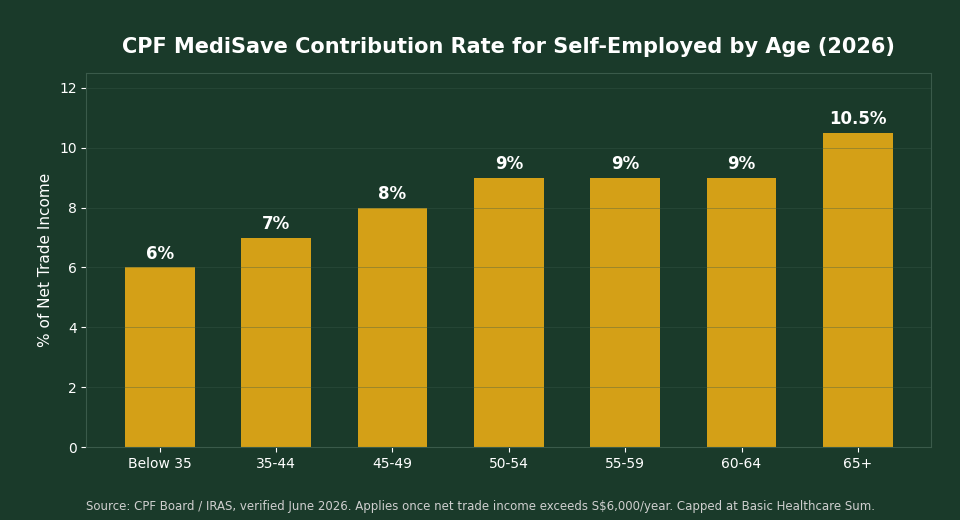
Self-employed persons in Singapore must contribute to MediSave once their net trade income exceeds S$6,000 a year. Unlike salaried CPF contributions, there’s no employer share — 100% comes out of your own pocket, and IRAS assesses the amount after you file your annual tax return.
| Age | MediSave Rate (% of net trade income) | Max annual MediSave contribution |
|---|---|---|
| Below 35 | 6% | S$10,700 |
| 35-44 | 7% | S$10,700 |
| 45-49 | 8% | S$10,700 |
| 50-54 | 9% | S$10,700 |
| 55-59 | 9% | S$10,700 |
| 60-64 | 9% | S$10,700 |
| 65 and above | 10.5% | S$10,700 |
Source: CPF Board, IRAS. Verified June-August 2026. See TKN’s full CPF contribution rate guide for self-employed persons for voluntary contribution options.
Here’s the key distinction: MediSave money is earmarked for hospital bills, MediShield Life premiums, and approved medical expenses. It cannot pay your rent, your assistant’s salary, or your own living costs while you recover. That’s precisely the gap a CI insurance lump-sum payout is designed to fill — the cash is yours to use however you need it.
One more thing to budget for: standalone CI insurance premiums generally do not reduce your income tax. IRAS’s Life Insurance Relief is capped at S$5,000 (and only available if your CPF contributions for the year are below that cap), and it applies mainly to base life insurance premiums — critical illness riders and standalone CI plans typically don’t qualify. Because CI insurance protects you personally rather than your trade, it also isn’t a deductible business expense. Treat the premium as a personal cost, not a future tax write-off.
4. Real 2026 Premium Comparison
Critical illness premiums vary far more than most first-time buyers expect. For the exact same S$100,000 sum assured at age 35, TKN’s 2026 CI cost comparison found real quotes ranging from S$296.20 to S$3,411 a year across major insurers.
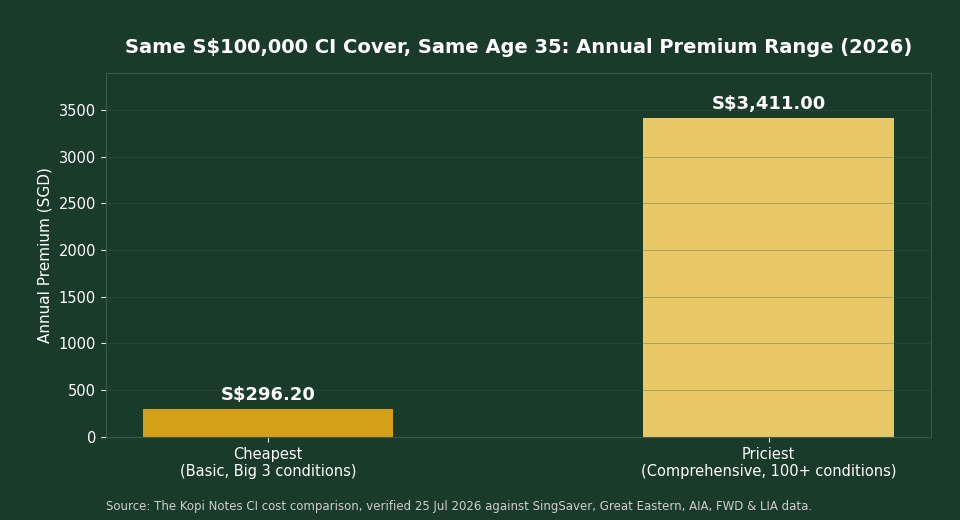
The gap comes down to how many conditions a plan covers (a basic Big 3 plan versus a 100+ condition comprehensive plan), whether it pays out once or multiple times over your life, and whether premiums stay level or climb every year on a yearly renewable term (YRT) basis.
As a freelancer with irregular income, a cheap YRT plan can look tempting in your first year. But YRT premiums rise every year and can become expensive once you’re in your 50s — right when your business overheads and dependants may be at their highest. Weigh the lower starting cost against that long-term trajectory before you commit.
5. Choosing the Right CI Structure for Irregular Income
Singapore insurers generally offer three CI structures: standalone CI (pays out once), multi-pay CI (can pay out multiple times for unrelated conditions), and early CI (ECI) riders that pay out at an earlier stage of illness, before it becomes a full “standard” critical illness. TKN’s early CI vs multi-pay vs standalone comparison breaks down how each structure works.
For self-employed buyers, multi-pay plans deserve a closer look. If you already have no paid sick leave for a first illness, you certainly won’t have any for a second, unrelated one years later. A multi-pay structure means you’re not left with zero CI protection after your first claim.
CI insurance also isn’t the only tool worth considering. It only pays out for a defined list of illnesses — it won’t help if an accident leaves you unable to work but doesn’t meet a CI definition. That’s where disability income insurance comes in, replacing a portion of your income for broader causes of incapacity. And if you have dependants relying on your income, pairing CI cover with income term life insurance ensures they’re protected even in the worst-case scenario.
6. Common Mistakes Self-Employed Buyers Make
A few patterns show up again and again among self-employed CI buyers in Singapore:
Sizing coverage off take-home pay, not gross billings. If your business has fixed overheads — a studio rental, a part-time hire, subscription tools — those costs don’t pause when you’re sick. Size your coverage around what it costs to keep the lights on, not just your personal spending.
Assuming MediSave or MediShield Life is enough. As covered above, MediSave money is ring-fenced for medical bills. It was never designed to replace lost income.
Skipping disability income insurance because “CI covers me.” CI only pays for a defined illness list. A back injury or chronic condition that isn’t on that list gets you nothing from a CI plan.
Buying once and never reviewing. As your business grows and your income rises, a sum assured that felt adequate at S$54,000/year of income can fall short a few years later at S$90,000/year. Revisit your coverage annually, especially after a good year.
7. Frequently Asked Questions
Can self-employed persons in Singapore buy critical illness insurance?
Do I need CI insurance if I already pay MediSave?
Is CI insurance premium tax-deductible for self-employed persons?
How much CI coverage should a freelancer buy?
What's the difference between CI insurance and disability income insurance?
Can I claim CI insurance and my Integrated Shield Plan at the same time?
Get Free Insurance Advice
Speak with a licensed insurance advisor. No obligation, no cost.
By submitting this form, you agree to our Privacy Policy.
This article was researched with the help of AI. While we strive to keep all information accurate and up to date, there may be errors. If you notice any discrepancies, please contact us.