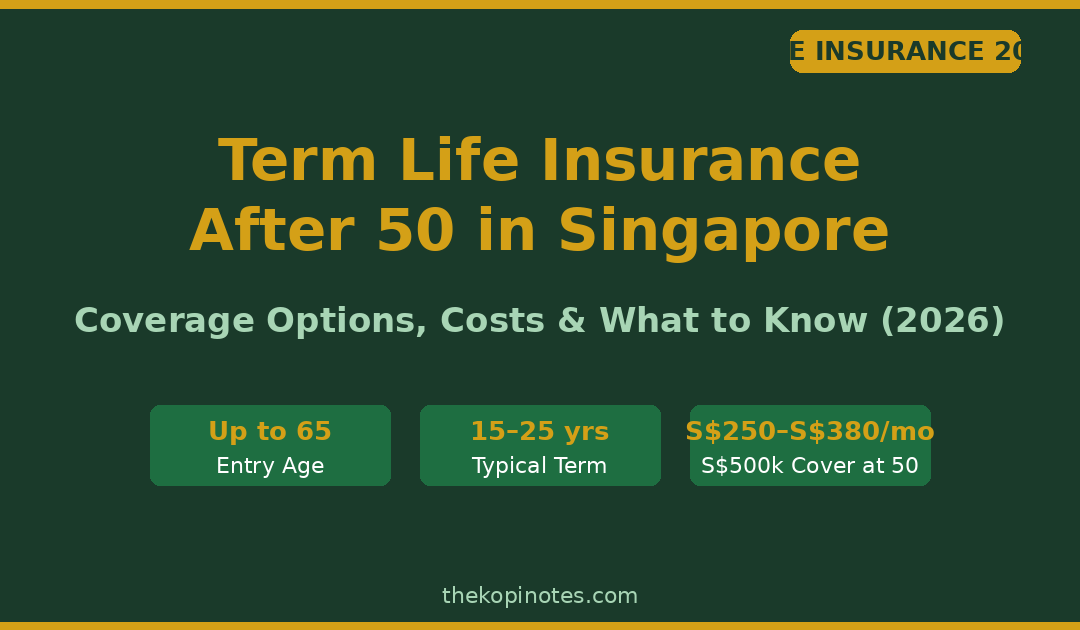
Data verified as at 29 August 2026. Premium figures are indicative benchmarks based on published market data — always obtain a personal quote directly from your insurer or licensed adviser before making any decision.
You’ve just turned 50 — or you’re close to it — and you’re wondering whether it’s too late to buy term life insurance in Singapore. The honest answer: no, it’s not too late, but it is more expensive and more complicated than if you’d started at 30. This guide tells you exactly what to expect.
Why You Might Still Need Term Life Coverage After 50
Many Singaporeans in their 50s have fewer financial buffers than they think. Consider these common situations:
Late-starting family: If you had children in your late 30s or 40s, a 50-year-old parent may still have teenagers or young adults who depend on your income for the next 10–15 years.
Outstanding mortgage: A 25-year HDB or private property loan taken at age 35 still has a decade left at age 50. If you die without coverage, your spouse may struggle to service the loan alone.
Business guarantees and liabilities: Business owners who have signed personal guarantees for company loans face real risk — a term policy can cover this liability.
Insufficient CPF: Many Singaporeans, especially those who took CPF housing withdrawals in the 1990s and 2000s, find their Retirement Account balance is below the Enhanced Retirement Sum (ERS). A term policy tops up the gap for dependants.
Ageing parents: Being the financial pillar for elderly parents adds another layer of responsibility that justifies coverage even without children.
Entry Age Limits by Insurer (2026)
Most Singapore life insurers still accept applications from people in their 50s. The key numbers to know: entry age limit (the oldest age at which you can buy a new policy) and maximum coverage age (how long the policy can run).
| Insurer | Max Entry Age | Max Coverage To Age | Notable Features for 50+ |
|---|---|---|---|
| AIA (Secure Flexi Term) | 65 | 99 | Conversion right to whole life before age 70; no medical exam needed to convert |
| Great Eastern (GREAT Term 2) | 65 | 85 | Flexible maturity ages (65/70/75/80/85); guaranteed renewability |
| FWD (Term Life Plus) | 65 | 85 | Direct online purchase; no agent required; fast quote engine |
| Manulife (ManuProtect Term) | 70 | 85 | One of the highest entry age limits; good option for late starters |
| Prudential (PRUActive Term II) | 65 | 85 | Convertibility to whole life or endowment; strong insurer brand |
| Income (Star Term Protect) | 65 | 85 | Backed by NTUC; competitive premiums; strong claims track record |
| Singlife (Elite Term II) | 65 | 85 | Digital-first insurer; competitive premiums for non-smokers |
| DPS (Govt scheme) | 60 | 65 | Auto-enrolled via CPF; very low premiums but capped at S$70k |
Sources: Individual insurer product summaries. Entry ages and coverage limits are as of August 2026; always verify the latest terms with your insurer. Max entry age refers to age at next birthday (ANB) unless stated otherwise.
Key takeaway: at 50 and even at 60, you can still get term life insurance from most major Singapore insurers. The window doesn’t close until age 65–70 for most plans.
For a comparison of all major best term life insurance plans in Singapore, see our full review.
How to Apply for Term Life Insurance After 50
The application process after 50 is broadly the same as at any age, but medical underwriting is stricter and more thorough.
Step 1: Calculate Your Coverage Need
Use the DIME method as a quick estimate: Debt (mortgage, personal loans) + Income (years of income your dependants need) + Mortgage (remaining balance) + Education (children’s future costs). For most Singaporeans over 50, the number is typically S$200,000–S$700,000. A detailed breakdown is in our guide on how much critical illness insurance you need (the same sizing framework applies to death coverage).
Step 2: Compare Term Length
For a 50-year-old, meaningful options are a 10-year term (coverage to 60) or a 15-year term (coverage to 65). A 20-year term is possible with Manulife and some others (to age 70). Shorter terms cost less but leave you uninsured at older ages. Most financial advisers recommend matching term length to your youngest dependant’s expected financial independence date.
Step 3: Prepare for Medical Underwriting
At 50+, insurers typically require:
- A full medical questionnaire (blood pressure, cholesterol, BMI, family history)
- A blood test and urine test for most sum assureds above S$200,000
- An ECG for applications above S$500,000
- Possible medical examination for high-sum or health-flagged applications
Common exclusions or premium loadings at 50+ include: hypertension, diabetes, high cholesterol, sleep apnoea, and previous cancer treatment. Insurers may still accept you with a premium loading (a surcharge for elevated risk) or an exclusion clause (covering everything except the flagged condition).
Step 4: Apply via a Financial Adviser or Direct
FWD and NTUC Income offer direct-purchase options online. Most other insurers require a licensed financial adviser. A fee-based or commission-based IFA (Independent Financial Adviser) can compare quotes across multiple insurers — which matters more at 50+ when premiums vary significantly. Compare the full term life insurance plan comparison to narrow down shortlisted plans before speaking to an adviser.
Alternatives If You Can’t Qualify (or Can’t Afford Premiums)
Not everyone over 50 will qualify for a standard-rate policy, especially with pre-existing conditions. Here are alternatives worth exploring:
1. DPS (Dependants’ Protection Scheme)
If you’re working and contributing to CPF, you are automatically enrolled in DPS — a government-backed term life scheme administered by Great Eastern and Singlife. It pays out S$70,000 on death or total permanent disability, up to age 65. Premiums are extremely affordable (S$228–S$365/year depending on age band), with no additional medical underwriting if you’ve been continuously enrolled. If you opted out in the past, you can re-apply but will need to pass medical underwriting.
2. Increase Existing Coverage via a Top-Up Rider
If you already hold a whole life policy from your 30s or 40s, check whether it has an Accelerated Death Benefit or Term Rider that you can increase. Some insurers allow you to add or top up riders on an existing policy with simplified (not full) underwriting.
3. Mortgage Reducing Term Assurance (MRTA)
If your primary concern is your outstanding mortgage, an MRTA product (offered by banks and insurers) covers specifically the loan balance — with premiums that decrease as the loan reduces. It’s cheaper than a flat-sum term policy and may be easier to qualify for. Note that it only protects the bank (not your family’s other needs), so it’s not a complete replacement for personal life insurance.
4. CPF Nomination and Building a Protection Fund
Singapore’s CPF nomination allows you to designate specific beneficiaries for your CPF savings (Ordinary, Special, MediSave, Retirement Accounts). Unlike a will, CPF nominations bypass probate and pay out within days of a claim. For those who can’t afford term premiums, ensuring a valid, updated CPF nomination (and maximising CPF top-ups under the prevailing ERS) is a meaningful protective measure. Pair this with a low-cost investment strategy through platforms like Endowus (referral code: 2V343) to grow investable assets for your family.
The CPF Angle: Does It Change the Equation?
For many Singaporeans in their 50s, CPF savings are their largest financial asset. Understanding how CPF interacts with life insurance needs can significantly change the calculation:
CPF Ordinary Account (OA): If you die, your CPF OA balance is distributed to nominated beneficiaries. For someone with S$150,000 in their OA at age 55, this alone provides some base protection for a spouse.
CPF Life Payouts: If you’ve met the Basic Retirement Sum (BRS) or Full Retirement Sum (FRS) in your Retirement Account, your CPF Life payouts will continue for life — but only to you, not to your beneficiaries after death (except for a small bequest from the premium pool). This means CPF Life does NOT replace life insurance for dependants.
What this means at 50+: If you have a large CPF balance (S$500k+) being built up toward retirement, you may need less term life coverage because your family can inherit the OA/SA/MA balances at death. But if your CPF has been heavily used for housing and your RA is low, the insurance gap is real. See our term vs whole life insurance comparison for a full framework on deciding between coverage types in later life.
Start Building Your Insurance Gap Picture
Use our free insurance gap calculator and compare the best term life plans in Singapore to see exactly where you stand.
Frequently Asked Questions
Can I still buy term life insurance at age 55 in Singapore?
What is the maximum age to buy term life insurance in Singapore?
How much does term life insurance cost at age 50 in Singapore?
Will I need a medical examination to get term life insurance after 50?
Can I get term life insurance if I have high blood pressure or diabetes?
Is it better to buy a shorter or longer term at age 50?
What happens to DPS coverage at age 60?
Should I get term or whole life insurance after 50?
How does CPF affect my life insurance needs after 50?
Get Free Insurance Advice
Speak with a licensed insurance advisor. No obligation, no cost.
By submitting this form, you agree to our Privacy Policy.
This article was researched with the help of AI. While we strive to keep all information accurate and up to date, there may be errors. If you notice any discrepancies, please contact us.