Whole Life Insurance Singapore 2026: Is It Worth It? Complete Guide
Whole life premiums, cash value, best plans and the honest verdict — for Singapore residents in 2026.
Whole life insurance Singapore policies provide lifetime coverage combined with a cash value component that grows over time. Unlike term life insurance, premiums are higher but a portion accumulates as a savings element you can surrender or borrow against. For a 30-year-old male non-smoker, annual premiums for S$500,000 whole life coverage typically range from S$3,100 to S$4,250 per year — roughly 5 to 6 times more expensive than equivalent term coverage.
Not financial advice. All figures are for educational reference only. Data as at June 2026 unless noted.
Table of Contents
Contents — Click to expand
- What Is Whole Life Insurance?
- How Whole Life Insurance Works in Singapore
- Whole Life Premiums by Age (2026)
- Cash Value: How It Grows and When You Can Use It
- Whole Life vs Term Life: Which Is Better?
- Best Whole Life Insurance Plans Singapore 2026
- Who Should Buy Whole Life Insurance?
- How to Buy Whole Life Insurance in Singapore
- Frequently Asked Questions
What Is Whole Life Insurance?
Whole life insurance (also called permanent life insurance) provides coverage for your entire lifetime — not just a fixed term. As long as premiums are paid, beneficiaries receive a death benefit whenever you pass away. In Singapore, whole life policies from major insurers (Great Eastern, AIA, Prudential, NTUC Income, Manulife, Singlife) include two core components: a death benefit (sum assured) paid on death or total permanent disability, and a cash value — a savings element that accumulates as part of your premium is invested in the insurer’s participating (par) fund.
Most Singapore whole life plans also allow a critical illness (CI) rider, providing an advance payout if diagnosed with one of the 37 conditions under the Life Insurance Association (LIA) framework — cancer, heart attack, and stroke being the most common claims.
How Whole Life Insurance Works in Singapore
Your premium is split into two buckets: the cost of insurance (mortality charge) and the par fund contribution. Over time, your par fund share grows into the policy’s cash value, comprising a guaranteed cash value (contractually minimum) plus non-guaranteed reversionary bonuses declared annually and a terminal bonus paid on surrender or maturity.
Most Singapore policies use a limited premium payment term — commonly 20 or 25 years, or to age 65. After payments end, coverage continues for life at no further cost. Key payment terms:
| Premium Term | Description | Best For |
|---|---|---|
| 20-Year Limited Pay | Pay for 20 years; covered for life | High earners wanting to finish by ~age 50 |
| Pay to Age 65 | Pay until retirement; covered for life | Lower annual premium preference |
| Whole Life Pay | Pay premiums forever | Lowest annual outlay |
Source: TKN overview of standard Singapore whole life policy structures, June 2026.
Whole Life Premiums by Age (2026)
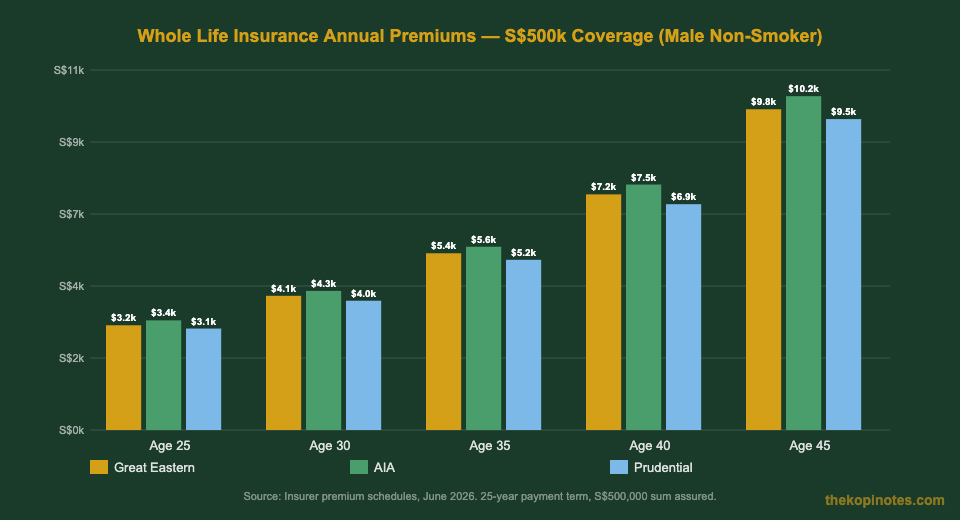
Whole life premiums are substantially higher than term life because part of every payment builds cash value. Below are approximate annual premiums for a S$500,000 sum assured, 20-year limited pay whole life policy for a male non-smoker in 2026.
| Age | Great Eastern | AIA | Prudential | Monthly (Avg) |
|---|---|---|---|---|
| 25 | S$3,200 | S$3,350 | S$3,100 | ~S$265 |
| 30 | S$4,100 | S$4,250 | S$3,950 | ~S$345 |
| 35 | S$5,400 | S$5,600 | S$5,200 | ~S$450 |
| 40 | S$7,200 | S$7,500 | S$6,900 | ~S$600 |
| 45 | S$9,800 | S$10,200 | S$9,500 | ~S$820 |
Source: Approximate premium schedules from insurer illustrative quotes, June 2026. 20-year limited pay, S$500,000 basic sum assured, non-smoker. Equivalent 20-year term life costs approximately S$500–S$800/yr for the same sum assured.
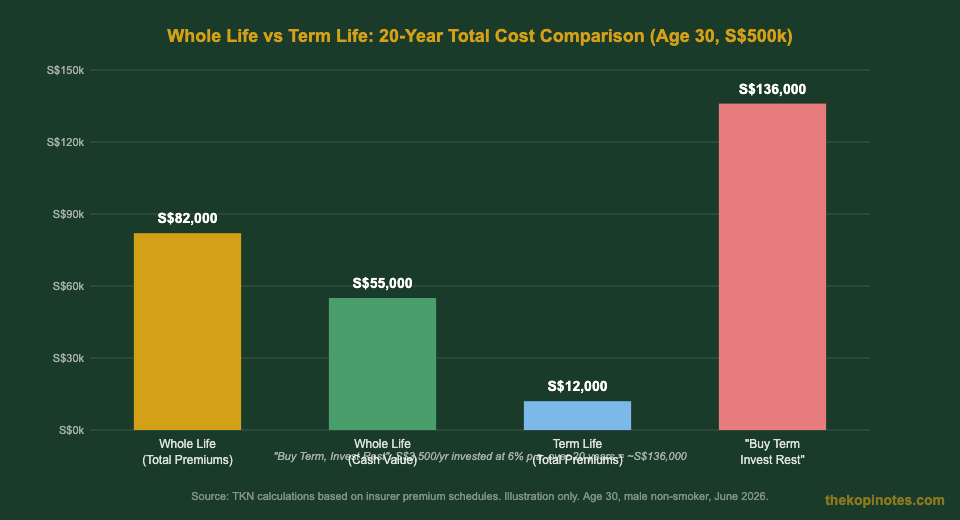
A 30-year-old starting today would pay approximately S$4,100 × 20 years = S$82,000 in total premiums. A 20-year term life policy for the same sum assured costs roughly S$600/yr × 20 years = S$12,000 — a S$70,000 difference. Whether the gap is worth it depends on the cash value and permanent coverage you receive in return.
Cash Value: How It Grows and When You Can Use It
Cash value is the surrender value of your policy — what the insurer pays if you cancel. It is not a bonus on top of the death benefit. It comprises a guaranteed portion (contractually stated) plus non-guaranteed par fund bonuses. Cash value builds slowly in the first 5–10 years and accelerates thereafter. For a 30-year-old with S$500,000 sum assured on a 20-year pay plan:
| Policy Year | Guaranteed Cash Value | Projected Total (incl. bonuses) | Return on Premiums Paid |
|---|---|---|---|
| Year 5 | S$12,000 | S$18,500 | ~37% of premiums paid |
| Year 10 | S$32,000 | S$47,000 | ~57% of premiums paid |
| Year 20 (end of pay) | S$55,000 | S$90,000 | ~110% of premiums paid |
| Age 65 | S$95,000 | S$180,000 | Continues growing |
| Age 85 | S$140,000 | S$320,000 | Death benefit remains S$500k |
Source: TKN illustration based on Singapore insurer product summaries, June 2026. Non-guaranteed projections assume 4.25% p.a. par fund return (MAS-mandated illustration rate). Actual returns may vary.
You can access your cash value in three ways: (1) Surrender the policy and receive the cash — losing all coverage; (2) Take a policy loan of up to ~80–90% of cash value at ~5–6% p.a. interest; (3) Use a premium holiday — let accumulated cash value pay premiums if cash-strapped. The MAS requires insurers to show both 3.25% and 4.25% p.a. par fund scenarios in the Benefit Illustration — always read the lower scenario.
Whole Life vs Term Life: Which Is Better for Singapore?
For pure income replacement, term life wins on cost. For permanent coverage and legacy planning, whole life has its place. The key comparison:
| Feature | Whole Life | Term Life (20yr) |
|---|---|---|
| Coverage period | Lifetime | Fixed term |
| Annual premium (S$500k, age 30M) | ~S$4,000/yr | ~S$600/yr |
| Cash value | Yes | None |
| Best for | Estate planning, lifelong CI | Income replacement (working years) |
| Renewability | Never expires | Must renew at higher cost |
| Par fund return | ~3–4% p.a. | No returns |
Source: TKN comparison based on Singapore insurer plan features, June 2026.
The popular “Buy Term, Invest the Rest” approach: buy cheap term for protection, invest the S$3,400/yr saving in diversified ETFs or passive income assets. At 6% p.a. over 20 years, that grows to ~S$136,000 vs ~S$90,000 whole life cash value. However, whole life provides permanent CI coverage past age 70 when term renewals become prohibitively expensive — a point many “buy term” advocates underweight.
Best Whole Life Insurance Plans Singapore 2026
All major Singapore insurers offer whole life plans. Key plans to consider as at June 2026:
| Insurer | Plan | Key Feature | Par Fund 5-yr | CI Rider |
|---|---|---|---|---|
| Great Eastern | GREAT Life Advantage | Highest early guaranteed cash value | 4.1% p.a. | Yes |
| AIA | AIA Guaranteed Protect Plus | Flexible sum assured multiplier | 3.9% p.a. | Yes |
| Prudential | PRUActive Life II | Lowest premiums; strong bonuses | 4.0% p.a. | Yes |
| NTUC Income | VivoLife | Cooperative; above-average bonuses | 4.2% p.a. | Yes |
| Manulife | ReadyProtect | Strong CI coverage; global backing | 3.8% p.a. | Yes |
| Singlife | Singlife Whole Life | Digital-first; competitive pricing | 3.7% p.a. | Yes |
Source: TKN review of Singapore insurer plan brochures and par fund performance reports, June 2026. Par fund returns are 5-year annualised figures and non-guaranteed going forward.
When comparing plans, focus on: (1) guaranteed cash value at years 5, 10, and 20; (2) par fund 5- and 10-year track record; (3) CI rider annual cost. Always compare at least three Benefit Illustrations side-by-side. The LIA CompareFIRST portal allows limited online comparisons without an adviser.
Who Should Buy Whole Life Insurance?
Whole life makes most sense for: (1) Legacy and estate planning — guaranteeing a sum to pass on regardless of when you die; (2) Lifelong CI coverage — protecting against critical illness in retirement when new standalone CI policies become unaffordable; (3) Forced savings discipline — the compulsory premium acts as structured savings; (4) Business keyman insurance — permanent coverage for key executives; (5) High-income earners who have maximised CPF and SRS and want a low-volatility savings vehicle.
Whole life is generally not the right choice if: your primary need is income replacement (use term life insurance instead); you have limited disposable income (premium gap vs term is significant); or your main goal is investment returns (par fund 3–4% p.a. lags diversified equity ETFs historically). Use our retirement calculator to see how that premium gap compounds over time.
Many Singapore advisers recommend a hybrid approach: small whole life base plan for permanent CI + larger term policy for income protection + ETF/S-REIT investments via Syfe or Endowus for wealth accumulation.
How to Buy Whole Life Insurance in Singapore
Two main routes: Route 1 — Financial Adviser (FA): Most common. An MAS-licensed FA conducts a Financial Needs Analysis, recommends a plan, and processes the application. Advantage: personalised advice and full rider access. Disadvantage: commission-driven (typically 30–50% of first-year premium). Route 2 — Direct Purchase Insurance (DPI): MAS requires insurers to offer simplified online whole life plans without adviser commission. Lower premiums but no advice. Access via CompareFIRST.sg.
Before buying, use our Insurance Gap Calculator to determine how much coverage you actually need. A common rule: 9–10x your annual income for income replacement, adjusted for existing CPF DPS coverage and outstanding mortgage. You can also use your SRS account to pay premiums on qualifying whole life plans — providing annual tax deductions of up to S$15,300. Check insurer eligibility before assuming SRS payment is available for your specific plan.
Disclaimer: The Kopi Notes is not a licensed financial adviser. Nothing in this article constitutes financial or insurance advice. Consult a MAS-licensed financial adviser before purchasing any insurance product.
Frequently Asked Questions
What is whole life insurance Singapore and how does it differ from term life?
Whole life insurance provides lifelong death benefit coverage combined with a cash value savings component. Unlike term life — which covers you for a fixed period and has no savings element — whole life never expires and builds up a surrender value you can access while alive. The trade-off is significantly higher premiums: roughly 5–7 times more expensive than equivalent term cover for a Singapore resident.
Is whole life insurance worth it in Singapore 2026?
It depends on your goals. If your primary need is income replacement during working years, term life is more cost-efficient. Whole life is worth considering if you need permanent CI coverage in retirement (when new CI policies become unaffordable), want a capital-protected savings vehicle, or have estate planning goals. Many Singapore advisers recommend a hybrid: small whole life base for permanent CI + larger term plan for income protection.
How much does whole life insurance cost per month in Singapore?
For S$500,000 sum assured (20-year limited pay), a male non-smoker aged 30 pays approximately S$3,950–S$4,250 per year (about S$330–S$355 per month) depending on the insurer. At age 25 the same coverage costs roughly S$260–S$280/month; at age 40 it rises to approximately S$575–S$625/month. Smoker rates are typically 50–100% higher.
Can I use CPF or SRS to pay for whole life insurance in Singapore?
CPF funds generally cannot pay whole life insurance premiums directly. However, your Supplementary Retirement Scheme (SRS) account can pay premiums on qualifying whole life plans, providing a tax deduction. Check with your insurer whether the specific policy is SRS-eligible. The CPF Dependants’ Protection Scheme (DPS) is a separate basic term-equivalent policy that auto-enrols CPF members — it does not apply to standalone whole life plans.
What happens if I stop paying whole life insurance premiums?
Your insurer will first use accumulated cash value to pay premiums on your behalf via an automatic premium loan. Once cash value is exhausted, the policy lapses. Before that happens, you can: (1) surrender for the current cash value; (2) use a premium holiday if available; or (3) convert to a reduced paid-up policy with a lower sum assured but no further premiums required. Contact your insurer promptly if facing payment difficulties.
Which insurer has the best whole life insurance plan in Singapore 2026?
There is no single best plan — the right choice depends on your age, health, and whether you want CI riders. As at June 2026, Great Eastern’s GREAT Life Advantage and NTUC Income’s VivoLife have the strongest par fund track records (4.1–4.2% p.a. over 5 years). Prudential’s PRUActive Life II tends to offer the most competitive premiums. Always compare at least three Benefit Illustrations focusing on guaranteed (not just projected) cash values.
What is the cash value of whole life insurance and when can I access it?
Cash value is the surrender value of your policy — the amount you receive if you cancel. For a 30-year-old with a S$500,000 policy on a 20-year pay plan, expected cash value at year 20 is approximately S$55,000 (guaranteed) to S$90,000 (projected including bonuses). You can access it by surrendering, taking a policy loan (up to ~80–90% of cash value), or using it to pay premiums during a cash flow crunch.
Is whole life insurance a good investment for Singapore residents?
Whole life is not primarily an investment — it is a protection product with a savings component. Par fund returns of 3–4% p.a. are generally lower than diversified equity ETFs historically (7–9% p.a. real). However, the par fund offers lower volatility and capital protection. If wealth accumulation is your primary goal, ETFs or S-REITs via platforms like Syfe or Endowus are more efficient. Use whole life for permanent, guaranteed protection with a modest low-risk savings element.
Do I need whole life insurance if I already have term life in Singapore?
Not necessarily — it depends on life stage and goals. Term life suffices for most working Singaporeans needing income replacement. Whole life adds value if you want coverage past the term expiry (especially for CI in retirement), wish to leave a guaranteed legacy, or want a forced savings element with insurance protection. Many advisers suggest reviewing your insurance portfolio at age 40–45 to determine if a small whole life base plan makes sense alongside existing term coverage.
Plan Your Insurance and Investment Strategy
Use our free tools and top Singapore investment platforms to build a complete financial plan.
Get Free Insurance Advice
Speak with a licensed insurance advisor. No obligation, no cost.
By submitting this form, you agree to our Privacy Policy.
This article was researched with the help of AI. While we strive to keep all information accurate and up to date, there may be errors. If you notice any discrepancies, please contact us.