What Is Endowus? Singapore’s CPF, SRS & Cash Robo-Advisor Explained (2026)
The only MAS-licensed platform that lets you invest your CPF, SRS and cash together — explained in plain English.
Endowus is a MAS-licensed robo-advisor and Singapore’s only platform that lets you invest your CPF, SRS and cash together in one account. It gives you access to over 300 institutional-class funds with zero sales charges, at yearly fees between 0.25% and 0.60%. If you want your CPF Ordinary Account earning more than 2.5%, Endowus is worth understanding first.
Not financial advice. All figures are for educational reference only. Data as at July 2026 unless noted.
- Endowus is the only Singapore robo-advisor that invests your CPF, SRS and cash in the same low-cost funds
- You pay one access fee (0.25%-0.60% depending on how much you invest) on top of the fund’s own expense ratio
- Sign up takes about 10 minutes and there’s no minimum for cash accounts
What Is Endowus, Exactly?
Endowus is a Singapore-founded digital wealth platform, set up in 2017 and running since 2019. It holds a Capital Markets Services (CMS) Licence from the Monetary Authority of Singapore (MAS) — that’s the regulator’s stamp that it’s allowed to give investment advice and handle your money here.
Here’s what makes Endowus different from every other robo-advisor in Singapore: it’s the only one that lets you invest your CPF Ordinary Account, SRS and cash savings through the same platform. Most robo-advisors only take cash. Endowus built its whole business around the idea that your CPF money shouldn’t just sit there earning 2.5%.
As at late 2024, Endowus reported managing over S$10 billion in assets. That scale matters — it’s what lets Endowus negotiate institutional pricing on funds that would normally cost retail investors much more.
The idea behind Endowus is fairly simple: banks and pension funds have always had access to cheaper, institutional-class share classes of the same funds ordinary investors buy through banks or insurance agents. Endowus’s founders built a platform to pass that pricing on to everyday Singaporeans, instead of the retail-priced version with higher embedded costs. That’s also why Endowus doesn’t earn sales commissions the way a traditional bank relationship manager might — its revenue comes from the access fee it charges you directly, which it says keeps its incentives aligned with getting you a good outcome rather than pushing a specific fund.
How Endowus Works: CPF, SRS & Cash
You open one account, then choose which pool of money you want to invest. Each one has different rules:
| Account Type | What It Is | Why People Use It |
|---|---|---|
| Cash | Money from your bank account | No lock-in, full flexibility, no minimum |
| CPF Ordinary Account (OA) | Your CPF-OA savings, invested via CPFIS | CPF-OA earns a base 2.5% p.a. — investing aims to beat that over the long run |
| SRS | Supplementary Retirement Scheme funds | Tax relief on contributions, plus tax-deferred growth |
Source: Endowus product pages, verified July 2026.
Your CPF and SRS money is priced separately from cash — it doesn’t get mixed in for fee-tier purposes. We’ll break down exactly what that costs you in the fees section below.
What Can You Invest In?
Endowus calls its fund platform Fund Smart. It gives you access to more than 300 institutional-class funds — the same share classes that banks and pension funds get, not the retail versions with higher fees. That covers equity funds, fixed income (bond) funds, multi-asset portfolios, and ESG (environmental, social, governance) strategies.
There are no sales charges on any fund, no switching fees if you change your mind, and trailer commissions (the kickback fund managers usually pay distributors) are fully rebated back into the fund rather than pocketed by Endowus.
You don’t have to pick funds yourself. Endowus builds ready-made portfolios based on your risk profile, so most people just answer a few questions and let the platform do the allocating. The two main options are:
- Core (Flagship) portfolios — broad, globally diversified allocations across equities and bonds, built to track major market indices at low cost. This is the default choice for most first-time investors.
- Factor portfolios — tilt the allocation toward specific academically-backed factors (like value or small-cap), aiming to capture a long-term premium over the broad market, in exchange for potentially bumpier short-term performance.
Both options rebalance automatically over time, so you’re not manually buying and selling every time markets move.
Endowus Fees Explained
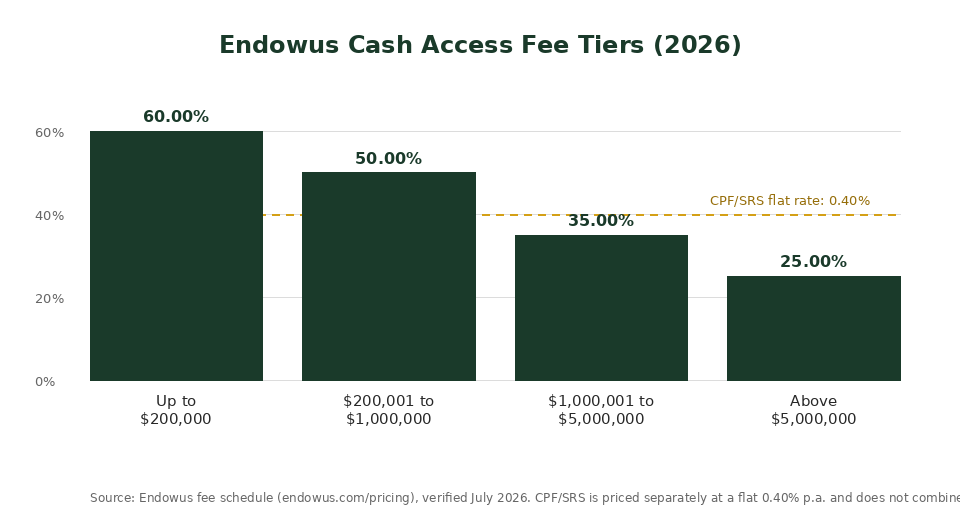
Endowus charges an “access fee” for its advice, platform and fund access. For cash, that fee drops in tiers as you invest more:
| Cash Invested | Access Fee (p.a.) |
|---|---|
| Up to S$200,000 | 0.60% |
| S$200,001 to S$1,000,000 | 0.50% |
| S$1,000,001 to S$5,000,000 | 0.35% |
| Above S$5,000,000 | 0.25% |
Source: Endowus pricing page, verified July 2026.
That access fee isn’t the only cost. Each underlying fund also charges its own expense ratio — typically 0.10% to 0.50% p.a. for the institutional-class funds Endowus uses. Layer the two together and here’s roughly what you’d pay in total:
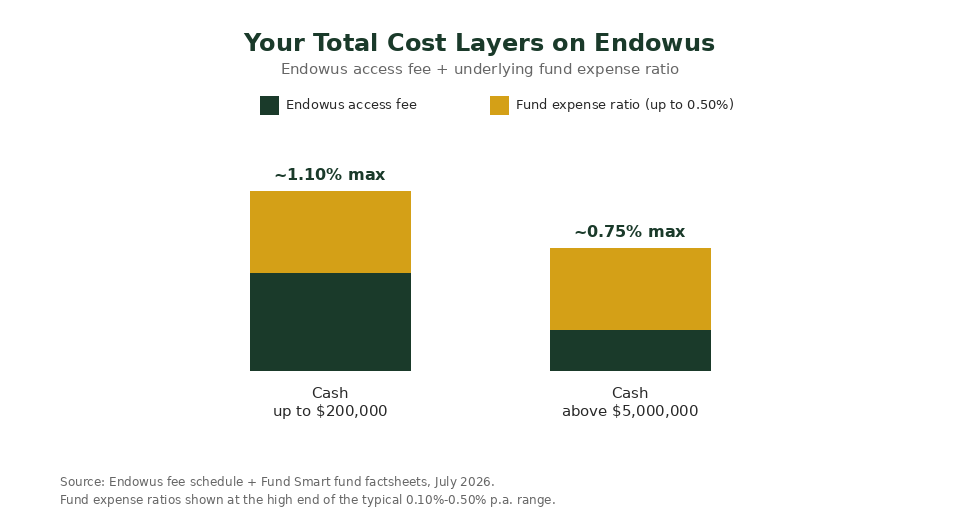
In other words, a smaller investor pays roughly 0.70%-1.10% a year all-in, while a large investor above S$5 million pays closer to 0.35%-0.75%. For a full line-by-line breakdown, see our detailed guide to Endowus fees.
Here’s what that looks like in dollars. Say you invest S$50,000 cash in a Core portfolio. You’re in the “up to S$200,000” tier, so you pay a 0.60% access fee — about S$300 a year — plus the fund’s own expense ratio, say 0.30% — another S$150 a year. All-in, that’s roughly S$450 a year, or about S$37.50 a month, before any investment gains or losses. Compare that figure against what you’re paying (or not paying) anywhere else you currently hold that S$50,000, so you know exactly what you’re trading off.
Endowus vs Other Robo-Advisors
Syfe, StashAway and FSMOne all let you invest cash. But Endowus remains the only one of the major players that also handles CPF-OA and SRS money in the same account — that’s the single biggest reason people choose it over the alternatives.
That said, “only one that does CPF/SRS” doesn’t automatically mean “best for everyone.” If you only ever plan to invest cash, it’s worth weighing Endowus against the competition on fees and fund choice. We’ve laid out the full picture in our Best Robo Advisors in Singapore comparison and our Endowus CPFIS guide for investing your CPF-OA.
Is Endowus Right for You?
| Pros | Cons |
|---|---|
| Only platform for CPF-OA + SRS + cash investing | Access fee is charged regardless of fund performance |
| Access to 300+ institutional-class funds, no sales charge | No direct single-stock or REIT trading |
| Fee tiers reward larger portfolios | CPF/SRS returns are not guaranteed — you can lose money vs the CPF-OA floor |
If you already max out your CPF-OA at 2.5% and want to explore whether long-term market returns could do better — while accepting the risk that markets can also fall — Endowus is worth a look. If you’re risk-averse and want guaranteed returns, comparing against your retirement planning calculator projections first is a sensible gut-check before moving CPF money anywhere.
How to Sign Up (With Referral Code)
Signing up takes about 10 minutes: download the Endowus app or visit the website, verify your identity with Singpass, answer a short risk questionnaire, then fund your account with cash, CPF-OA or SRS.
If you use referral code 2V343 when you sign up, you and the friend who referred you both get a fee credit. Full terms and the latest referral bonus amount are via the button below.
Frequently Asked Questions
Is Endowus legit and MAS regulated?
What is the minimum amount to start with Endowus?
Can I lose money investing my CPF-OA through Endowus?
How is Endowus different from Syfe or StashAway?
What happens to trailer fees on Endowus funds?
Do I pay tax on Endowus investment gains?
How much does Endowus charge in total fees?
Can foreigners use Endowus in Singapore?
Disclaimer: This article is for educational purposes only and is not financial advice. Fee figures are sourced from Endowus’s published pricing page as at July 2026 and may change — always verify current rates directly with Endowus before investing. The Kopi Notes may earn a referral fee if you sign up using our link, at no extra cost to you.
This article was researched with the help of AI. While we strive to keep all information accurate and up to date, there may be errors. If you notice any discrepancies, please contact us.