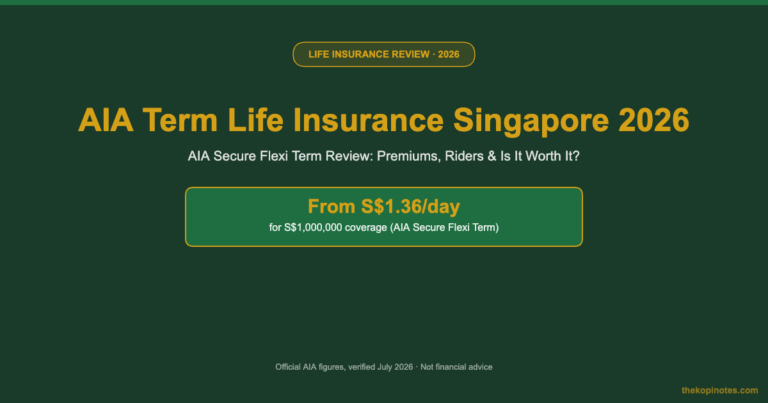
Term life insurance is the cheapest way to protect your family — but Singapore’s market has over 20 insurers, wildly different premiums, and policy terms that can catch you out. This guide cuts through the noise with real 2026 premium data, a 5-insurer comparison, and a clear framework for how much cover you actually need.
Key Takeaways
- Term life pays a lump sum if you die (or are diagnosed terminal) within the policy term — no cash value, just pure protection.
- A healthy 35-year-old can get S$1 million of cover for S$700–S$900/year — roughly the cost of two Grab rides a week.
- The standard recommendation is 9–10× your annual income, adjusted for dependants, debts, and CPF.
- Renewable vs fixed-term matters: most Singapore plans offer 20–40 year terms or coverage to age 65/70/99.
- Check if your plan includes TPD (Total Permanent Disability) — not all do at no extra cost.
- Use our Insurance Gap Calculator to find your exact shortfall before you compare plans.
What Is Term Life Insurance?
Term life insurance is the simplest form of life cover. You pay a fixed annual premium; if you die or are diagnosed with a terminal illness during the policy term, the insurer pays your beneficiaries a lump sum (the “sum assured”). If you outlive the term, you get nothing back — no cash value, no bonuses.
That is exactly why term life is so affordable. You are buying pure protection, not a savings or investment wrapper. For most working Singaporeans with dependants, term life is the single most cost-effective tool to plug the income-replacement gap.
Key features of term life in Singapore
- Death benefit: Lump sum paid to beneficiaries on death during the term.
- Terminal illness benefit: Most Singapore policies advance the death benefit (typically 100%) on diagnosis of a terminal condition, regardless of age.
- Total Permanent Disability (TPD): Many plans include TPD cover up to age 65 or 70 at no extra charge — check this before signing.
- No cash value: Unlike whole life or endowment plans, term policies do not accumulate a surrender value.
- Renewable or level-term: You can choose a fixed term (e.g., 20 years) or coverage to a specific age (e.g., 65, 70, 99).
Who needs term life insurance?
Term life makes most sense if you have dependants (spouse, children, ageing parents) who rely on your income, or significant liabilities (HDB mortgage, car loan) that would become a burden if you were gone. Singles with no dependants and no major debts generally need less cover — but many still buy a smaller policy for final expenses and to lock in insurability while young and healthy.
How Much Cover Do You Need?
The Life Insurance Association (LIA) of Singapore recommends a minimum of 9 times your annual income as a starting benchmark. However, the right number depends on your specific situation.
A simple framework: Sum Assured = (Annual income × 10) + Outstanding debts – Existing liquid assets
For a 35-year-old earning S$6,000/month (S$72,000/year) with a S$400,000 HDB mortgage and S$50,000 in savings, the rough calculation is: (S$72,000 × 10) + S$400,000 − S$50,000 = S$1,070,000. Most financial advisers would round this to a S$1 million term policy.
The Insurance Gap Calculator on this site does this calculation automatically, factoring in CPF and existing DPS cover.
Factors that increase your cover need
- Stay-at-home spouse (economic value of childcare/homemaking)
- Children under 18 (until they are financially independent)
- Ageing parents dependent on your income transfer
- Self-employed (no employer group insurance fallback)
Factors that reduce your cover need
- Significant CPF Ordinary Account balance (accessible by beneficiaries via CPF nomination)
- DPS (Dependants’ Protection Scheme) — automatic S$70,000 cover via CPF; read our DPS Singapore guide
- Existing employer group insurance
- Accumulated liquid assets or investments
2026 Premium Comparison Table
The table below shows indicative annual premiums for a S$1,000,000 sum assured, 30-year term (or to age 65 where 30-year is unavailable), non-smoker rates. Actual premiums depend on health declaration and underwriting.
| Insurer / Plan | Age 30 (M/F) | Age 35 (M/F) | Age 40 (M/F) | Age 45 (M/F) | TPD Included? |
|---|---|---|---|---|---|
| Singlife Term Life II | S$540 / S$380 | S$780 / S$540 | S$1,230 / S$840 | S$2,050 / S$1,380 | Yes (to age 70) |
| FWD Term Life | S$490 / S$360 | S$720 / S$510 | S$1,180 / S$810 | S$1,990 / S$1,340 | Yes (to age 65) |
| Manulife Term to 100 | S$560 / S$400 | S$820 / S$570 | S$1,310 / S$890 | S$2,200 / S$1,480 | Yes (to age 70) |
| AIA Secure Term II | S$530 / S$375 | S$770 / S$535 | S$1,250 / S$855 | S$2,080 / S$1,400 | Yes (to age 70) |
| Prudential PRULife Income II | S$580 / S$415 | S$850 / S$590 | S$1,360 / S$930 | S$2,280 / S$1,530 | Yes (to age 70) |
*Indicative non-smoker premiums for S$1M sum assured, 30-year term. Actual premiums depend on underwriting. Source: insurer product sheets and policywatcher.sg comparisons, June 2026.
Best Term Life Plans in Singapore 2026
Best for lowest premiums: FWD Term Life
FWD consistently offers the most competitive rates among direct-purchase plans. Their online-only model eliminates adviser commission, passing savings to the policyholder. The drawback: no in-person advisory support. Suitable for buyers who understand their coverage needs and are comfortable with digital-only engagement.
Best for comprehensive built-in riders: Singlife Term Life II
Singlife’s plan includes TPD cover to age 70 and a waiver of premium on total permanent disability — features that cost extra with some competitors. Claims service has been rated highly by policyholders in MAS complaint statistics.
Best for older applicants (40+): AIA Secure Term II
AIA accepts applicants up to age 70 for new term policies, with competitive rates for the 40–55 age band. Their accelerated underwriting for applications under S$1.5M also speeds up the process — useful if you need cover quickly.
Best for high sum assured (S$2M+): Manulife or Prudential
For very high sum-assured requirements, Manulife and Prudential have the strongest financial strength ratings (AA- from S&P) and the broadest reinsurance networks. Both offer jumbo cover options with more flexible underwriting for high-income earners.
Term vs Whole Life vs ILP
| Feature | Term Life | Whole Life | Investment-Linked (ILP) |
|---|---|---|---|
| Premium (S$1M cover, age 35M) | ~S$720–S$850/yr | ~S$9,000–S$14,000/yr | ~S$5,000–S$8,000/yr |
| Cash value | None | Yes (guaranteed + bonus) | Yes (fund-linked, variable) |
| Coverage duration | Fixed term or to age 99 | Whole of life | Whole of life (if premiums maintained) |
| Investment component | None | Par fund (insurer managed) | Sub-funds (policyholder chooses) |
| Best for | Pure protection, maximum coverage per dollar | Legacy planning, cash value accumulation | Investors who want insurance + fund exposure |
| TKN verdict | ✅ Best for most working Singaporeans | Consider after term needs are met | High fees — compare carefully vs ETFs |
For most working Singaporeans with young families and a mortgage, term life offers the highest protection per dollar spent. A common strategy: buy term now (cheap while young and healthy), invest the premium savings via platforms like Endowus (code: 2V343) or Syfe (code: SRPRFFFCD), and review your whole-life needs later.
CPF, DPS & Your Insurance Gap
Many Singaporeans overestimate how much CPF protects their family. Here is the reality:
DPS (Dependants’ Protection Scheme) gives you automatic term cover of S$70,000 (ages 21–60) funded by CPF OA/SA deductions — approximately S$18–S$298/year depending on age. S$70,000 covers about 1 year of median household income. It is a floor, not a solution. Read the full DPS Singapore guide for the premium table and claims process.
CPF nomination ensures your CPF balances go to your nominees — but CPF funds are not immediately liquid for beneficiaries. There is a process through the CPF Board, and any outstanding home loan CPF amounts are deducted first.
The gap: For a family with S$1 million of insurance need, DPS covers 7% of it. A term policy covers the rest at a fraction of the cost of whole life.
Use the Insurance Gap Calculator to input your income, CPF balances, debts, and existing cover — it outputs your exact gap and a recommended sum assured.
How to Buy Term Life Insurance in Singapore
Step 1: Calculate your coverage need
Use the 9–10× income formula or the Insurance Gap Calculator. Factor in mortgage balance, dependants, and existing CPF/DPS.
Step 2: Compare plans
Get quotes from at least 3 insurers. Direct-purchase plans (FWD, Singlife) are often 10–20% cheaper than adviser-sold equivalents for the same cover. Use PolicyWatcher or CompareFIRST (MoneySense) for side-by-side comparisons.
Step 3: Understand the health declaration
All Singapore term policies require a health declaration. Pre-existing conditions (hypertension, diabetes, high BMI) may result in premium loading or exclusions. Always declare fully — non-disclosure can void your policy at claim.
Step 4: Complete underwriting
Applications under S$1.5M typically use accelerated underwriting (a few health questions + credit check). Larger sums may require a medical examination.
Step 5: Nominate beneficiaries
Make a CPF nomination AND a will-based nomination. A CPF nomination covers your CPF monies but not your insurance policy proceeds — you need a separate nomination under the Insurance Act or a trust nomination for the policy payout.
Step 6: Review annually
Major life events (marriage, first child, property purchase, income increase) are triggers to review your sum assured. Your coverage need typically peaks in your 40s and decreases as your mortgage is paid down and children become independent.
Frequently Asked Questions
What is the cheapest term life insurance in Singapore?
How much term life insurance do I need in Singapore?
Should I choose a 20-year, 30-year, or whole-of-life term?
Can I use CPF to pay for term life insurance premiums?
Does term life cover critical illness?
What happens if I miss a term life premium payment?
Are term life payouts taxable in Singapore?
Can I get term life insurance if I have a pre-existing condition?
What is the difference between term life and whole life insurance?
Start Investing the Premium Savings
Term life frees up thousands of dollars a year vs whole life. Put that money to work with Singapore’s leading robo-advisors:
Get Free Insurance Advice
Speak with a licensed insurance advisor. No obligation, no cost.
By submitting this form, you agree to our Privacy Policy.
This article was researched with the help of AI. While we strive to keep all information accurate and up to date, there may be errors. If you notice any discrepancies, please contact us.