Critical Illness Insurance Singapore 2026: Complete Guide to Plans, Coverage & Costs
A critical illness diagnosis can derail your finances in weeks. Critical illness insurance Singapore pays a tax-free lump sum on diagnosis — giving you cash to cover treatment gaps, lost income, and recovery costs that MediShield Life and Integrated Shield Plans do not address. This guide covers every aspect of CI insurance in Singapore: what it covers, how much you need, the best plans in 2026, and how to compare premiums intelligently.
Disclaimer: This article is for informational purposes only and does not constitute financial advice. Please consult a licensed financial adviser before making any insurance decisions.
Key Takeaways
- Critical illness insurance pays a lump-sum cash benefit on diagnosis of covered conditions — no receipts required.
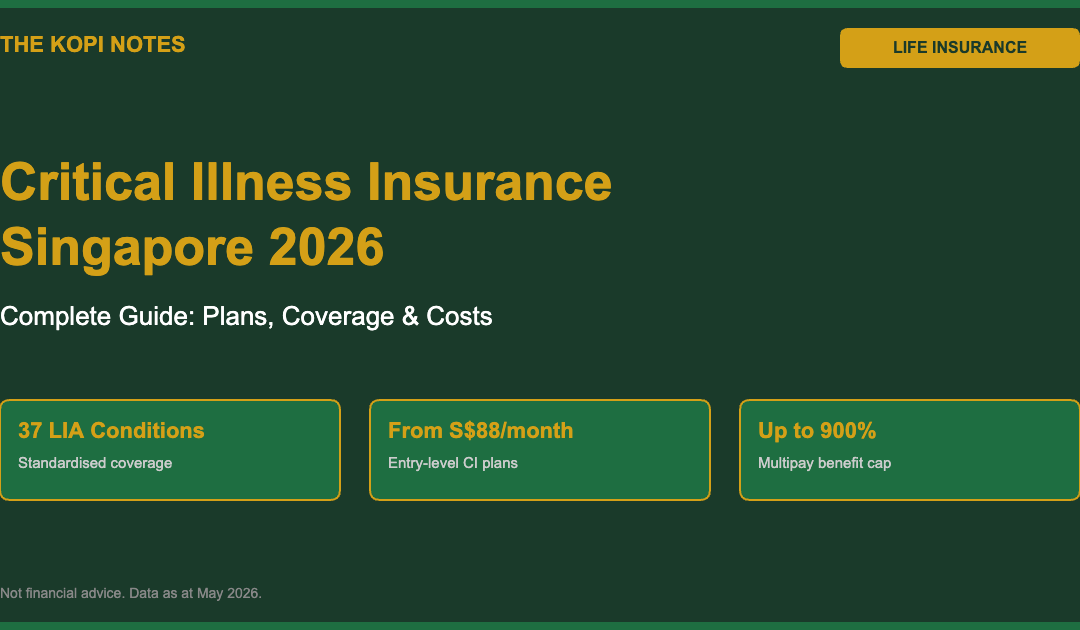
- The LIA framework standardises 37 severe-stage conditions across all Singapore insurers, making comparison easier.
- Plans range from entry-level Big-3 cover (cancer, heart attack, stroke) to 187-condition multipay plans with up to 900% payout.
- A 30-year-old non-smoker can get S$200,000 CI cover for roughly S$88–S$130/month depending on plan type.
- The LIA recommends coverage of 3.9× your annual income to cover a 5-year recovery period.
- Early Critical Illness (ECI) plans pay out at earlier, more treatable stages — especially valuable for cancer.
- CPF Medisave can be used for certain CI riders attached to life insurance plans.
Table of Contents
Contents — Click to expand
- What Is Critical Illness Insurance Singapore?
- What Does Critical Illness Insurance Cover? The LIA 37 Conditions
- What Is the Difference Between CI and Early CI Insurance?
- How Much Critical Illness Cover Do I Need in Singapore?
- Best Critical Illness Insurance Plans Singapore 2026 — Comparison Table
- Critical Illness Insurance Premiums: What Does It Cost in Singapore?
- How Do I Choose the Right CI Plan in Singapore?
- Can I Use CPF or Medisave for Critical Illness Insurance?
- Frequently Asked Questions
What Is Critical Illness Insurance Singapore?
Critical illness insurance (CI insurance) is a standalone protection policy that pays a lump-sum cash benefit when you are diagnosed with a covered serious illness — regardless of your actual medical bills. Unlike MediShield Life or Integrated Shield Plans (IPs), which reimburse hospitalisation and surgery expenses, CI insurance gives you unrestricted cash to use however you need: replacing lost income, paying for expensive treatments not covered by IPs, funding home modifications, or covering daily expenses during a lengthy recovery.
According to data from the Life Insurance Association Singapore (LIA), the top three critical illnesses in Singapore are cancer, heart attack, and stroke — collectively accounting for over 90% of all CI claims paid in recent years. Cancer alone has been the most prevalent condition for over a decade, with the Singapore Cancer Registry reporting around 10,000 new cases per year.
CI insurance is especially important in the Singapore context because:
- Income gap: Most Singaporeans rely on employment income. A serious illness can mean months or years off work.
- Treatment costs: Cancer immunotherapy, for example, can cost S$10,000–S$30,000 per month and is not always covered by IPs.
- Caregiver costs: Home nursing, domestic helpers, and rehabilitation costs add up quickly.
- CPF gap: CPF withdrawals before age 55 (under the CPF Investment Strategy framework) are restricted, so liquid cash becomes critical.
CI insurance bridges the gap between what your health insurance pays and what you actually need to survive and recover financially. You can use the Insurance Gap Calculator on this site to estimate your personal coverage shortfall.
What Does Critical Illness Insurance Cover? The LIA 37 Conditions
The Life Insurance Association Singapore (LIA) mandates a standardised framework of 37 severe-stage critical illness definitions that all Singapore insurers must use. This makes comparing policies significantly easier: a “major cancer” claim from AIA uses the exact same medical definition as one from Manulife or Prudential.
The 37 LIA-standardised conditions include (but are not limited to):
- Cancers: Major Cancer (covers most invasive malignant tumours)
- Heart conditions: Heart Attack of Specified Severity, Coronary Artery By-Pass Surgery, Heart Valve Surgery
- Neurological: Stroke with Permanent Neurological Deficit, Major Head Trauma, Parkinson’s Disease
- Organ conditions: Kidney Failure, Major Organ / Bone Marrow Transplant, Blindness, Deafness
- Others: Motor Neurone Disease, Fulminant Hepatitis, HIV due to Blood Transfusion
Many insurers offer enhanced plans that go beyond the 37 LIA conditions, covering early-stage illnesses, intermediate conditions, and special conditions. The most comprehensive multipay plans in 2026 now cover up to 187 conditions across early, intermediate, and severe stages.
What Is the Difference Between CI and Early CI Insurance?
This is one of the most important distinctions for Singapore buyers. Standard CI insurance (also called “late-stage CI”) pays out only when a condition reaches a severe or advanced stage. Early Critical Illness (ECI) insurance pays a benefit when an illness is detected at an earlier, more treatable stage.
Consider cancer as an example. Standard CI would pay out at advanced or invasive cancer. ECI would pay out at carcinoma-in-situ (stage 0) — the earliest detectable stage, when treatment success rates are highest and costs can still be substantial.
Key differences:
| Feature | Standard CI (Late-Stage) | Early CI (ECI) |
|---|---|---|
| Payout trigger | Severe/advanced stage only | Early, intermediate & severe stages |
| Number of claims | Typically 1 (single pay) or multiple | Multiple claims across stages/conditions |
| Cancer coverage | Invasive cancer only | Carcinoma-in-situ + invasive |
| Premium cost | Lower | Higher (20–50% more) |
| Best for | Budget-conscious buyers | Comprehensive protection seekers |
If you can afford the higher premiums, ECI coverage is generally recommended because early-stage diagnosis is increasingly common with Singapore’s regular health screening programmes (such as Screen for Life). Catching cancer at stage 0 or 1 is good news medically — but CI insurance without ECI cover means no payout at that stage.
How Much Critical Illness Cover Do I Need in Singapore?
The LIA recommends a CI coverage amount of at least 3.9× your annual income, based on a typical 5-year recovery and treatment period. For a Singaporean earning S$60,000 per year, that translates to roughly S$234,000 in CI coverage.
However, the right coverage amount depends on several personal factors:
- Annual income & expenses: Higher earners with dependants need more coverage to replace income during illness.
- Existing savings & investments: If you have substantial liquid assets (e.g., Endowus or Syfe portfolios), you may need less CI cover.
- Existing CI coverage: Some whole life and term life plans include CI riders — check for overlapping coverage before buying a standalone plan.
- Dependants: Parents with young children or elderly parents to support need higher coverage.
A practical rule of thumb for Singapore: aim for S$200,000–S$300,000 in CI cover as a baseline for most working adults, with additional ECI coverage of S$100,000–S$150,000. Use the Insurance Gap Calculator to personalise this figure.
Best Critical Illness Insurance Plans Singapore 2026 — Comparison Table
Based on data compiled as at May 2026, here is a comparison of the leading CI and ECI plans available to Singapore residents. Premiums shown are indicative for a 30-year-old non-smoking male, S$200,000 sum assured.
| Plan | Conditions Covered | Max Payout | Type | Est. Annual Premium |
|---|---|---|---|---|
| Manulife CI FlexiCare (Deluxe) | 152 conditions | 800% (up to S$250k/claim) | Multipay ECI+CI | ~S$1,543/yr |
| Singlife Multipay CI | 159 conditions | 900% (up to S$250k/claim) | Multipay ECI+CI | ~S$1,465/yr |
| AIA Absolute Critical Cover | 187 conditions | 500% (up to S$350k/claim) | Multipay ECI+CI | ~S$1,999/yr |
| HSBC Life Super CritiCare | 132 conditions | 600% (up to S$1M/claim) | Multipay ECI+CI | ~S$1,165/yr |
| Singlife Comprehensive CI | 159 conditions | Single pay (max S$100k SA) | Single-pay ECI | ~S$920/yr |
| FWD Big 3 CI | Cancer, Heart Attack, Stroke | 100% of SA | Single-pay (Big 3) | From ~S$88/yr |
Premiums are indicative only. Actual premiums depend on age, gender, smoking status, health declaration, and sum assured chosen. Consult a licensed financial adviser for a personalised quote.
Critical Illness Insurance Premiums: What Does It Cost in Singapore?
CI insurance premiums in Singapore vary widely depending on your age, gender, smoking status, the type of plan (single-pay vs multipay, CI vs ECI), and the sum assured you choose. Below is an indicative premium table for a non-smoking female, S$200,000 sum assured, multipay CI plan (approximate figures for HSBC Life Super CritiCare, 2026):
| Age at Entry | Female (Non-Smoker) | Male (Non-Smoker) | Annual Increase |
|---|---|---|---|
| 25 | ~S$900/yr | ~S$980/yr | Low |
| 30 | ~S$1,100/yr | ~S$1,165/yr | Low–Moderate |
| 35 | ~S$1,400/yr | ~S$1,600/yr | Moderate |
| 40 | ~S$2,000/yr | ~S$2,400/yr | Moderate–High |
| 45 | ~S$2,900/yr | ~S$3,500/yr | High |
Key insight: buying CI cover early dramatically reduces your lifetime premium cost. A 25-year-old buying S$200,000 in CI cover will pay substantially less over 30 years than a 40-year-old buying the same coverage. Premiums on term-based CI plans also increase with age — another reason to start early.
For retirement income planning context, it is worth noting that many Singaporeans combine CI insurance with investments through platforms like Endowus (referral code: 2V343) and Syfe (referral code: SRPRFFFCD) to ensure both protection and wealth accumulation are addressed simultaneously.
How Do I Choose the Right CI Plan in Singapore?
Choosing between the many CI plans available in Singapore comes down to five key considerations:
-
Single-pay vs multipay: Single-pay plans are cheaper and pay once. Multipay plans allow you to claim multiple times for different conditions or different stages of the same condition. If your budget allows, a multipay plan offers significantly better long-term value — especially as Singaporeans are living longer and may face more than one critical illness in a lifetime.
-
ECI vs CI only: As discussed above, ECI cover pays at earlier stages. In an era of improved screening and earlier diagnosis, ECI coverage is increasingly important. Given Singapore’s Screen for Life programme, many cancers are now caught at early stages where standard CI would not pay out.
-
Coverage breadth: More conditions covered is generally better, but scrutinise which conditions beyond the LIA 37 are included. Unique-to-insurer conditions that are very rare add little practical value. Focus on conditions relevant to your family history and demographics.
-
Premium waiver: After a CI claim, can you afford to keep paying premiums? Look for plans that waive premiums after the first claim (e.g., Manulife CI FlexiCare) rather than requiring multiple claims before waiver kicks in.
-
Coverage term flexibility: Some plans cover to age 65 or 75; others cover to age 99. Longer coverage terms provide greater peace of mind but cost more. Match your coverage term to your financial independence target age.
For a comprehensive view of your protection needs — including life, CI, disability income, and health insurance — use the Insurance Gap Calculator and consider speaking with an MAS-licensed financial adviser.
Can I Use CPF or Medisave for Critical Illness Insurance?
CPF Medisave cannot be used to pay premiums for standalone CI insurance plans directly. However, there is an indirect route: if your CI coverage is structured as a rider attached to an eligible life insurance policy (e.g., a whole life plan), a portion of the combined premiums may qualify for Medisave deduction under the Medisave-approved insurance framework.
For example:
- A whole life plan with a CI rider may qualify for Medisave usage up to the Medisave Contribution Ceiling limits.
- The CI rider premiums, however, are generally NOT claimable separately from the base policy.
- You can use SRS (Supplementary Retirement Scheme) contributions to pay CI premiums if the plan is an investment-linked policy (ILP) with CI protection.
For CPF-linked retirement planning that complements your CI insurance, see the CPF Investment Strategy Guide and the Retirement Planning Calculator.
Find Your Critical Illness Coverage Gap
Use our free Insurance Gap Calculator to estimate how much CI cover you actually need — based on your income, expenses, and existing policies.
Frequently Asked Questions
Is critical illness insurance the same as health insurance in Singapore?
No. Health insurance (such as MediShield Life or Integrated Shield Plans) reimburses hospital bills and surgery costs. Critical illness insurance pays a lump-sum cash benefit on diagnosis, regardless of actual medical expenses. The cash can be used for anything — lost income replacement, non-medical costs, caregiving, or daily living expenses. Both types of coverage are complementary and most financial advisers recommend having both.
How many conditions does critical illness insurance cover in Singapore?
All Singapore CI insurers must cover at least the LIA-standardised 37 severe-stage critical illness conditions. Many enhanced plans go far beyond this: as at 2026, the broadest plans (such as AIA Absolute Critical Cover) cover up to 187 conditions across early, intermediate, and advanced stages. When comparing plans, check both the total number of conditions and whether ECI (early-stage) coverage is included.
What is a multipay critical illness plan?
A multipay CI plan allows you to make more than one CI claim during the policy term, either for different conditions or for different stages of the same condition. For example, you might claim for early-stage breast cancer, recover, and then claim again later for a heart attack. Multipay plans typically allow total payouts of 500% to 900% of the sum assured. They cost 20–50% more than single-pay plans but provide far more comprehensive lifetime protection.
What is the waiting period for critical illness insurance in Singapore?
Most CI policies in Singapore have a 90-day waiting period from the policy commencement date, during which no claims for critical illness can be made (except for accidental claims). Some conditions, particularly cancer, may have a specific waiting period. Always read the policy terms carefully and disclose any pre-existing conditions during application to avoid claim rejection.
Can I buy critical illness insurance if I have pre-existing conditions?
It depends on the condition and insurer. Most CI policies require a health declaration and may exclude pre-existing conditions or load premiums higher. However, some plans are specifically designed for individuals with common health conditions like Type 2 diabetes, high blood pressure, or high cholesterol — for example, Singlife Essential Critical Illness covers 14 CI conditions and accepts applicants with these conditions from around S$353/year. An MAS-licensed financial adviser can help you find the right plan given your health history.
How much critical illness insurance do I need in Singapore?
The LIA recommends a minimum of 3.9× your annual income in CI coverage. For a person earning S$60,000/year, that is approximately S$234,000. In practice, most financial advisers recommend S$200,000–S$300,000 as a baseline for working Singaporeans with dependants. Use the Insurance Gap Calculator to personalise your target based on your income, expenses, existing savings, and current policies.
Is critical illness insurance worth it in Singapore?
For most working Singaporeans, yes. Cancer, heart attack, and stroke collectively account for over 90% of CI claims in Singapore. Treatment for advanced cancer can cost tens of thousands of dollars per month in drugs and therapies not covered by MediShield Life. A CI payout of S$200,000 can provide 2–5 years of income replacement and treatment support — which could make the difference between financial survival and bankruptcy during a serious illness. The question is not whether you need it, but how much and which plan type fits your budget and risk profile.
What is the difference between critical illness and disability income insurance?
Critical illness insurance pays a one-time (or multipay) lump sum on diagnosis of a covered condition. Disability income insurance pays a monthly income replacement benefit if you are unable to work due to illness or injury — regardless of whether your condition is one of the specified CI conditions. Both are important: CI covers the treatment and recovery cash need, while disability income insurance covers ongoing living expenses during prolonged inability to work. See also our guide on Dependants’ Protection Scheme (DPS) for Singapore’s government-subsidised term life cover.
Get Free Insurance Advice
Speak with a licensed insurance advisor. No obligation, no cost.
By submitting this form, you agree to our Privacy Policy.
This article was researched with the help of AI. While we strive to keep all information accurate and up to date, there may be errors. If you notice any discrepancies, please contact us.