How Much Term Life Insurance Do You Need in Singapore (2026)?
Your DPS baseline, the DIME method, and Singapore’s S$373 billion protection gap — a step-by-step way to find your real number.
Most Singaporeans need term life insurance equal to 9 to 12 times their annual income, minus their DPS cover and existing savings. The Life Insurance Association’s 2022 Protection Gap Study found Economically Active Singaporeans are collectively underinsured by S$373 billion. This guide walks through the DIME method and a worked example so you land on a number that fits your actual family, not a generic rule of thumb.
Not financial advice. All figures are for educational reference only. Data verified as at 30 July 2026 against official CPF Board, LIA, and SingSaver sources.
- Singapore’s mortality protection gap is S$373 billion — the average working adult is underinsured by 21% (LIA, 2022 Protection Gap Study).
- Your DPS cover (S$70,000 to age 60, S$55,000 from 60 to 65) is a floor, not a full plan — most families need far more.
- Use the DIME method (Debt + Income replacement + Mortgage + Education) for a number tailored to your household, then check it against our free Insurance Gap Calculator.
Table of Contents
Contents — Click to expand
- Singapore’s S$373 Billion Protection Gap
- Start With What You Already Have: DPS Coverage
- The Income Replacement Rule: 9x, 10x, or More?
- The DIME Method: A More Precise Calculation
- Worked Example: A 35-Year-Old Family of Four
- What Different Coverage Amounts Actually Cost
- Who Needs More (or Less) Than the Rule of Thumb
- How to Buy the Right Amount of Coverage
- Frequently Asked Questions
Singapore’s S$373 Billion Protection Gap
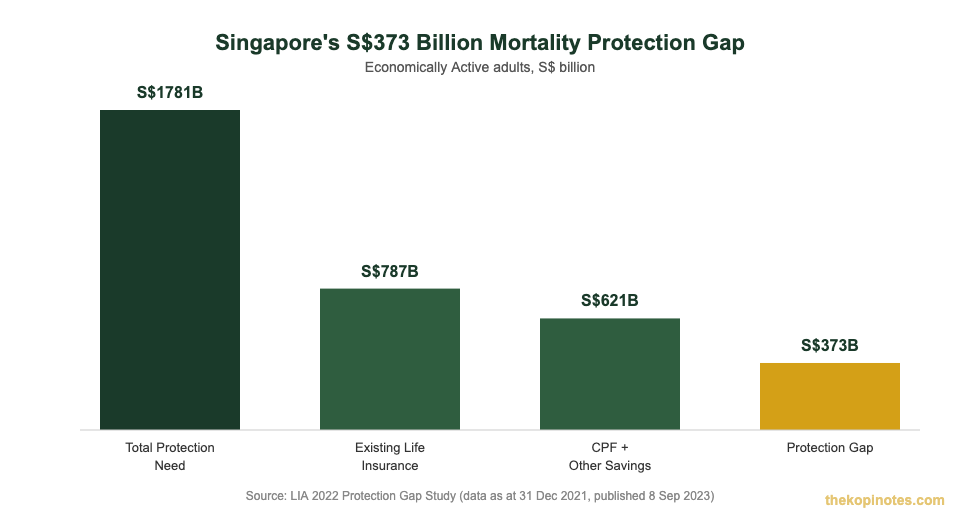
The Life Insurance Association of Singapore (LIA) engaged Ernst & Young to run its 2022 Protection Gap Study, using policy and reference data as at 31 December 2021. The headline number: Economically Active Singaporeans and Permanent Residents needed S$1,781 billion of mortality protection in total — equivalent to 9.0x their average annual income.
Of that need, S$787 billion was covered by existing life insurance, and S$621 billion by CPF savings and other cash and deposits. That still leaves a gap of S$373 billion, or 21% of total protection needs, unfunded. In practice, this means the average working adult in Singapore is underinsured — often without realising it, because CPF and their employer’s group insurance feel like “enough” until you actually run the numbers.
Here’s why that matters for you: if you’re relying on gut feeling rather than a calculation, you’re probably in the 21% that’s short. The rest of this guide gives you a repeatable way to check.
| Metric | 2022 Protection Gap Study Figure |
|---|---|
| Total Mortality Protection Need (EA adults) | S$1,781 billion (9.0x annual income) |
| Existing Life Insurance Coverage | S$787 billion |
| CPF + Other Savings | S$621 billion |
| Total Protection Gap | S$373 billion (21%) |
Source: LIA 2022 Protection Gap Study, data as at 31 December 2021, published 8 September 2023.
Start With What You Already Have: DPS Coverage
Before you calculate anything, check what you already have. If you’re a Singapore Citizen or PR aged 21 to 65 with a valid CPF contribution, you’re automatically covered under the Dependants’ Protection Scheme (DPS) — a low-cost term life insurance scheme administered by Great Eastern Life on CPF Board’s behalf.
DPS pays out on death, terminal illness, or total permanent disability. It’s genuinely useful as a baseline. But S$70,000 doesn’t go far if you’re the sole breadwinner for a young family — it covers a few years of expenses at most, not a full income replacement. We’ve covered this gap in detail in our DPS coverage gap breakdown.
| Age Band | DPS Sum Assured | Approx. Annual Premium |
|---|---|---|
| 21–59 years | S$70,000 | S$18–S$298 (age-banded) |
| 60–64 years | S$55,000 | S$298 |
Source: CPF Board, effective 1 April 2021, current as at 2026.
The Income Replacement Rule: 9x, 10x, or More?
The simplest starting point is an income multiple. LIA’s own data puts the Singapore average at 9.0x annual income. You’ll also see the “10x rule” quoted often — the idea being that ten years of your salary gives your family enough time to adjust without a sudden drop in living standards.
In practice, most financial advisers in Singapore work with a range of 8x to 12x annual income, adjusted for your specific situation. A single 25-year-old with no dependants might need close to zero. A 35-year-old with a spouse, two young kids, and an outstanding mortgage could reasonably need 12x or more.
However, an income multiple alone ignores your specific debts, your mortgage balance, and how many years of education you still need to fund for your kids. That’s where the DIME method comes in.
The DIME Method: A More Precise Calculation
DIME stands for Debt, Income replacement, Mortgage, and Education. MAS-licensed financial advisers commonly use it as a starting point because it adds up your actual, specific obligations rather than applying one multiple to everyone.
- D — Debt: Add up non-mortgage debts your family would still owe — car loans, credit cards, personal loans, renovation loans.
- I — Income replacement: Multiply your annual income by the number of years your family would need support. Most planners use 10 to 15 years, not your full working life, since your spouse’s income and your children growing up both reduce the need over time.
- M — Mortgage: Your outstanding home loan balance today, whether HDB or private. This ensures your family isn’t forced to sell the home to cover it.
- E — Education: A planning estimate for your children’s future education, from now until they’re financially independent. S$40,000 to S$150,000+ per child is a common range depending on local vs. overseas university plans.
Add D + I + M + E together, then subtract your DPS cover, any existing life insurance, and liquid savings your family could draw on. What’s left is your term life insurance coverage gap.
Worked Example: A 35-Year-Old Family of Four
Numbers make this concrete. Take Wei Jie, a 35-year-old Singaporean earning S$6,500 a month (S$78,000 a year), married with two young children and an outstanding HDB loan. Here’s how his DIME calculation plays out.
| Component | Basis | Amount |
|---|---|---|
| D — Debt | Car loan + credit card balance | S$18,000 |
| I — Income replacement | S$78,000/year x 10 years | S$780,000 |
| M — Mortgage | Outstanding HDB loan balance | S$280,000 |
| E — Education | 2 children x S$50,000 (illustrative) | S$100,000 |
| Subtotal (DIME) | S$1,178,000 | |
| Less: DPS cover | –S$70,000 | |
| Less: Existing savings/investments | –S$50,000 | |
| Estimated coverage need | ≈ S$1,058,000 |
Wei Jie would round this to roughly S$1 million to S$1.05 million of term life coverage — close to LIA’s 9x income average of S$702,000 for his salary, but higher because of his mortgage and two children’s education costs. This is exactly why a single income multiple can undershoot: it doesn’t know about your specific mortgage or family size.
Not sure where you’d land? Our free Insurance Gap Calculator runs this same DIME-style calculation with your own numbers in under two minutes.
What Different Coverage Amounts Actually Cost
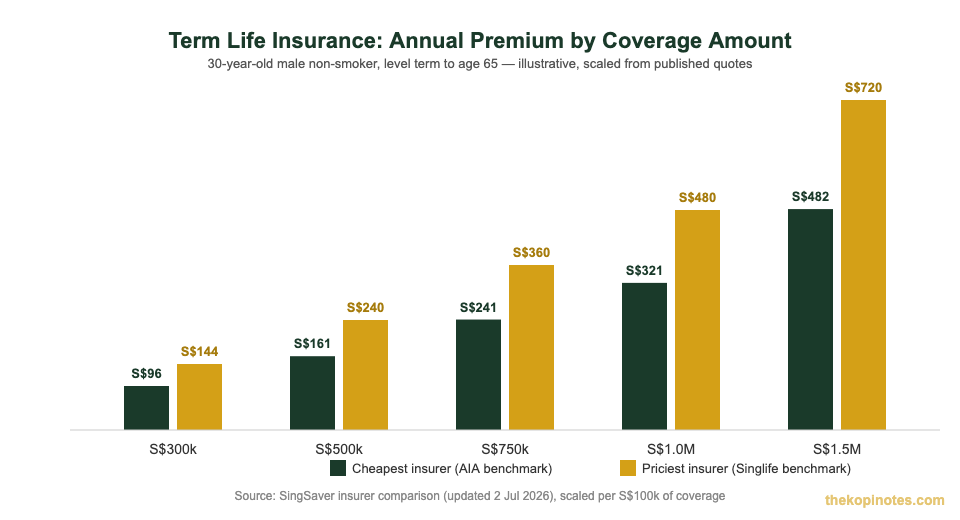
Bigger coverage doesn’t have to mean an unaffordable premium. Comparison data for a 30-year-old male non-smoker taking S$1 million of death and terminal illness cover to age 65 shows a range of roughly S$321 to S$480 a year across five major insurers — call it S$32 to S$48 per S$100,000 of coverage. Scaling that per S$100k gives you a rough sense of what other coverage amounts would cost.
| Coverage Amount | Low (Cheapest Insurer) | High (Priciest Insurer) |
|---|---|---|
| S$300,000 | ≈ S$96/year | ≈ S$144/year |
| S$500,000 | ≈ S$161/year | ≈ S$240/year |
| S$750,000 | ≈ S$241/year | ≈ S$360/year |
| S$1,000,000 | ≈ S$321/year | ≈ S$480/year |
| S$1,500,000 | ≈ S$482/year | ≈ S$720/year |
Illustrative — extrapolated linearly from a published 5-insurer comparison for a 30-year-old male non-smoker. Source: SingSaver, updated 2 July 2026. Older applicants, smokers, and those with health conditions will pay more — get a personalised quote before deciding.
Who Needs More (or Less) Than the Rule of Thumb
The 9x to 12x income range is a starting point, not a fixed answer. Your actual number should move up or down based on your household.
Consider more coverage if: you’re the sole or majority breadwinner, you have young children with 15+ years until financial independence, you carry a large mortgage relative to your income, you own a business with debts personally guaranteed, or your spouse doesn’t work and has no independent income.
Consider less coverage if: you and your partner both earn similar, substantial incomes and either could cover household costs alone, you have no dependants (DINK households), you’ve already built significant liquid savings or investments, or your children are already financially independent adults.
If you’re unsure which camp you fall into, run both the income-multiple and DIME calculations — if they land in a similar range, that’s a good sign your number is realistic.
How to Buy the Right Amount of Coverage
Once you have a target number, buying the right policy is a five-step process:
- 1. Calculate your need using the DIME method or an income multiple of 9x to 12x — whichever gives you more confidence in the number.
- 2. Subtract what you already have: your DPS cover, any existing life insurance, and liquid savings your family could draw on immediately.
- 3. Decide your term length — typically until your mortgage is paid off or your youngest child turns financially independent, often age 60 to 65.
- 4. Get 2–3 quotes from different insurers before committing. Our Term Life Insurance Singapore Comparison guide has a full side-by-side, and the Great Eastern Term Life review breaks down one insurer’s premium in detail.
- 5. Choose your buying channel — go through a financial adviser if you want help sizing coverage and riders, or a Direct Purchase Insurance (DPI) plan if you’re confident in your number and need S$400,000 or less. Our Affordable Term Life Insurance guide covers 7 concrete ways to cut your premium either way.
One more thing worth knowing: LIA Singapore is the industry body that represents every licensed life insurer here and administers the Policy Owners’ Protection (PPF) Scheme, which protects your policy even if your insurer becomes insolvent. Our LIA Singapore guide covers what that protection actually means for you.
Frequently Asked Questions
How much term life insurance do I need in Singapore?
Most Singaporeans need coverage equal to 9 to 12 times their annual income, based on LIA’s 2022 Protection Gap Study average of 9.0x. For a more precise number, use the DIME method — add your debts, years of income replacement needed, mortgage balance, and children’s education costs, then subtract your DPS cover and existing savings.
Is DPS enough life insurance on its own?
No. DPS provides S$70,000 of coverage (S$55,000 from age 60 to 65), which covers only a few years of expenses for most families. It’s a useful automatic baseline, but it isn’t a substitute for a proper term life policy sized to your income and dependants. See our full breakdown in the DPS coverage gap article.
What is the DIME method and how do I use it?
DIME stands for Debt, Income replacement, Mortgage, and Education. Add up your non-mortgage debts, your annual income multiplied by 10–15 years of support, your outstanding mortgage balance, and an estimate for your children’s education. Subtract your DPS cover and existing savings to get your coverage gap.
Does the amount of coverage I need change as I get older?
Yes. Your coverage need typically peaks in your 30s and 40s when your mortgage, dependants, and income-replacement years are all at their highest, then declines as your mortgage shrinks, children become financially independent, and you build up other savings. Many people reduce or let term coverage lapse in their late 50s and 60s.
How much does S$1 million of term life insurance cost in Singapore?
Based on published comparison data, a 30-year-old male non-smoker pays roughly S$321 to S$480 a year for S$1 million of death and terminal illness cover to age 65, depending on the insurer. Premiums are higher for older applicants, smokers, and those with pre-existing health conditions — get a personalised quote before deciding.
Should I buy more coverage than the 9x to 12x income rule suggests?
It depends on your household. Sole breadwinners, families with young children, business owners with personally guaranteed debts, and households with a non-working spouse often need more than the average multiple. Dual-income couples without dependants, or those with substantial existing savings, may reasonably need less.
Work Out Your Exact Coverage Number
Run your own numbers through our free Insurance Gap Calculator, then compare term life quotes before you buy.
Get Free Insurance Advice
Speak with a licensed insurance advisor. No obligation, no cost.
By submitting this form, you agree to our Privacy Policy.
This article was researched with the help of AI. While we strive to keep all information accurate and up to date, there may be errors. If you notice any discrepancies, please contact us.