Term Life Insurance Singapore Comparison 2026: Best Plans, Premiums & Side-by-Side Table
Compare FWD, Singlife, Manulife, AIA, Prudential & NTUC Income — side by side, with real 2026 premium data.
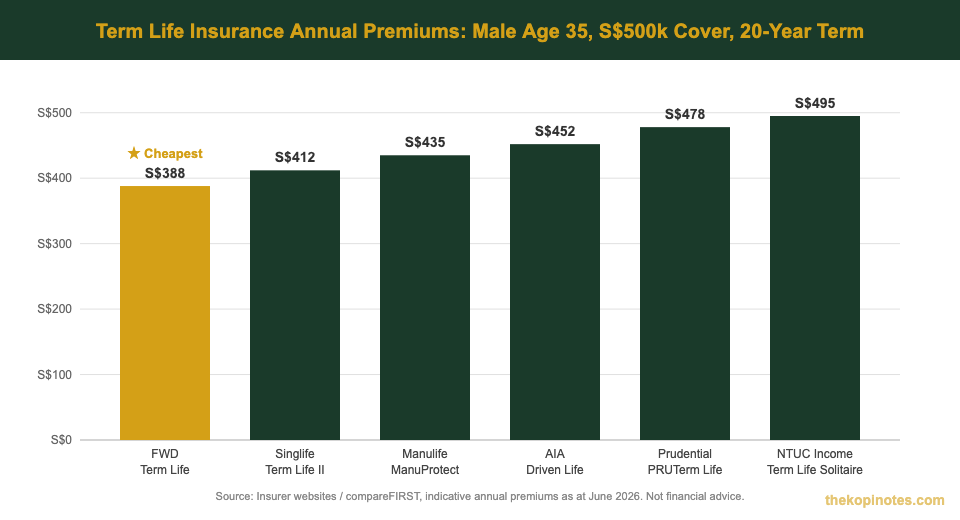
Term life insurance in Singapore offers pure death-cover protection at the lowest possible cost — no cash value, no investment component, just straightforward coverage. If you are comparing term life insurance plans in Singapore in 2026, FWD Term Life consistently offers the lowest premiums, followed closely by Singlife and Manulife. For a 35-year-old male with S$500,000 coverage over 20 years, annual premiums range from S$388 (FWD) to S$495 (NTUC Income). This guide compares six major insurers side by side so you can pick the right plan for your budget and coverage needs.
Not financial advice. All figures are indicative and for educational reference only. Data as at June 2026 unless noted.
- FWD, Singlife and Manulife offer the most competitive premiums for term life in Singapore 2026.
- The cheapest plan for a 35-year-old male (S$500k, 20yr) is FWD at ~S$388/year — about S$32/month.
- Use compareFIRST or speak to an MAS-licensed financial adviser to get quotes tailored to your exact age and health profile.
Table of Contents
What Is Term Life Insurance?
Term life insurance pays a lump-sum death benefit to your beneficiaries if you die within a fixed term — typically 10, 20, 25 or 30 years. Unlike whole life or endowment plans, term life has no cash value. You pay only for pure protection.
This makes term life the most cost-efficient way to replace your income for your family if you are no longer around. Most financial planners recommend term life as the foundation of any Singaporean’s protection portfolio, especially for those with dependants, a mortgage, or a young family.
Key features of term life in Singapore:
- Fixed coverage period: choose 10–35 years, or a specific age (e.g. to age 65 or 70).
- Level or decreasing cover: most plans offer level cover (same sum assured throughout). Some offer decreasing cover for mortgage protection.
- Renewable or convertible: many plans allow renewal at the end of the term (at higher premiums) or conversion to a permanent plan without underwriting.
- Riders available: add critical illness (CI), early CI, total permanent disability (TPD), or waiver of premium for added protection.
In Singapore, term life is regulated by the Monetary Authority of Singapore (MAS). All insurers selling term life must be licensed by MAS and are members of the Life Insurance Association (LIA) Singapore.
6-Insurer Plan Comparison Table
This side-by-side table compares the six major term life insurance providers in Singapore. All premiums shown are indicative annual figures for a non-smoker male, age 35, S$500,000 sum assured, 20-year term. Actual premiums depend on health, occupation and age at application.
| Insurer | Plan Name | Annual Premium | Max Coverage Age | CI Rider Available | DPI Available |
|---|---|---|---|---|---|
| FWD | FWD Term Life | ~S$388/yr | Age 85 | ✅ | ✅ (FWD.com) |
| Singlife | Singlife Term Life II | ~S$412/yr | Age 85 | ✅ | ✅ (Singlife.com) |
| Manulife | ManuProtect Term (II) | ~S$435/yr | Age 85 | ✅ | ✅ |
| AIA | AIA Driven Life | ~S$452/yr | Age 85 | ✅ | ❌ (adviser only) |
| Prudential | PRUTerm Life II | ~S$478/yr | Age 85 | ✅ | ❌ (adviser only) |
| NTUC Income | Term Life Solitaire | ~S$495/yr | Age 85 | ✅ | ❌ (adviser only) |
Source: Insurer websites and compareFIRST portal, June 2026. Premiums are indicative for non-smoker male age 35, S$500,000 sum assured, 20-year level term. DPI = Direct Purchase Insurance (no adviser commission). Actual premiums vary by age, health, and occupation. Not financial advice.
The difference between the cheapest (FWD, ~S$388) and most expensive (NTUC Income, ~S$495) is about S$107 per year. Over a 20-year term, that adds up to over S$2,100 in savings — just by choosing the right insurer.
However, price is not everything. Consider the insurer’s claims-paying history, policy flexibility, rider options, and whether Direct Purchase Insurance (DPI) suits your needs.
Premium Comparison by Age & Gender
Term life premiums in Singapore increase significantly with age. Locking in a policy at a younger age saves you money over the long run. Here is a detailed comparison of annual premiums for FWD and Manulife across key age groups and both genders, for S$500,000 sum assured and a 20-year term.
| Age | FWD (Male) | FWD (Female) | Manulife (Male) | Manulife (Female) | NTUC Income (Male) |
|---|---|---|---|---|---|
| 25 | ~S$220/yr | ~S$185/yr | ~S$245/yr | ~S$205/yr | ~S$280/yr |
| 30 | ~S$290/yr | ~S$240/yr | ~S$322/yr | ~S$268/yr | ~S$366/yr |
| 35 | ~S$388/yr | ~S$318/yr | ~S$435/yr | ~S$356/yr | ~S$495/yr |
| 40 | ~S$565/yr | ~S$455/yr | ~S$635/yr | ~S$508/yr | ~S$720/yr |
| 45 | ~S$868/yr | ~S$680/yr | ~S$975/yr | ~S$762/yr | ~S$1,105/yr |
Source: Insurer websites / compareFIRST, indicative premiums for non-smoker, S$500,000 sum assured, 20-year term, as at June 2026. Actual premiums depend on health declaration and underwriting. Not financial advice.
Key takeaways from this table:
- Female premiums are 15–22% cheaper than male premiums across all ages — women statistically live longer, so insurers charge less.
- Premiums roughly double from age 35 to age 45 for males. Buying at 35 vs 45 saves you ~S$480–S$610/year.
- FWD is consistently the cheapest option across all age groups in this comparison.
These are indicative figures. For your exact premium, use compareFIRST (the LIA’s official comparison portal) or request a quote directly from the insurer’s website.
How Much Coverage Do You Need?
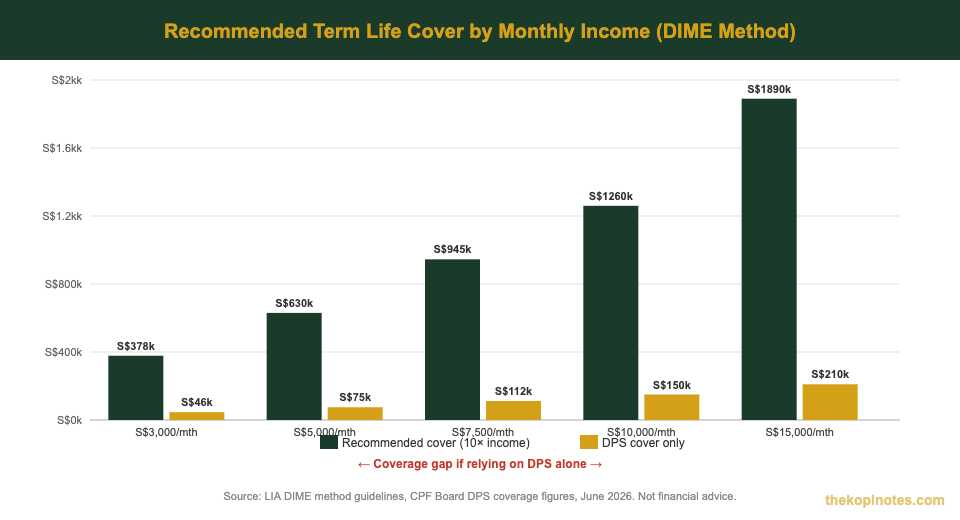
Most Singaporeans are underinsured. According to LIA Singapore’s Protection Gap Study, the average Singaporean working adult has a protection gap of S$763,000. That means if you died today, your family would face nearly S$763,000 in unmet financial needs.
The DIME method is the most straightforward way to estimate your coverage needs. DIME stands for:
- D — Debt: outstanding loans (mortgage, car loan, personal loan)
- I — Income replacement: 10× your annual income (to support your family for 10 years)
- M — Mortgage: remaining home loan balance
- E — Education: projected education costs for each child (S$50,000–S$150,000 per child)
For example: if you earn S$7,500/month (S$90,000/year), you need roughly S$900,000 in coverage just for income replacement. Add your mortgage balance and debts on top. Most Singaporeans earning S$5,000–S$10,000/month should target S$500,000–S$1,500,000 in term life coverage.
The DPS (Dependants’ Protection Scheme) that you are automatically enrolled in through CPF provides only S$46,000–S$70,000 in coverage — a small fraction of what most families need. Term life insurance fills this gap affordably.
For more details on the DPS and how to calculate your exact gap, use our insurance gap calculator.
Riders & Add-Ons to Consider
A base term life policy only pays out on death or terminal illness. To strengthen your coverage, most insurers offer riders (add-ons) that can be attached to your base policy at an additional premium. Here are the most important ones for Singaporeans.
| Rider | What It Covers | Who Should Add It | Estimated Cost (Male 35) |
|---|---|---|---|
| Critical Illness (CI) | Lump sum on diagnosis of 37 major conditions (LIA standard) | Everyone — 1 in 3 Singaporeans will face a major illness in their lifetime | +S$600–S$900/yr |
| Early CI (ECI) | Covers early-stage conditions before full CI criteria met | Higher-risk profiles, family history of cancer or heart disease | +S$800–S$1,200/yr |
| Total Permanent Disability (TPD) | Pays sum assured if you become totally and permanently disabled | Breadwinners — replaces income if you can never work again | Typically included in base plan |
| Waiver of Premium (WOP) | Premiums waived if you become disabled or critically ill | Recommended — keeps your coverage in force when you most need it | +S$40–S$80/yr |
| Accidental Death Benefit | Additional payout if death occurs due to an accident | Those in higher-risk occupations or with high-risk hobbies | +S$80–S$150/yr |
Source: LIA Singapore, insurer product summaries, June 2026. Rider costs are indicative for male, age 35, S$300,000 sum assured. Not financial advice.
For most Singaporeans, the most valuable combination is term life + critical illness rider. The CI rider ensures you receive a payout even if you survive a serious illness — which is far more likely than dying young. According to LIA Singapore, about 70% of claims are for critical illness, not death.
If you want to learn more about standalone critical illness cover, read our best critical illness insurance Singapore 2026 guide.
Term Life vs Whole Life: Which Is Better?
This is one of the most common questions from first-time insurance buyers in Singapore. The short answer: for most people, term life is the better choice. Here is why.
| Feature | Term Life | Whole Life |
|---|---|---|
| Coverage period | Fixed term (10–35 yrs) | Lifetime (to age 99–100) |
| Monthly premium (S$500k, male 35) | ~S$32/mth | ~S$600–S$900/mth |
| Cash value | ❌ None | ✅ Builds over time |
| Coverage flexibility | ✅ Choose exact term | Limited |
| Best for | Income replacement, mortgage protection | Estate planning, legacy gifting |
| Investment return (premiums paid) | N/A — pure protection | ~3–4% p.a. non-guaranteed |
Source: LIA Singapore product summaries, June 2026. Indicative figures. Not financial advice.
The financial advice community often recommends “buy term, invest the rest” — meaning you buy cheap term life for pure protection, and invest the premium savings (S$568+ per month compared to whole life) into index ETFs or REITs for potentially higher long-term returns.
If you already have a whole life policy and are wondering whether to switch, read our whole life insurance Singapore 2026 guide before making any changes. Surrendering a whole life policy early usually results in significant cash value losses.
For retirement planning with your investment savings, try our Singapore retirement calculator to model different scenarios.
How to Buy Term Life Insurance in Singapore
There are two routes to buying term life in Singapore: Direct Purchase Insurance (DPI) or through an MAS-licensed financial adviser. Here is a step-by-step guide to both.
Route 1: Direct Purchase Insurance (DPI) — No Adviser Commission
DPI plans are standardised term life plans you buy directly from the insurer’s website — no adviser, no commission, lower premiums. FWD, Singlife, and Manulife all offer DPI-eligible plans. This is ideal if you already know how much coverage you need.
- Calculate your coverage needs using the DIME method or our insurance gap calculator.
- Compare plans on compareFIRST — visit comparefirst.sg to compare DPI term life plans side by side.
- Apply online directly — most insurers allow full online application with health declaration. FWD and Singlife offer near-instant approval for standard risk profiles.
- Pay your first premium — premiums can often be paid via PayNow, credit card, or GIRO (annual is usually cheapest).
- Nominate your beneficiaries — do this immediately after purchase to ensure the right person receives the payout.
Route 2: Through a Financial Adviser (FA)
For complex needs — large sums, CI riders, trust arrangements, or business insurance — working with an MAS-licensed financial adviser gives you tailored advice. All licensed advisers and agents are listed on MAS’s Financial Advisers Directory.
Whichever route you choose, never delay buying insurance. A medical condition discovered after your application could result in exclusions or higher premiums — or worse, you being uninsured when you need it most.
You can also invest in your financial future by pairing your term life policy with a Endowus account (use code 2V343) or Syfe (use code SRPRFFFCD) to grow your savings alongside your protection.
Check Your Insurance Coverage Gap
Use our free calculator to find out exactly how much term life coverage you need based on your income, debts, and dependants.
Frequently Asked Questions
Which is the cheapest term life insurance in Singapore 2026?
How much term life insurance do I need in Singapore?
What is the difference between term life and whole life insurance?
Can I use CPF or Medisave to pay for term life insurance?
What is Direct Purchase Insurance (DPI) and should I buy it?
What is compareFIRST and how do I use it?
Should I get a critical illness rider with my term life plan?
How long a term should I choose for my term life policy?
Can I get term life insurance if I have a pre-existing condition?
What happens if I miss a term life premium payment?
Disclaimer: This article is for educational purposes only and does not constitute financial advice. Insurance premiums quoted are indicative only and based on data available as at June 2026. Actual premiums depend on your individual health, age, occupation, and underwriting outcome. Always consult an MAS-licensed financial adviser or use compareFIRST before purchasing any insurance product. The Kopi Notes may earn referral fees from partners linked in this article.
Get Free Insurance Advice
Speak with a licensed insurance advisor. No obligation, no cost.
By submitting this form, you agree to our Privacy Policy.
This article was researched with the help of AI. While we strive to keep all information accurate and up to date, there may be errors. If you notice any discrepancies, please contact us.