Bank Stocks Slip From Record Highs: What DBS, OCBC & UOB’s 1H 2026 Rally Means Now
The STI fell 1% on 30 July as DBS, OCBC and UOB pulled back from record highs — but all three still trounced the benchmark in 1H2026. Here’s what drove the rally and what the pullback means if you hold these stocks.
The Straits Times Index fell 1% at Thursday’s (30 July 2026) open, dragged down by DBS, OCBC and UOB slipping from recent record highs. The dip follows a blowout first half in which all three banks beat the STI benchmark, led by OCBC’s 28.2% total return. Here’s what drove the rally, why analysts are turning cautious, and what it means if you hold these stocks.
This is an editorial analysis, not financial advice. Data verified as at 31 July 2026.
- The STI opened 1% lower (down 57.40 points to 5,655.79) on 30 July 2026, led by DBS, OCBC and UOB slipping from recent record highs.
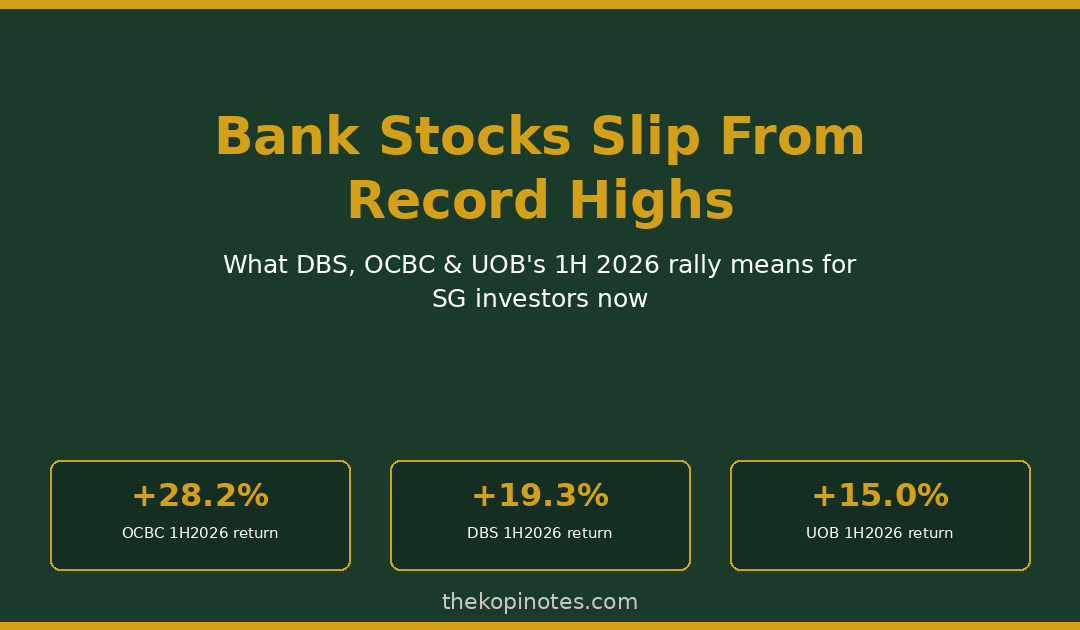
- 1H2026 total returns: OCBC +28.2%, DBS +19.3%, UOB +15.0% — all three beat the SPDR STI ETF’s +13.1%.
- Falling net interest margins at all three banks were more than offset by wealth management and fee income — OCBC and DBS grew profits, UOB’s dipped 4%.
- Analysts now rate OCBC and DBS “Buy” but UOB “Hold,” flagging that valuations look largely priced in after the rally.
Table of Contents
Contents — Click to expand
- What Happened: STI Slips as Banks Retreat From Record Highs
- The 1H 2026 Scoreboard: How OCBC, DBS and UOB Beat the STI
- Why the Rally Happened: Fee Income Offsets Margin Compression
- Are Valuations Now Too Rich? What Analysts Are Saying
- What This Means If You Hold via CPF OA or the STI ETF
- Should Dividend Investors Buy the Dip?
- Bottom Line for SG Investors
- FAQs
What Happened: STI Slips as Banks Retreat From Record Highs
The Straits Times Index opened Thursday, 30 July 2026 down 57.40 points, or 1%, at 5,655.79, with losers outnumbering gainers 160 to 66 in early trade. The weakness was led squarely by the three heavyweight bank counters that make up more than half the index’s weight: DBS Group Holdings slipped 0.97% to S$74.27, OCBC traded at S$29.13, and UOB stood at S$43.48.
None of this is a crisis. It’s a pullback from record territory — DBS had touched a fresh all-time high above S$70 earlier in July, and all three banks had just finished a first half in which they comfortably beat the broader market. But for the large share of Singapore retail investors who hold DBS, OCBC or UOB directly, through the STI ETF, or inside their CPF Ordinary Account, a 1% index-wide dip driven by the banks is worth understanding rather than reacting to.
The 1H 2026 Scoreboard: How OCBC, DBS and UOB Beat the STI
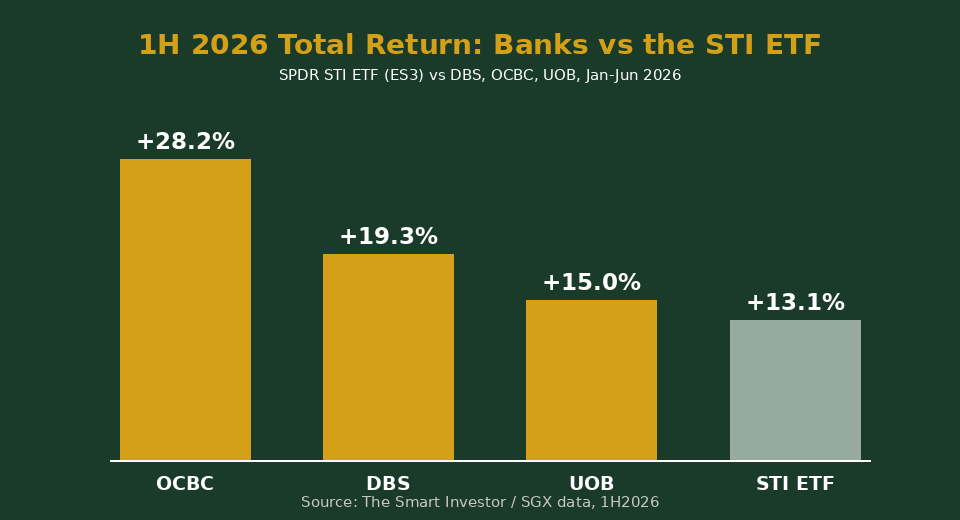
To understand the pullback, you need the rally that came before it. The SPDR STI ETF (SGX: ES3), which tracks the Straits Times Index, returned 13.1% in the first half of 2026 — a strong showing in its own right. Yet all three of Singapore’s biggest banks left it behind.
OCBC led with a total return of 28.2% for 1H2026. DBS returned 19.3%. UOB, the laggard of the trio, still managed 15.0%. Since the three banks make up the largest components of the STI’s 30 constituents, their outperformance was a major reason the broader index did as well as it did — and why a pullback in the same three names is what dragged the whole market down on 30 July.
Here’s the twist that makes the rally worth digging into: net interest margins (NIM) — the spread banks earn between what they pay depositors and charge borrowers — fell at every single one of the three banks in 1Q2026. In other words, the traditional engine of bank profit was losing power throughout the rally. So where did the returns come from?
Why the Rally Happened: Fee Income Offsets Margin Compression
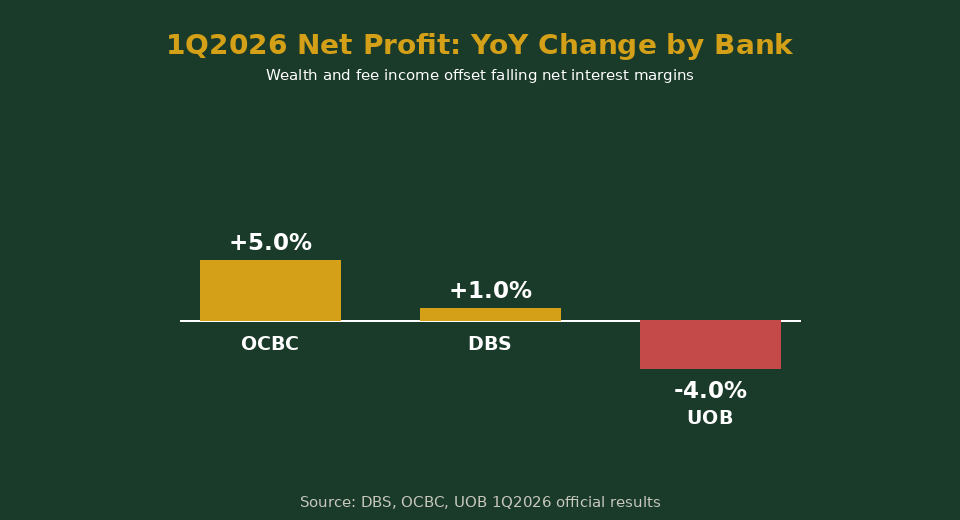
OCBC delivered a record total income of S$3.83 billion in 1Q2026, up 5% year-on-year, even as net interest income fell and its NIM narrowed 0.28 percentage points to 1.76%. The gains came from everywhere else: loans grew 9% YoY, non-interest income surged more than 20%, net fee income rose sharply on a 34% jump in wealth management fees, and insurance income climbed 34% to S$409 million. Net profit rose 5% YoY to S$1.97 billion.
DBS posted a record total income of S$5.95 billion, up 1% YoY, with its NIM narrowing 0.23 percentage points to 1.89%. Non-interest income rose sharply on record wealth management fees, and net profit edged up 1% YoY to S$2.93 billion. Asset quality held steady, with the non-performing loan ratio unchanged at 1%. DBS also raised its dividend to S$0.81 per share (S$0.66 ordinary plus a S$0.15 capital return), 8% higher than the S$0.75 paid in 1Q2025 — a signal dividend investors do not tend to miss.
UOB is the more nuanced case. Total income eased to S$3.4 billion and net profit fell 4% YoY to S$1.437 billion, as its NIM compressed 2 basis points to 1.82% and non-interest income declined. The likely reason UOB shares still returned 15% anyway was forward-looking: UOB completed its Citi consumer banking integration across Indonesia, Malaysia, Thailand and Vietnam, and now serves more than 8.5 million retail customers across ASEAN, with management reaffirming full-year guidance for loan and fee growth.
| Bank | 1Q2026 Net Profit (YoY) | 1Q2026 NIM | 1H2026 Total Return |
|---|---|---|---|
| OCBC | S$1.97b (+5%) | 1.76% | +28.2% |
| DBS | S$2.93b (+1%) | 1.89% | +19.3% |
| UOB | S$1.437b (-4%) | 1.82% | +15.0% |
Source: OCBC, DBS and UOB official 1Q2026 results press releases; The Smart Investor 1H2026 total return analysis.
The pattern across all three banks is the same story with different endings: falling rates squeezed the traditional lending margin everywhere, and the market rewarded whichever bank replaced that income the fastest. OCBC did it most convincingly through wealth management and insurance. DBS backed steady fee income with a bigger dividend cheque. UOB leaned on a bigger regional franchise to carry a softer quarter. For our full breakdown of how the three compare on yield and valuation, see our DBS vs OCBC vs UOB dividend comparison for H2 2026.
Are Valuations Now Too Rich? What Analysts Are Saying
After a run like this, the natural question is whether the good news is already in the price. Analyst sentiment has turned more cautious: OCBC and DBS carry a solid “Buy” from most desks, while UOB is more often rated “Hold,” with commentary pointing to steady fundamentals but limited near-term upside because valuations are largely priced in after the recent gains. OCBC’s valuation in particular has risen above its historical average following its outsized share price performance.
None of this means the rally is over — DBS and OCBC’s wealth management engines have kept earnings resilient even as margins fall, and that trend doesn’t obviously reverse just because a stock has gone up. But it does mean the easy money from re-rating has likely been made, and further gains from here need to be earned through actual earnings growth rather than the market simply deciding to pay more for the same earnings.
What This Means If You Hold via CPF OA or the STI ETF
Because DBS, OCBC and UOB together make up more than half the STI’s weight, anyone holding the STI ETF (SGX: ES3) — including through CPF Ordinary Account investing under CPFIS — is more exposed to this bank-driven swing than the “30 stocks, well diversified” framing usually suggests. A 1% index move on a single day driven almost entirely by three counters is a useful reminder that the STI is not as spread out as it looks.
That’s not a reason to avoid the STI ETF or CPFIS-OA investing in bank shares — it’s a reason to know what you actually own. If you’re investing CPF OA savings and want a sense of how that concentration has played out historically, our CPF Investment Scheme returns breakdown is a useful companion read. The record S$20.5 billion of SGX ETF inflows in 2026 we covered separately shows just how much retail money has been flowing into STI-tracking funds this year, much of it arriving right as bank valuations were climbing.
Should Dividend Investors Buy the Dip?
A 1% pullback from a record high is not, on its own, a buying signal or a warning sign — it’s noise around a much bigger trend. The more useful question for a dividend-focused investor is whether the underlying earnings story still supports the price, and here the three banks diverge.
DBS raised its dividend on record fee income and a stable NPL ratio — the kind of quarter income investors want to see repeated. OCBC is growing profit fastest of the three, but its valuation premium means you’re now paying more for that growth than you were six months ago. UOB is the value case: a softer quarter and a net profit decline, but also the cheapest of the three on a relative basis and a completed regional acquisition that hasn’t yet shown up fully in earnings.
If bank valuations feel stretched after this rally but you still want Singapore dividend income, it’s worth widening the lens rather than chasing the dip in a single stock. Our best S-REITs in Singapore for 2026 guide covers an income alternative that moves on different drivers (interest rates and property fundamentals rather than bank fee income), and our guide to investing when the market is at an all-time high covers the broader question of whether to keep buying into a rally like this one at all.
Bottom Line for SG Investors
The 30 July pullback is a one-day wobble inside a much bigger trend: Singapore’s three banks have outrun the market for six straight months on the back of wealth management and fee income doing the work that lending margins can no longer do. Falling interest rates — and MAS’s own tightening moves in 2026, which shape the SGD funding environment banks operate in — are part of why margins keep narrowing, and part of why non-interest income has become the swing factor for bank earnings this year.
Three practical takeaways if you hold these stocks or the STI ETF: first, don’t treat a single down day as a signal — the rally that preceded it was built on genuine earnings diversification, not just sentiment. Second, recognise that “buying the STI ETF for diversification” concentrates you in bank earnings more than the 30-stock label suggests. Third, if bank valuations feel rich to you specifically, the honest options are to hold for the dividends, rotate part of your income allocation into S-REITs, or simply wait — not to guess the next 1% move.
Frequently Asked Questions
Why did the STI fall on 30 July 2026?
The Straits Times Index opened 1% lower (down 57.40 points to 5,655.79), led by DBS, OCBC and UOB pulling back from recent record highs. Since the three banks make up more than half the index’s weight, their dip dragged the broader market down with it.
How much did DBS, OCBC and UOB return in 1H 2026?
OCBC returned 28.2%, DBS returned 19.3%, and UOB returned 15.0% on a total-return basis in the first half of 2026, all ahead of the SPDR STI ETF’s 13.1% return over the same period.
Why are bank profits rising if interest margins are falling?
Net interest margins narrowed at all three banks in 1Q2026, but non-interest income — wealth management fees, insurance income and trading — grew fast enough to offset the squeeze at OCBC and DBS. UOB’s non-interest income fell too, which is why its net profit declined 4% year-on-year even as its share price still rose.
Is it still a good time to buy DBS, OCBC or UOB shares?
This is not financial advice, but the facts to weigh are: analysts currently rate OCBC and DBS “Buy” and UOB “Hold,” with commentary noting valuations look largely priced in after the 1H2026 rally. A single 1% pullback does not by itself change that picture.
How exposed am I to bank stocks if I just hold the STI ETF?
Significantly more exposed than the “30 diversified stocks” framing suggests. DBS, OCBC and UOB are the three largest constituents of the Straits Times Index by weight, so a move in the banks moves the STI ETF (and CPFIS-OA money invested in it) more than any other single sector.
Did UOB really underperform despite a 15% return?
Relative to OCBC and DBS, yes — UOB was the weakest of the three on both earnings (net profit fell 4% YoY in 1Q2026) and total return (+15.0% versus +28.2% and +19.3%). In absolute terms, a 15% total return still comfortably beat the STI ETF’s 13.1%.
What drove OCBC's outperformance specifically?
OCBC posted the strongest non-interest income growth of the three banks in 1Q2026, led by a 34% jump in wealth management fees and a 34% rise in insurance income to S$409 million, which offset a falling net interest margin and pushed net profit up 5% year-on-year to a record S$1.97 billion.
Where can I compare DBS, OCBC and UOB dividends directly?
See the DBS vs OCBC vs UOB Singapore bank stocks H2 2026 dividend comparison linked above for a full head-to-head on yields, dividend-per-share history, valuations and which bank suits income versus growth investors.
Not financial advice. This article is for educational and informational purposes only and reflects publicly available data as at 31 July 2026.
Primary sources: OCBC Group 1Q2026 results press release; DBS 1Q2026 trading update; UOB 1Q2026 results coverage; STI market data, 30 July 2026; The Smart Investor, 1H2026 bank returns analysis.
This article was researched with the help of AI. While we strive to keep all information accurate and up to date, there may be errors. If you notice any discrepancies, please contact us.